Within Cuban Folklore
How Did Taíno Myth Survive in Cuba?
Taíno cave traditions and zemís show how Indigenous Cuban inheritance survives through places, objects and contested memory.
On this page
- Zemís, ancestors and sacred force
- Caves as entrances to origin and memory
- La Patana and the problem of lost stories
Page outline Jump by section
Introduction
The clearest surviving traces of Taíno myth in Cuba are often not found in written stories but in places and objects: caves, rock art, carved figures and sacred stones. Much of Cuba’s Indigenous oral tradition was disrupted by colonisation, disease and forced labour after 1492, leaving only fragments of older narratives. Yet those fragments reveal a worldview in which caves were not simply geological features but sacred points of origin, entrances to other realms and places where ancestors remained present. Zemís—powerful sacred beings represented through carvings, stones, wood and cave imagery—linked people to spirits, history and the landscape itself. Together, caves and zemís provide some of the strongest evidence that Indigenous Cuban religious traditions survived long after the collapse of Taíno political society.[Wikipedia]WikipediaTaíno mythologyTaíno mythology
For readers interested in Cuban folklore, these sites matter because they show how memory can survive even when stories are partly lost. Archaeology, local traditions and modern Indigenous identity movements continue to recover pieces of a spiritual landscape that once stretched across eastern Cuba and the wider Caribbean.[Smithsonian Magazine]smithsonianmag.comSmithsonian Magazine Searching for Cuba's Pre-Columbian RootsSmithsonian MagazineSearching for Cuba's Pre-Columbian RootsNovember 1, 2016 — 1 Nov 2016 — A small yet growing movement to reclaim Cuba'…
Zemís, Ancestors and Sacred Force
One common misunderstanding is that a zemí was simply an idol or statue. In Taíno belief, the term referred to a spiritual force associated with deities, ancestors and powerful beings. A carved object could embody that force, but the object itself was only part of a wider relationship between humans, spirits and the natural world.[Smarthistory]smarthistory.orgTaíno zemís and duhosWhile many zemís, were used as cohoba stands, the word “zemí” in the Taíno language refers to “a spiritu…
Zemís appeared in many forms:
- Stone carvings placed in ritual settings.
- Wooden figures preserved in caves.
- Rock carvings and cave images.
- Sacred objects connected with agriculture, healing or political authority.
- Ancestor representations believed to contain spiritual power.[wikipedia.org]WikipediaOpen source on wikipedia.org.
For the Taíno, the boundary between living people, ancestors and spiritual beings was porous. Chiefs, ritual specialists and communities interacted with zemís through ceremonies, offerings and sacred gatherings. Rather than occupying a distant supernatural realm, these forces were thought to act within everyday life, influencing crops, weather, health and social order.[Wikipedia]WikipediaTaíno mythologyTaíno mythology
Cuba has produced important archaeological evidence of this tradition. One of the best-known examples is the great zemí associated with La Patana in eastern Cuba, a remarkable survival that has become central to discussions of Taíno heritage and the recovery of Indigenous memory.[americanindianmagazine.org]americanindianmagazine.orgetter known locally as the “Cueva del Agua” (Cave of the Water), “Cueva del Cemi” (the…Read more…
Why Were Caves Sacred?
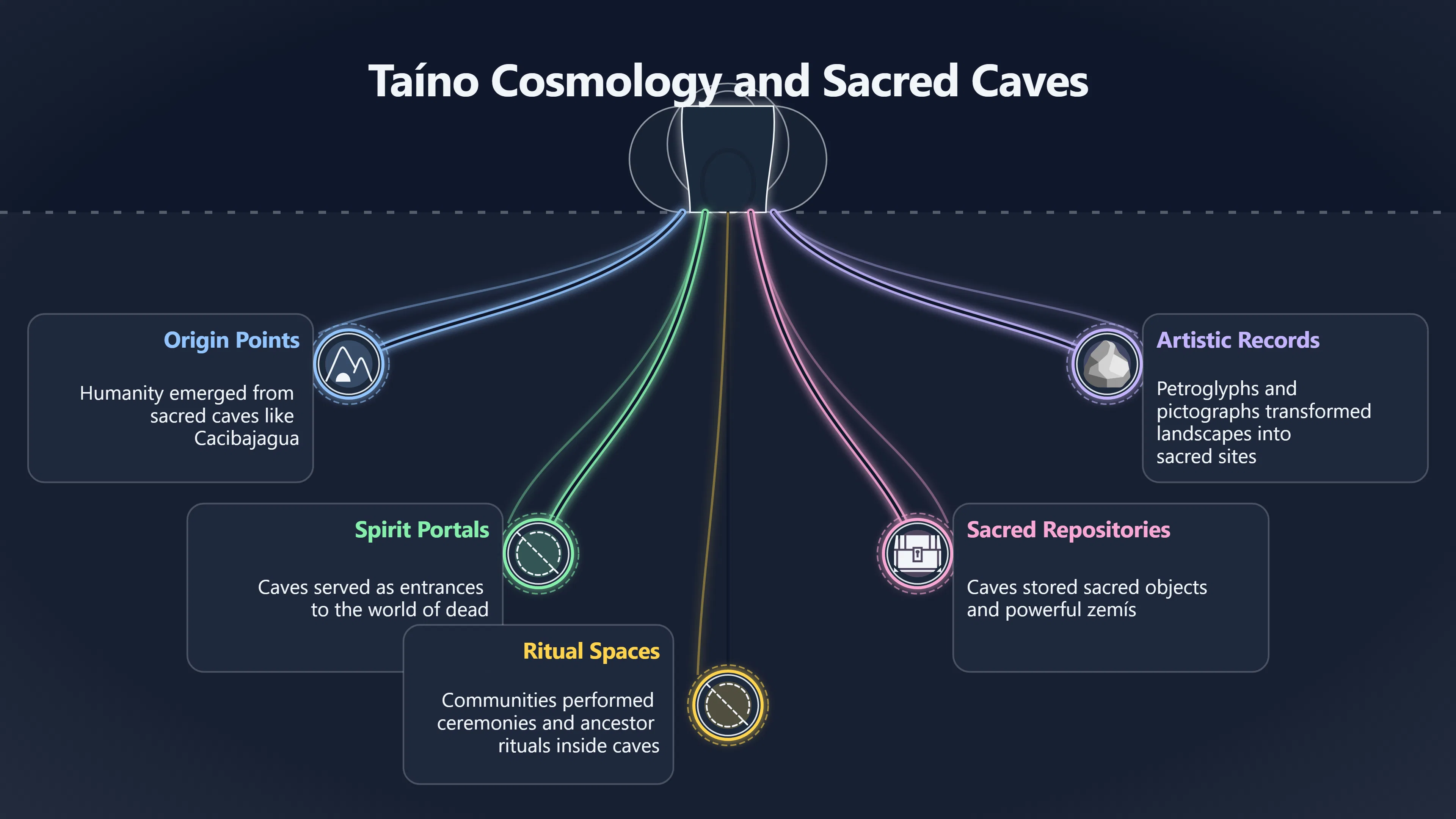
Across the Greater Antilles, caves occupied a special place in Taíno cosmology. The best-recorded origin tradition states that humanity emerged from a sacred cave called Cacibajagua. While this story was recorded on Hispaniola, the same cave-centred worldview appears throughout Taíno territory, including Cuba. Caves were understood as places where worlds met: the realm of the living, the realm of ancestors and the mysterious powers hidden beneath the earth.[wikipedia.org]WikipediaTaíno mythologyTaíno mythology
Archaeological evidence helps explain why. Cave sites across the Caribbean contain burials, petroglyphs, pictographs and ritual deposits. These were not ordinary shelters. Many appear to have functioned as ceremonial spaces where communities encountered sacred forces and remembered their origins.[ufl.edu]floridamuseum.ufl.eduFlorida MuseumTaíno Use of Flooded Caverns in the East National Park…December 16, 2002 — by CD Beeker · 2002 · Cited by 23 — Many of t…
Researchers studying Taíno cave use note several recurring themes:
- Caves as places of emergence and creation.
- Caves as entrances to the world of the dead.
- Caves as locations for ancestor rituals.
- Caves as repositories for sacred objects and zemís.
- Caves as sites for ceremonial art and religious performance.[timespub.tc]timespub.tcTalking Taino: CavesTimes of the IslandsAs the myth at the beginning of this article tells us, the Tainos believed that all humans shared a common origin. Th…
This helps explain why cave art appears repeatedly in Taíno archaeology. Petroglyphs carved into cave walls, stalagmites and rock surfaces transformed natural landscapes into sacred spaces. Some caves even appear to have had restricted access, with ritual specialists controlling entry to particularly holy chambers.[Tiboko]tiboko.comTAINOS & CAVES, FOCUSING ON HISPANIOLAThe sacred ones were protected by guardian petroglyphs carved onto stalactites or stalagmit…

Caves as Entrances to Origin and Memory
The symbolic importance of caves survived partly because they anchored stories to real places. Even when narratives changed or disappeared, the landscape remained.
In Taíno tradition, emergence myths linked humanity directly to cave entrances. People came from the earth rather than arriving from a distant heaven. Other stories described individuals transformed into stone, animals or natural features when they violated sacred rules. These narratives blurred the distinction between mythic history and physical geography. A cave, a rock formation or a carved stalagmite could become evidence that a story had happened there.[latinamericanstudies.org]latinamericanstudies.orgK Schwantes · 2011 · Cited by 1 — In Hispaniola, it was said that people emerged from a mountain cave called…
This relationship between story and place is particularly important in Cuba, where many Indigenous narratives were not preserved in written form. Archaeological sites often carry more of the surviving tradition than complete tales do. The cave itself becomes a form of memory.[americanindianmagazine.org]americanindianmagazine.orgetter known locally as the “Cueva del Agua” (Cave of the Water), “Cueva del Cemi” (the…Read more…
La Patana and the Problem of Lost Stories
La Patana illustrates both the richness and the fragility of Cuba’s Indigenous inheritance.
The site is famous for a major zemí associated with a cave in southeastern Cuba. Archaeological discoveries there include sacred objects, burials and evidence linking the cave to ceremonial activity. The surviving zemí became one of the most important known examples of Taíno religious art from Cuba.[americanindianmagazine.org]americanindianmagazine.orgetter known locally as the “Cueva del Agua” (Cave of the Water), “Cueva del Cemi” (the…Read more…
Yet La Patana also demonstrates how much has been lost. Archaeologists can identify sacred use, ritual deposits and symbolic imagery, but the full stories once attached to the site largely disappeared. Scholars have suggested links between the cave and myths recorded elsewhere in the Taíno world, including stories about beings transformed into stone near cave entrances, but certainty is impossible because so much oral tradition vanished during the colonial period.[Caribbean Connections]fieldresearchcentre.weebly.comCaribbean ConnectionsTHE TAÍNO USE OF CAVES: A REVIEWThis myth may have been a replicated theme in Taíno cave ritual. In a cave called La…
For folklore researchers, this creates a familiar challenge. A cave may preserve physical evidence of belief while preserving only fragments of the narrative framework that once explained it. La Patana is therefore important not merely because of what it reveals, but because of what it reminds us has been lost.[americanindianmagazine.org]americanindianmagazine.orgetter known locally as the “Cueva del Agua” (Cave of the Water), “Cueva del Cemi” (the…Read more…
Indigenous Survival Beyond the Myth of Extinction
For generations, Cuban history was often presented as if the island’s Indigenous population had disappeared entirely. Modern research has complicated that story.
Archaeological work, genetic studies and community identity movements have shown that Indigenous ancestry and cultural memory survived in parts of Cuba, particularly in the east. Researchers and cultural activists have worked to recover Taíno heritage through local traditions, archaeology, museums and educational projects.[smithsonianmag.com]smithsonianmag.comSmithsonian Magazine Searching for Cuba's Pre-Columbian RootsSmithsonian MagazineSearching for Cuba's Pre-Columbian RootsNovember 1, 2016 — 1 Nov 2016 — A small yet growing movement to reclaim Cuba'…
Caves and zemís have become important symbols within this process because they provide tangible connections to the pre-colonial past. Unlike many stories that vanished from the historical record, a cave cannot be erased so easily. Rock carvings, ritual objects and sacred landscapes continue to testify that Indigenous spiritual traditions once shaped the island.[americanindianmagazine.org]americanindianmagazine.orgetter known locally as the “Cueva del Agua” (Cave of the Water), “Cueva del Cemi” (the…Read more…
This does not mean that modern Cubans practise Taíno religion unchanged from the fifteenth century. Rather, caves and zemís function as evidence of continuity, helping people reconnect with a heritage long declared extinct. Their importance today lies as much in memory and identity as in religion itself.[smithsonianmag.com]smithsonianmag.comSmithsonian Magazine Searching for Cuba's Pre-Columbian RootsSmithsonian MagazineSearching for Cuba's Pre-Columbian RootsNovember 1, 2016 — 1 Nov 2016 — A small yet growing movement to reclaim Cuba'…

What These Sites Mean in Cuban Folklore Today
Within the wider landscape of Cuban folklore, Taíno caves occupy a distinctive position. They are not famous because of a single monster, ghost or miracle tale. Instead, they represent something rarer: physical locations where myth, archaeology and cultural survival meet.
The surviving evidence suggests that caves were places of origin, communication with ancestors and encounters with sacred force. Zemís embodied relationships between communities, spirits and the land. Even where stories have become fragmentary, these places continue to shape how Cubans understand Indigenous history and belonging.[wikipedia.org]WikipediaTaíno mythologyTaíno mythology
The result is a form of folklore rooted not only in narrative but in landscape itself. A cave entrance, a carved face in stone or a recovered zemí can carry meanings that survived centuries of disruption. In Cuba, that endurance may be the most remarkable Taíno story of all.[americanindianmagazine.org]americanindianmagazine.orgetter known locally as the “Cueva del Agua” (Cave of the Water), “Cueva del Cemi” (the…Read more…
Amazon book picks
Further Reading
Books and field guides related to How Did Taíno Myth Survive in Cuba?. Use these as the next step if you want deeper reading beyond the article.
Lonely Planet Cuba
Useful for readers interested in visiting cave and heritage sites tied to Taíno culture.
CUBA: AN AMERICAN HISTORY
Explains the colonial disruptions that affected Taíno traditions.
eBay marketplace picks
Marketplace Samples
Live-tested eBay searches with available results related to this page.
Endnotes
1.
Source: Wikipedia
Title: Taíno mythology
Link:https://en.wikipedia.org/wiki/Ta%C3%ADno_mythology
2.
Source: smarthistory.org
Link:https://smarthistory.org/taino-zemis-and-duhos/
Source snippet
Taíno zemís and duhosWhile many zemís, were used as cohoba stands, the word “zemí” in the Taíno language refers to “a spiritu...
3.
Source: americanindianmagazine.org
Link:https://www.americanindianmagazine.org/story/idol-patana
Source snippet
etter known locally as the “Cueva del Agua” (Cave of the Water), “Cueva del Cemi” (the...Read more...
4.
Source: Wikipedia
Link:https://en.wikipedia.org/wiki/Ta%C3%ADno
5.
Source: timespub.tc
Title: Talking Taino: Caves
Link:https://www.timespub.tc/2007/01/talking-taino-caves/
Source snippet
Times of the IslandsAs the myth at the beginning of this article tells us, the Tainos believed that all humans shared a common origin. Th...
6.
Source: latinamericanstudies.org
Link:https://www.latinamericanstudies.org/taino/Taino-Geomorphology.pdf
Source snippet
K Schwantes · 2011 · Cited by 1 — In Hispaniola, it was said that people emerged from a mountain cave called...
7.
Source: tiboko.com
Link:https://tiboko.com/wp-content/uploads/2023/07/TAINOS___CAVES.pdf
Source snippet
TAINOS & CAVES, FOCUSING ON HISPANIOLAThe sacred ones were protected by guardian petroglyphs carved onto stalactites or stalagmit...
8.
Source: latinamericanstudies.org
Link:https://www.latinamericanstudies.org/book/Cuba_Before_Columbus.pdf
Source snippet
Cuba before ColumbusTaino burial, Cave No.1, La. Patana, MaUd: 4, looking north; b, looking... Platform of wood in burial cave near La P...
9.
Source: dnagenics.com
Title: taíno: echoes of the greater antilles
Link:https://www.dnagenics.com/spotlights/ta%C3%ADno%3A-echoes-of-the-greater-antilles?srsltid=AfmBOorm3Ltv3RFMnAXQJv6UC1GDqLd3FFWSx0CpXIpqTlrad92AOYH0
Source snippet
Archaeological and genetic evidence from 268 ancient individuals (1400 BCE–1650 CE) traces Taíno emergence across the Greater Antilles...
10.
Source: tiboko.com
Link:https://tiboko.com/wp-content/uploads/2023/07/A_Niche_in_Time_JD-5_Caribbean_Cave_Art.pdf
Source snippet
JD-5, Caribbean Cave Art, and the Fourth DimensionThis paper will discuss the cave art of JD-5 in southern Puerto Rico, “constitutes a fo...
11.
Source: americanindianmagazine.org
Title: abuelas ancestors and atabey spirit taino resurgence
Link:https://www.americanindianmagazine.org/story/abuelas-ancestors-and-atabey-spirit-taino-resurgence
Source snippet
Abuelas, Ancestors and Atabey: The Spirit of Taíno...8 Sept 2018 — La Mujer de Caguana (Woman of Caguana) is a preColumbian Taíno petrog...
12.
Source: smithsonianmag.com
Title: Smithsonian Magazine Searching for Cuba’s Pre-Columbian Roots
Link:https://www.smithsonianmag.com/travel/taino-indigenous-culture-pre-columbian-roots-archaeology-cuban-identity-cultural-travel-180960975/
Source snippet
Smithsonian MagazineSearching for Cuba's Pre-Columbian RootsNovember 1, 2016 — 1 Nov 2016 — A small yet growing movement to reclaim Cuba'...
Published: November 1, 2016
13.
Source: floridamuseum.ufl.edu
Link:https://www.floridamuseum.ufl.edu/wp-content/uploads/sites/44/2017/04/Beekeretal.pdf
Source snippet
Florida MuseumTaíno Use of Flooded Caverns in the East National Park...December 16, 2002 — by CD Beeker · 2002 · Cited by 23 — Many of t...
Published: December 16, 2002
14.
Source: fieldresearchcentre.weebly.com
Link:https://fieldresearchcentre.weebly.com/uploads/1/8/0/7/18079819/morton_a_2015.pdf
Source snippet
Caribbean ConnectionsTHE TAÍNO USE OF CAVES: A REVIEWThis myth may have been a replicated theme in Taíno cave ritual. In a cave called La...
15.
Source: blogs.baruch.cuny.edu
Link:https://blogs.baruch.cuny.edu/latinoamerica/?p=349
Source snippet
Baruch BlogsTainos: Mythology and Cosmology (Chapter 7)- Sebastián...9 Sept 2021 — Guahayona and Anacacuya were among the first Taino to...
16.
Source: jarniascyril.com
Title: histoire cuba peuples autochtones renaissance taino
Link:https://www.jarniascyril.com/expatriation/moving-to-cuba-as-an-expat-complete-guide/histoire-cuba-peuples-autochtones-renaissance-taino/
Source snippet
History of Cuba: From the Taíno People to the Indigenous...17 Jan 2026 — Explore Cuba's complex history, from the indigenous Taíno peopl...
Additional References
17.
Source: facebook.com
Link:https://www.facebook.com/groups/191766699268/posts/10156312669139269/
Source snippet
CUBA'S FORGOTTEN TRIBE "THE TAINOS INDIANS....CUBA'S FORGOTTEN TRIBE "THE TAINOS INDIANS. The indigenous Taino tribe we were told arrive...
18.
Source: researchgate.net
Link:https://www.researchgate.net/publication/261948975_Caciques_and_Cemi_Idols_The_Web_Spun_by_Taino_Rulers_Bteween_Hispaniola_and_Puerto_Rico
Source snippet
(PDF) Caciques and Cemí Idols: The Web Spun by Taíno...This book takes a close look at the relationships with humans and other (non-huma...
19.
Source: researchgate.net
Link:https://www.researchgate.net/publication/248392993_Lucayan-Taino_Burials_from_Preacher%27s_Cave_Eleuthera_Bahamas
Source snippet
ResearchGate(PDF) Lucayan–Taíno Burials from Preacher's Cave...This study emphasises the significance of caves to Lucayan–Taíno mytholo...
20.
Source: instagram.com
Link:https://www.instagram.com/p/DNN_Y5pOxWJ/
Source snippet
ould be found on many of them. The indigenous pantheon...Read more...
21.
Source: academia.edu
Title: Cueva de Chicho served primarily as a water
Link:https://www.academia.edu/9271289/TA%C3%8DNO_USE_OF_FLOODED_CAVERNS_IN_THE_EAST_NATIONAL_PARK_REGION_DOMINICAN_REPUBLIC
Source snippet
(PDF) TAÍNO USE OF FLOODED CAVERNS IN THE EAST...The Taíno utilized flooded caverns for both practical and ritual purposes, highlighting...
22.
Source: facebook.com
Link:https://www.facebook.com/PuertoRicanStories/posts/to-our-taino-ancestors-the-spirit-world-was-not-far-away-in-the-sky-it-lived-in-/122117555691279590/
Source snippet
To our Taino ancestors, the spirit world was not far away in...The cemíes were sacred figures in #Taino culture, representing deities, a...
23.
Source: youtube.com
Title: Paradise Cave | Taino Burial Grounds and Archeological Site | Baracoa | Cuba
Link:https://www.youtube.com/watch?v=Kpleet5HgRY
Source snippet
GUAMA - The Last Great Taino Chief of Cuba...
24.
Source: youtube.com
Title: Where The Sun And The Moon Came From (Taíno- Cuba)
Link:https://www.youtube.com/watch?v=hSkBu1xmzDE
Source snippet
Paradise Cave | Taino Burial Grounds and Archeological Site | Baracoa | Cuba...
25.
Source: youtube.com
Title: Lost People of the Caribbean: The Taino Genetic Mystery
Link:https://www.youtube.com/watch?v=5J8e-xJPvFs
Source snippet
Murals teaching Indigenous history: Baracoa, Cuba | WIDE...
26.
Source: youtube.com
Link:https://www.youtube.com/watch?v=QaUs-P6KsUA
Source snippet
Lost People of the Caribbean: The Taino Genetic Mystery...
Topic Tree