What Lives Inside Eritrean Folklore?
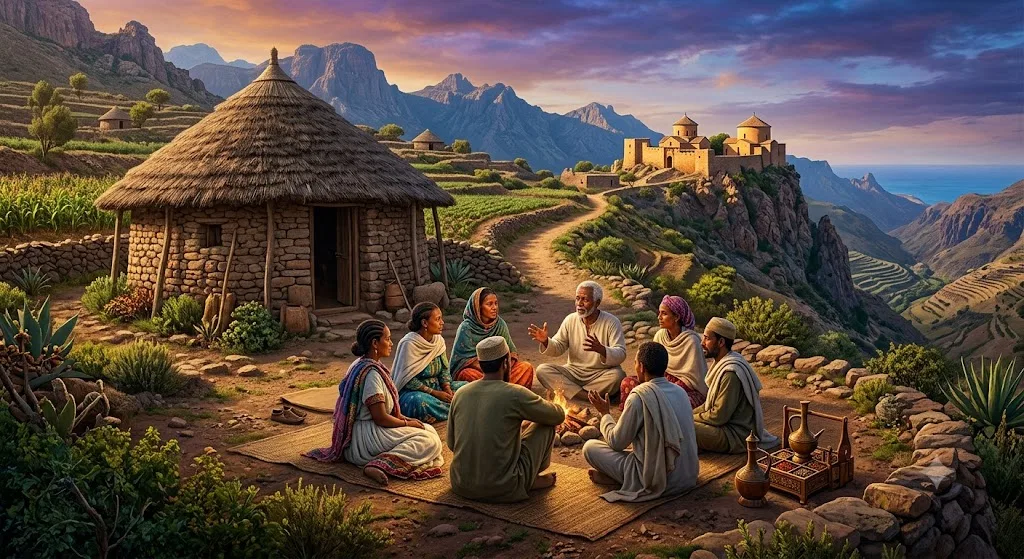
Eritrean folklore is best understood as a living web of oral poetry, proverbs, folktales, saints’ lives, protective customs, spirit beliefs, sacred landscapes, and family storytelling rather than as a single national mythology.
Page outline Jump by section
Introduction
For a curious reader, the most important point is this: Eritrean folklore is not mainly about famous “monsters” in the modern fantasy sense. Its richest material sits in oral performance, moral tales, praise poetry, wedding and mourning customs, pilgrimage, saintly legend, evil-eye belief, spirit-healing traditions, and stories attached to monasteries, wells, islands, ruins, and mountains. Some traditions are old and locally embedded; others are modern retellings, diaspora preservation projects, or internet-era story collections that should be read with care.[shabait.com]shabait.comEritrea Ministry Of InformationOral Tradition: A cultural Heritage that Should be Recorded…March 6, 2024 — 6 Mar 2024 — Each of the ni…
Why Eritrean folklore is hard to reduce to one story
Eritrea’s folklore belongs to a multilingual society. The nine recognised groups commonly listed are Afar, Bilen, Hedareb, Kunama, Nara, Rashaida, Saho, Tigre and Tigrinya; their traditions sit across Semitic, Cushitic and Nilo-Saharan language communities, with religious life broadly divided between Christianity and Islam, alongside smaller traditional belief systems.[IWGIA]iwgia.orgIndigenous peoples in EritreaThere are nine officially recognized ethnic groups in Eritrea, Afar, Blien, Hidareb, Kunama, Nara, Rash…
That diversity matters because a tale told in the central highlands may carry different assumptions from a lowland pastoral story, a Red Sea coastal memory, or a Kunama or Nara tradition in the west. A single “Eritrean folklore” page therefore has to avoid flattening the country into one ethnic or religious voice. The more accurate picture is a country where oral culture has many local homes: songs, riddles, genealogies, animal tales, family sayings, praise poems, saints’ narratives and cautionary stories.
Modern Eritrean cultural writing also stresses that oral tradition is not merely old entertainment. Eritrea’s Ministry of Information has described oral traditions across the nine ethnic groups as including poetry, proverbs, songs and folk tales, and recent public discussions have focused on recording them before elders and specialised performers disappear.[Eritrea Ministry Of Information]shabait.comEritrea Ministry Of InformationOral Tradition: A cultural Heritage that Should be Recorded…March 6, 2024 — 6 Mar 2024 — Each of the ni…
Oral storytelling is the centre of the tradition
The strongest thread in Eritrean folklore is oral literature: stories and poems performed, remembered, adapted and retold. In Tigre-language culture, oral tradition is described as covering marriage, death, pilgrimage, customary law, resistance, childhood, pregnancy, birth, circumcision, seasons, traditional medicine, religious traditions and rites of passage. That range shows why “folklore” in Eritrea is not just a set of fairy tales; it is a way of organising social memory.[Eritrea Ministry Of Information]shabait.comOpen source on shabait.com.
Tigrinya oral poetry is especially important in published discussion of Eritrean literature. City Lore’s Endangered Poetry Initiative describes Tigrinya as closely related to Tigre and descended from the older Ge’ez literary world, and notes that oral recitation remains part of contemporary Eritrean culture.[City Lore]citylore.orgCity Lore Negusse, Negusse: A Tigrinya Oral EpicCity Lore Negusse, Negusse: A Tigrinya Oral Epic
Folktales themselves often work as moral and social instruction. They may test cleverness, expose greed, praise patience, warn against envy, dramatise obligations between kin, or turn animals into comic mirrors of human behaviour. Modern online collections labelled “Eritrean folktales” include stories of talking trees, clever hares, greedy hyenas, ancestral voices, forgotten wells and cannibal women, but these should be treated as accessible retellings unless they identify their collector, language, date and community source.[Folktales Africa]folktales.africaOpen source on folktales.africa.
The safest way to read such stories is to ask three questions: who told it, in which language, and in what setting? A tale performed at home, a proverb explained in a village dispute, a poem recited at a public gathering and a polished English retelling on the web can all preserve tradition, but they do not carry the same evidential weight.

Saints, monasteries and sacred mountains
Eritrean legendary tradition is strongly tied to sacred Christian landscapes. The country’s old monasteries are not only religious institutions; they are also keepers of manuscript culture, pilgrimage memory, saintly biography and local legend. Eritrean cultural-heritage writing says local traditions connect some monastic foundations to missionaries from the Near East in the late fifth or early sixth century, while monasteries preserved Christian art, liturgical treasures, manuscripts and religious practices.[Eritrea Ministry Of Information]shabait.comOpen source on shabait.com.
Debre Bizen is one of the clearest examples. Perched high above the town of Nefasit, it is described by Eritrean heritage writing as a major symbol of Eritrean Christianity, founded in 1361 by Abune Philipos. The same account preserves a saintly legend: his shadow was said to have cured three disabled people because of his holiness.[Eritrea Ministry Of Information]shabait.comEritrea Ministry Of Information Bizen Monastery: The City in the CloudsEritrea Ministry Of Information Bizen Monastery: The City in the Clouds
Debre Libanos of Ham is another important sacred site. Eritrean sources describe it as an ancient monastery believed by tradition to have been founded in the late fifth or early sixth century by Aba Meta, also known as Libanos, and later moved to its cliff-edge location below the Ham plateau.[Eritrea Ministry Of Information]shabait.comOpen source on shabait.com.
These stories matter because they show how folklore and formal religion overlap. A monastery may have a documented architectural or manuscript history, but it may also be surrounded by legends of founding saints, miraculous protection, healing, hidden manuscripts, dangerous cliffs, pilgrimage paths and holy isolation. For believers, these are part of sacred memory. For folklore readers, they are examples of how place, faith and narrative become inseparable.
Evil eye, protective customs and the feared gaze
One of the best-known supernatural themes in the wider Eritrean and Ethiopian cultural region is the evil eye. In Horn of Africa traditions, the feared gaze is often associated with envy, illness, misfortune and social danger. A common regional term is “buda”, although the details vary by language, community and religious setting.[Wikipedia]WikipediaBuda (folkloreBuda (folklore
This belief is not just a spooky idea; it is a social explanation for vulnerability. Beautiful children, successful households, livestock, pregnancy, wealth or sudden good fortune can become narratively exposed to envy. One Eritrean retelling about “traditional fairies” includes a mother hiding her beautiful children from visitors because eye contact might activate the Evil Eye and make them ill.[Eritrea Ministry Of Information]shabait.comOpen source on shabait.com.
Some versions of the buda complex in the wider region connect the evil eye with hyena transformation, artisans, marginal social groups or nocturnal danger. These claims should be handled carefully. They are important as folklore, but they have also historically been used to stigmatise real people. A responsible account describes the belief without endorsing accusations against any living group.[Wikipedia]WikipediaBuda (folkloreBuda (folklore
Protective practice can include prayer, blessed objects, amulets, crosses, icons or religious specialists, depending on the community. The important point is not whether the evil eye is “real”, but how the belief helps explain illness, envy, misfortune, social tension and the need for ritual protection.
Spirit possession and healing traditions
Another major strand of Eritrean supernatural belief is spirit possession, especially traditions associated with zār in the wider Red Sea, Horn of Africa and north-east African world. Medical and anthropological literature describes zār as both a possession belief and a healing ritual found across parts of northern Africa, eastern Africa and the Middle East.[PMC]pmc.ncbi.nlm.nih.govPMCZār Spirit Possession in Iran and African CountriesPMCZār Spirit Possession in Iran and African Countries
An Eritrean cultural article describes zār as a spirit or demon believed to possess individuals and cause discomfort or illness, with rituals involving food, music and ecstatic dancing that may last several nights. It also notes that in contemporary urban culture the practice is fading or changing, sometimes becoming women-only entertainment rather than a feared healing rite.[Eritrea Ministry Of Information]shabait.comhalloween and eritreahalloween and eritrea
That change is important. Folklore is not frozen. A ritual once understood as a serious response to affliction may later be reframed as heritage, performance, memory, entertainment or superstition, especially in cities and diaspora communities. In Eritrea, as elsewhere, spirit traditions sit at the boundary between religion, medicine, gendered social space, music, community pressure and personal suffering.
Fairies, hidden hosts and journeys out of ordinary life
Eritrean fairy-like traditions are less internationally famous than European fairies or West African water spirits, but local retellings do preserve stories of hidden beings, enchanted hospitality and dangerous returns. One widely circulated Eritrean article recounts a woman taken into a fairy realm, treated hospitably, then returning to her village only to be dismissed as mentally disturbed by those who heard her story.[awate.com]awate.comeritrean traditional fairieseritrean traditional fairies
The same account uses the idea of a risky visit to fairyland: a person may receive food, lodging and wonder, but can return marked, bruised, mocked or mentally altered. This is familiar folklore logic across many cultures, but the Eritrean setting gives it local meaning. Such stories ask what happens when someone crosses the boundary between visible village life and hidden worlds, and how a community treats people who claim to have encountered the extraordinary.[awate.com]awate.comeritrean traditional fairieseritrean traditional fairies
These tales are valuable precisely because they are ambiguous. They can be read as supernatural adventure, social warning, comic tale, mental-health metaphor, religious allegory or a way to talk about people who fall outside ordinary expectations.
Ruins, islands and landscapes that gather legend
Eritrean folklore is also attached to landscape. Ancient places such as Qohaito, Adulis and the Dahlak Islands are not folklore sites in a narrow sense, but they create the kind of historical depth in which legend grows.
Qohaito, on Eritrea’s high plateau, is on UNESCO’s Tentative List as a cultural landscape with archaeological sites dating from around 700 BC and a major settlement phase from the second to seventh centuries AD, linked to the trade route between Adulis and Aksum.[UNESCO World Heritage Centre]whc.unesco.orgOpen source on unesco.org.
A site-management document for Qohaito notes that recording Saho oral history and local legends would be important not only for socio-cultural history but also for tourist interpretation. That is a useful reminder: archaeological ruins often become meaningful to local people through stories as much as through excavation reports.[tegnestuen-raadvad.dk]tegnestuen-raadvad.dkSite Management and Implementation PlanSite Management and Implementation Plan
The Dahlak Islands offer a different kind of memory. Dahlak Kebir is known for Islamic tombstones with Arabic inscriptions, and the British Museum identifies basalt tombstones from Dahlak with carved inscriptions, including one for Sheikh Makki ibn Jami ibn Salim al-Sawakini, whose name points to Red Sea connections with Sawakin in present-day Sudan.[British Museum]britishmuseum.orgOpen source on britishmuseum.org.
Such places matter to folklore because they widen the frame beyond the village tale. Eritrean story culture has been shaped by highland Christianity, Red Sea Islam, caravan routes, ports, migration, pilgrimage, pastoral movement and borderland exchange.
What survives in archives, books and diaspora memory
Eritrean folklore survives unevenly. Some oral traditions remain in performance; some have been written down in Tigrinya, Tigre, Arabic or English; some are preserved in community memory; some are held in archives, private collections or diaspora cultural projects.
The Eritrean Print and Oral Culture project in Edmonton presents itself as a growing archive of Eritrean texts and artefacts, including traditional folktales, fiction, autobiography, historical writing, periodicals and traditional ceremonies lent by Eritrean-Canadians.[eritreanprintandoralculture.ca]eritreanprintandoralculture.caOpen source on eritreanprintandoralculture.ca.
Academic and bibliographic sources also show the importance of Eritrean oral literature. Ghirmai Negash’s work on Tigrinya oral poetry and the history of Tigrinya literature is repeatedly cited in Eritrean literary studies, and a Google Books record describes his history of Tigrinya literature as a study that treats oral and written traditions as one literary system shaped by colonial history.[Africabib]africabib.orgOpen source on africabib.org.
More recent Eritrean cultural initiatives also emphasise preservation. UNESCO records show Eritrea working on intangible cultural heritage safeguarding, including inventorying and digital archiving activities with community participation.[UNESCO ICH]ich.unesco.orgeritrea launches inventorying of intangible cultural heritage 00230eritrea launches inventorying of intangible cultural heritage 00230
For readers, this means Eritrean folklore is not always easy to access in neat English-language collections. The evidence is scattered across oral communities, local-language publications, government cultural articles, diaspora archives, museum records, academic bibliographies and modern retellings.
Old tradition, modern retelling and internet folklore
A lot of material now labelled “Eritrean folklore” online is not equally reliable. Some pages preserve plausible oral motifs but give no collector, no original language, no narrator and no date. Others are modern creative retellings inspired by Eritrean landscapes and values. These can be enjoyable and even culturally meaningful, but they should not automatically be treated as old, well-attested oral tradition.
A careful reader can separate the material into rough categories:
- Older oral tradition: stories, poems, proverbs, ritual language and saintly legends passed through families, religious institutions or specialist performers.
- Recorded heritage: material collected in books, archives, museum notes, linguistic studies, community projects or cultural inventories.
- Literary adaptation: poems, stories and novels that reshape oral material for print.
- Diaspora preservation: community archives, school projects and websites created to keep language and memory alive outside Eritrea.
- Internet-era folklore: anonymous or lightly sourced stories that may blend genuine motifs with modern invention.
This distinction does not make modern retellings worthless. It simply prevents confusion. A polished English story about a talking tree or a spirit-haunted well may introduce readers to Eritrean themes, but the strongest evidence for tradition comes when the source identifies the community, language, performance context or collection history.[Folktales Africa]folktales.africaOpen source on folktales.africa.
Why Eritrean folklore matters today
Eritrean folklore matters because it carries memory in a country where history has often been shaped by migration, empire, religion, war, language politics and diaspora life. Oral tradition preserves more than entertainment: it carries ethics, humour, grief, social criticism, genealogy, religious feeling and local explanations for danger or misfortune.
It also matters because many traditions are vulnerable. When elders die, languages weaken, rural life changes, cities reshape ritual practice, and diaspora children grow up far from the landscapes of the stories, oral culture can fade quickly. That is why recent discussions of Eritrean oral tradition place so much emphasis on recording poetry, proverbs, songs and tales for future generations.[Eritrea Ministry Of Information]shabait.comEritrea Ministry Of InformationOral Tradition: A cultural Heritage that Should be Recorded…March 6, 2024 — 6 Mar 2024 — Each of the ni…
For the outside reader, Eritrea’s folklore is most rewarding when approached with patience. Do not look only for a single national monster or a sensational haunted legend. Look instead for the deeper pattern: words performed aloud, saints remembered in mountains, spirits negotiated through music, envy guarded against by prayer or protection, ruins made meaningful by local memory, and stories retold wherever Eritreans carry their languages.
Amazon book picks
Further Reading
Books and field guides related to What Lives Inside Eritrean Folklore?. Use these as the next step if you want deeper reading beyond the article.
African Religions and Philosophy
Provides background for spirit beliefs and sacred customs.
eBay marketplace picks
Marketplace Samples
Live-tested eBay searches with available results related to this page.

Endnotes
1.
Source: iwgia.org
Link:https://iwgia.org/en/eritrea.html
Source snippet
Indigenous peoples in EritreaThere are nine officially recognized ethnic groups in Eritrea, Afar, Blien, Hidareb, Kunama, Nara, Rash...
2.
Source: ich.unesco.org
Link:https://ich.unesco.org/en/projects/strengthening-the-capacities-of-eritrea-for-implementing-the-convention-for-the-safeguarding-of-the-intangible-cultural-heritage-00272
3.
Source: eritreanprintandoralculture.ca
Link:https://eritreanprintandoralculture.ca/
4.
Source: folktales.africa
Link:https://folktales.africa/category/african-folktales/east-african-folktales/eritrean-folktales/
5.
Source: unesdoc.unesco.org
Link:https://unesdoc.unesco.org/ark%3A/48223/pf0000098638
6.
Source: Wikipedia
Title: Buda (folklore)
Link:https://en.wikipedia.org/wiki/Buda_%28folklore%29
7.
Source: awate.com
Title: eritrean traditional fairies
Link:https://awate.com/eritrean-traditional-fairies/
8.
Source: whc.unesco.org
Link:https://whc.unesco.org/en/tentativelists/5600/
9.
Source: tegnestuen-raadvad.dk
Title: Site Management and Implementation Plan
Link:https://tegnestuen-raadvad.dk/wp-content/uploads/2016/04/Site-Management.pdf
10.
Source: africabib.org
Link:https://www.africabib.org/rec.php?RID=276956869
11.
Source: books.google.com
Link:https://books.google.com/books/about/A_History_of_Tigrinya_Literature_in_Erit.html?id=TNakcQAACAAJ
12.
Source: ich.unesco.org
Title: eritrea launches inventorying of intangible cultural heritage 00230
Link:https://ich.unesco.org/en/news/eritrea-launches-inventorying-of-intangible-cultural-heritage-00230
13.
Source: Wikipedia
Title: Eritrean literature
Link:https://en.wikipedia.org/wiki/Eritrean_literature
14.
Source: Wikipedia
Link:https://en.wikipedia.org/wiki/Z%C4%81r
15.
Source: Wikipedia
Title: Evil eye
Link:https://en.wikipedia.org/wiki/Evil_eye
16.
Source: Wikipedia
Title: Debre Bizen
Link:https://en.wikipedia.org/wiki/Debre_Bizen
17.
Source: Wikipedia
Title: Dahlak Archipelago
Link:https://en.wikipedia.org/wiki/Dahlak_Archipelago
18.
Source: Wikipedia
Link:https://en.wikipedia.org/wiki/Eritrea
19.
Source: Wikipedia
Title: Culture of Eritrea
Link:https://en.wikipedia.org/wiki/Culture_of_Eritrea
20.
Source: Wikipedia
Link:https://en.wikipedia.org/wiki/Qohaito
21.
Source: Wikipedia
Title: Nine Saints
Link:https://en.wikipedia.org/wiki/Nine_Saints
22.
Source: Wikipedia
Link:https://en.wikipedia.org/wiki/Adulis
23.
Source: ia903100.us.archive.org
Title: African Folklore An Encyclopedia
Link:https://ia903100.us.archive.org/30/items/africanfolkloreanencyclopedia/African%20Folklore%20-%20An%20Encyclopedia.pdf
24.
Source: archive.org
Link:https://archive.org/details/whoneedsstorycon0000unse
25.
Source: whc.unesco.org
Link:https://whc.unesco.org/en/urban-heritage-atlas/asmara/
26.
Source: unesco.org
Link:https://www.unesco.org/en/articles/unesco-publishes-east-african-case-studies-living-heritage-and-climate-change
27.
Source: whc.unesco.org
Link:https://whc.unesco.org/en/list/1550/
28.
Source: ich.unesco.org
Title: the first heritage legislation in eritrea 00176
Link:https://ich.unesco.org/en/news/the-first-heritage-legislation-in-eritrea-00176
29.
Source: ich.unesco.org
Title: eritrea ER
Link:https://ich.unesco.org/en/state/eritrea-ER
30.
Source: whc.unesco.org
Link:https://whc.unesco.org/en/statesparties/er
31.
Source: whc.unesco.org
Link:https://whc.unesco.org/en/list/974/
32.
Source: awate.com
Title: eritrea language and identity and globalization
Link:https://awate.com/eritrea-language-and-identity-and-globalization/
33.
Source: folktales.africa
Title: abunawas and the bet an eritrean folktale that teaches lessons on clever justice
Link:https://folktales.africa/abunawas-and-the-bet-an-eritrean-folktale-that-teaches-lessons-on-clever-justice/
34.
Source: youtube.com
Title: Agaiazian Folklore Of Rainy and Harvest Season Traditions
Link:https://www.youtube.com/watch?v=4X98Zc0SnUQ
Source snippet
Eritrea - Eritrean customs and traditions (Bilen)...
35.
Source: youtube.com
Link:https://www.youtube.com/watch?v=IkyAzWTNbqk
Source snippet
Saho Culture...
36.
Source: shabait.com
Link:https://shabait.com/2024/03/06/oral-tradition-a-cultural-heritage-that-should-be-recorded-for-posterity/
Source snippet
Eritrea Ministry Of InformationOral Tradition: A cultural Heritage that Should be Recorded...March 6, 2024 — 6 Mar 2024 — Each of the ni...
Published: March 6, 2024
37.
Source: shabait.com
Link:https://shabait.com/2022/04/16/presentation-on-the-oral-tradition-of-tigre/
38.
Source: citylore.org
Title: City Lore Negusse, Negusse: A Tigrinya Oral Epic
Link:https://citylore.org/grassroots-poetry/endangered-poetry-initiative/negusse-negusse-a-tigrinya-oral-epic/
39.
Source: shabait.com
Link:https://shabait.com/2017/08/08/the-medieval-period-of-eritrea-reflections-from-cultural-heritage/
40.
Source: shabait.com
Title: Eritrea Ministry Of Information Bizen Monastery: The City in the Clouds
Link:https://shabait.com/2017/08/09/bizen-monastery-the-city-in-the-clouds/
41.
Source: shabait.com
Link:https://shabait.com/2012/10/05/debre-libanos-of-ham-the-ancient-and-historical-monastery/
42.
Source: shabait.com
Link:https://shabait.com/2013/09/27/from-cultural-heritages-of-eritrea-on-eritrean-traditional-fairies/
43.
Source: pmc.ncbi.nlm.nih.gov
Title: PMCZār Spirit Possession in Iran and African Countries
Link:https://pmc.ncbi.nlm.nih.gov/articles/PMC4801492/
44.
Source: shabait.com
Title: halloween and eritrea 2 0
Link:https://shabait.com/2021/10/30/halloween-and-eritrea-2-0/
45.
Source: britishmuseum.org
Link:https://www.britishmuseum.org/collection/object/W
46.
Source: britishmuseum.org
Link:https://www.britishmuseum.org/collection/object/W
47.
Source: shabait.com
Title: tigre traditions and rituals from womb to tomb
Link:https://shabait.com/2025/12/29/tigre-traditions-and-rituals-from-womb-to-tomb/
48.
Source: shabait.com
Title: the dahlak islands
Link:https://shabait.com/2013/01/11/the-dahlak-islands/
49.
Source: shabait.com
Title: urban hinterlands in antiquity view from qohaito cultural landscape
Link:https://shabait.com/2017/07/04/urban-hinterlands-in-antiquity-view-from-qohaito-cultural-landscape/
50.
Source: shabait.com
Title: lets start seeking in the past
Link:https://shabait.com/2012/08/31/lets-start-seeking-in-the-past/
51.
Source: zenodo.org
Link:https://zenodo.org/records/18895226
52.
Source: study.com
Title: Eritrea | Overview, People & Ethnic Groups
Link:https://study.com/academy/lesson/eritrean-ethnic-groups.html
53.
Source: insideeritrea.com
Title: Debre Bizen
Link:https://www.insideeritrea.com/monastery/bizen2.htm
Additional References
54.
Source: minorityrights.org
Link:https://minorityrights.org/country/eritrea/
Source snippet
Minority Rights GroupEritreaMinority groups include Tigre 16%, Afar 3.3%, Saho 3.7%, Beni Amer (Bedawi) 3.1%, Bilen 1.4%, Kunama 2.2 % an...
55.
Source: youtube.com
Title: FIDEL TV
Link:https://www.youtube.com/watch?v=OYWZX_QcCkc
Source snippet
Agaiazian Folklore Of Rainy and Harvest Season Traditions...
56.
Source: youtube.com
Title: Eritrea: Preserving Oral Traditions and Folklore
Link:https://www.youtube.com/watch?v=HmWpdoR6Ek4
Source snippet
FIDEL TV - Tigrinya Folk Tale - The Four Brothers And King Hyaena...
57.
Source: instagram.com
Link:https://www.instagram.com/reel/DZPz5lmKf03/
58.
Source: researchgate.net
Link:https://www.researchgate.net/publication/226309804_Variability_in_Eritrea_and_the_Archaeology_of_the_Northern_Horn_During_the_First_Millennium_BC_Subsistence_Ritual_and_Gold_Production
59.
Source: researchgate.net
Link:https://www.researchgate.net/publication/31230272_Lost_Tribes_and_Coffee_Ceremonies_Zar_Spirit_Possession_and_the_Ethno-Religious_Identity_of_Ethiopian_Jews_in_Israel
60.
Source: researchgate.net
Link:https://www.researchgate.net/publication/349395507_Here_is_a_small_publication_about_some_Monasteries_of_Eritrea_suveyed_except_Dabra_LibanosHam_with_photographs_and_drawings_Volum_3_of_Collection_Cultures_et_Patrimoines_d%27ErythreeMonasteres_d%27Erythre
61.
Source: gonomad.com
Link:https://www.gonomad.com/920-a-650-year-old-eritrean-monastery-in-the-clouds
62.
Source: pressbooks.pub
Link:https://pressbooks.pub/africanguide/chapter/chapter-1/
63.
Source: facebook.com
Link:https://www.facebook.com/groups/eritrearchitecture/posts/2102824783125822/
Topic Tree
Follow this branch
Related pages 192
- Afghan Folklore
- Albanian Folklore
- Algerian Folklore
- Australian Folklore
- Azerbaijan Folklore
- +187 more in sidebar