Why Monaco's Legends Gather Around One Rock
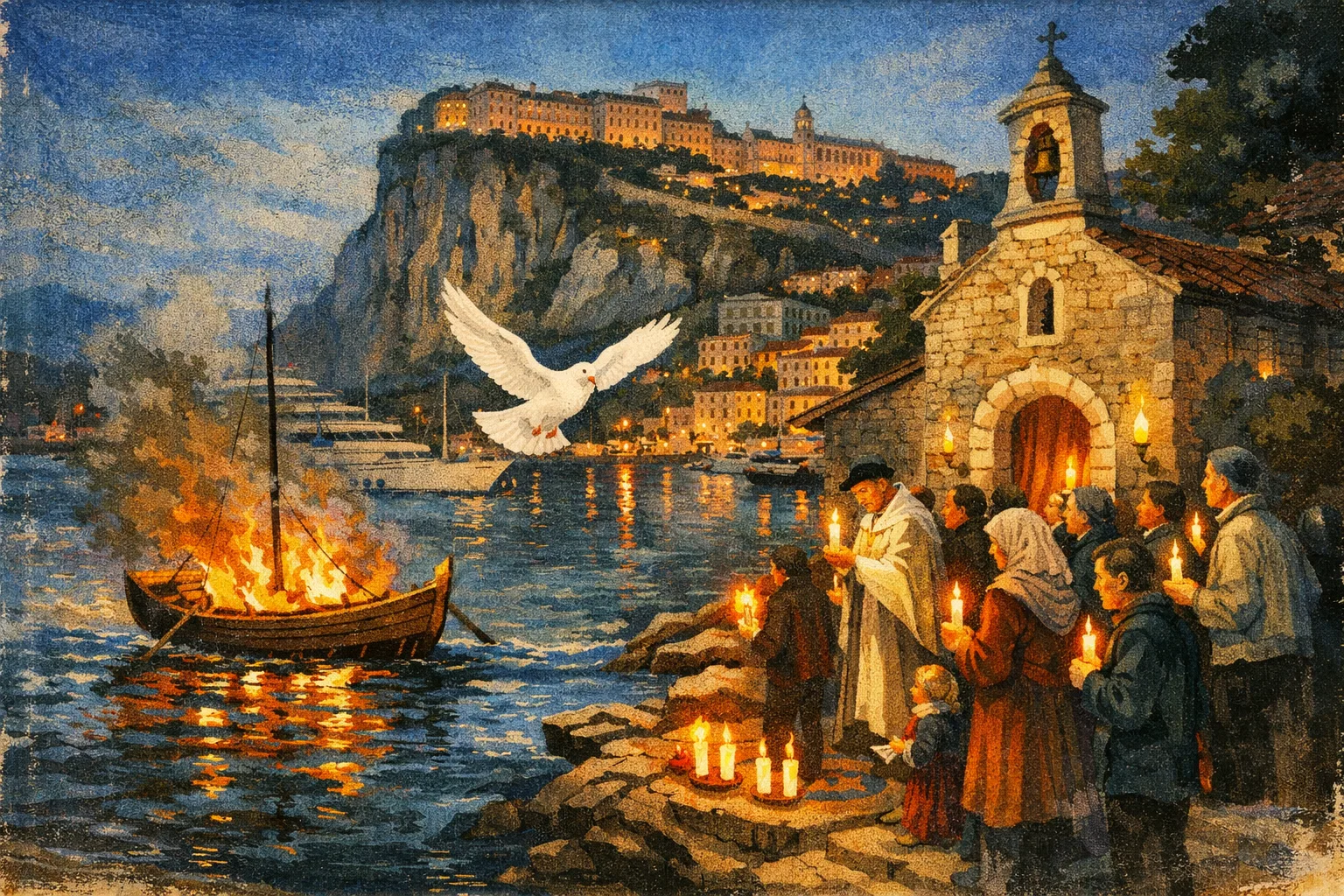
Monaco’s folklore is not a crowded bestiary of dragons, fairies and witches. Its strongest legendary tradition is more compact and civic: the story of Saint Dévote, a Corsican martyr whose body is said to have reached Monaco by sea, guided by a dove, and whose protection became part of the Principality’s religious and national identity.
Page outline Jump by section
Introduction
That does not make it thin or uninteresting. Monaco’s legends show how a very small coastal state has used story to explain belonging: why this rock, this harbour, this ruling house and these annual ceremonies feel historically charged. The key is to read Monaco’s folklore as a living civic tradition rather than as a catalogue of supernatural creatures.
Why Monaco’s folklore is different from larger national mythologies
Monaco is tiny, urban and deeply tied to the Mediterranean borderlands of Liguria, Provence, Corsica and Catholic Europe. That means its traditional culture has never developed in isolation. Its stories often share motifs with neighbouring regions: saints’ relics travelling by boat, midsummer fires, blessed Christmas bread, maritime devotion, oral sayings and songs, and local-language performance.
The National Committee of Monegasque Traditions, founded in 1924 by representatives of old Monegasque families, describes its mission as maintaining civil and religious traditions, preserving and promoting the Monegasque language, conserving documents and objects of historical and cultural heritage, protecting sites and monuments, and advising folkloric and traditional groups in the Principality. Its headquarters also house the Museum of Old Monaco, which gives the country’s small-scale traditions an institutional home rather than leaving them only to memory.[Traditions Monaco]traditions-monaco.comTraditions Monaco AccueilTraditions Monaco Accueil
This matters because many readers arrive expecting “folklore” to mean ancient pagan gods or frightening creatures. Monaco’s best-attested folklore is instead ceremonial, devotional and historical. It survives through processions, church services, symbolic fire, local language, costume, food and annual gatherings. The supernatural element is present, especially in miracle stories, but it is usually embedded in Catholic ritual and civic identity rather than presented as independent ghost lore.
Saint Dévote: the legend at the heart of Monaco
The central Monegasque legend is the story of Saint Dévote, patron saint of the Principality and of the ruling family. The National Committee of Monegasque Traditions says she is celebrated solemnly on 27 January and gives the traditional account: Dévote, a young Christian woman, was martyred in Corsica under the emperor Diocletian in 304; her body was placed in a boat; a dove guided it through a storm to the valley of the Gaumates, at the foot of what became Monaco.[Traditions Monaco]traditions-monaco.comTraditions Monaco Fêtes et traditionsTraditions Monaco Fêtes et traditions
This is a classic Mediterranean relic-arrival legend. It explains why a saint who died elsewhere belongs intensely to one coastal community. The boat, the storm, the dove and the landing place turn Monaco’s harbour landscape into sacred geography. Official and local accounts continue to stress that the tradition comes through a medieval document and has been repeatedly embedded in Monaco’s history, religion, art and public culture.[Government of Monaco]gouv.mcsaint devota celebrations2saint devota celebrations2
The story also has a second dramatic episode: the attempted theft of the saint’s relics. In modern retellings, thieves try to carry the relics away by boat, fail, and the vessel is burned. This is the legendary background to the annual burning of a symbolic boat outside the Church of Sainte-Dévote on the eve of the feast. Some accounts date the public custom of burning the boat to 1874, while others emphasise its modern ceremonial form and its performance by members of the Princely Family.[HelloMonaco]hellomonaco.comHello Monaco When Monaco Lights the Boat: Sainte Devote BringsHello Monaco When Monaco Lights the Boat: Sainte Devote Brings
The importance of the legend is not that every detail can be treated as literal history. Its importance is that it supplies Monaco with a protective origin story. Dévote arrives from the sea, becomes attached to a named place, protects the community, and is renewed annually through public ritual. In folklore terms, the story does the work of a charter myth: it explains why a place is special and why a community gathers in a particular way.

A ritual calendar built around light, fire and protection
Saint Dévote is the best-known celebration, but Monaco’s calendar contains several traditions that show how religious custom, seasonal timing and local identity overlap.
The Saint John celebration is explicitly linked by the National Committee of Monegasque Traditions to an older summer-solstice custom. The Church fixed 24 June as the feast of John the Baptist, and the lighting of bonfires is explained as a way of prolonging the sun’s brightness into the night and, in Christian interpretation, marking the victory of Christ as light over darkness.[Traditions Monaco]traditions-monaco.comTraditions Monaco Fêtes et traditionsTraditions Monaco Fêtes et traditions
Saint Nicholas is another important local devotion. The committee celebrates him on 6 December with a Mass in the Monegasque language at the chapel dedicated to him in the Cathedral. The committee’s own explanation is telling: Saint Nicholas was chosen because, after Saint Dévote, he had long been honoured by Monegasques “in ancient times”.[Traditions Monaco]traditions-monaco.comTraditions Monaco Fêtes et traditionsTraditions Monaco Fêtes et traditions
Saint Roman links Monaco’s religious calendar to local historical memory. The tradition honours a Roman martyr said to have been decapitated in 258, and the committee traces the annual festivities to a Saint-Roman festival committee created in 1868, with older roots connected to a relic sent in 1543. A recent report on the 2025 festival described a Mass in Monegasque, a community gathering and evening events drawing hundreds of people, showing how an older devotional pattern still functions as neighbourhood culture.[Traditions Monaco]traditions-monaco.comTraditions Monaco Fêtes et traditionsTraditions Monaco Fêtes et traditions
Christmas brings a more domestic form of folklore. The Christmas bread tradition is described by the National Committee as very old and revived so that families could again participate “as in former times”. The bread is offered by participating Monaco bakers before Christmas, donations go to charitable causes, and the loaves are blessed by families and during midnight Mass.[Traditions Monaco]traditions-monaco.comTraditions Monaco Fêtes et traditionsTraditions Monaco Fêtes et traditions
These customs are not “myths” in the sense of long narrative tales. They are folklore as repeated action. Fire, bread, relics, language and public gathering turn belief into something visible.
Hercules and the ancient harbour legend
Before Saint Dévote and the Grimaldis, Monaco was already attached to a much older Mediterranean story-world: Hercules. Official Monaco history notes a tempting hypothesis connecting the name Monaco with Hercules and says legend made Hercules the founder of Monaco. The same ancient association survives in the name Port Hercule, the main harbour.[Government of Monaco]gouv.mcOpen source on gouv.mc.
The historical issue is complicated. Ancient writers linked the place-name to Hercules under the form “Monoikos” or “Monoecus”, and later explanations interpreted this as “the solitary one” or “the one with a single temple”. A Monaco consular history page is careful to call this a popular etymology, adding that the name is probably native and Ligurian in origin rather than straightforwardly Greek.[Consulate General of Monaco]monaco-consulate.comOpen source on monaco-consulate.com.
For folklore, that distinction is useful. The Hercules story is not a secure historical foundation stone; it is a layered place-legend. It shows how ancient ports gained prestige by being attached to famous heroic journeys. In Monaco’s case, the harbour becomes not just a practical refuge but a mythic stop on the route between Italy, Gaul and Spain.
This older mythic layer also explains why Monaco’s folklore feels maritime. The sea is not scenery. It is the route by which heroes pass, saints arrive, relics are threatened, fishermen intervene and the community imagines itself protected.
The Grimaldi disguise: history turned founding legend
The capture of the Rock of Monaco by François Grimaldi in 1297 is historical memory, but it is also told like a legend. The National Committee’s history recounts that the Guelph François Grimaldi, disguised as a monk, entered the fortress by trickery on 8 January 1297; since then the Grimaldi coat of arms has been flanked by two monks brandishing swords, and the statue of François “Malizia” stands near the Palace Square.[Traditions Monaco]traditions-monaco.comTraditions Monaco L'histoire de MonacoTraditions Monaco L'histoire de Monaco
This is not supernatural folklore, but it functions much like a foundation tale. It gives Monaco a vivid origin scene: the rock, the gate, the disguise, the clever seizure, the heraldic memory. It also supplies a moral texture. Monaco’s ruling story is not simply conquest by force, but cunning, timing and survival in a region divided by Genoese factional conflict.
For readers interested in legends, the Grimaldi story is important because it bridges folklore and state symbolism. The monk disguise is not just a colourful anecdote. It is visually fixed into the country’s heraldry and landscape, appearing in arms, statues and public retellings. That is how history becomes legendary memory.

Language, proverbs and oral tradition
A country’s folklore is not only its famous legends. It also lives in the language used for songs, sayings, prayers, theatre and family speech. Monaco’s traditional language, Monegasque, is therefore central to its folk culture.
The Monaco government describes Monegasque as a language that local people were eager to preserve; in 1924, Monaco nationals founded what became the National Committee for Monegasque Traditions and began work to safeguard it.[Government of Monaco]gouv.mcmonegasque languagemonegasque language The committee’s own website hosts language resources, poems, texts, dictionaries and grammar materials, and it advertises adult Monegasque language lessons.[Traditions Monaco]traditions-monaco.comTraditions Monaco La LangueTraditions Monaco La Langue
This matters for folklore because oral tradition depends on wording. A saint’s legend translated into the local language, a proverb printed as the “saying of the day”, a Mass sung in Monegasque, or a children’s performance of Saint Nicholas all carry cultural memory differently from a tourist summary in French or English. The preservation effort also shows that Monaco’s folklore is partly a revival project: some practices have continued, while others have been consciously restored, taught or staged.
That revival is not fake by default. Many modern folk traditions survive because communities decide they are worth renewing. In Monaco, the same pattern appears in the Christmas bread revival, the teaching of language, folk groups, museum work and public saint days.
Are there Monegasque monsters, ghosts or witches?
The honest answer is: not many that are well attested in public sources. Monaco does not have a widely documented national creature comparable to a dragon of Tarascon, a British black dog, a Balkan vampire, or an Alpine wild man. Searches for Monaco-specific ghosts and witches tend to produce thin material, modern gossip, generic haunted-location lists, or stories imported from neighbouring France and Italy rather than stable Monegasque oral tradition.
One example is the supposed “curse” of the Grimaldi family, often repeated in modern media as a witch’s curse linked to unhappy marriages. It is popular as royal gossip, but it is not as firmly grounded in Monaco’s documented civic folklore as Saint Dévote, Saint John’s fires, Saint Roman, Christmas bread or the 1297 Grimaldi foundation story. It is better treated as modern dynastic folklore: a rumour-shaped narrative that tries to explain misfortune after the fact, not as an old, securely sourced Monegasque belief.
The lack of a large monster tradition should not be overread. Monaco’s size, urban continuity and strong official ceremonial culture mean that its folklore has been preserved most visibly through institutions and public rites. It may well have had more everyday ghost stories, charms, fishermen’s beliefs or neighbourhood tales than survive in accessible online documentation, but those should not be inflated without evidence.
Old tradition, revival and tourist retelling
A useful way to understand Monaco’s folklore is to separate four overlapping layers.
Older devotional tradition includes the cult of Saint Dévote, the relic story, Saint Nicholas, Saint Roman and Catholic seasonal customs. These are not merely tourist performances; they are tied to churches, processions, language, relics and long-standing local identity.[Traditions Monaco]traditions-monaco.comTraditions Monaco Fêtes et traditionsTraditions Monaco Fêtes et traditions
Historical legend includes Hercules and François Grimaldi. Hercules belongs to ancient Mediterranean mythic geography and place-name speculation; Grimaldi’s disguise belongs to medieval political history retold in legendary form.[Consulate General of Monaco]monaco-consulate.comOpen source on monaco-consulate.com.
Revival and preservation includes the work of the National Committee of Monegasque Traditions, adult language classes, the Museum of Old Monaco, revived Christmas bread practices and folk groups. These efforts show an active, self-conscious safeguarding of culture rather than passive survival.[Traditions Monaco]traditions-monaco.comTraditions Monaco AccueilTraditions Monaco Accueil
Tourist and media retelling includes simplified summaries of Saint Dévote, Formula One references to the Sainte-Dévote corner, polished Christmas-market imagery and modern royal curse stories. These can spread folklore widely, but they often flatten the difference between ritual, history, legend and entertainment.
The strongest reading of Monaco’s folklore keeps these layers visible. Saint Dévote is not just a “nice local legend”; she is a patronal figure whose story structures Monaco’s sacred geography and ritual year. Hercules is not proven ancient history; he is a prestigious mythic association around the harbour. The Grimaldi monk disguise is not a ghost story; it is a founding memory turned into heraldic symbolism. The Christmas bread is not a fairy tale; it is domestic folk religion, charity and seasonal belonging in edible form.

Why Monaco’s folklore still matters
Monaco’s folklore matters because it answers a question that the country’s wealth and glamour can obscure: how does a very small place remember itself? The answer is through repeated stories attached to exact sites. The valley of the Gaumates, the Church of Sainte-Dévote, Port Hercule, the Rock, the Palace Square, the Cathedral, the market at La Condamine and the streets of Monaco-Ville all carry traditions that make the Principality feel older and more intimate than its modern image suggests.
Its legends are also unusually clear examples of how folklore and state identity can merge. The patron saint protects the Principality and the ruling family. The founding trick of François Grimaldi appears in heraldry. The old language is taught and sung as a marker of belonging. Seasonal food and fire rituals are revived as public heritage. Monaco’s folklore is therefore less about escaping into fantasy than about making continuity visible.
For readers looking for monsters, Monaco may seem quiet. For readers interested in how legends become national memory, it is surprisingly rich. Its folklore is concentrated, ceremonial and place-bound: a dove-guided boat, a burning vessel, a solitary hero at the harbour, a disguised monk at the fortress gate, bonfires for midsummer, blessed bread at Christmas, and a small community repeatedly telling itself why this rock by the sea is home.
Amazon book picks
Further Reading
Books and field guides related to Why Monaco's Legends Gather Around One Rock. Use these as the next step if you want deeper reading beyond the article.
eBay marketplace picks
Marketplace Samples
Live-tested eBay searches with available results related to this page.



Endnotes
1.
Source: traditions-monaco.com
Title: Traditions Monaco Accueil
Link:https://www.traditions-monaco.com/
2.
Source: traditions-monaco.com
Title: Traditions Monaco Fêtes et traditions
Link:https://www.traditions-monaco.com/fetes-et-traditions
3.
Source: hellomonaco.com
Title: Hello Monaco When Monaco Lights the Boat: Sainte Devote Brings
Link:https://www.hellomonaco.com/news/latest-news/monaco-celebrates-its-patron-saint-with-faith-fire-and-light-at-the-2026-sainte-devote-festivities/
4.
Source: traditions-monaco.com
Title: Traditions Monaco L’histoire de Monaco
Link:https://www.traditions-monaco.com/histoire-de-monaco
5.
Source: traditions-monaco.com
Title: Traditions Monaco La Langue
Link:https://www.traditions-monaco.com/langue-monaco-monegasque-dictionnaire-poeme-textes-traduction
6.
Source: museum.de
Title: comite national des tradtions monegasques
Link:https://www.museum.de/museen/comite-national-des-tradtions-monegasques
7.
Source: the-monegasque.com
Title: the reel deal
Link:https://the-monegasque.com/en/article/the-reel-deal
8.
Source: culture.mc
Link:https://culture.mc/en/themes/intangible-heritage
9.
Source: culture.mc
Link:https://culture.mc/thematiques/patrimoine-immateriel
10.
Source: hellomonaco.com
Link:https://www.hellomonaco.com/leisure-entertainment/holidays-festivals/christmas-traditions-in-monaco2/
11.
Source: hellomonaco.com
Link:https://www.hellomonaco.com/news/latest-news/the-national-monegasque-traditions-committee-is-celebrating-its-100th-anniversary/
12.
Source: gouv.mc
Title: saint devota celebrations2
Link:https://www.gouv.mc/en/news/saint-devota-celebrations2
13.
Source: gouv.mc
Link:https://www.gouv.mc/en/government-institutions/history-and-heritage/periods/an-ancient-history-prehistory-and-antiquity/a-port-during-greek-then-roman-antiquity
14.
Source: monaco-consulate.com
Link:https://monaco-consulate.com/about-2/history/
15.
Source: gouv.mc
Title: monegasque language
Link:https://www.gouv.mc/en/government-institutions/history-and-heritage/symbols/monegasque-language
16.
Source: facebook.com
Link:https://www.facebook.com/groups/6482181692/posts/10161642668271693/
17.
Source: Wikipedia
Title: François Grimaldi
Link:https://en.wikipedia.org/wiki/Fran%C3%A7ois_Grimaldi
18.
Source: Wikipedia
Link:https://en.wikipedia.org/wiki/Devota
19.
Source: gouv.mc
Link:https://www.gouv.mc/en/government-institutions/history-and-heritage/periods/an-ancient-history-prehistory-and-antiquity/sainte-devote-the-spread-of-christianity
20.
Source: cloud.gouv.mc
Link:https://cloud.gouv.mc/webweb/Annuoff.nsf/%28ListCh%29/6B152233A12D5CB9C125677500378BCC%21OpenDocument
21.
Source: monaco-consulate.com
Link:https://monaco-consulate.com/redesign/traditions/
22.
Source: monaco-consulate.com
Link:https://monaco-consulate.com/traditions/
23.
Source: sites.pitt.edu
Link:https://sites.pitt.edu/~dash/witch.html
Additional References
24.
Source: youtube.com
Link:https://www.youtube.com/watch?v=eAGaMQAULxc
Source snippet
Monaco Explained in 9 Minutes (History and Culture)...
25.
Source: youtube.com
Title: Monaco, Visiting the Amazing Sainte-Dévote Church
Link:https://www.youtube.com/watch?v=ScOSdnujfSI
Source snippet
The House of Grimaldi Has Ruled Monaco for 700 Years — Where Are They Now?...
26.
Source: academia.edu
Link:https://www.academia.edu/113338670/Spirit_Beings_in_European_Folklore_4
27.
Source: facebook.com
Link:https://www.facebook.com/scmp/posts/a-series-of-ghostly-folklore-tales-led-to-the-belief-that-the-palaces-red-walls-/1361013469408035/
28.
Source: cotedazurfrance.com
Link:https://cotedazurfrance.com/discover/christmas-on-the-cote-dazur/christmas-in-monaco/
29.
Source: ebay.de
Link:https://www.ebay.de/itm/137304580812?srsltid=AfmBOorY1Oz47dan49jVA8EgCdXmSXQdE5YGpnKIgK3IAFFz9cP-Xemx&mkevt=1&mkcid=1&mkrid=710-53481-19255-0&campid=5339151051&customid=endnote-source&toolid=10001
30.
Source: ebsco.com
Link:https://www.ebsco.com/research-starters/womens-studies-and-feminism/feast-st-devote-monaco
31.
Source: reddit.com
Link:https://www.reddit.com/r/Monaco/comments/1gnqyq2/folk_tales/
32.
Source: facebook.com
Link:https://www.facebook.com/MonacoTribune.en/videos/learn-monegasque-basics-in-3-minutes/372835391306259/
33.
Source: monacovoice.com
Link:https://monacovoice.com/en/article/power-lunch-la-pcherie-u-luvassu
Topic Tree
Follow this branch
Related pages 192
- Afghan Folklore
- Albanian Folklore
- Algerian Folklore
- Australian Folklore
- Azerbaijan Folklore
- +187 more in sidebar