Where Ancient Myth Meets Living Folklore
Greek folklore is not simply “Greek mythology continued”. It is the living and recorded tradition of stories, customs, supernatural beings, saints’ days, seasonal rituals, local legends, songs, proverbs, crafts and village performances that shaped everyday Greek life after antiquity and still colours how Greece presents its cultural identity today.
Page outline Jump by section
Introduction
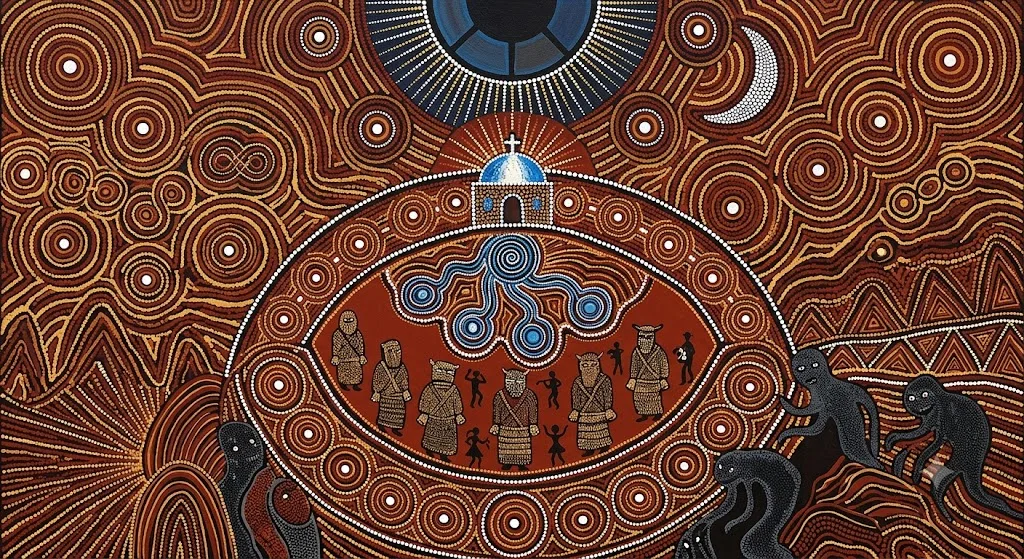
The result is a layered tradition. A Christmas goblin may carry traces of older winter fears while belonging firmly to Christian seasonal custom; a vampire-like revenant may look less like Dracula than like a warning about bad death, improper burial and broken community order; a fairy of the mountain or spring may recall ancient nymphs but behave like a much later village spirit. Greece’s folklore is best understood as a conversation between old stories, local practice and modern reinterpretation, rather than as a single unbroken survival from classical religion.[ResearchGate]researchgate.netOpen source on researchgate.net.
Why Greek folklore is more than ancient myth
For many readers, “Greek folklore” first brings to mind Zeus, Athena, the Minotaur, Medusa or the heroes of Homer. Those figures belong mainly to ancient myth and literature, not to the same category as later folk belief, although the two worlds constantly overlap. Modern Greek folklore is closer to what people told, sang, feared, performed and celebrated in households, fields, chapels, ports and village squares.
That distinction matters because it changes the evidence. Ancient mythology is known largely through literary texts, archaeology and classical art. Folklore is often preserved through oral tales, ritual practice, travellers’ reports, local manuscripts, museum collections, fieldwork and modern archives. The Hellenic Folklore Research Centre of the Academy of Athens, founded in 1918 from earlier folklore-archive work, was created precisely to collect and study this kind of material; its manuscript archive contains thousands of mostly unpublished fieldwork manuscripts, some preserving material from the early nineteenth century.[Kentrolaografias]kentrolaografias.grOpen source on kentrolaografias.gr.
It is also important not to flatten Greece into one folklore zone. Mountain villages, Aegean islands, Pontic Greek communities, Crete, the Peloponnese, Epirus, Macedonia, Thrace and urban Athens all preserve different emphases. Island traditions often foreground sea danger, saints, shipwrecks, wind, caves and revenants. Northern Greek ritual traditions may involve masking, bells, mumming or ecstatic dance. Rural tales often turn on livestock, springs, harvests, marriage, death and household protection. A country-level page can only map the main patterns, but the regional texture is where Greek folklore becomes most vivid.
The big thread: continuity, change and argument
One of the most tempting claims about Greek folklore is that it preserves ancient religion almost unchanged. Early folklorists and classicists often searched for survivals of antiquity in modern village belief, and some parallels are real. John Cuthbert Lawson’s 1910 study, for example, explicitly investigated modern Greek customs and beliefs as possible evidence for ancient Greek religion, while also drawing on field observation, local histories and earlier scholarship.[Project Gutenberg]gutenberg.orgModern Greek Folklore and Ancient Greek Religion, by John Cuthbert Lawson—A Project Gutenberg eBook…
Modern scholarship is more cautious. Agis Marinis’ study of Nikolaos Politis and Greek folklore studies stresses that the link between modern custom and antiquity was never a neutral question: it was tied to nationalism, Romantic ideas of continuity and the challenge of fitting popular customs, Orthodox practice and ancient heritage into one story of Greek identity. Greek folklore studies are often traced to Politis, who introduced the Greek equivalent of “folklore studies” in the late nineteenth century, but the intellectual roots go back to the Greek Enlightenment and the making of the modern Greek nation.[ResearchGate]researchgate.netOpen source on researchgate.net.
A good rule for readers is this: Greek folklore may preserve old motifs, but a similar image is not proof of direct survival. A mountain fairy may resemble an ancient nymph, but she may also reflect medieval Christian demonology, local ideas about dangerous beauty, Ottoman-era village life, or later literary reshaping. A masked winter custom may contain pre-Christian seasonal themes, but its present form may be shaped by Orthodox calendars, refugee history, tourism, heritage policy and local performance. The interesting question is not “is it ancient or modern?” but “which layers are visible, and what did each generation do with them?”
Beings that still define Greek folk imagination
Greek folklore has a rich supernatural population, but a few figures carry much of the country’s distinctive folk texture: Christmas goblins, fairy-like women of wild places, revenants, dragons and child-threatening female monsters. These beings are not all “mythological creatures” in the modern fantasy sense. Many worked as explanations for illness, misfortune, dangerous landscapes, social disorder, bad death, unbaptised children, storms, infertility or the risks of crossing boundaries.
The best-known winter creatures are the Christmas goblins said to appear during the Twelve Days from Christmas to Epiphany. In popular retellings they emerge from underground, cause household disorder and vanish when the waters are blessed at Epiphany. A 2024 public-facing account from Greece Is describes them as mischievous beings tied to the Twelve Days of Christmas and to older ideas about the dark season, while older folkloric sources connect them to a wide Balkan-Mediterranean pattern of winter masking, inversion and protective rites.[Greece Is]greece-is.comGreece Is Watch Out! The Kallikantzaroi Are About!Greece Is Watch Out! The Kallikantzaroi Are About!
Greek fairy traditions are equally important. The female beings often translated loosely as fairies or nymphs belong to springs, caves, mountains, trees, crossroads and lonely places. They can be beautiful and dangerous, especially to young men, women after childbirth, infants and people who trespass at the wrong time. Older scholarship frequently compared them with ancient nymphs; the safer interpretation is that modern fairy lore keeps some ancient-looking motifs while also belonging to later village ideas about purity, danger, enchantment and the invisible inhabitants of landscape. Lawson’s chapter structure itself shows how central nymphs, lamias and related beings were to early attempts to connect modern folklore with ancient religion.[Project Gutenberg]gutenberg.orgModern Greek Folklore and Ancient Greek Religion, by John Cuthbert Lawson—A Project Gutenberg eBook…
The Greek revenant is one of the most striking figures because it is not just a “vampire” in the cinematic sense. Folklore research on Greek vampire stories links the revenant to death customs, improper burial, injustice, sin, disease, excommunication and the fear that the dead may not rest properly. One study summarising Politis’ documentation notes that such beings appear in legends across Greece and may attack, frighten, damage households or carry disease; the belief is bound up with burial and Orthodox moral order more than with the aristocratic blood-drinking vampire of later Gothic fiction.[webbut.unitbv.ro]webbut.unitbv.roOpen source on unitbv.ro.
Dragons, giants and ogre-like figures also appear in Greek folktales. They often belong to the wonder-tale world rather than to everyday belief: they guard water, threaten princesses, test heroes, or embody brute power defeated by cleverness. The published English collection Folktales of Greece, edited by Georgios A. Megas and issued by the University of Chicago Press in 1970, is one accessible doorway into this tale tradition, while the broader Greek folktale catalogues cover recorded texts from the mainland, islands and Greek-speaking communities beyond the present state’s borders.[Internet Archive]archive.orgOpen source on archive.org.
Monsters, death and the anxious household
Greek supernatural lore is often domestic. It asks what can enter the house, what happens when a child is not protected, whether the dead have been properly settled, and how a family should behave around birth, marriage and burial. That is why some of the most memorable beings are not grand Olympian monsters but intimate threats: night visitors, child-stealers, revenants, jealous spirits and household disturbers.
The child-threatening female monster is a deep and recurring pattern. Lamia begins in ancient myth as a child-eating figure and later becomes a wider night-haunting or seductive danger in post-ancient tradition. A recent study of vampire-like beings in Greek folktales groups Lamia with other nocturnal female beings that enter houses, attack infants or seduce young men, while distinguishing them from revenants whose origin depends on death and burial.[Theoi]theoi.comOpen source on theoi.com.
This distinction helps explain how Greek folklore classifies fear. Some beings simply exist in the wonder-tale world: dragons, fairies, lamias, goblins and giants may appear because stories need otherworldly antagonists. Revenants are different. They are socially produced by a bad death, a curse, a moral rupture or a failure in ritual. In that sense, the Greek vampire-like tradition is not only a monster story; it is a story about the community’s responsibility to the dead.
The household is also where seasonal protection becomes practical. Fires, blessed water, crosses, incense, food offerings, thresholds, windows, cradles and night-time rules all become part of the folklore of safety. Whether or not any one custom is still widely believed today, the pattern shows how Greek folk religion turned cosmic ideas into small domestic actions: protect the baby, bless the house, honour the dead, feed the guest, do not mock the saints, and be careful at liminal times.
The ritual calendar: when folklore enters the street
Some Greek folklore is told in words; much of it is performed. The ritual year gives supernatural ideas a public shape through processions, songs, masking, feasting, fasting, bells, dances, fires, water blessings and household visits. These customs sit at the meeting point of Orthodox Christianity, older seasonal symbolism, village theatre and local identity.
The Christmas-to-Epiphany period is especially rich. Alongside carols and house blessings, northern Greece preserves mumming and masked traditions that turn the village into a stage. UNESCO’s entry for Momoeria, a New Year celebration in eight villages of the Kozani area in western Macedonia, describes dancers, actors and musicians performing in village streets and visiting homes between 25 December and 5 January to wish prosperity for the new year. The dancers are interpreted locally as priests of Momos or as commanders of Alexander the Great trying to persuade nature not to endanger village livelihoods; UNESCO inscribed the custom in 2016.[Intangible Cultural Heritage]ich.unesco.orgOpen source on unesco.org.
Carnival is another major zone of folk performance. The Greek Foreign Ministry describes the Carnival season as a period of masquerading, eating, drinking and dancing that begins before Orthodox Easter and culminates before the start of Lent. Folklorist George Megas’ work on calendar customs records older popular Carnival performances in Athens, including mummers dressed as women or foreigners, mock animals, dances and coin collections, showing that urban folk theatre was not confined to remote villages.[Hellenic MFA]mfa.grOpen source on mfa.gr.
Firewalking traditions in northern Greece show how complex the boundary between folk religion and official religion can be. The Anastenaria are linked to the feast of Saints Constantine and Helen and are practised by communities descended from refugees from Eastern Thrace; accounts describe private shrines, icons, music, ecstatic dance and walking over hot coals. Scholarly and popular treatments debate how much to emphasise Christian devotion, Thracian refugee memory, ecstatic healing, ancient parallels or modern heritage performance, which makes the custom a useful warning against single-origin explanations.[Wikipedia]WikipediaOpen source on wikipedia.org.
Sacred landscapes: caves, springs, ruins and islands
Greek folklore is deeply geographical. Stories cling to springs, ruined churches, caves, ancient stones, mountain passes, threshing floors, bridges, wells, coastlines and islands. This is partly because Greece’s landscape is so varied, but also because local folklore gives moral and supernatural meaning to places that people use every day.
Springs and caves often belong to fairy lore. A dangerous spring may be beautiful, healing or forbidden; a cave may shelter saints, spirits, dragons or hidden treasure. Mountains are places of pasture and danger, where shepherds encounter beings outside village order. The sea produces its own folklore of storms, saints, drowned sailors, mermaid-like figures and miraculous rescues. In a maritime country, supernatural geography is also practical geography: a dangerous cape, a wind pattern or a shipwrecking coast becomes memorable through story.
Ruins carry a different charge. Greece’s ancient sites are part of world heritage, tourism and national identity, but local folk imagination has often treated ruins as haunted, treasure-filled or inhabited by spirits. Old stones may be explained through giants, buried kings, hidden gold, saints’ miracles or the work of ancient people imagined as almost superhuman. The folklore of ruins is not the same as archaeology; it is how communities narrate the presence of the past in the visible landscape.
Churches and chapels add another layer. A remote chapel may be tied to a saint’s dream, a healing spring, a shepherd’s discovery of an icon, or a local vow. In such stories, Orthodox devotion does not erase older landscape feeling; it often gives it a new grammar. The sacred place becomes both Christian and local, both official and intimate.

Oral tales: cleverness, danger and moral imagination
Greek folktales include wonder tales, animal tales, comic stories, legends, moral anecdotes, tall tales and local origin stories. Some are recognisably international tale types adapted to Greek settings; others are strongly regional. The folktale world is full of poor brothers, clever girls, dragons, enchanted brides, ungrateful relatives, talking animals, saints, devils, kings, shepherds and tricksters.
What makes these tales feel Greek is often not the plot outline but the social world around it: the importance of hospitality, marriage, dowry, sibling rivalry, poverty, seafaring, shepherd life, cunning speech and honour. A dragon may belong to an international wonder-tale pattern, but the landscape, food, household arrangements and moral tone make the story local.
Collectors matter here. Georgios A. Megas’ Folktales of Greece helped make Greek oral narrative accessible to English readers, while Greek scholarly catalogues have organised a much larger body of material from mainland Greece, islands and Greek-speaking communities abroad. Reviews of the catalogue tradition note that recorded texts range roughly from the mid-nineteenth to late twentieth centuries, the great age of European folktale collecting.[Internet Archive]archive.orgOpen source on archive.org.
A reader should also distinguish folktales from legends. A folktale may begin in a timeless “once upon a time” world where dragons and magic operate by narrative logic. A legend is usually closer to belief: it may name a village, grave, saint, bridge, family, island or ruined building, and it asks to be taken as something that might have happened. Greece has both in abundance, and many creatures move between the two.
Archives and museums: how Greece preserves folklore
Greek folklore survives because people kept practising it, but also because institutions recorded it. The Hellenic Folklore Research Centre’s collections bring together material on Greek folk culture and the social life of modern Hellenism; SearchCulture.gr lists thousands of digital items from the centre and identifies large archives of proverbs, popular legends and digital publications.[SearchCulture]searchculture.grKEEL AcademyKEEL Academy
Museums preserve the material side of folklore: costumes, tools, embroidery, ceramics, puppet theatre, religious objects, domestic equipment, agricultural implements, photographs and craft traditions. The Museum of Modern Greek Culture in Athens, formerly associated with the Museum of Greek Folk Art, presents Greek folk art, urban life and cultural heritage through several sites, including the Bath House of the Winds and the Tzisdarakis Mosque.[mnep.gr]mnep.grMuseum of Modern Greek CultureMuseum of Modern Greek Culture
University and regional museums also matter. The National and Kapodistrian University of Athens’ folklore museum and archive reports around 4,000 unpublished manuscripts and about 1,100 folklore objects, while the Folklore Historical Museum of Larissa describes collections of more than 20,000 objects from the fifteenth to mid-twentieth century. These collections remind readers that folklore is not only supernatural narrative; it is also dress, labour, tools, foodways, music, ritual objects and the physical world of ordinary life.[estories.uoa.gr]estories.uoa.grOpen source on uoa.gr.
Digital heritage has widened access. SearchCulture.gr aggregates digitised Greek cultural collections, including folklore and intangible-heritage material, while Greece’s National Inventory of Intangible Cultural Heritage records living practices under the framework of UNESCO’s 2003 convention. Such systems do not freeze folklore in the past; they show which traditions communities and institutions consider worth safeguarding now.[ekt.gr]ekt.grOpen source on ekt.gr.
Living heritage and modern reinterpretation
Greek folklore today appears in at least four forms: community practice, heritage policy, tourism and popular culture. These forms overlap, but they are not identical. A village performance done for local ritual reasons is not the same as a staged version for visitors, although the same people may participate in both.
UNESCO listings show how local custom can become international heritage. Greece’s recognised intangible-heritage elements include practices such as Momoeria, Byzantine chant, Tinian marble craftsmanship, Chios mastic cultivation, August festivities in northern highland communities, transhumance and the Mediterranean diet. Not all are “folklore” in the monster-story sense, but they belong to the broader cultural field of transmitted practice, ritual, craft, song, seasonal knowledge and community identity.[Wikipedia]WikipediaList of Intangible Cultural Heritage elements in GreeceList of Intangible Cultural Heritage elements in Greece
Tourism can both preserve and simplify folklore. Visitors may encounter Christmas goblins in seasonal articles, island legends in guidebooks, “haunted” ruins in walking tours, or folk dance at festivals. These retellings can be useful entry points, but they often compress regional variation and uncertainty. A vivid tourist version of a legend may be modern, selective or polished for entertainment.
Popular culture has also reshaped Greek folklore. International fantasy often borrows ancient Greek myth more readily than modern Greek folk tradition, but creatures such as the revenant, lamia, nymph and Christmas goblin increasingly appear in horror writing, games, illustration, folklore podcasts and internet explainers. The risk is that local beings are turned into generic monsters. The opportunity is that readers discover that Greek story culture did not end with antiquity.
What readers often get wrong
The most common mistake is treating every Greek supernatural being as ancient. Some figures have ancient names or parallels, but their recorded folk behaviour may be medieval, early modern, Christian, regional or recently reshaped. Continuity exists, but it is rarely simple.
A second mistake is assuming Greek folklore is only rural. Villages are crucial, but Athens and other towns had popular Carnival performances, urban legends, craft traditions, songs, puppet theatre and museum-worthy folk culture. Modern Greek folklore includes both shepherds and city streets.
A third mistake is translating too aggressively. A revenant becomes “vampire”, a fairy becomes “nymph”, a goblin becomes “troll”, and a dragon becomes “dragon” in the western fantasy sense. These translations are useful shortcuts, but they can mislead. The Greek revenant is entangled with burial, sin and community order; the fairy-like woman may be a landscape spirit, illness explanation and erotic danger at once; the Christmas goblin belongs to a ritual calendar rather than to a dungeon full of monsters.
A final mistake is imagining folklore as a museum fossil. Many Greek traditions are archived, but some are still practised, debated, staged, revived or reinvented. A custom can be old and still changing. That is not a weakness in the evidence; it is how folklore works.
Why Greek folklore still matters
Greek folklore matters because it gives a human-scale view of a country too often reduced to classical ruins and postcard islands. It shows how people imagined the dangers of childbirth, burial, winter darkness, sea travel, mountain pasture, hunger, shame, hospitality and divine help. It explains why a spring, chapel, costume, song, mask or household blessing can carry more meaning than a casual visitor sees.
It also complicates the story of Greek identity. Ancient myth, Orthodox Christianity, Byzantine memory, Ottoman-era local life, refugee traditions, Balkan neighbours, island routes, national scholarship and modern tourism all meet inside Greek folklore. The result is not a tidy survival of antiquity, nor a purely modern invention, but a dense cultural landscape in which stories are continually adapted to new needs.
For curious readers, the best way into Greek folklore is to hold two ideas together. First, Greece has one of the world’s most famous ancient mythological inheritances, and later folklore often speaks with echoes of it. Second, modern Greek folk tradition has its own history, evidence and imagination. Its goblins, fairies, revenants, saints, songs, masks and haunted landscapes deserve to be understood on their own terms.
Amazon book picks
Further Reading
Books and field guides related to Where Ancient Myth Meets Living Folklore. Use these as the next step if you want deeper reading beyond the article.
eBay marketplace picks
Marketplace Samples
Live-tested eBay searches with available results related to this page.

Endnotes
1.
Source: researchgate.net
Link:https://www.researchgate.net/publication/357719564_Roots_ancient_or_medieval_Nikolaos_Politis_modern_Greek_folklore_studies_and_ancient_Greek_religion
2.
Source: gutenberg.org
Title: Project Gutenberg
Link:https://www.gutenberg.org/files/66116/66116-h/66116-h.htm
Source snippet
Modern Greek Folklore and Ancient Greek Religion, by John Cuthbert Lawson—A Project Gutenberg eBook...
3.
Source: kentrolaografias.gr
Link:https://kentrolaografias.gr/en/content/manuscript-archive
4.
Source: searchculture.gr
Title: KEEL Academy
Link:https://www.searchculture.gr/aggregator/portal/collections/KEEL_Academy?language=en
5.
Source: greece-is.com
Title: Greece Is Watch Out! The [Kallikantzaroi]({{ ‘kallikantzaroi/’ | relative_url }}) Are About!
Link:https://www.greece-is.com/watch-out-the-kallikantzaroi-are-about/
6.
Source: webbut.unitbv.ro
Link:https://webbut.unitbv.ro/index.php/Series_IV/article/download/963/881/1657
7.
Source: archive.org
Link:https://archive.org/details/folktalesofgreec0000mega
8.
Source: theoi.com
Link:https://www.theoi.com/Ther/Lamia.html
9.
Source: ich.unesco.org
Link:https://ich.unesco.org/en/RL/momoeria-new-year-s-celebration-in-eight-villages-of-kozani-area-west-macedonia-greece-01184
10.
Source: unesco.org
Title: document 4363
Link:https://www.unesco.org/archives/multimedia/document-4363
11.
Source: mfa.gr
Link:https://www.mfa.gr/missionsabroad/en/about-greece/history-and-culture/culture.html?page=8
12.
Source: Wikipedia
Link:https://en.wikipedia.org/wiki/Anastenaria
13.
Source: mnep.gr
Title: Museum of Modern Greek Culture
Link:https://www.mnep.gr/en
14.
Source: estories.uoa.gr
Link:https://estories.uoa.gr/en/cultural_heritage/museums/folkrore-museum-and-archives
15.
Source: ekt.gr
Link:https://www.ekt.gr/en/news/21731
16.
Source: ich.unesco.org
Title: Intangible Cultural Heritage Greece
Link:https://ich.unesco.org/en/state/greece-GR?info=periodic-reporting
17.
Source: Wikipedia
Title: List of Intangible Cultural Heritage elements in Greece
Link:https://en.wikipedia.org/wiki/List_of_Intangible_Cultural_Heritage_elements_in_Greece
18.
Source: ich.unesco.org
Title: Intangible Cultural Heritage Greece
Link:https://ich.unesco.org/en/state/greece-GR
19.
Source: Wikipedia
Link:https://en.wikipedia.org/wiki/Kallikantzaros
20.
Source: Wikipedia
Title: Modern Greek folklore
Link:https://en.wikipedia.org/wiki/Modern_Greek_folklore
21.
Source: Wikipedia
Link:https://en.wikipedia.org/wiki/[Vrykolakas
22.
Source: Wikipedia
Link:https://en.wikipedia.org/wiki/Nereids
23.
Source: Wikipedia
Link:https://en.wikipedia.org/wiki/Lamia
24.
Source: Wikipedia
Link:https://en.wikipedia.org/wiki/Momoeria
25.
Source: researchgate.net
Link:https://www.researchgate.net/publication/402321273_Onomatological_and_etymological_questions_on_the_ritual_masks_and_folk_customs_of_the_Greek_festival_Calendar
26.
Source: researchgate.net
Link:https://www.researchgate.net/publication/360861383_Universities%27_folklore_museum_collections_in_Greece_past_present_future
27.
Source: researchgate.net
Link:https://www.researchgate.net/profile/Georgios-Tserpes-2/publication/385753927_Proverbs_in_Greek_tall_tales_A_surrealistic_use_of_metaphors/links/67345912a78ba469f05fb48e/Proverbs-in-Greek-tall-tales-A-surrealistic-use-of-metaphors.pdf
28.
Source: ich.unesco.org
Link:https://ich.unesco.org/en/lists
29.
Source: ich.unesco.org
Link:https://ich.unesco.org/
30.
Source: ich.unesco.org
Link:https://ich.unesco.org/en/Decisions/11.COM/10.b.16
31.
Source: ich.unesco.org
Link:https://ich.unesco.org/en/video/36428
32.
Source: ich.unesco.org
Link:https://ich.unesco.org/en/lists?id=36428&include=film_inc.php
33.
Source: mnep.gr
Title: Hours & Admission
Link:https://www.mnep.gr/en/visit/the-bath-house-of-the-winds/hours-admission/
34.
Source: theoi.com
Title: NEREID S (Nereides)
Link:https://www.theoi.com/Pontios/Nereides.html
35.
Source: archive.org
Link:https://archive.org/details/moderngreekfolkl00laws
36.
Source: archive.org
Link:https://archive.org/details/greekfolkreligio00nils
37.
Source: ejournals.epublishing.ekt.gr
Link:https://ejournals.epublishing.ekt.gr/index.php/historicalReview/article/view/22824
38.
Source: odysseus.culture.gr
Link:https://odysseus.culture.gr/h/1/eh155.jsp?obj_id=3319
39.
Source: odysseus.culture.gr
Link:https://odysseus.culture.gr/h/1/eh150.jsp?obj_id=3319
40.
Source: kentrolaografias.gr
Title: establishment and institutional framework
Link:https://kentrolaografias.gr/en/content/establishment-and-institutional-framework
41.
Source: en.phil.uoa.gr
Link:https://en.phil.uoa.gr/fileadmin/depts/phil.uoa.gr/www/uploads/Byzantine_philology-Folklore/cv/KOUZAS-CV_ENGLISH.pdf
42.
Source: greece-is.com
Title: seven greek traditions recognized intangible cultural heritage
Link:https://www.greece-is.com/news/seven-greek-traditions-recognized-intangible-cultural-heritage/
43.
Source: scholarworks.iu.edu
Link:https://scholarworks.iu.edu/journals/index.php/jfrr/article/view/38748
44.
Source: books.google.com
Title: Greek Folk Religion
Link:https://books.google.com/books/about/Greek_Folk_Religion.html?id=UwnGYe8WiCUC
45.
Source: old.academyofathens.gr
Link:https://old.academyofathens.gr/en/publications/byresearchcenters/folklore
46.
Source: traditionarchives.org
Link:https://www.traditionarchives.org/archives/greece
47.
Source: mythus.fandom.com
Link:https://mythus.fandom.com/wiki/Lamia
48.
Source: mythoi.org
Link:https://mythoi.org/en/lamia/
49.
Source: introducingathens.com
Title: Museum of Greek Folk Art
Link:https://www.introducingathens.com/museum-of-greek-folk-art
Additional References
50.
Source: youtube.com
Title: Greek Christmas Trolls: Kallikantzaroi | Greek Folklore
Link:https://www.youtube.com/watch?v=FJ_HQZclF7Y
Source snippet
Kallikantzaros: The Origins of the CHRISTMAS Goblins...
51.
Source: academia.edu
Link:https://www.academia.edu/122597150/Greece_and_Italy_The_Nereids_Those_from_Outside_
52.
Source: reddit.com
Link:https://www.reddit.com/r/folklore/comments/q7e3mx/a_near_exhaustive_list_of_traits_that_define_the/
53.
Source: allovergreece.com
Link:https://www.allovergreece.com/Custom/Descr/25/en
54.
Source: scribd.com
Link:https://www.scribd.com/document/477202545/Cultural-diversity-in-Greek-religion-Fro-pdf
55.
Source: isfnr.org
Link:https://isfnr.org/resources/folklore-archives/
56.
Source: openlibrary.org
Link:https://openlibrary.org/books/OL17305093M/Folktales_of_Greece
57.
Source: academia.edu
Link:https://www.academia.edu/22888517/Georgios_A_Megas_1893_1976_and_his_contribution_to_the_academic_organization_and_development_of_Greek_Folklore_a_review_of_evaluations_of_his_work_Neograeca_Bohemica_15_2015%CF%83
58.
Source: amazon.com
Link:https://www.amazon.com/Books-Georgios-Megas/s?rh=n%3A283155%2Cp_27%3AGeorgios%2BA.%2BMegas&tag=searcht-20
59.
Source: facebook.com
Link:https://www.facebook.com/groups/1782459378589048/posts/3180581212110184/
Topic Tree
Follow this branch
Related pages 192
- Afghan Folklore
- Albanian Folklore
- Algerian Folklore
- Australian Folklore
- Azerbaijan Folklore
- +187 more in sidebar