Where Do Equatorial Guinea's Spirits Live?
Equatorial Guinea’s folklore is best understood as a set of living oral traditions rather than a single national mythology.
Page outline Jump by section
Introduction
The challenge for readers is that Equatorial Guinea’s folklore is under-published in English. Much survives through oral practice, Spanish-language literary recovery, museum catalogues, missionary-era ethnography, music studies and diaspora writing. That makes the tradition fascinating, but it also means that confident claims about “the” national pantheon or a neat list of monsters should be treated carefully.[African Studies Centre Leiden]ascleiden.nlAfrican Studies Centre Leiden Equatorial Guinea | African Studies Centre LeidenAfrican Studies Centre Leiden Equatorial Guinea | African Studies Centre Leiden
Why Equatorial Guinea’s folklore is not one tradition
Equatorial Guinea is a small country with a surprisingly complex cultural map. Its mainland region, Río Muni, is closely tied to Fang-speaking Central Africa, while Bioko has deep Bubi histories; the coast has Ndowe traditions, and Annobón has its own island identity shaped by people brought from São Tomé and Angola under Portuguese rule. A music and culture reference survey lists Fang, Ndowe, Bubi, Bisio, Crió and Annobonese communities as major cultural strands, each with distinctive performance and ritual forms.[ResearchGate]researchgate.net397639846 ARANZADI 2019 Equatorial Guinea History Culture and Geography of Music397639846 ARANZADI 2019 Equatorial Guinea History Culture and Geography of Music
This matters because folklore here does not sit neatly inside modern national borders. Fang/Ekang traditions link Equatorial Guinea to Gabon, Cameroon and Congo; Bubi sacred geography belongs specifically to Bioko; Annobonese traditions connect the island to the wider Gulf of Guinea. A country-level page therefore has to hold two ideas together: Equatorial Guinea has a national folklore field, but many of its deepest stories are regional, ethnic, linguistic and island-based rather than state-made.[UNESCO ICH]ich.unesco.orgOpen source on unesco.org.
Christianity, especially Roman Catholicism, has also reshaped how older beliefs are practised and described. The US State Department’s 2023 religious freedom report says most people identify as Christian, while a remaining share follows animist, Baha’i, Jewish or other beliefs; it also notes that many Christians reportedly practise some traditional beliefs. This is important for folklore because older ideas about spirits, ancestors, protection, healing and misfortune have often continued alongside church life rather than disappearing completely.[U.S. Department of State]state.govU.S. Department of State Equatorial GuineaU.S. Department of State Equatorial Guinea
The Fang mvet: epic song, history and mythic imagination
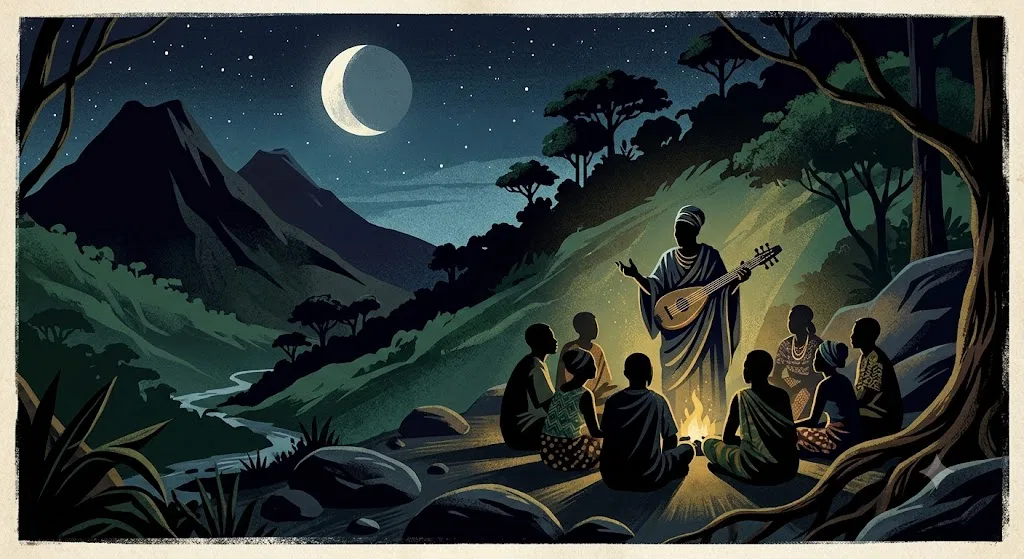
The mvet is the best-attested Equatoguinean folklore form for an international reader. It is both an instrument and a storytelling tradition associated with Fang/Ekang-speaking peoples across Central Africa. In Equatorial Guinea’s Fang context, the mvet is performed by troubadour-like singers who tell epic stories, love narratives and genealogies; one survey describes the communal house as a place for speeches, disputes, social gathering and recitation, where instruments often accompany public life.[ResearchGate]researchgate.net397639846 ARANZADI 2019 Equatorial Guinea History Culture and Geography of Music397639846 ARANZADI 2019 Equatorial Guinea History Culture and Geography of Music
At the centre of mvet performance is not a “fairy tale” in the narrow European sense, but an epic universe. Scholars describe the Mvet as oral literature that preserves philosophical, moral and historical memory. Marc Mvé Bekale’s study of the Ekang saga argues that the epic can encode memories of the Atlantic slave trade and act as a form of cultural resistance, with later artists in Gabon, Cameroon and Equatorial Guinea reworking it for postcolonial identity.[AUC Library]library.au.intOpen source on au.int.
UNESCO’s recent listing of Mvet Oyeng for Gabon, Cameroon and Congo is not an Equatorial Guinea listing, but it is still useful context because it describes the wider Ekang practice to which Fang traditions in Equatorial Guinea are related. UNESCO characterises it as sung epic storytelling accompanied by dancing and a traditional stringed instrument, with audiences participating through clapping, singing and engagement with the storyteller. The same source distinguishes sacred and popular forms, which helps explain why mvet can be both ritual art and public entertainment.[UNESCO ICH]ich.unesco.orgOpen source on unesco.org.
For folklore readers, the key point is that the mvet is not simply “old music”. It is a vehicle for mythic history: heroes, ancestors, memory, courage, conflict and moral order are carried through performance. When modern writers and musicians invoke it, they are not just borrowing a picturesque tradition; they are drawing on one of the most powerful narrative engines in the Fang cultural world.[AUC Library]library.au.intOpen source on au.int.
Bubi sacred geography: Bioko as a spirit landscape
If the mvet gives Equatorial Guinea one of its great epic forms, Bubi tradition gives it one of its most distinctive sacred landscapes. Bioko is a volcanic island, and Bubi belief has long associated spiritual force with places: mountains, rivers, caves, waterfalls, stones and trees. A SAGE music-and-culture entry describes Bubi religion as rich and varied, with Ruppé as a masculine principle and Bisila as a feminine principle from which spirits of creation, superhuman beings and human heroes emerge. It also notes numerous sacred places, including upright stones, caves, rivers, mountains and falls.[ResearchGate]researchgate.net397639846 ARANZADI 2019 Equatorial Guinea History Culture and Geography of Music397639846 ARANZADI 2019 Equatorial Guinea History Culture and Geography of Music
This is folklore rooted in terrain. Rather than imagining spirits as detached characters in a book of myths, Bubi tradition often links them to recognisable places on Bioko. A site summarising Father Antonio Aymemí’s ethnographic work and later scholarship describes a layered spirit world and says that distinctive landmarks, including rivers, lakes and mountains, were associated with spiritual energy. Because that source is a modern presentation of older material rather than a peer-reviewed edition, it is best used cautiously; still, it aligns with the stronger SAGE summary that Bubi ritual life attached importance to sacred natural places.[thebubis.com]thebubis.comThe BubisThe Bubis
Protective practice is another recurring theme. The same Aymemí-based account describes village approaches marked by arches, amulets, animal materials, sacred trees and water vessels intended to keep harmful spirits away and invoke good spirits. Whether every detail should be treated as representative of all Bubi communities is uncertain, but the pattern is clear: danger, illness, fertility, ancestry and protection were understood through relations between the human village and the spirit-filled landscape.[thebubis.com]thebubis.comThe BubisThe Bubis
This gives Bubi folklore a different feel from the mvet. The Fang epic tradition often foregrounds sung heroic narrative; Bubi tradition, as visible in available sources, foregrounds place, ritual protection, ancestors and the sacred quality of Bioko itself. Both are story worlds, but one is most visible through performance and the other through landscape and ritual memory.[ResearchGate]researchgate.net397639846 ARANZADI 2019 Equatorial Guinea History Culture and Geography of Music397639846 ARANZADI 2019 Equatorial Guinea History Culture and Geography of Music
Ritual, healing and the everyday supernatural
Folklore in Equatorial Guinea is not limited to fireside stories. It also appears in ideas about health, misfortune, sound, ritual cleansing and social danger. A medical anthropology study of Fang cultural syndromes in Equatorial Guinea examined explanatory models of illness among Fang community leaders, elders, health workers, traditional healers and pastors, showing that older cultural categories still matter in how some people interpret suffering and seek help.[PMC]pmc.ncbi.nlm.nih.govOpen source on nih.gov.
Among the Bubi, sound itself can be protective or curative. The SAGE survey notes that a bell is used for cleansing evil with sound, symbolising particular spirits and being used to evoke them; it also mentions instruments and sound-making practices connected to ceremonies, spirit-calling and communication. These details are valuable because they show that folklore is performed bodily and socially: through bells, seeds, flutes, clapping, dance and voice, not just through narrated plots.[ResearchGate]researchgate.net397639846 ARANZADI 2019 Equatorial Guinea History Culture and Geography of Music397639846 ARANZADI 2019 Equatorial Guinea History Culture and Geography of Music
Public celebrations also carry older meanings, though the evidence is scattered. General cultural summaries often mention the Bubi abira as a cleansing ceremony and balélé as a dance performed along the coast and on Bioko around Christmas, but many online summaries repeat these claims without much detail. The safer conclusion is that Equatorial Guinea’s festive culture mixes Christian calendars, local dance, ethnic performance and older ideas about cleansing or protection, rather than preserving rituals in an untouched precolonial form.[Wikipedia]WikipediaCulture of Equatorial GuineaCulture of Equatorial Guinea
Folktales in print: what has been collected
Equatorial Guinea’s oral tradition has been partly preserved through Spanish-language collection and literary recovery. A HathiTrust catalogue record for Cuentos bubis de Guinea Ecuatorial, published in Malabo in 1992, identifies it as a collection of Bubi tales from Equatorial Guinea, with introductions and tales in Spanish and some tales also in Bube. The same catalogue points to related collections of Annobonese and Ndowe tales, suggesting a broader effort to record oral traditions from several communities.[catalog.hathitrust.org]catalog.hathitrust.orgCatalog Record: Cuentos bubis de Guinea Ecuatorial | Hathi Trust Digital LibraryCatalog Record: Cuentos bubis de Guinea Ecuatorial | Hathi Trust Digital Library
One especially important recovery text is Raquel Ilonbé’s Leyendas guineanas, published in 1981. A study of Hispanic African literature describes it as a collection of traditional stories from different Equatoguinean ethnic groups, gathered by the author throughout the country “in search of her roots”, and notes that it appeared to promise a recovery of oral tradition. That promise was only partly fulfilled, partly because political exile, weak publishing infrastructure and censorship repeatedly disrupted cultural work.[Center for African Studies]afrst.illinois.eduCenter for African Studies Microsoft WordCenter for African Studies Microsoft Word
This print history matters because it separates well-attested folklore from internet-era invention. Equatorial Guinea does have collected tales, named collectors, literary anthologies and cultural institutions, but much of the material remains hard to access, out of print, or available mainly in Spanish. For an English-speaking reader, the absence of famous monster names online should not be mistaken for an absence of folklore. It often means the archive is local, oral, Spanish-language, or scattered across specialist catalogues.[catalog.hathitrust.org]catalog.hathitrust.orgCatalog Record: Cuentos bubis de Guinea Ecuatorial | Hathi Trust Digital LibraryCatalog Record: Cuentos bubis de Guinea Ecuatorial | Hathi Trust Digital Library
Modern writers and the afterlife of oral tradition
Equatorial Guinea’s modern literature is one of the main places where older story forms reappear in public, especially because many writers have worked from exile. The African Studies Centre Leiden notes that Spanish remains the country’s main language of communication alongside ethnic languages such as Bubi, Fang, Ndowe, Bisio, Annobonese, Balengue and Baseke, and that much Equatoguinean literature is written in Spanish and published in Spain.[African Studies Centre Leiden]ascleiden.nlAfrican Studies Centre Leiden Equatorial Guinea | African Studies Centre LeidenAfrican Studies Centre Leiden Equatorial Guinea | African Studies Centre Leiden
Donato Ndongo, one of the country’s best-known writers, is often discussed in relation to Fang oral tradition. A recent literary essay describes his storytelling style as reminiscent of Fang oral forms, comparing his narrative movement through memory and motive to the work of the mvet performer. This does not make his fiction “folklore” in a simple sense, but it shows how oral aesthetics can shape modern novels about colonialism, memory and exile.[Africa Is a Country]africasacountry.coma barren sowinga barren sowing
Other writers have used literature to recover identity, loss and ethnic memory. The same Hispanic African literature study notes that Juan Balboa Boneke’s poetry reflects the trauma of exile and that María Nsue Angüe’s Ekomo offered a major representation of Fang women from a Fang woman’s perspective. Africultures similarly frames Equatoguinean literature as a mixed Hispano-African creation rooted in ritual, myths, legends, tales, dance and communal discussion.[Center for African Studies]afrst.illinois.eduCenter for African Studies Microsoft WordCenter for African Studies Microsoft Word
For folklore readers, this means modern Equatoguinean literature should be read as part of the tradition’s afterlife. It does not merely record old tales; it reworks oral memory under the pressures of colonialism, dictatorship, exile, language loss and national reconstruction.[Center for African Studies]afrst.illinois.eduCenter for African Studies Microsoft WordCenter for African Studies Microsoft Word
What is well attested, and what remains uncertain
The best-supported elements of Equatorial Guinea’s folklore are broad but meaningful: Fang mvet epic performance; Bubi sacred geography and spirit-centred ritual life; collected Bubi, Ndowe and Annobonese tales; and the continuing influence of oral tradition in Spanish-language literature. These are supported by academic catalogues, cultural studies, music references and institutional sources.[au.int]library.au.intOpen source on au.int.
What is less secure is the kind of tidy “mythology guide” that readers may expect from better-documented traditions. There is no widely accessible, authoritative English canon of Equatoguinean gods, monsters, ghosts and fairies. Some online pages list spirits or sacred sites in detail, but those often depend on translated missionary-era material, diaspora memory or unsourced repetition. They can be useful starting points, but they should not be treated as equal to direct fieldwork, published tale collections or specialist studies.[thebubis.com]thebubis.comThe BubisThe Bubis
A careful reader should therefore ask three questions when encountering a claimed Equatoguinean legend: Is it tied to a named community such as Fang, Bubi, Ndowe or Annobonese? Is it found in a collection, performance tradition, ethnographic study or literary work? And is it being presented as an old oral belief, a modern retelling, a tourist simplification or an internet invention? Those questions do more justice to Equatorial Guinea’s folklore than forcing it into a single national myth chart.[African Studies Centre Leiden]ascleiden.nlAfrican Studies Centre Leiden Equatorial Guinea | African Studies Centre LeidenAfrican Studies Centre Leiden Equatorial Guinea | African Studies Centre Leiden
Why this folklore matters today
Equatorial Guinea’s folklore matters because it preserves ways of thinking about land, ancestry, memory and community that are not captured by political history alone. In Fang mvet performance, story becomes a way to remember heroic worlds, moral conflict and historical trauma. In Bubi sacred geography, Bioko is not just a volcanic island but a landscape of spirits, ancestors and ritual obligation. In literary recovery, oral tradition becomes a way for writers and exiles to rebuild identity after colonial disruption and dictatorship.[au.int]library.au.intOpen source on au.int.
It also matters because the tradition is vulnerable. Some practices continue in changed form, some are remembered through literature, and some are known mainly through older collections or specialist studies. The country’s multilingual reality means that Spanish may be the main written medium, while many traditions belong originally to Bube, Fang, Annobonese or other languages. Every translation makes the material more accessible, but also moves it further from the sound, setting and social situation in which it first lived.[African Studies Centre Leiden]ascleiden.nlAfrican Studies Centre Leiden Equatorial Guinea | African Studies Centre LeidenAfrican Studies Centre Leiden Equatorial Guinea | African Studies Centre Leiden
The most honest way to approach Equatorial Guinea’s folklore is therefore not as a lost cabinet of exotic creatures, but as a living and interrupted cultural field. Its stories are sung, danced, ritualised, translated, exiled, published, remembered and sometimes only partly recoverable. That uncertainty is not a weakness of the subject; it is part of the story of a country where oral tradition, sacred landscape and modern literature remain deeply connected.

Amazon book picks
Further Reading
Books and field guides related to Where Do Equatorial Guinea's Spirits Live?. Use these as the next step if you want deeper reading beyond the article.
African Myths of Origin
Strong fit for readers exploring Central African oral traditions.
The Palm-Wine Drinkard
Introduces readers to spirit worlds and oral storytelling traditions.
African Religions and Philosophy
Explains spirit belief, ancestors and sacred landscapes across Africa.
eBay marketplace picks
Marketplace Samples
Live-tested eBay searches with available results related to this page.

Endnotes
1.
Source: researchgate.net
Title: 397639846 ARANZADI 2019 Equatorial Guinea History Culture and Geography of Music
Link:https://www.researchgate.net/publication/397639846ARANZADI_2019_Equatorial-_Guinea_History_Culture_and_Geography_of_Music
2.
Source: ich.unesco.org
Link:https://ich.unesco.org/en/RL/mvet-oyeng-musical-art-practices-and-skills-associated-with-the-ekang-community-02253
3.
Source: state.gov
Title: U.S. Department of State Equatorial Guinea
Link:https://www.state.gov/reports/2023-report-on-international-religious-freedom/equatorial-guinea
4.
Source: unesco.org
Title: committee 2025
Link:https://www.unesco.org/en/intangible-cultural-heritage/committee-2025
5.
Source: thebubis.com
Title: The Bubis
Link:https://www.thebubis.com/Overview.html
6.
Source: pmc.ncbi.nlm.nih.gov
Link:https://pmc.ncbi.nlm.nih.gov/articles/PMC6128453/
7.
Source: Wikipedia
Title: Culture of Equatorial Guinea
Link:https://en.wikipedia.org/wiki/Culture_of_Equatorial_Guinea
8.
Source: catalog.hathitrust.org
Title: Catalog Record: Cuentos bubis de Guinea Ecuatorial | Hathi Trust Digital Library
Link:https://catalog.hathitrust.org/Record/006940999
9.
Source: africultures.com
Title: Literary landscape in Equatorial Guinea | Africultures
Link:https://africultures.com/literary-landscape-in-equatorial-guinea-5455/
10.
Source: Wikipedia
Title: Equatoguinean literature in Spanish
Link:https://en.wikipedia.org/wiki/Equatoguinean_literature_in_Spanish
11.
Source: Wikipedia
Title: Bubi people
Link:https://en.wikipedia.org/wiki/Bubi_people
12.
Source: Wikipedia
Link:https://en.wikipedia.org/wiki/Mvet
13.
Source: Wikipedia
Title: Equatorial Guinea
Link:https://en.wikipedia.org/wiki/Equatorial_Guinea
14.
Source: Wikipedia
Title: Religion in Equatorial Guinea
Link:https://en.wikipedia.org/wiki/Religion_in_Equatorial_Guinea
15.
Source: Wikipedia
Title: Donato Ndongo Bidyogo
Link:https://en.wikipedia.org/wiki/Donato_Ndongo-Bidyogo
16.
Source: Wikipedia
Title: Lists of Intangible Cultural Heritage elements
Link:https://en.wikipedia.org/wiki/Lists_of_Intangible_Cultural_Heritage_elements
17.
Source: researchgate.net
Link:https://www.researchgate.net/publication/331278918_Language_Vitality_of_Spanish_in_Equatorial_Guinea_Language_Use_and_Attitudes
18.
Source: researchgate.net
Link:https://www.researchgate.net/publication/329063488_Memories_and_Mechanisms_of_Resistance_to_the_Atlantic_Slave_Trade_The_Ekang_Saga_in_West_Central_Africa%27s_Epic_Tale_the_Mvet
19.
Source: researchgate.net
Link:https://www.researchgate.net/publication/298835017_LANDSCAPES_OF_EXILE_IN_THE_POETRY_OF_JUAN_BALBOA_BONEKE_SOCIAL_DILEMMA_WITH_THE_EQUATORIAL_GUINEA_HOMELAND
20.
Source: researchgate.net
Link:https://www.researchgate.net/publication/28212893_An_Introduction_to_Spanish_Post-colonial_Exile_The_Narrative_of_Donato_Ndongo
21.
Source: 2021-2025.state.gov
Title: equatorial guinea
Link:https://2021-2025.state.gov/reports/2020-report-on-international-religious-freedom/equatorial-guinea/
22.
Source: 2009-2017.state.gov
Link:https://2009-2017.state.gov/outofdate/bgn/equatorialguinea/40580.htm
23.
Source: ich.unesco.org
Link:https://ich.unesco.org/en/video/76528
24.
Source: ich.unesco.org
Link:https://ich.unesco.org/en/decisions/20.COM/7.B.19
25.
Source: ich.unesco.org
Link:https://ich.unesco.org/en/lists
26.
Source: ich.unesco.org
Link:https://ich.unesco.org/en/video/81170
27.
Source: ich.unesco.org
Title: LHE 25 20.CO M 7.b EN.docx
Link:https://ich.unesco.org/doc/src/LHE-25-20.COM-7.b_EN.docx
28.
Source: library.au.int
Link:https://library.au.int/memories-and-mechanisms-resistance-atlantic-slave-trade-ekang-saga-west-central-africas-epic-tale
29.
Source: ascleiden.nl
Title: African Studies Centre Leiden Equatorial Guinea | African Studies Centre Leiden
Link:https://www.ascleiden.nl/content/webdossiers/equatorial-guinea
30.
Source: afrst.illinois.edu
Title: Center for African Studies Microsoft Word
Link:https://afrst.illinois.edu/system/files/2020-09/sem-ngom-2001.pdf
31.
Source: africasacountry.com
Title: a barren sowing
Link:https://africasacountry.com/2025/06/a-barren-sowing
32.
Source: africasacountry.com
Title: a powerful storytelling tradition
Link:https://africasacountry.com/2025/04/a-powerful-storytelling-tradition
33.
Source: beingafrican.org
Title: Equatorial Guinea
Link:https://beingafrican.org/equatorial-guinea/
34.
Source: facebook.com
Title: Juan Balboa Boneke (
Link:https://www.facebook.com/WoGA1884/photos/equatorial-guinea-juan-balboa-boneke-june-9-1938-march-10-2014-was-an-equatorial/370565770057973/
35.
Source: youtube.com
Title: Guinea Ecuatorial
Link:https://www.youtube.com/watch?v=OgxWqZkt8Ng
36.
Source: minorityrights.org
Link:https://minorityrights.org/communities/bubi/
Additional References
37.
Source: youtube.com
Title: 2 Hrs of Fang Mvet, Bantu Drums, Bubi Flute, and Bayele Forest Music
Link:https://www.youtube.com/watch?v=qqaFgrZZKRw
Source snippet
Bioko Island: A Forgotten Gem in the Gulf of Guinea - travel documentary for Czech Television...
38.
Source: youtube.com
Title: Bioko Island: A Forgotten Gem in the Gulf of Guinea
Link:https://www.youtube.com/watch?v=WnDQTdqXS10
Source snippet
Equatorial Guinea – Voces del Mbini...
39.
Source: academia.edu
Link:https://www.academia.edu/126775598/Donato_NDONGO_BIDYOGO_The_dream
40.
Source: joshuaproject.net
Link:https://joshuaproject.net/people_groups/10977
41.
Source: tribeguess.com
Link:https://www.tribeguess.com/learn/bubi
42.
Source: 101lasttribes.com
Link:https://www.101lasttribes.com/tribes/bubi.html
43.
Source: coursehero.com
Link:https://www.coursehero.com/file/147420086/Equatorial-Guinea-Literaturetxt/
44.
Source: encyclopedia.com
Link:https://www.encyclopedia.com/international/encyclopedias-almanacs-transcripts-and-maps/equatorialguineans
45.
Source: lastplaces.com
Link:https://lastplaces.com/en/trips/ethnographic-trip-to-equatorial-guinea-november-2025/
46.
Source: tribeguess.com
Link:https://www.tribeguess.com/learn/fang
Topic Tree
Follow this branch
Related pages 192
- Afghan Folklore
- Albanian Folklore
- Algerian Folklore
- Australian Folklore
- Azerbaijan Folklore
- +187 more in sidebar