Somalia's Living World of Story and Spirit
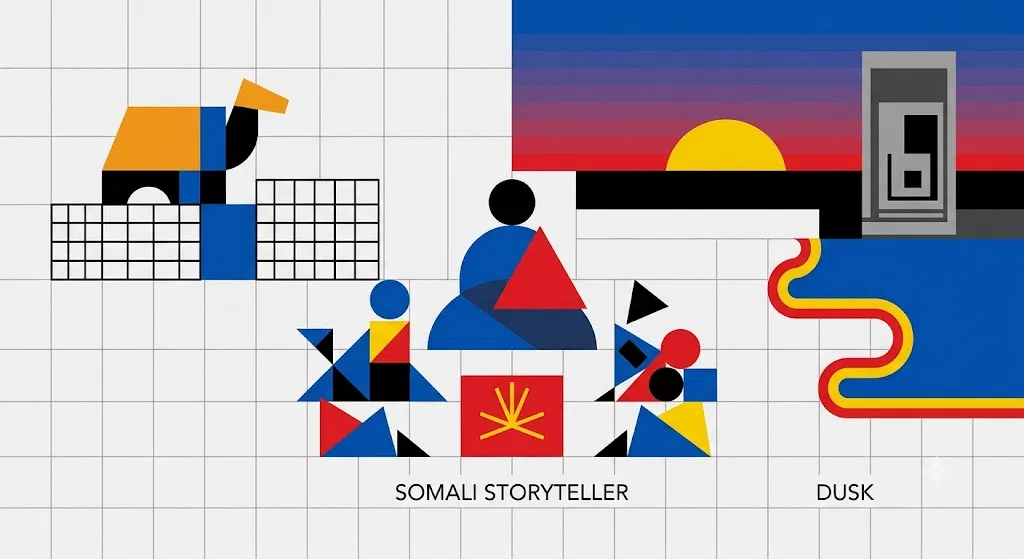
Somalia’s folklore is best understood as a living oral tradition rather than a fixed “mythology book”. Its stories travel through poetry, riddles, children’s tales, clan memory, religious teaching, women’s healing rituals, jokes, songs and diaspora retellings.
Page outline Jump by section
Introduction
That makes Somalia especially interesting for folklore readers. The country’s traditions include famous figures such as the legendary queen Arawelo, wise-ruler tales such as Wiil Waal, animal fables where hyenas and donkeys often play foolish roles, spirit-possession traditions linked to saar or mingis, and sacred places where Islamic devotion, older ritual memory and archaeology overlap. The evidence is uneven: some traditions are well collected in scholarly folktale anthologies and oral-poetry studies, while others survive mainly through community storytelling, children’s books, internet discussion and diaspora performance.[uniroma3.it]arcadia.sba.uniroma3.itOpen source on uniroma3.it.
Why Somali folklore is so oral
Somalia is often called a “nation of poets”, and that phrase is more than a compliment. Poetry, song and formal speech have long carried public argument, historical memory, praise, satire, grief and moral instruction. Scholars of Somali literature repeatedly stress that oral forms are not a lesser stage before writing; they are a core cultural technology in their own right. Ali Jimale Ahmed describes Somalis as “still an oral people”, while also warning against the false idea that oral and written culture are sealed off from one another.[Wikidot]somali.wdfiles.comOpen source on wdfiles.com.
This matters because Somali folklore often appears in performance rather than in a single authorised text. A tale may change depending on the teller, audience, region, political mood or moral lesson being drawn from it. A heroic figure can become comic in one setting and threatening in another. A story told to frighten children at night may later be published as a bilingual classroom book. A song can carry a public message, a hidden political memory or a family teaching.
Somali oral poetry also has social rank and genre distinctions. Martin Orwin notes that northern pastoral poetry is commonly divided into classical and modern categories, while the African Studies Centre Leiden describes a wide range of Somali poetic genres, from work songs linked to camel-herding and rural labour to more prestigious composed verse memorised by reciters.[Oral Tradition]journal.oraltradition.orgOral Tradition On the Concept of “Definitive Text” in Somali PoetryOral Tradition On the Concept of “Definitive Text” in Somali Poetry This helps explain why folklore, history and literature can be hard to separate in Somalia: the same culture that preserves a folktale may also preserve a political poem, a praise song, a proverb, a genealogical claim and a saint’s legend.
A recent public example shows how alive this oral culture remains. In 2025, the Associated Press reported on Somali poets gathering in Mogadishu’s National Theatre to recite verse about citizenship, peace and cultural memory after decades of conflict had damaged cultural institutions. The report described oral poetry as one of Somalia’s highest arts, still recited in remote areas as well as in formal settings.[AP News]apnews.comAP News Somalia's poets keep hope alive for storytelling and for peaceEfforts to revive poetry and traditional arts continue despite security threats and limited funding. Groups like the Somali Council of Po…
The stories Somalis tell: queens, riddles and animal fools
Somali folktales are not one kind of story. A 1982 field collection by A. Nakano includes animal tales, human tales, long stories, and religious or hagiographic tales; G. L. Kapchits’ classification of Somali folk-tales lists mythological tales, origin tales, heroic legends, animal tales, fairy tales and more realistic short narratives.[ArcAdiA]arcadia.sba.uniroma3.itOpen source on uniroma3.it. For a general reader, three clusters are especially useful starting points: legendary rulers, testing tales, and animal trickster stories.
Arawelo, the queen people still argue about
Arawelo is one of the best-known legendary figures in Somali folklore. She is usually presented as a powerful queen whose rule overturned male authority, but the moral meaning of her story changes dramatically depending on who is telling it. In some versions she is remembered as a cruel ruler who punished men; in modern feminist or diaspora retellings she may become a symbol of female power and resistance.[Wikipedia]WikipediaOpen source on wikipedia.org.
That instability is the point. Arawelo is not a simple historical biography. She is a legend used to think with: about gender, authority, fear, memory and social order. Early colonial-era accounts and later Somali retellings differ over where she ruled and how literally to treat the story. Modern writers, musicians and commentators have continued to reshape her, turning an old cautionary or satirical figure into a contested emblem of independence. The Guardian, discussing a Somali BBC theme tune composed by Abdullahi Qarshe, noted that the tune was named “Arawelo’s Gait”, linking the legendary queen to coded anti-colonial memory and Somali verbal wit.[The Guardian]theguardian.comOpen source on theguardian.com.
For folklore readers, Arawelo is a good example of how an old narrative can survive by changing its use. She may be frightening, comic, admirable or politically useful. What remains constant is that she marks a reversal of expected power.
Wiil Waal and the riddle of wisdom
Wiil Waal is a different kind of figure: a wise, testing ruler whose stories often turn on riddles, judgement and unexpected intelligence. The widely circulated bilingual children’s book Wiil Waal: A Somali Folktale tells of a leader who asks men to bring him the part of a sheep that symbolises what can unite people; the riddle is solved through the insight of a poor farmer’s daughter.[Internet Archive]archive.orgOpen source on archive.org.
The tale works because it rewards intelligence from below. A powerful man sets the challenge, but the decisive interpretation comes from someone socially easy to overlook. In that sense, Wiil Waal stories belong with a large family of world folktales in which riddles expose the limits of rank. Their Somali texture comes from the pastoral setting, the importance of speech, and the social seriousness of wisdom.
Some sources identify Wiil Waal with a historical nineteenth-century chieftain, while others treat him as a possibly mythical ruler or folk hero.[Wikipedia]WikipediaWiil WaalWiil Waal This is a common pattern in Somali legend: a remembered person, a political reputation and a folktale role can fuse until it is no longer useful to ask which element came “first”.
Animal tales and the comic intelligence of the weak
Animal tales are a major part of Somali narrative folklore. Kapchits notes that animal tales occupy an important place in Somali storytelling and that the hyena and donkey often appear as foolish figures.[DigitalCommons]digitalcommons.macalester.eduOpen source on macalester.edu. This fits a wider Horn of Africa and pastoral-world pattern: animals are not decorative. They are a way to talk about hunger, greed, danger, stupidity, cunning and survival.
The hyena is especially useful as a comic monster. It is strong, scavenging and threatening, but in tales it can also be tricked. The donkey, by contrast, often carries the humour of dullness or misplaced confidence. These stories are memorable because they lower the stakes enough for laughter while still teaching hard lessons about deceit, appetite and social intelligence.
For a reader used to European fairy tales, Somali animal tales may feel less like enchanted castles and more like sharp social cartoons. The setting is closer to everyday pastoral life: animals, scarcity, travel, food, bargaining and the need to outthink danger.
Spirits, healing and the unseen world
Somali supernatural belief has been deeply shaped by Islam, but that does not mean older or local spirit traditions simply disappeared. In practice, Somali belief culture includes Quranic ideas of unseen beings, local healing customs, saintly devotion, and contested rituals that some communities accept while stricter religious voices reject.
One of the most discussed examples is saar or mingis spirit possession. Research on Somalis in Sweden describes saar or mingis as a spirit-possession and healing practice in which a spirit may become a person’s companion within a ritual group; the same paper notes that some Somalis understand the practice as a form of therapy for distress, while stricter Islamic interpretations may condemn it as improper.[Iscte Repository]repositorio.iscte-iul.ptWedel Johan ECAS 2013Wedel Johan ECAS 2013
Country-study material on Somalia similarly describes possession rituals as ceremonies often led by a woman who has herself experienced the affliction, with dance and trance forming part of the healing process.[Country Studies]countrystudies.usCountry Studies Folk Islam and Indigenous RitualCountry Studies Folk Islam and Indigenous Ritual These accounts should not be read as simple “exorcism stories” in the horror-film sense. They sit closer to a social and ritual language for suffering, gendered grievance, bodily distress and the negotiation of invisible forces.
Jinn belief also remains important in Somali communities, including in diaspora settings. Anthropological work on Somali migrants notes that belief in jinn or spirit possession as a cause of mental distress has remained strong among both men and women across Somalia and the diaspora.[JSTOR]jstor.orgOpen source on jstor.org. The practical meaning of such belief varies. For some people it belongs to religious explanation; for others it overlaps with family conflict, healing, mental-health interpretation or everyday caution about dangerous places and times.
The key distinction is that “spirit belief” in Somalia is not one uniform doctrine. It includes Islamic teaching, folk healing, women’s ritual authority, local experience and modern disagreement. That makes it culturally rich but also easy to misrepresent if reduced to spooky entertainment.
Sacred landscapes: where legend meets archaeology
Somali folklore is also tied to place. Caves, shrines, old settlements, wells, graves, pilgrimage sites and painted rock shelters can all gather stories around them. Some are primarily archaeological sites; others are living religious places; some are both.
Laas Geel, near Hargeisa in Somaliland, is one of the most visually striking examples. It is famous for exceptionally preserved Neolithic rock paintings, including decorated cattle and human figures. Leiden University describes the rock-art complexes of Laas Geel, Dhagah Kureh and Dhagah Nabi Galay as essential to the Horn of Africa’s historical and heritage legacy, while the French archaeology site for Laas Geel notes that Somali rock art was, until recently, among the least known in the Horn of Africa.[Universiteit Leiden]universiteitleiden.nlOpen source on universiteitleiden.nl.
Laas Geel should not be casually turned into a “myth site” without evidence. Its main importance is archaeological and heritage-based. Yet it matters for folklore because it anchors a much older relationship between people, animals, landscape and meaning. Modern visitors often approach it through a mixture of heritage pride, local knowledge, tourism and speculation about ancient ritual life. Factum Foundation, which has worked on documentation, describes Laas Geel as a complex of 22 rock shelters with paintings estimated at around 5,000 years old and stresses the need for conservation as human and natural pressures increase.[Factum Foundation]factumfoundation.orgOpen source on factumfoundation.org.
Aw-Barkhadle is a more direct meeting point between sacred landscape, oral memory and religious practice. Archaeologist Sada Mire’s study of the site examines a sacred wooden object kept by Somali women, fertility rituals, phallic stelae and the shrine landscape of Saint Aw-Barkhadle, arguing that these materials may preserve traces of older Cushitic sky-god belief within later religious practice.[Springer Link]link.springer.comOpen source on springer.com. A later review of Mire’s work describes Aw-Barkhadle as a major Sufi pilgrimage centre in Somaliland, believed to have been established in the twelfth century.[Geeska]geeska.comUnveiling sacred kinship: a review of Sada Mire's DivineUnveiling sacred kinship: a review of Sada Mire's Divine
This is where careful wording matters. The evidence does not prove a simple survival of one ancient religion unchanged into the present. It suggests layering: older symbols, women’s ritual knowledge, fertility concerns, local sacred geography and Islamic saint veneration interacting over time. For folklore, that layering is often more interesting than a clean origin story.
Islam, older memory and the danger of over-simple “pre-Islamic mythology”
Many online summaries of Somali mythology present neat lists of ancient beings, spirits or deities. Some may preserve real fragments of older belief, but readers should be cautious. The stronger evidence points less to a fully recoverable mythology and more to fragments embedded in oral tradition, ritual practice, sacred objects, place-lore and later literature.
Sada Mire’s work is important because it does not simply invent a lost pantheon. It uses archaeology, local knowledge, oral history and folklore to interpret material culture at Aw-Barkhadle and related sites.[Aζ South Asia]architexturez.netAζ South Asia Wagar, fertility and phallic stelae: Cushitic sky-god beliefAζ South Asia Wagar, fertility and phallic stelae: Cushitic sky-god belief That is a better model for reading Somali religious folklore: look for evidence in objects, rituals, places and stories, and accept that the boundaries between older belief and Islamic reinterpretation may be blurred.
Modern Somali fiction also shows how older religious motifs continue to matter imaginatively. A 2022 study of contemporary Somali fiction argues that elements associated with pre-Islamic Somali religion can appear alongside Islamic belief in literary texts, challenging simple claims that older religious material vanished completely.[SciELO]scielo.org.zaOpen source on scielo.org.za. Literature is not direct evidence for ancient religion, but it does show how writers use inherited motifs to think about identity, memory and cultural difference.
The safest conclusion is also the most useful: Somali folklore is not a museum cabinet labelled “before Islam” and “after Islam”. It is a long conversation in which Islamic devotion, clan memory, pastoral life, women’s ritual practice, oral art and older sacred symbols have interacted for centuries.
Folklore in the diaspora and online age
Somali folklore today is not confined to Somalia. Civil war, migration and diaspora life have changed how stories are preserved, taught and performed. Museums, community arts projects, children’s books and digital archives now play a major role.
The Somali Museum in Minnesota describes itself as North America’s only Somali-focused museum and uses exhibits, performances and workshops to share Somali art and history.[The Somali Museum]somalimuseum.orgOpen source on somalimuseum.org. Minnesota Historical Society material states that the museum was founded to preserve Somali culture and tradition through art exhibits, educational programmes and dance, becoming an important cultural centre for Somali Americans.[Minnesota Historical Society]mnhs.orgMinnesota Historical Society Somali Museum of Minnesota | MNopediaMinnesota Historical Society Somali Museum of Minnesota | MNopedia
In the UK, Culture House opened in London in 2025 as a permanent cultural space dedicated to Somali heritage, displaying community-donated artefacts and running cultural programming.[The Guardian]theguardian.comThe artefacts are displayed under three themes—Spiritual Echoes, Threads of Daily Life, and Crafting for the Individual—and include tradi… Such institutions matter because oral cultures can be vulnerable in displacement: stories once learned from grandparents, weddings, rural work or neighbourhood gatherings may need new homes in classrooms, exhibitions, recordings and public events.
Digital projects also reshape the tradition. Numbi Arts’ retelling and archiving of Somali folktales is an example of diaspora heritage work aimed at helping younger Somali people stay connected to oral histories.[Dark 'n' Light]darknlight.comDark 'n' Light Archiving Somali Folktales: Language, Song, and RhythmDark 'n' Light Archiving Somali Folktales: Language, Song, and Rhythm The risk is that living tales can become flattened into single “official” versions. The benefit is that stories which might otherwise remain inaccessible to younger audiences can be heard, translated, illustrated and shared.
The internet has also produced a looser layer of modern folklore: jinn stories, horror retellings, short videos, Reddit threads and social-media posts about legendary figures such as Arawelo. These can be culturally revealing, but they should not be treated as equal to field collections, oral-history projects or scholarly work. They show how people are still playing with the tradition, not always how old the tradition is.
What is well attested, and what should be treated carefully?
A good Somalia folklore page has to separate strong evidence from attractive but weak claims. The strongest evidence is not always the most dramatic.
Well attested: Somali oral poetry, storytelling and folktale traditions are strongly documented in scholarship, cultural institutions and contemporary reporting. Collections of folktales, studies of oral poetry, museum programming and living performance all support the central role of oral tradition in Somali culture.[jstor.org]jstor.orgOpen source on jstor.org.
Well attested but locally variable: Animal tales, heroic legends, riddle tales and religious stories are documented in folktale collections and classifications, but individual versions vary. A tale such as Wiil Waal can be historical, legendary and educational at once, depending on how it is framed.[uniroma3.it]arcadia.sba.uniroma3.itOpen source on uniroma3.it.
Culturally important but contested: Arawelo is famous, but her interpretation is highly unstable. She can be described as cruel, heroic, feminist, dangerous, comic or politically symbolic. That does not weaken her folkloric importance; it is exactly why she remains powerful.[wikipedia.org]WikipediaOpen source on wikipedia.org.
Real traditions, not simple horror stories: Saar, mingis and jinn-related beliefs are documented in anthropological and migrant-health research, but they should be described as belief and healing traditions rather than proof of supernatural events. Their meanings can include distress, gendered experience, ritual belonging, religious disagreement and mental-health interpretation.[iscte-iul.pt]repositorio.iscte-iul.ptWedel Johan ECAS 2013Wedel Johan ECAS 2013
Most fragile claims: Online lists of ancient Somali gods, monsters or exact prehistoric myths should be handled with caution unless tied to fieldwork, archaeology, oral-history evidence or reputable scholarship. Somalia almost certainly has deep layers of older belief, but many neat modern summaries overstate how much can be known with confidence.
Why Somalia’s folklore still matters
Somali folklore matters because it is not just old entertainment. It is a way of remembering, arguing, healing and belonging. A riddle tale can teach that wisdom may come from the socially powerless. A queen legend can carry centuries of anxiety about gender and authority. A possession ritual can express suffering that ordinary speech cannot safely hold. A rock-art site can connect modern heritage pride to a landscape inhabited and interpreted for thousands of years.
It also matters because Somalia’s cultural record has been exposed to war, displacement and institutional loss. UNESCO has supported work on a national strategy for safeguarding Somalia’s tangible and intangible cultural heritage, including the need to protect both physical sites and living traditions.[UNESCO World Heritage Centre]whc.unesco.orgOpen source on unesco.org. Recent poetry revivals, diaspora museums and community archives are not side stories; they are part of how Somali folklore survives now.
The most honest way to approach Somali folklore is therefore neither to romanticise it as a vanished ancient mythology nor to reduce it to a few famous tales. It is a spoken, performed, argued-over inheritance: pastoral and urban, Islamic and locally layered, old and newly remade, rooted in Somalia and carried across the world by Somali communities.
Amazon book picks
Further Reading
Books and field guides related to Somalia's Living World of Story and Spirit. Use these as the next step if you want deeper reading beyond the article.
Oral Poetry and Somali Nationalism
Explains the oral culture behind Somali storytelling.
eBay marketplace picks
Marketplace Samples
Live-tested eBay searches with available results related to this page.


Endnotes
1.
Source: ich.unesco.org
Link:https://ich.unesco.org/es/actividades/panel-discussion-somali-women-s-role-in-passing-down-oral-traditions-00594
2.
Source: Wikipedia
Link:https://en.wikipedia.org/wiki/Arawelo
3.
Source: wardheernews.com
Title: what is driving the arawelo phenomenon
Link:https://wardheernews.com/what-is-driving-the-arawelo-phenomenon/
4.
Source: archive.org
Link:https://archive.org/details/wiilwaalsomalifo00reto
5.
Source: Wikipedia
Title: Wiil Waal
Link:https://en.wikipedia.org/wiki/Wiil_Waal
6.
Source: jstor.org
Link:https://www.jstor.org/stable/48809198
7.
Source: link.springer.com
Link:https://link.springer.com/article/10.1007/s10437-015-9181-z
8.
Source: jstor.org
Link:https://www.jstor.org/stable/43916848
9.
Source: geeska.com
Title: Unveiling sacred kinship: a review of Sada Mire’s Divine
Link:https://www.geeska.com/en/unveiling-sacred-kinship-review-sada-mires-divine-fertility
10.
Source: jstor.org
Link:https://www.jstor.org/stable/3818614
11.
Source: whc.unesco.org
Link:https://whc.unesco.org/en/news/2206
12.
Source: reddit.com
Link:https://www.reddit.com/r/Somalia/comments/1degrxc/drop_your_jinn_stories/
13.
Source: reddit.com
Link:https://www.reddit.com/r/Somalia/comments/1rto7xf/preislamic_somalis/
14.
Source: reddit.com
Link:https://www.reddit.com/r/Thetruthishere/comments/42ti1m/a_night_in_the_somali_desert/
15.
Source: reddit.com
Link:https://www.reddit.com/r/Somalia/comments/1n9gg1r/what_are_some_somali_folklore/
16.
Source: Wikipedia
Title: Somali mythology
Link:https://en.wikipedia.org/wiki/Somali_mythology
17.
Source: Wikipedia
Link:https://en.wikipedia.org/wiki/Z%C4%81r
18.
Source: Wikipedia
Title: Somali Museum of Minnesota
Link:https://en.wikipedia.org/wiki/Somali_Museum_of_Minnesota
19.
Source: Wikipedia
Title: Laas Geel
Link:https://en.wikipedia.org/wiki/Laas_Geel
20.
Source: Wikipedia
Title: Sada Mire
Link:https://en.wikipedia.org/wiki/Sada_Mire
21.
Source: ich.unesco.org
Title: oral traditions and expressions 00053
Link:https://ich.unesco.org/en/oral-traditions-and-expressions-00053
22.
Source: wardheernews.com
Title: somali language and oral tradition from spoken legacy to written identity
Link:https://wardheernews.com/somali-language-and-oral-tradition-from-spoken-legacy-to-written-identity/
23.
Source: youtube.com
Title: Somali Mythology
Link:https://www.youtube.com/watch?v=9B4hvSqbbHE
Source snippet
2 Tale of Queen Arawelo of Somali...
24.
Source: somali.wdfiles.com
Link:https://somali.wdfiles.com/local–files/readings/AhmedMHC.pdf
25.
Source: arcadia.sba.uniroma3.it
Link:https://arcadia.sba.uniroma3.it/handle/2307/5845
26.
Source: persee.fr
Title: ista 0000 0000 1993 act 495 1 2881
Link:https://www.persee.fr/doc/ista_0000-0000_1993_act
27.
Source: journal.oraltradition.org
Title: Oral Tradition On the Concept of “Definitive Text” in Somali Poetry
Link:https://journal.oraltradition.org/wp-content/uploads/files/articles/20ii/Orwin.pdf
28.
Source: ascleiden.nl
Title: somali literature
Link:https://www.ascleiden.nl/content/webdossiers/somali-literature
29.
Source: apnews.com
Title: AP News Somalia’s poets keep hope alive for storytelling and for peace
Link:https://apnews.com/article/10b56e338a1a268d05d77d2bc51f0298
Source snippet
Efforts to revive poetry and traditional arts continue despite security threats and limited funding. Groups like the Somali Council of Po...
30.
Source: theguardian.com
Link:https://www.theguardian.com/global-development/2024/dec/24/50-years-the-bbc-somali-service-theme-tune-anti-colonial
31.
Source: digitalcommons.macalester.edu
Link:https://digitalcommons.macalester.edu/cgi/viewcontent.cgi?article=1197&context=bildhaan
32.
Source: repositorio.iscte-iul.pt
Title: Wedel Johan ECAS 2013
Link:https://repositorio.iscte-iul.pt/bitstream/10071/7534/1/Wedel_Johan_ECAS_2013.pdf
33.
Source: countrystudies.us
Title: Country Studies Folk Islam and Indigenous Ritual
Link:https://countrystudies.us/somalia/48.htm
34.
Source: universiteitleiden.nl
Link:https://www.universiteitleiden.nl/en/research/research-output/archaeology/digitally-preserving-heritage-at-risk-somaliland-rock-art–laas-geel-dhagah-kureh-and-dhagah-nabi-gelay
35.
Source: factumfoundation.org
Link:https://www.factumfoundation.org/our-projects/digitisation/rock-art-the-painted-chambers-of-laas-geel/
36.
Source: architexturez.net
Title: Aζ South Asia Wagar, fertility and phallic stelae: Cushitic sky-god belief
Link:https://architexturez.net/doc/10-1007/s10437-015-9181-z
37.
Source: scielo.org.za
Link:https://www.scielo.org.za/scielo.php?pid=S1753-53872022000400002&script=sci_arttext
38.
Source: somalimuseum.org
Link:https://www.somalimuseum.org/
39.
Source: mnhs.org
Title: Minnesota Historical Society Somali Museum of Minnesota | MNopedia
Link:https://www.mnhs.org/mnopedia/search/index/place/somali-museum-minnesota
40.
Source: theguardian.com
Link:https://www.theguardian.com/artanddesign/2025/sep/02/artefacts-london-museum-preserving-somali-culture-house
Source snippet
The artefacts are displayed under three themes—Spiritual Echoes, Threads of Daily Life, and Crafting for the Individual—and include tradi...
41.
Source: darknlight.com
Title: Dark ‘n’ Light Archiving Somali Folktales: Language, Song, and Rhythm
Link:https://darknlight.com/projects/interview/archiving-somali-folktales-language-song-and-rhythm-as-old-as-the-world/
42.
Source: swordsandsceptres.co.uk
Title: Queen Arawelo
Link:https://www.swordsandsceptres.co.uk/mythical-legendary-women-12/queen-arawelo
43.
Source: echox.org
Title: Somali Folktales
Link:https://echox.org/somali-folktales/
44.
Source: romatrepress.uniroma3.it
Title: folk xapu
Link:https://romatrepress.uniroma3.it/wp-content/uploads/2019/05/folk-xapu.pdf
45.
Source: arcadia.sba.uniroma3.it
Title: it Caroweelo
Link:https://arcadia.sba.uniroma3.it/bitstream/2307/2733/1/Caroweelo%20-%20When%20an%20Abyssinian%20Queen%20Dominates%20the%20Horn%20of%20Africa_%20Teen%20Centuries%20ago….pdf
46.
Source: ucl.academia.edu
Title: Sada Mire
Link:https://ucl.academia.edu/SadaMire
47.
Source: somalimuseum.org
Link:https://www.somalimuseum.org/book-with-us
48.
Source: artspace.org
Title: The Somali Museum of Minnesota
Link:https://www.artspace.org/somali-museum-minnesota
49.
Source: culturehouse.org.uk
Title: Culture House
Link:https://culturehouse.org.uk/
Additional References
50.
Source: youtube.com
Title: The hyena and the fox. Somali traditional stories Ep 01
Link:https://www.youtube.com/watch?v=rC7QzK3L0DI
Source snippet
5 The Somali Legend of Giants, With Grave Proof!?...
51.
Source: facebook.com
Link:https://www.facebook.com/HarvardEducation/videos/books-of-belonging-episode-4-wiil-waal-a-somali-folktale/577024702887961/
52.
Source: facebook.com
Link:https://www.facebook.com/groups/275114380263865/posts/387014375740531/
53.
Source: facebook.com
Link:https://www.facebook.com/cgtnafrica/posts/imageofafricalaas-geel-are-cave-formations-on-the-rural-outskirts-of-hargeisa-so/2558259280890262/
54.
Source: researchgate.net
Link:https://www.researchgate.net/publication/236787351_When_Orature_Becomes_Literature_Somali_Oral_Poetry_and_Folktales_In_Somali_Novels
55.
Source: amazon.co.uk
Link:https://www.amazon.co.uk/Araweelo-Her-Story-Jama-Ali-ebook/dp/B07VBBVPB6?tag=searcht-20
56.
Source: instagram.com
Link:https://www.instagram.com/reel/DOLiqqiDdku/?hl=en
57.
Source: archeologie.culture.gouv.fr
Link:https://archeologie.culture.gouv.fr/en/laas-geel-african-lascaux
58.
Source: zwemercenter.com
Link:https://www.zwemercenter.com/christian-heritage-and-the-rise-of-islam-in-somalia/
59.
Source: researchgate.net
Link:https://www.researchgate.net/publication/348662106_Could_Poetry_Define_Nationhood_The_Case_of_Somali_Oral_Poetry_and_the_Nation
Topic Tree
Follow this branch
Related pages 192
- Afghan Folklore
- Albanian Folklore
- Algerian Folklore
- Australian Folklore
- Azerbaijan Folklore
- +187 more in sidebar