Within Seychelles Folklore
How Loulou Became Seychelles' Island Monster
Loulou shows how Malagasy, Bantu and European story patterns became new island monsters in Seychellois tales.
On this page
- Spirit, swallowing monster and wolf
- How names change in oral tradition
- What monster tales reveal about migration
Page outline Jump by section
Introduction
Loulou is one of the most revealing figures in Seychellois folklore because it shows how stories change when they travel. On the surface, Loulou is often described as a wolf-like monster, the dangerous predator of folktales. Yet wolves have never lived in Seychelles, and the character’s deeper roots point elsewhere. Folklore researchers have traced Loulou to a blending of Malagasy spirit traditions and East African monster tales that were carried across the western Indian Ocean and reshaped in Creole storytelling. In the process, an island society created a new monster that was neither entirely African, Malagasy nor European, but distinctly Seychellois.[Seychelles Research Journal]seychellesresearchjournal.comSeychelles Research JournalMonsters, Mythical Creatures, and Island Hopping in…July 3, 2023 — by TP Choppy — swallowing monster in Sey…

Loulou therefore matters for more than a single story. The character illustrates how migration, slavery, trade and cultural exchange transformed inherited folklore into something new. Rather than preserving creatures exactly as they arrived, Seychellois storytellers adapted them to a new language, a new landscape and a new audience.[Seychelles Research Journal]seychellesresearchjournal.comSeychelles Research JournalMonsters, Mythical Creatures, and Island Hopping in…July 3, 2023 — by TP Choppy — swallowing monster in Sey…
Spirit, Swallowing Monster and Wolf
The most famous appearance of Loulou is in stories connected with the folk hero Tizan. In the best-known version, Loulou is defeated and burned, but from the ashes grows a vine carrying an enormous pumpkin. When the pumpkin is disturbed, it becomes a terrifying creature that rolls after people with snapping jaws, attempting to swallow them whole. Folklorist Thérésia Penda Choppy identifies this as a classic example of the “swallowing monster” tradition found in East African folklore. Similar stories are recorded among Bantu-speaking peoples, including versions in which a pumpkin grows from the remains of an ogre and later chases children.[Seychelles Research Journal]seychellesresearchjournal.comSeychelles Research JournalMonsters, Mythical Creatures, and Island Hopping in…July 3, 2023 — by TP Choppy — swallowing monster in Sey…
What makes the Seychellois version unusual is that this swallowing monster becomes associated with Loulou. According to Choppy’s analysis, two originally separate traditions appear to have merged. One is the East African devouring monster represented by the pumpkin. The other is a creature associated with Malagasy lore, known as Loulou. Through the process of creolisation, both became part of a single Seychellois character.[Seychelles Research Journal]seychellesresearchjournal.comSeychelles Research JournalMonsters, Mythical Creatures, and Island Hopping in…July 3, 2023 — by TP Choppy — swallowing monster in Sey…
In popular imagination, however, many Seychellois came to picture Loulou as a wolf. Illustrations by the writer and artist Antoine Abel portray the character in wolf form, reinforcing this interpretation for modern readers. Yet the wolf image raises an obvious question: why would an island folklore tradition feature a European predator that never existed locally?[Seychelles Research Journal]seychellesresearchjournal.comSeychelles Research JournalMonsters, Mythical Creatures, and Island Hopping in…July 3, 2023 — by TP Choppy — swallowing monster in Sey…
The answer lies in language as much as folklore.
How Names Change in Oral Tradition
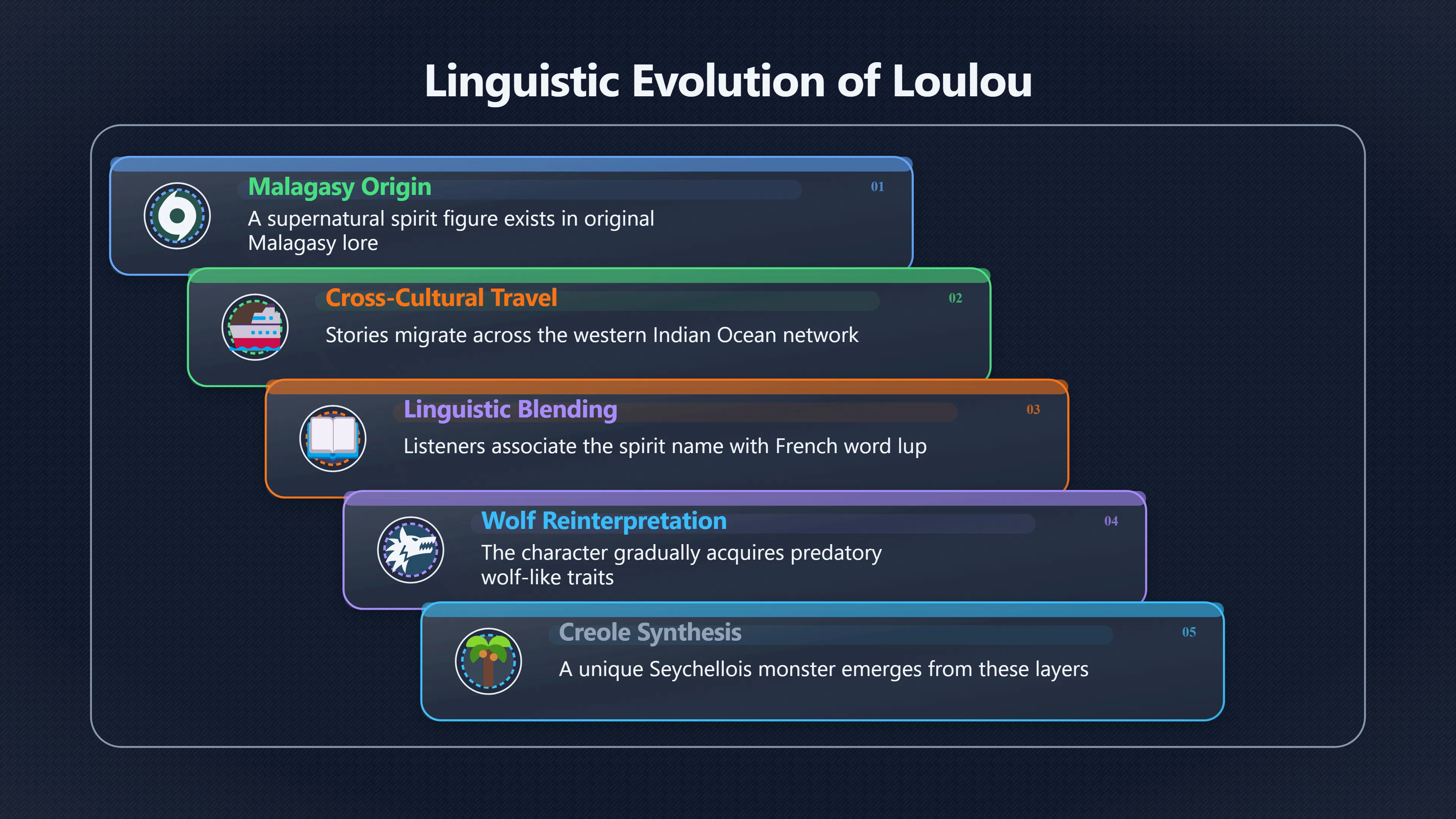
Researchers argue that the Seychellois Loulou probably emerged through a gradual transformation of a Malagasy spirit figure. In Malagasy tradition, a similar word refers to a spirit or supernatural being rather than a literal wolf. As stories moved through multilingual communities around Madagascar, East Africa and the islands of the southwest Indian Ocean, listeners and storytellers increasingly associated the unfamiliar spirit name with the French word loup, meaning wolf.[Seychelles Research Journal]seychellesresearchjournal.comSeychelles Research JournalMonsters, Mythical Creatures, and Island Hopping in…July 3, 2023 — by TP Choppy — swallowing monster in Sey…
Once that connection was made, the character began to acquire wolf-like characteristics. The result was a remarkable act of folk reinterpretation. A spirit became a beast. A supernatural presence became a predator. The original meaning was not entirely lost, however. Older stories retained traces of the spirit’s earlier identity, while newer retellings emphasised the wolf.[The Creole Melting Pot]thecreolemeltingpot.comThe Creole Melting PotThe Main Characters of Seychellois Folktales4 Nov 2025 — The wolf, or Loulou in Seychelles, originates from the Mal…
This process is a classic example of what happens in oral tradition when stories cross linguistic boundaries:
- A creature enters a new language.
- Its original name becomes unclear.
- Storytellers connect the unfamiliar name to a familiar word.
- The creature gradually acquires the traits associated with that new meaning.
- Over generations, the transformed version becomes the accepted local character.
Loulou is therefore not simply a wolf imported from Europe. It is a monster created through reinterpretation, carrying layers of older meanings beneath its newer appearance.[Seychelles Research Journal]seychellesresearchjournal.comSeychelles Research JournalMonsters, Mythical Creatures, and Island Hopping in…July 3, 2023 — by TP Choppy — swallowing monster in Sey…
What Monster Tales Reveal About Migration
Loulou provides a miniature history of the Indian Ocean world. The character contains traces of several cultural routes that converged in Seychelles.
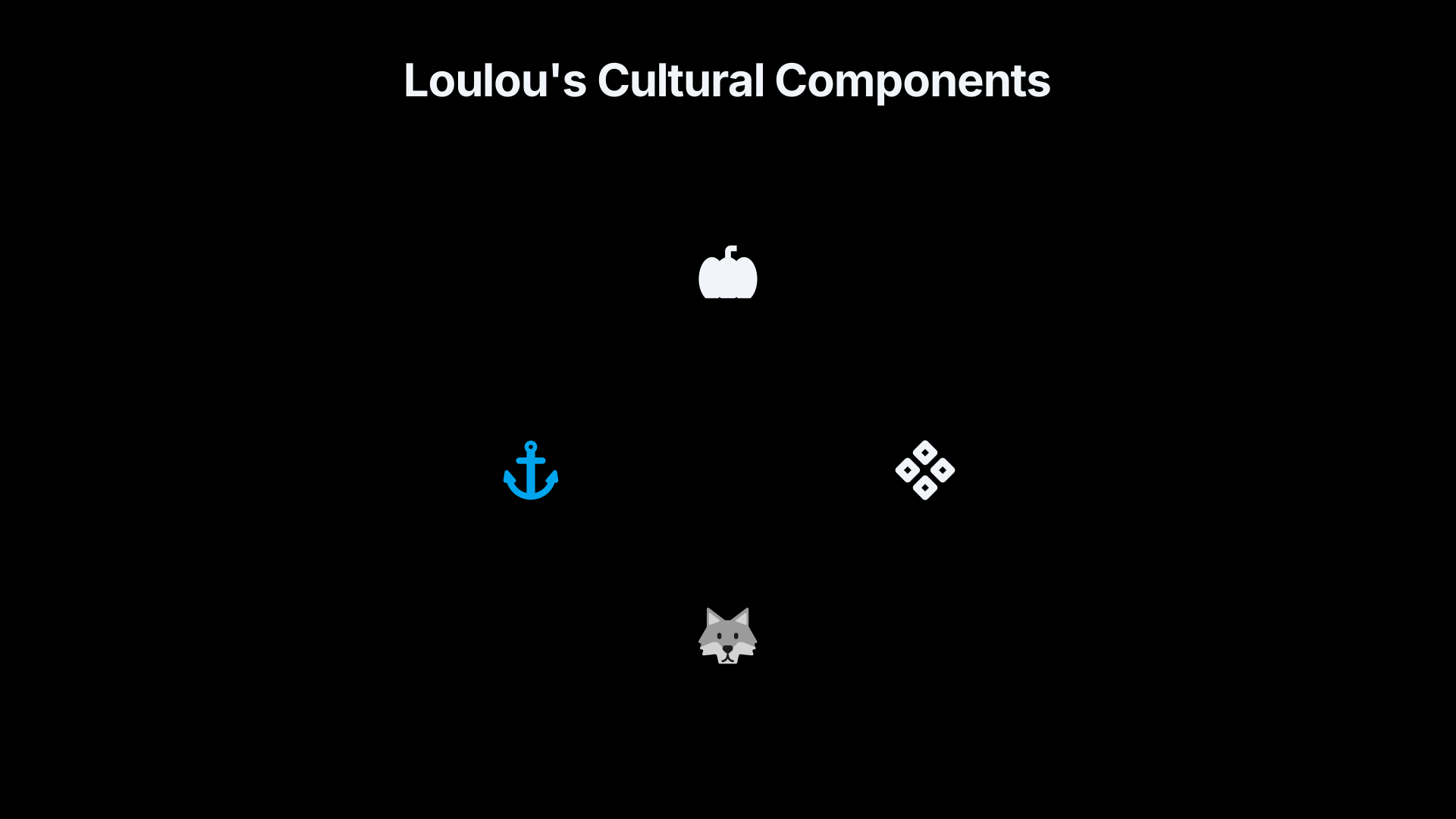
The swallowing-monster element points towards Bantu-speaking communities of East Africa, including traditions associated with Yao and Swahili-speaking peoples. The spirit element points towards Madagascar and its mixed African and Austronesian heritage. The wolf imagery reflects the influence of French language and European storytelling conventions. These layers came together in a Creole society formed by migration, enslavement and settlement.[Seychelles Research Journal]seychellesresearchjournal.comSeychelles Research JournalMonsters, Mythical Creatures, and Island Hopping in…July 3, 2023 — by TP Choppy — swallowing monster in Sey…
This is why folklorists describe Seychellois folktales as evidence of “island hopping”. Stories did not move directly from one homeland to one destination. Instead, they travelled through a network linking East Africa, Madagascar, Mauritius, Réunion, the Comoros and Seychelles. At each stop they changed slightly, absorbing new meanings and losing others. By the time they reached Seychelles, they were already products of centuries of cultural mixing.[Seychelles Research Journal]seychellesresearchjournal.comtransformation in the creolization process. These mythical creatures include the trickster Soungoula, the Swallowing Monster, Loulou, and…
Loulou demonstrates that folklore can preserve memories of these journeys even when historical records are silent. A monster may seem like a simple character in a children’s tale, but its shape, name and behaviour can reveal the paths along which people, languages and beliefs once moved.[Seychelles Research Journal]seychellesresearchjournal.comSeychelles Research JournalMonsters, Mythical Creatures, and Island Hopping in…July 3, 2023 — by TP Choppy — swallowing monster in Sey…
Why Loulou Still Matters
Modern readers often encounter Loulou as the villain of a folk tale, the island equivalent of the “big bad wolf”. Yet reducing the character to that role misses what makes it distinctive. Loulou survives because it embodies the creative transformation at the heart of Seychellois folklore.[The Creole Melting Pot]thecreolemeltingpot.comThe Creole Melting PotThe Main Characters of Seychellois Folktales4 Nov 2025 — The wolf, or Loulou in Seychelles, originates from the Mal…
Unlike monsters rooted in a single mythology, Loulou is a hybrid creature. It combines a Malagasy spirit, an East African swallowing monster and a European wolf image into one figure. The result is not a confused mixture but a uniquely Seychellois monster, shaped by the same processes that created the islands’ Creole language and culture.[Seychelles Research Journal]seychellesresearchjournal.comSeychelles Research JournalMonsters, Mythical Creatures, and Island Hopping in…July 3, 2023 — by TP Choppy — swallowing monster in Sey…
Seen in this light, Loulou is less important as a terrifying beast than as evidence of how stories adapt. The monster’s changing identity mirrors the history of Seychelles itself: a society formed from many origins, where inherited traditions were continually reinterpreted and transformed into something new.[Seychelles Research Journal]seychellesresearchjournal.comSeychelles Research JournalMonsters, Mythical Creatures, and Island Hopping in…July 3, 2023 — by TP Choppy — swallowing monster in Sey…
Amazon book picks
Further Reading
Books and field guides related to How Loulou Became Seychelles' Island Monster. Use these as the next step if you want deeper reading beyond the article.
A treasury of African folklore
Useful for understanding swallowing-monster traditions.
African Myths of Origin
Explores narrative patterns shared across African-derived folklore.
The Creole Folktales of Seychelles
Includes the storytelling tradition from which Loulou emerges.
eBay marketplace picks
Marketplace Samples
Live-tested eBay searches with available results related to this page.
Endnotes
1.
Source: seychellesresearchjournal.com
Link:https://seychellesresearchjournal.com/wp-content/uploads/2023/07/monsters_mythical_creatures_and_island_hopping_in_seychellois_folktales-theresia_penda_choppy-seychelles_research_journal-5-2.pdf
Source snippet
Seychelles Research JournalMonsters, Mythical Creatures, and Island Hopping in...July 3, 2023 — by TP Choppy — swallowing monster in Sey...
Published: July 3, 2023
2.
Source: seychellesresearchjournal.com
Link:https://seychellesresearchjournal.com/archive-5-2/
Source snippet
transformation in the creolization process. These mythical creatures include the trickster [Soungoula]({{ 'soungoula/' | relative_url }}), the Swallowing Monster, Loulou, and...
3.
Source: thecreolemeltingpot.com
Link:https://www.thecreolemeltingpot.com/the-main-characters-of-seychellois-folktales/
Source snippet
The Creole Melting PotThe Main Characters of Seychellois Folktales4 Nov 2025 — The wolf, or Loulou in Seychelles, originates from the Mal...
4.
Source: thecreolemeltingpot.com
Link:https://www.thecreolemeltingpot.com/introduction-to-the-folktales-of-seychelles-zistwar-seselwa/
Source snippet
Introduction to the Folktales of Seychelles-Zistwar Seselwa17 May 2025 — A very intriguing aspect of our heritage are monsters and mythic...
Published: May 2025
Additional References
5.
Source: unisey.ac.sc
Link:https://unisey.ac.sc/wp-content/uploads/2025/11/Dr.-Penda-Choppy-Publications.pdf
Source snippet
ac.scDr. Penda Choppy Publications'Monsters, Mythical Creatures and Island Hopping in Seychellois Folktales'. Seychelles Research Journal...
6.
Source: isisa.org
Link:https://www.isisa.org/userfiles/ISISA_2022_Book_of_Abstracts_FIN.pdf
7.
Source: kups.ub.uni-koeln.de
Title: Magdalena von Sicard Die kreolsprachige Oralliteratur von La Reunion
Link:https://kups.ub.uni-koeln.de/72297/1/Magdalena%20von%20Sicard%20-%20Die%20kreolsprachige%20Oralliteratur%20von%20La%20Reunion.pdf
Source snippet
kreolsprachige Oralliteratur von La Réunionby M von Sicard · 2022 — Chaudenson (1992: 263).Allerdings schreibt Penda Choppy: „In Seychell...
8.
Source: researchgate.net
Link:https://www.researchgate.net/publication/352361749_presence_orientale-the_indian_ocean_world_in_seychelles_cultural_heritage-penda_choppy-srj
Source snippet
It discusses how pre-colonial cultural...Read more...
9.
Source: superstitionsmap.com
Title: seychellois superstitions
Link:https://superstitionsmap.com/seychellois-superstitions/
Source snippet
(World #137, ≈100 total)11 May 2026 — [3] Seychelles Research Journal — “Monsters, Mythical Creatures, and Island Hopping in Seychellois...
Published: May 2026
10.
Source: ep.sci.hokudai.ac.jp
Link:https://www.ep.sci.hokudai.ac.jp/~inex/y2015/0501/practical/kadaidata/bin/dic2010
Source snippet
outo louyi lov lova lovaea...Read more...
11.
Source: folklore.unisey.ac.sc
Title: sc Folklore
Link:https://folklore.unisey.ac.sc/
Source snippet
University Of SeychellesTIZAN EK BEBET SET LATET Tizan and the Seven Headed Monster... Tizan saves a princess from a seven-headed monste...
12.
Source: youtube.com
Title: She Hatched A Baby From A Magic Pumpkin (African Folktale)
Link:https://www.youtube.com/watch?v=SOnAMWWPorM
Source snippet
Mamlambo: Zulu Beliefs & South African Mythology...
13.
Source: youtube.com
Title: Mamlambo: Zulu Beliefs & South African Mythology
Link:https://www.youtube.com/watch?v=ynmZM4iODpQ
Source snippet
Seychelles History in 3 Minutes...
14.
Source: youtube.com
Title: Speak Creole Seychellois
Link:https://www.youtube.com/watch?v=lhgu8P0lghc
Source snippet
16 Shocking Facts About The Seychelles...
Topic Tree