Why Do Sao Tome's Folk Stories Live on Stage?
The folklore of Sao Tome and Principe is best understood as a living island culture rather than a neat catalogue of gods and monsters.
Page outline Jump by section
Introduction
That history matters because Sao Tomean and Principean traditions rarely separate entertainment from memory. A play about Charlemagne can become a local argument about colonial power and justice. A plantation ruin can be remembered as haunted because people know, even when archives are thin, that suffering happened there. A healing rite can sit beside Catholic festival life without being reducible to either Christianity or “pagan survivals”. The result is folklore that is theatrical, Creole, island-specific and often far more complex than the brief tourist summaries suggest.
Why the islands’ folklore looks different from a mythological pantheon
A first-time reader looking for “Sao Tome and Principe mythology” may expect named deities, origin myths and a fixed supernatural hierarchy. The evidence points elsewhere. The islands’ most visible folklore is embedded in performance, oral storytelling, ritual healing, Catholic feast days, plantation memory and Creole language culture. Portuguese is the official language, but Forro, Angolar and other Portuguese-based Creoles are part of the cultural setting in which stories, songs and ritual speech have circulated.[OpenFactBook]openfactbook.orgOpen Fact Book Sao Tome and PrincipeOpen Fact Book Sao Tome and Principe
This is partly because the country itself was created through movement. Minority Rights Group describes communities such as Forros, Angolares, Serviçais and Tongas as linked to freed enslaved people, fishing communities, contract labourers and their descendants. Those histories help explain why the folklore blends West and Central African elements, Portuguese Catholic forms, plantation-era social memory and local island inventions rather than preserving a single precolonial “national mythology”.[Minority Rights Group]minorityrights.orgMinority Rights GroupSão Tomé and PríncipeForros are the descendants of slaves freed at abolition. Serviçais are contracted African plant…
The strongest caution is that some traditions are old and well-attested, while others are known through later description, modern performance, tourism writing or literary reinterpretation. Tchiloli, for example, is often said to have arrived in the sixteenth century, but the Calouste Gulbenkian Foundation notes that there is no known documentary evidence proving an uninterrupted sixteenth-century presence in Sao Tome, even though the performance is unquestionably central to modern cultural heritage.[Fundação Calouste Gulbenkian]gulbenkian.ptOpen source on gulbenkian.pt.
Tchiloli: Charlemagne becomes an island drama about justice
Tchiloli is the best-known traditional performance of Sao Tome and Principe and one of the clearest examples of how imported story material became local folklore. It is based on a medieval Iberian text about Charlemagne, the Marquis of Mantua, murder, betrayal and legal judgement. UNESCO describes it as a traditional open-air theatre involving actors, musicians and an engaged audience, performed during festivals and community occasions.[Intangible Cultural Heritage]ich.unesco.orgOpen source on unesco.org.
The plot turns on a grave question: should the emperor protect his own son, or should law and justice prevail? In local performance, this is not merely a medieval court story. Tchiloli has been read as a way for Sao Tomeans to speak about authority, inequality and the search for justice in a society marked by slavery, forced labour and colonial hierarchy. Buala’s account puts the point sharply, describing the tradition as a story of blood and justice that local people made their own, with connections to suppressed ancestral invocation and resistance to oppression.[Buala]buala.orgtchiloli of stome or charlemagne in africatchiloli of stome or charlemagne in africa
The performance itself is memorable because it refuses historical tidiness. Actors may wear European-style court costumes, mourning clothes, masks, modern suits, sunglasses or bureaucratic accessories, while the story remains set around Charlemagne’s court. A specialist account of Sao Tomean performing arts describes long open-air performances, family transmission of roles, audience commentary, drums, bamboo flutes, rattles, a symbolic coffin for the murdered Valdevinos and masks that may evoke the spiritual world.[São Tomé Paradise Tours]saotome-paradise.comSão Tomé Paradise Tours Microsoft WordSão Tomé Paradise Tours Microsoft Word
That mixture is exactly why Tchiloli matters as folklore. It is not simply “Portuguese theatre preserved in Africa”. It is a Creole performance system in which a European text has been slowed, expanded, localised, ritualised and made answerable to island audiences. Gulbenkian records that some performances can last seven or eight hours, while heritage projects have also experimented with shorter versions for wider audiences and tourists.[Fundação Calouste Gulbenkian]gulbenkian.ptOpen source on gulbenkian.pt.

Príncipe’s Auto de Floripes and Sao Tome’s Danço Congo
Tchiloli has a close cousin on Príncipe: the Auto de Floripes, a dramatic street performance linked to the feast of Saint Lawrence in Santo António. Like Tchiloli, it draws on Charlemagne-cycle material, but its central story concerns Floripes, daughter of a Moorish commander, who falls in love with a Christian knight. The performance is staged through colourful costume, battle scenes, music, procession and improvisation rather than through a single fixed script.[São Tomé Paradise Tours]saotome-paradise.comSão Tomé Paradise Tours Microsoft WordSão Tomé Paradise Tours Microsoft Word
Auto de Floripes shows how folklore can travel and still become intensely local. Its story world belongs to medieval Christian-Muslim conflict as imagined in Iberian popular tradition, yet its island setting, annual performance, community casting and street movement make it part of Príncipe’s cultural calendar. It is a good example of why folklore in Sao Tome and Principe should not be judged only by where a plot first came from. What matters is what the community has done with it.
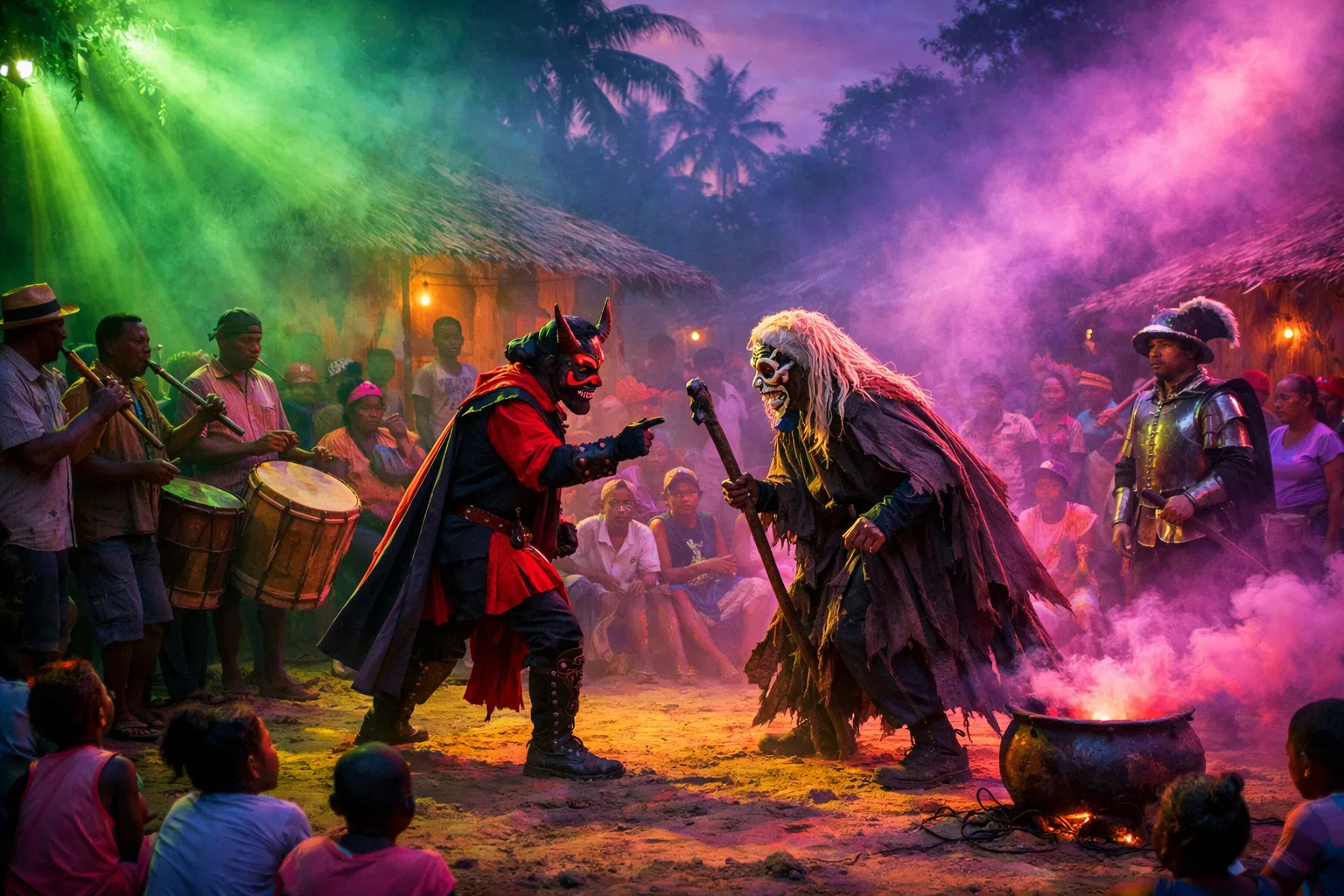
Danço Congo is more obviously populated by figures that look like “folk characters”: a captain of Congo, soldiers, buffoons, a plantation guard, a dying angel, singing angels, stilt-walkers, a sorcerer, the sorcerer’s assistant and a devil. Specialist descriptions present it as an open-air dumb show with dance, acrobatics, whistles and drumming, performed by cultural associations on Sao Tome during religious feast days and official festivals.[São Tomé Paradise Tours]saotome-paradise.comSão Tomé Paradise Tours Microsoft WordSão Tomé Paradise Tours Microsoft Word
Its story is not a simple morality tale. The plot involves inheritance, plantation space, a sorcerer, a devil, the killing of an angel and a party that keeps going despite disaster. That odd combination of comedy, danger, sacred language and social satire is part of its force. The same source compares Danço Congo with Congo-related brotherhood performances in Brazil, Colombia and Panama, while suggesting possible links through Angola, Bahia and the wider Lusophone Atlantic.[São Tomé Paradise Tours]saotome-paradise.comSão Tomé Paradise Tours Microsoft WordSão Tomé Paradise Tours Microsoft Word
Spirits, healing and the dead who remain close
Supernatural belief in Sao Tome and Principe is not confined to stage performance. One of the clearest accounts concerns the Forro ritual known as djambí, described as a communal event in which a neighbourhood or village gathers for drumming, dancing and spirit possession. The same ethnographic summary says people may consult ritual specialists for protection, healing, divination or help with personal problems.[EveryCulture]everyculture.comOpen source on everyculture.com.
The belief behind this is direct and emotionally powerful: the dead are not fully disconnected from the living. The same source states that Forros understand the spirits of the dead as still bound to the island and to the place where they died, and that misfortune may be attributed to spirits who have been forgotten or insufficiently propitiated.[EveryCulture]everyculture.comOpen source on everyculture.com.
For readers used to separating “religion”, “medicine” and “folklore”, this is an important corrective. Djambí belongs to a world in which healing, memory, place, drumming, social gathering and the dead all overlap. It also coexists with Catholic ritual life: patron-saint festivals, wakes, funerals and religious brotherhoods are part of the same broad cultural landscape, not a separate sealed-off category.[EveryCulture]everyculture.comOpen source on everyculture.com.
Animal tales, witches and the trickster turtle
The country’s oral storytelling tradition also includes more familiar folktale material: royalty, giants, witches, animal encounters and trickster plots. A specialist performing-arts survey notes that popular folktales in Sao Tome and Principe include figures familiar from both African and European traditions, and that the turtle often appears as a sympathetic, clever animal, comparable in function to the fox in many European stories.[São Tomé Paradise Tours]saotome-paradise.comSão Tomé Paradise Tours Microsoft WordSão Tomé Paradise Tours Microsoft Word
That detail is useful because it shows the local tradition working at several levels. Grand public performances such as Tchiloli deal with law, monarchy and justice; ritual practice addresses spirits, illness and protection; everyday tales can teach cunning, social caution and survival through animals. The turtle’s prominence also fits a broader Atlantic and African pattern in which small or apparently weak creatures win through intelligence rather than force.
The available English-language evidence is thinner for named Sao Tomean monsters than for performance and ritual. Claims about “creatures of Sao Tome and Principe” should therefore be treated carefully unless tied to a specific collected tale, community performance or literary source. The better-supported picture is not a bestiary but a storytelling ecology: witches, giants, animals, devils, sorcerers, angels, ancestors and dead spirits move through different genres rather than belonging to one official myth system.

Haunted places and plantation memory
Sao Tome and Principe’s haunted-place folklore is closely tied to plantation history. A Guardian report on archaeological work at the Praia Melão sugar-mill ruins records local stories that people died there and that spirits remained, with some neighbours avoiding the site and others treating it as a place for nocturnal pranks and mango picking. The same report places those ghost stories beside the site’s larger importance: Praia Melão was part of the early sugar plantation system that helped shape plantation slavery in the Atlantic world.[The Guardian]theguardian.comOpen source on theguardian.com.
This is a useful example of how haunting works as folk memory. The ghost story is not a reliable archive by itself, but it signals that local people understood the ruins as a place of suffering before archaeology began to recover the material history. The Guardian account describes excavations that have found roof tiles, sugar moulds and a cowrie shell, while researchers and local participants are using the site to reconnect residents with a history that had often been reduced to rumours, fear and fragmentary memory.[The Guardian]theguardian.comOpen source on theguardian.com.
For folklore readers, Praia Melão matters because it shows the meeting point between legend and evidence. A haunted ruin can be dismissed as superstition, but in this case the atmosphere of dread sits beside documented plantation violence, enslavement and forced labour. The haunting tradition is not proof of ghosts; it is proof that places keep stories even when formal history has neglected them.
From oral myth to literature: the Ossobó example
Modern Sao Tomean literature has also reworked local folklore. One important example is Ossobó, a bird associated with myth, history and intertextual writing in Sao Tomean literature. A scholarly article on the subject identifies the writer Francisco Stockler as the figure who elevated Ossobó from local oral traditions and myths into a major symbol of Sao Tomean literature.[JSTOR]jstor.orgOpen source on jstor.org.
That movement from oral tradition into print matters. Once a mythic image becomes literary, it can travel beyond the village, schoolyard or family setting. It may begin to stand for the nation, exile, memory, landscape or postcolonial identity. But it also changes form: the literary Ossobó is not simply “the old myth written down”. It is an artistic reinterpretation of oral material by named authors working in modern literary traditions.
This distinction is important across Sao Tome and Principe folklore. Tchiloli is not just an old text; it is a performed inheritance. Djambí is not just a “belief”; it is embodied ritual practice. Haunted plantation stories are not just spooky tales; they are attached to ruins and historical trauma. Literary myths are not just folklore collected on the page; they are acts of transformation.
How the traditions are changing today
Today, Sao Tome and Principe’s folklore is being preserved, condensed, staged, studied and marketed in new ways. UNESCO lists Tchiloli on its Representative List of the Intangible Cultural Heritage of Humanity, under the title “Tchiloli, living theatre of Sao Tome and Principe in the quest of justice”. That recognition gives the tradition international visibility, but it also raises a familiar safeguarding question: how can a long, local, participatory performance survive when audiences, tourism and funding structures may prefer shorter, clearer, exportable versions?[Intangible Cultural Heritage]ich.unesco.orgOpen source on unesco.org.
Community associations remain central. The Gulbenkian account names Formiguinha da Boa Morte, founded in 1956, as the oldest group staging Tchiloli in the country, and describes work to support heritage linked to Bairro da Boa Morte through performance, visual arts and technology.[Fundação Calouste Gulbenkian]gulbenkian.ptOpen source on gulbenkian.pt.
At the same time, some older forms are fragile. The performing-arts survey notes that certain older Forro dance forms have disappeared, while others such as ússua and socopé continue through community-based groups; it also describes socopé as now performed by only a few groups.[São Tomé Paradise Tours]saotome-paradise.comSão Tomé Paradise Tours Microsoft WordSão Tomé Paradise Tours Microsoft Word
The living folklore of Sao Tome and Principe is therefore not frozen tradition. It is a set of practices under pressure: from language shift, tourism, urban migration, school systems, church life, heritage policy and the changing economics of performance. What survives most strongly is what communities continue to find useful: stories of justice, rituals for the troubled dead, dances that hold associations together, and local tales that turn island history into memorable form.
Amazon book picks
Further Reading
Books and field guides related to Why Do Sao Tome's Folk Stories Live on Stage?. Use these as the next step if you want deeper reading beyond the article.
African Folktales
Introduces storytelling traditions connected to the islands' heritage.
King Leopold's Ghost
Helps explain Central African historical influences on island culture.
The Penguin Book of Myths and Legends of Africa
Offers broad African folklore context relevant to São Tomé and Príncipe.
eBay marketplace picks
Marketplace Samples
Live-tested eBay searches with available results related to this page.

Endnotes
1.
Source: openfactbook.org
Title: Open Fact Book Sao Tome and Principe
Link:https://openfactbook.org/countries/sao-tome-and-principe/
2.
Source: gulbenkian.pt
Link:https://gulbenkian.pt/en/news/tchiloli-the-european-tragedy-which-is-part-of-sao-tomes-cultural-heritage/
3.
Source: ich.unesco.org
Link:https://ich.unesco.org/en/RL/tchiloli-living-theatre-of-sao-tome-and-principe-in-the-quest-of-justice-02309
4.
Source: buala.org
Title: tchiloli of stome or charlemagne in africa
Link:https://www.buala.org/en/stages/tchiloli-of-stome-or-charlemagne-in-africa
5.
Source: everyculture.com
Link:https://www.everyculture.com/Sa-Th/S-o-Tom-e-Pr-ncipe.html
6.
Source: jstor.org
Link:https://www.jstor.org/stable/10.2979/reseafrilite.47.4.01
7.
Source: ich.unesco.org
Link:https://ich.unesco.org/en/video/76583
8.
Source: ich.unesco.org
Title: sao tome and principe ST
Link:https://ich.unesco.org/en/state/sao-tome-and-principe-ST
9.
Source: ich.unesco.org
Title: sao tome and principe ST
Link:https://ich.unesco.org/en/state/sao-tome-and-principe-ST?call=film&id=76583&include=film_inc.php&width=700
10.
Source: buala.org
Title: solemn gestures on the sandy ground tchiloli in sao tome and principe
Link:https://www.buala.org/en/stages/solemn-gestures-on-the-sandy-ground-tchiloli-in-sao-tome-and-principe
11.
Source: youtube.com
Title: Danço Congo
Link:https://www.youtube.com/watch?v=ZncrEMk4qVE
Source snippet
STRANGE EVIL DANCE, SAO TOME (rare video)...
12.
Source: worldhistory.org
Title: the portuguese colonization of sao tome and princi
Link:https://www.worldhistory.org/article/1763/the-portuguese-colonization-of-sao-tome-and-princi/
Source snippet
World History EncyclopediaThe Portuguese Colonization of São Tomé and PrincipeMay 28, 2021 — by M Cartwright · 2021 · Cited by 2 — São To...
Published: May 28, 2021
13.
Source: minorityrights.org
Link:https://minorityrights.org/country/sao-tome-and-principe/
Source snippet
Minority Rights GroupSão Tomé and PríncipeForros are the descendants of slaves freed at abolition. Serviçais are contracted African plant...
14.
Source: saotome-paradise.com
Title: São Tomé Paradise Tours Microsoft Word
Link:https://saotome-paradise.com/wp-content/uploads/2025/09/Performing-Arts-Of-Sao-Tome-And-Principe-6p.pdf
15.
Source: theguardian.com
Link:https://www.theguardian.com/us-news/article/2024/jun/15/sao-tome-principe-excavation-slavery
16.
Source: worldfactbookarchive.org
Link:https://worldfactbookarchive.org/archive/field/ST/Languages
17.
Source: saotome-paradise.com
Link:https://saotome-paradise.com/wp-content/uploads/2025/09/Healing-And-Spirit-Possession-In-Sao-Tome-And-Principe-2p.pdf
18.
Source: beingafrican.org
Title: Sao Tome and Principe
Link:https://beingafrican.org/sao-tome-and-principe/
19.
Source: tureng.com
Link:https://tureng.com/en/turkish-english/sao
20.
Source: worldfactbook.co
Title: Sao Tome and Principe
Link:https://www.worldfactbook.co/country.php?slug=sao-tome-and-principe
21.
Source: sahistory.org.za
Title: sao tome and principe
Link:https://sahistory.org.za/place/sao-tome-and-principe
22.
Source: geofactbook.com
Title: sao tome and principe
Link:https://geofactbook.com/countries/sao-tome-and-principe
23.
Source: graphicmaps.com
Link:https://www.graphicmaps.com/sao-tome-and-principe/languages
Additional References
24.
Source: youtube.com
Title: A Brief History of Sao Tome and Principe
Link:https://www.youtube.com/watch?v=NGfAu-DwDK8
Source snippet
Africa Negra Conjunto Alice Negra Album 1981 Sao Tome e Principe - 80s Music...
25.
Source: academia.edu
Link:https://www.academia.edu/87369270/Language_shift_from_Forro_to_Portuguese_Language_ideologies_and_the_symbolic_power_of_Portuguese_on_S%C3%A3o_Tom%C3%A9_Island
26.
Source: facebook.com
Link:https://www.facebook.com/cgtnafrica/posts/imageofafricasanto-ant%C3%B3nio-is-the-main-settlement-of-the-island-of-pr%C3%ADncipe-in-s/4593130644069772/
27.
Source: aripo.org
Link:https://www.aripo.org/storage/copyright-publication/1674828596_phpOXoVfx.pdf
28.
Source: skyscanner.net
Link:https://www.skyscanner.net/routes/ista/saoa/istanbul-to-sao-paulo.html
29.
Source: opulentroutes.com
Link:https://www.opulentroutes.com/services/cultural-tourism-of-sao-tome-and-principe/
30.
Source: instagram.com
Link:https://www.instagram.com/p/DQVMb2aCE4n/
31.
Source: facebook.com
Link:https://www.facebook.com/luisgodinhophotography/videos/esta-semana-na-revista-vis%C3%A3o-um-trabalho-que-fiz-em-s%C3%A3o-tom%C3%A9-e-pr%C3%ADncipedjambirit/744029198208697/
32.
Source: reddit.com
Link:https://www.reddit.com/r/Portuguese/comments/ys952m/est%C3%A3o_or_s%C3%A3o/
33.
Source: afrika-junior.de
Link:https://afrika-junior.de/content/media/stories/fairy-tales.html
Topic Tree
Follow this branch
Related pages 192
- Afghan Folklore
- Albanian Folklore
- Algerian Folklore
- Australian Folklore
- Azerbaijan Folklore
- +187 more in sidebar