Within Belarus Folklore
Who Lives Beyond the Village Edge?
Belarusian spirits make forests, water, houses and fields feel alive with danger, luck, fertility and rules for daily behaviour.
On this page
- Forest paths and uncanny encounters
- Water spirits, drowned souls and seasonal danger
- Household spaces, omens and protective rules
Page outline Jump by section
Introduction
In Belarusian folk belief, the supernatural was not confined to distant heavens or ancient gods. It lived in the places people used every day: the forest path, the riverbank, the barn, the stove corner, the threshold and the field. Spirits were woven into practical life. They explained why travellers became lost, why livestock thrived or died, why children were warned away from deep water, and why certain actions were considered dangerous at particular times of year. Rather than forming a single mythology, these beliefs created a system of everyday rules. Respect the boundaries of a place, behave properly, and the unseen world might help you. Ignore those rules, and misfortune could follow. Folklore collectors and modern researchers have repeatedly noted that Belarusian traditions treat forests, waters, homes and agricultural spaces as inhabited landscapes where human conduct mattered.[ResearchGate]researchgate.netOpen source on researchgate.net.
Who Lives Beyond the Village Edge?
For many generations, rural Belarusians imagined the world outside the village as occupied by powers with their own territories. A forest belonged to its master, a river had its dangerous inhabitants, and a household possessed protective but demanding spirits. The key idea was not constant fear but negotiated coexistence. People entered these spaces with caution, greetings, rituals or taboos that acknowledged they were crossing into another domain.[ResearchGate]researchgate.netOpen source on researchgate.net.
This way of thinking reflected everyday realities. Belarus was historically a land of forests, marshes, rivers and scattered settlements. Getting lost in woodland, drowning during seasonal flooding, or losing crops and animals were genuine dangers. Folklore translated those risks into memorable stories about spirits who rewarded respect and punished carelessness.[ResearchGate]researchgate.netOpen source on researchgate.net.
Forest Paths and Uncanny Encounters
The forest was one of the most heavily charged supernatural spaces in Belarusian tradition. Researchers studying Belarusian forest-spirit beliefs have found recurring stories about a woodland master who controlled animals, confused travellers and enforced proper behaviour in the woods.[ResearchGate]researchgate.netOpen source on researchgate.net.
Many stories resemble the wider East Slavic figure often called the forest spirit. In Belarusian descriptions, this being could appear as an old man, a giant, a familiar neighbour or simply an unexplained presence. He was famous for misleading people. A traveller might hear a voice calling from the wrong direction, follow what seemed to be a friend, or discover that a familiar path suddenly led nowhere.[Wikipedia]WikipediaOpen source on wikipedia.org.
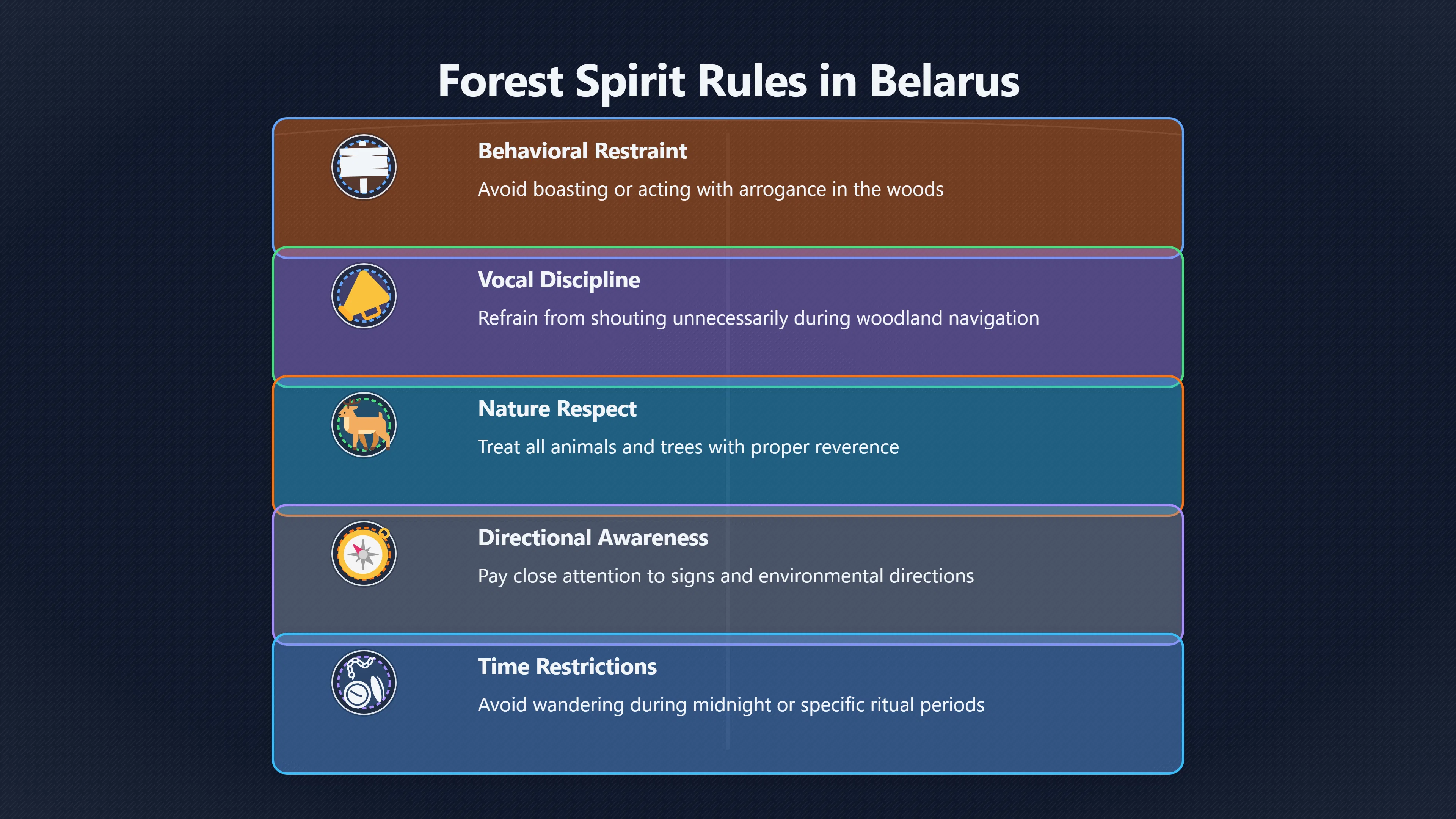
What mattered was the lesson attached to the encounter. Traditional rules included:
- Do not boast or behave arrogantly in the forest.
- Avoid shouting unnecessarily.
- Respect animals and trees.
- Pay attention to signs and directions.
- Do not wander during dangerous transitional times such as midnight or certain ritual periods.[Wikipedia]WikipediaOpen source on wikipedia.org.
These stories transformed practical woodland safety into memorable folklore. Getting lost became more than a navigational error; it could mean that the forest itself had rejected careless behaviour. At the same time, the spirit was not always hostile. Some tales describe him helping respectful travellers, guiding lost children or revealing places rich in mushrooms and berries. The forest was therefore neither purely evil nor purely benevolent. It responded to conduct.[wikipedia.org]WikipediaOpen source on wikipedia.org.
Water Spirits, Drowned Souls and Seasonal Danger
Belarusian rivers, lakes and marshes generated another large cluster of beliefs. Water was essential for life but also a source of sudden death. Folklore expressed this tension through stories of female spirits associated with drowning, fertility, vegetation and the restless dead. Studies of East Slavic and Belarusian traditions show that these figures were linked not only to water itself but also to seasonal rituals and agricultural cycles.[ResearchGate]researchgate.netResearchGate(PDF) Rusalki: Anthropology of Time, Death, and Sexuality…April 20, 2017 — 27 Mar 2026 — The Eastern Slavic rusalki are fe…
One of the most important periods was the early summer season often known as Rusalka Week. During this time, supernatural beings connected with water and untimely death were believed to move through the landscape rather than remain confined to rivers and lakes. Rituals marking their arrival and departure survived in Belarus well into the twentieth century.[Wikipedia]WikipediaOpen source on wikipedia.org.
The rules associated with this period were highly practical:
- Avoid swimming during the dangerous season.
- Be cautious near rivers, lakes and marshes.
- Pay attention to ritual restrictions connected with local festivals.
- Treat unusual encounters near water with suspicion.[Wikipedia]WikipediaOpen source on wikipedia.org.
Belarusian traditions often blurred the line between water spirits and the souls of those who died prematurely. Young women who drowned, victims of tragedy, or people denied a normal place among the ancestors could become part of this supernatural category. As a result, water spirits represented both physical danger and social anxiety about death, mourning and disrupted life cycles.[researchgate.net]researchgate.netResearchGate(PDF) Rusalki: Anthropology of Time, Death, and Sexuality…April 20, 2017 — 27 Mar 2026 — The Eastern Slavic rusalki are fe…
The agricultural aspect is equally important. In some traditions these beings were connected with fertility and the growth of crops. They could threaten people while simultaneously contributing to the renewal of nature. This dual role explains why seasonal rituals often focused on respectfully sending such spirits away rather than simply defeating them.[ResearchGate]researchgate.netResearchGate(PDF) Rusalki: Anthropology of Time, Death, and Sexuality…April 20, 2017 — 27 Mar 2026 — The Eastern Slavic rusalki are fe…

Household Spaces, Omens and Protective Rules
If forests and waters represented dangerous borders, the home represented protected space. Yet even the safest place in a Belarusian village was thought to contain unseen inhabitants.
Across the East Slavic world, including Belarus, belief in a household guardian spirit remained widespread. This being was usually imagined as attached to a family line and responsible for the wellbeing of the household, animals and stored food. Rather than functioning as a distant deity, the spirit acted almost like an invisible family member.[thoughtco.com]thoughtco.comdomovoi slavic mythology 4776526Domovoi, House Spirit of Slavic Mythology27 Nov 2019 — A domovoi, which can be spelled domovoj or domovoy, is a house spirit in…
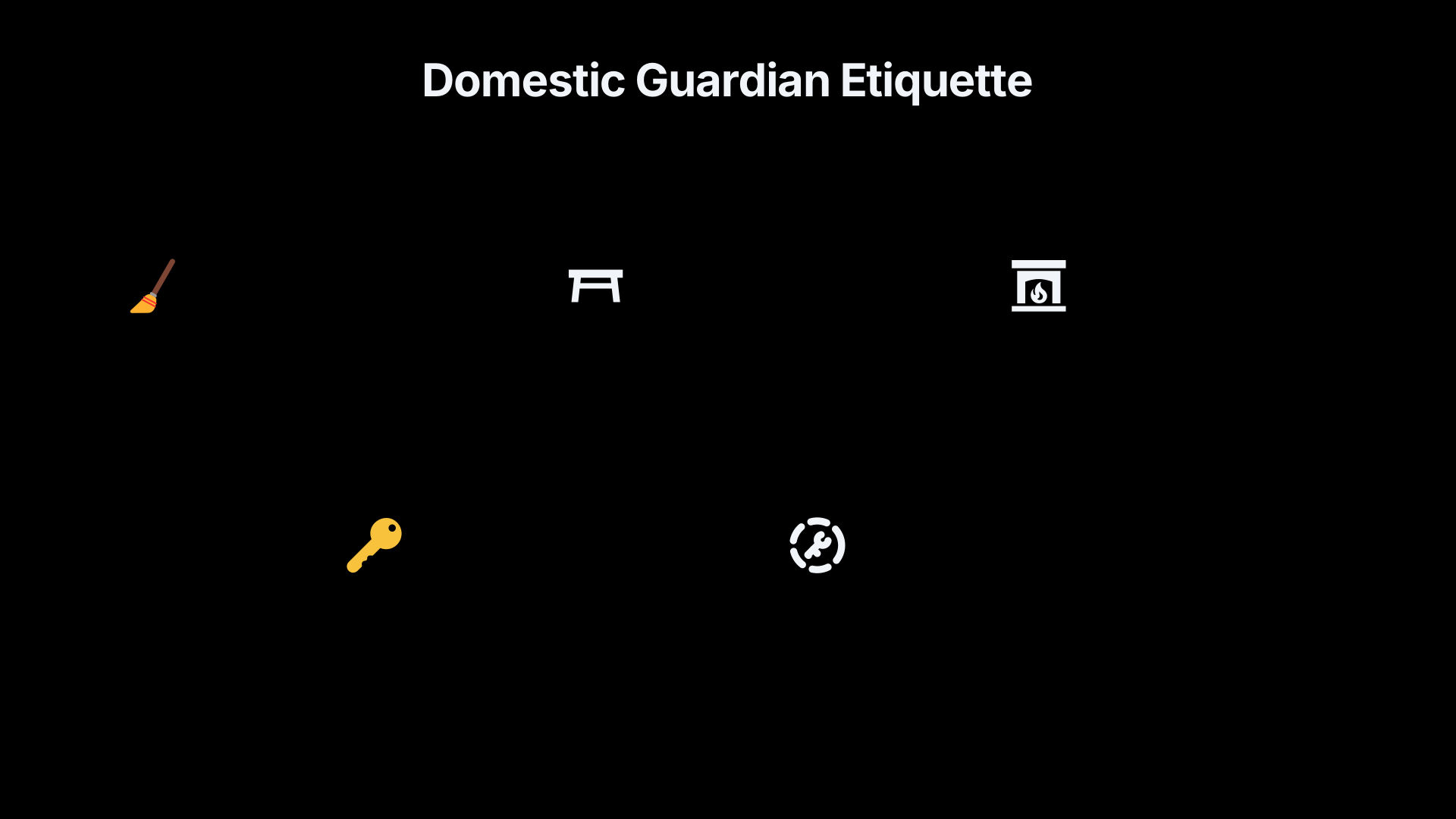
The relationship depended on behaviour. Traditional expectations included:
- Keep the home orderly.
- Treat family members properly.
- Respect the hearth and domestic spaces.
- Avoid unnecessary quarrels and disorder.
- Observe customary practices when moving into a new home.[study.com]study.comDomovoy | Mythology, Attributes & PowersIn Slavic mythology, a domovoy is a house spirit. He is a protector and guardian of the house and…
A contented household spirit protected people and animals, warned of danger and encouraged prosperity. An offended one created disturbances, strange noises, lost objects or bad luck. Such beliefs encouraged good household management while framing everyday successes and failures in supernatural terms.[study.com]study.comDomovoy | Mythology, Attributes & PowersIn Slavic mythology, a domovoy is a house spirit. He is a protector and guardian of the house and…
Belarusian folk tradition also recognised specialised spirits associated with outbuildings, bathhouses and agricultural structures. These spaces were necessary for village life but sat slightly outside the protected centre of the home. Rules about entering them at certain times, behaving respectfully and avoiding solitary visits after dark reflected a belief that they occupied a threshold between domestic order and the unknown.[Wikipedia]WikipediaOpen source on wikipedia.org.
Why These Rules Mattered
Modern readers sometimes treat such stories as collections of colourful supernatural characters. In traditional Belarusian culture, however, the spirits mattered less as individual monsters than as mechanisms for organising behaviour.
Forest spirits taught caution in dangerous landscapes. Water spirits reinforced seasonal warnings and attitudes toward death. Household spirits encouraged cleanliness, cooperation and respect for family traditions. The supernatural provided a moral and practical map of daily life.[ResearchGate]researchgate.netOpen source on researchgate.net.
This is one reason Belarusian folklore feels unusually grounded. Its spirits rarely inhabit distant mythical realms. They live beside roads, behind stoves, among reeds, under trees and at the edge of cultivated fields. The question is not whether a traveller can defeat them. It is whether the traveller understands the rules of the place they are entering.[researchgate.net]researchgate.netOpen source on researchgate.net.
How These Beliefs Survive Today
Most Belarusians no longer organise daily life around literal belief in household guardians or woodland masters. Yet the underlying ideas remain visible in folklore festivals, museum collections, ethnographic studies, children’s books, popular culture and modern retellings of traditional stories. Researchers continue to document narratives about forest encounters, seasonal rituals and domestic spirits as part of Belarus’s cultural heritage.[ResearchGate]researchgate.netOpen source on researchgate.net.
The enduring appeal of these traditions lies in their closeness to ordinary experience. They transform common places into meaningful landscapes. A river is never just water, a forest is never merely trees, and a house is more than a building. In Belarusian folklore, every familiar space has its own unseen etiquette, and understanding those rules is often the difference between safety and danger, luck and misfortune, belonging and becoming lost.[ResearchGate]researchgate.netOpen source on researchgate.net.
Amazon book picks
Further Reading
Books and field guides related to Who Lives Beyond the Village Edge?. Use these as the next step if you want deeper reading beyond the article.
The Bathhouse at Midnight
Examines spirits, magic and folk belief closely related to Belarusian traditions.
Russian Fairy Tales (Illustrated by Ivan Bilibin)
Includes many spirit types and motifs shared with Belarusian belief.
eBay marketplace picks
Marketplace Samples
Live-tested eBay searches with available results related to this page.
Endnotes
1.
Source: researchgate.net
Link:https://www.researchgate.net/publication/393989274_Forest_Spirits_and_Their_Functions_in_the_Traditions_of_Estonians_Estonian_Russians_and_Belarusians
2.
Source: thoughtco.com
Title: leshy 4774301
Link:https://www.thoughtco.com/leshy-4774301
Source snippet
Leshy, Slavic Spirit of the Forest28 Oct 2019 — In Slavic mythology, Leshy (Leshii or Ljeschi, plural Leshiye) is a demon-god, a tree spi...
3.
Source: Wikipedia
Link:https://en.wikipedia.org/wiki/Leshy
4.
Source: researchgate.net
Link:https://www.researchgate.net/publication/333721461_Rusalki_Anthropology_of_Time_Death_and_Sexuality_in_Slavic_Folklore_Rusalky_antropologie_casu_smrti_a_sexuality_ve_slovanskem_folklorubr
Source snippet
ResearchGate(PDF) Rusalki: Anthropology of Time, Death, and Sexuality...April 20, 2017 — 27 Mar 2026 — The Eastern Slavic rusalki are fe...
Published: April 20, 2017
5.
Source: Wikipedia
Link:https://en.wikipedia.org/wiki/Rusalka
6.
Source: brendan-noble.com
Link:https://brendan-noble.com/rusalka-rusalka-slavic-water-demon-slavic-mythology-saturday/
Source snippet
Rusalka/Rusałka – Slavic Water DemonThe Rusałka haunts the waters where she died, luring in men who pass as she searches for revenge on t...
7.
Source: slaviclore.com
Title: who is the rusalka
Link:https://slaviclore.com/who-is-the-rusalka
Source snippet
? | Slavic Lore16 Jul 2025 — The Rusalka is a Slavic female spirit associated with water, death and fertility. Unlike some of the other s...
8.
Source: thoughtco.com
Title: domovoi slavic mythology 4776526
Link:https://www.thoughtco.com/domovoi-slavic-mythology-4776526
Source snippet
Domovoi, House Spirit of Slavic Mythology27 Nov 2019 — A domovoi, which can be spelled domovoj or domovoy, is a house spirit in...
9.
Source: slaviclore.com
Link:https://slaviclore.com/domovoy-guardian-of-the-home
Source snippet
the guardian spirit of the home and the family16 Apr 2021 — The Slavic home is the domain of a spirit called the Domovoy, a small, furry...
10.
Source: study.com
Link:https://study.com/academy/lesson/domovoy-origin-mythology-beliefs.html
Source snippet
Domovoy | Mythology, Attributes & PowersIn Slavic mythology, a domovoy is a house spirit. He is a protector and guardian of the house and...
11.
Source: brendan-noble.com
Link:https://brendan-noble.com/the-domowik-domovoy-in-slavic-mythology/
Source snippet
Slavic Mythology SaturdayWhile the spirits are considered to be benevolent and protecting of the house, if you actually see one, it's con...
12.
Source: Wikipedia
Link:https://en.wikipedia.org/wiki/Domovoy
13.
Source: brendan-noble.com
Link:https://brendan-noble.com/leszy-leshy-slavic-protector-of-the-forest/
Source snippet
Slavic Protector of the ForestThis Slavic Saturday we're looking at perhaps the most well-known protector in all of Slavic mythology: the...
14.
Source: youtube.com
Link:https://www.youtube.com/watch?v=JZFDH5bTMZ4
Source snippet
Every Mythical Creature from Slavic Folklore Explained in 19 Minutes...
15.
Source: russianfolktales.com
Title: Russian Folktales Leshy
Link:https://www.russianfolktales.com/en/characters/leshy
Source snippet
Leshy - Russian Folktales CharacterLeshy. Trickster. A forest guardian spirit in Slavic folklore who can lead travelers astray or help th...
Additional References
16.
Source: facebook.com
Link:https://www.facebook.com/groups/281886105961506/posts/834082910741820/
Source snippet
Folklore stories about domovoi characters neededA Domovoi is a house spirit in Russian folklore, usually making its living place at the t...
17.
Source: mdpi-res.com
Link:https://mdpi-res.com/bookfiles/book/4441/EastSlavic_Religions_and_Religiosity_Mythologies_Literature_and_Folklore_A_Reassessment.pdf
Source snippet
MDPIEast-Slavic Religions and ReligiosityThis is a reprint of articles from the Special Issue published online in the open access journal...
18.
Source: dcmp.org
Link:https://dcmp.org/media/13488-monstrum-leshy-the-slavic-lord-of-the-forest
19.
Source: networkonculture.ca
Link:https://www.networkonculture.ca/assets/matrix/Volume%203%2C%20Issue%201%20%28Spring%20-%20Summer%202023%29/3.%20Lacroix%20%20Feminine%20Trees/3.%20Lacroix%20%20Trees%20Associated%20with%20Feminine%20Folklore%20in%20the%20Eastern%20Slavic%20Folk%20Calendar%20-%20Matrix%203%281%29%20%202023.pdf
Source snippet
Lacroix Trees Associated with Feminine Folklore in the...by R LACROIX · 2023 — In myth and folklore, trees were bestowed with masculine...
20.
Source: instagram.com
Link:https://www.instagram.com/p/DQeECJQAplc/
Source snippet
They are the named specific dead women who died violently before marriage, before...Read more...
21.
Source: mythus.fandom.com
Link:https://mythus.fandom.com/wiki/List_of_Slavic_creatures
Source snippet
of Slavic creatures | Myth and Folklore Wiki - FandomDomovoy (or Domovoi, Domovik, Matsich) is house spirit known in all Slavic countries...
22.
Source: facebook.com
Link:https://www.facebook.com/61574974992206/posts/-the-rusalka-spirits-of-slavic-watersin-slavic-folklore-the-rusalka-is-a-mysteri/122164091984832499/
Source snippet
sometimes sitting among reeds or emerging from the water on quiet...Read more...
23.
Source: medium.com
Link:https://medium.com/mythology-journal/the-rusalki-slavic-vampire-mermaid-and-a-warning-to-young-men-92895a369124
Source snippet
m the river in the middle of the night, walked out onto its...Read more...
24.
Source: reddit.com
Link:https://www.reddit.com/r/FolkloreAndMythology/comments/1kg2d5w/about_the_domovoj_the_slavic_household_spirit_and/
Source snippet
se him prospers in everything—buys cheaply, sells dearly, has...
25.
Source: tumblr.com
Title: Domovye are masculine, typically
Link:https://www.tumblr.com/russianfolklore/171145600666/domovoi-peeping-at-the-sleeping-merchants-wife
Source snippet
“Domovoi Peeping at the Sleeping Merchant's Wife” by...A domovoi or domovoy (Russian: домово́й, literally, "[he] from the house") is a p...
Topic Tree