How Rwanda Tells Its Oldest Stories
Rwanda’s folklore is not mainly a gallery of monsters. Its strongest traditions are oral histories, praise poetry, moral tales, heroic legends, royal ritual, spirit beliefs, sacred hills, cattle lore and stories about how social order came into being.
Page outline Jump by section
Rwanda’s folklore is an oral archive, not just a set of fairy tales
Rwandan tradition has long been carried through speech, song, praise, performance and memory. That makes it more flexible than a written canon: a tale can teach a moral, explain a place, praise a king, entertain children, preserve a genealogy, or justify a ritual practice. A useful way to read Rwandan folklore is therefore to ask what a story was doing for its community. Was it preserving royal history? Teaching good conduct? Explaining why cattle matter? Marking a sacred place? Making sense of illness, death or ancestral presence?
Older Rwandan oral forms included royal genealogies, court histories, praise poems and ritual knowledge. A New Times account of Rwandan oral traditions describes royal genealogies as a pillar of the wider tradition, with historical tales, royal ritual and symbolic poetry organised around them. That is important because much of what later readers call “myth” was not necessarily told as fantasy; it could be part of a political and ritual memory system.[The New Times]newtimes.co.rwThe New Times Continued: The Oral Traditions of Rwanda (Part 3The New Times…
There are also ordinary folktales, proverbs and moral stories. A 2023 University of Regensburg presentation on Eugène Hurel’s early collection notes that his 1922 volume contains what the editors identify as the oldest collection of Rwandan folktales. The same presentation points to later Rwandan collecting work by Aloys Bigirumwami, including a large body of long tales gathered between 1932 and 1967. This matters because the written record of Rwandan folktales is often mediated: missionaries, scholars, teachers, priests, translators and modern editors all shaped what reached print.[homepages.uni-regensburg.de]homepages.uni-regensburg.deOpen source on uni-regensburg.de.
That does not make the material false or useless. It means a careful reader should distinguish between living oral tradition, colonial-era collection, court-centred history, schoolbook moral tale, museum interpretation and modern internet retelling. Rwanda’s folklore has survived partly because it kept changing form.
Gihanga: the founder who turns history into legend
One of Rwanda’s central legendary figures is Gihanga, presented by the Rwanda Cultural Heritage Academy as a heroic founder and first king of Rwanda. In that official heritage retelling, he is not just a ruler but a culture hero: skilled in woodwork, smithing and tanning, adventurous, politically gifted and linked with the origins of royal power.[Google Arts & Culture]artsandculture.google.comGoogle Arts & CultureGihanga Ngomijana: The Founder of the Rwandan Kingdom — Google Arts & Culture…
The story has the familiar shape of a founder legend. Gihanga is born into danger, marked by prophecy, threatened by jealous relatives, and forced to move through important places before reaching kingship. This is not a simple biography in the modern sense. It is a way of making political origins memorable: the kingdom is imagined through a person whose talents explain craft, authority, settlement and sacred geography at once.[Google Arts & Culture]artsandculture.google.comGoogle Arts & CultureGihanga Ngomijana: The Founder of the Rwandan Kingdom — Google Arts & Culture…
Buhanga, now associated with forest heritage near the Volcanoes region, is especially important in this memory. The Rwanda Cultural Heritage Academy describes Buhanga as the spot remembered in oral tradition as Gihanga’s home and first palace. Tourism sources also present Buhanga Eco Park as a sacred site connected with royal coronation rituals, though details vary and should be treated as heritage tradition rather than securely dated history.[google.com]artsandculture.google.comGoogle Arts & CultureGihanga Ngomijana: The Founder of the Rwandan Kingdom — Google Arts & Culture…
Gihanga’s importance also shows how Rwandan folklore blends myth and state memory. He is a legendary ancestor, a founding king, a symbol of unity and a figure attached to real places. That combination is typical of country-level folklore: the story is less about proving every event than understanding how Rwandans have imagined origin, authority and belonging.
Cows, kings and the myth of Nyirarucyaba
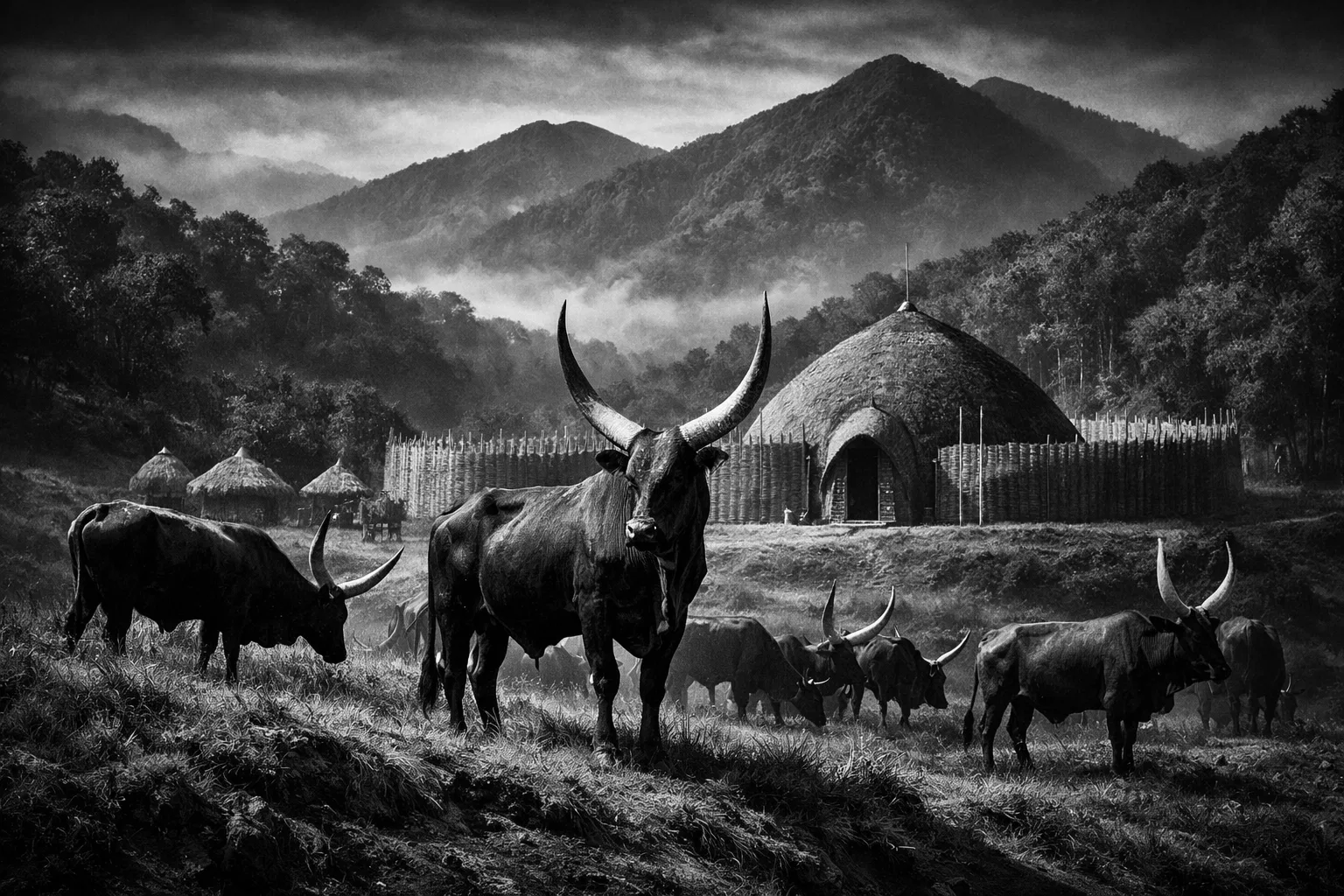
No account of Rwandan folklore is complete without cattle. In Rwandan cultural memory, cows are not merely livestock; they have carried meanings of wealth, beauty, status, poetry, marriage, diplomacy and royal ceremony. The Rwanda Cultural Heritage Academy’s story of Nyirarucyaba makes this point through myth. It presents Nyirarucyaba, daughter of Gihanga, as the woman credited with bringing cows to the kingdom and as the ancestor of a clan.[Google Arts & Culture]artsandculture.google.comOpen source on google.com.
The story begins with family conflict and exile. Nyirarucyaba flees the court after a violent dispute involving her mother and stepmother. In exile she marries a farmer, encounters an unfamiliar animal, and later returns with milk, which restores the ailing king and leads to the retrieval of cows for Rwanda. This is a compact myth with several layers: a woman outside the court becomes the channel through which a central symbol of Rwandan identity enters royal society; milk becomes a gift of healing and reconciliation; cattle become both economic and sacred-cultural property.[Google Arts & Culture]artsandculture.google.comOpen source on google.com.
The heritage account also links the myth to Mount Kabuye, where Nyirarucyaba and her cows are believed to have found shelter. The same account notes a cave associated with Gihanga and describes Kabuye as Rwanda’s third-highest non-volcanic peak. This is a good example of how Rwandan legend fixes memory into landscape: a mountain is not only scenery, but a place where origin stories can be visited, narrated and reinterpreted.[Google Arts & Culture]artsandculture.google.comOpen source on google.com.
The royal cattle tradition remains visible at the King’s Palace Museum in Nyanza. Rwanda Cultural Heritage Academy material describes the parade of long-horned royal cattle as accompanied by pastoral poems, while a recent Associated Press report describes the animals as living symbols of heritage, historically associated with wealth, prestige and power. The cows are sung to, cared for ceremonially and presented to visitors as part of Rwanda’s cultural education and tourism.[Google Arts & Culture]artsandculture.google.comArts & Culture What To See At The King's Palace Museum — Google Arts & CultureArts & Culture What To See At The King's Palace Museum — Google Arts & Culture
Ryangombe and the spirit world
Ryangombe is one of the most important names in Rwandan spirit tradition. He is associated with a wider initiation and spirit complex often discussed by scholars under the name Kubandwa, involving spirits known as Imandwa. The evidence here is stronger in specialist and historical work than in short popular summaries, and it is important not to flatten the tradition into a single neat myth.
A major Royal Museum for Central Africa publication on the Ryangombe cult presents it as part of a broader religious landscape that included family ancestors, Ryangombe and Nyabingi. The text notes that the cult of Ryangombe long developed independently of the royal court, overlapped with ancestor practices in some respects, yet remained distinct from them. It also records that older Rwandan religious culture changed under outside religious pressure, especially with the arrival of Christianity under colonial conditions.[africamuseum.be]africamuseum.beOpen source on africamuseum.be.
The ancestor dimension is crucial. The same study explains that Rwandans believed in the survival of the soul and in a human being made up of a material body and an immaterial spirit. After death, the spirit continued in another state and might remain connected to family life. That belief helps explain why ritual, memory and the dead occupy such an important place in Rwandan supernatural tradition.[africamuseum.be]africamuseum.beOpen source on africamuseum.be.
For ordinary readers, the simplest useful distinction is this: ancestor rites were tied to family spirits, while the Ryangombe complex involved a wider spirit order, initiation and ritual affiliation. Modern summaries sometimes make Ryangombe sound like a single “god of Rwanda”, but the better evidence points to a more complex religious system in which spirits, ancestors, ritual specialists, kingship and healing overlapped without collapsing into one category.[africamuseum.be]africamuseum.beOpen source on africamuseum.be.
Nyabingi: a northern tradition with a wider afterlife
Nyabingi is one of the most intriguing figures in the folklore and religious history of northern Rwanda and the neighbouring Great Lakes region. Jim Freedman’s study, “Ritual and History: the Case of Nyabingi”, describes Nyabingi worship among people in northern Rwanda, especially northern Byumba and northern Ruhengeri, and links the tradition to a mountainous zone extending towards southern Uganda. In that account, Nyabingi is treated as a powerful female figure connected with health and fertility, represented by devoted followers who mediated her power.[Persée]persee.frPersée Ritual and History: the Case of NyabingiPersée Ritual and History: the Case of Nyabingi
Freedman’s most useful point for readers is that Nyabingi should not simply be treated as a local version of Ryangombe. He argues that Nyabingi worship differed from Kubandwa in function and social setting. Whereas interpretations of Kubandwa often assume an established political structure, Nyabingi worship arose especially in areas without complex political organisation.[Persée]persee.frPersée Ritual and History: the Case of NyabingiPersée Ritual and History: the Case of Nyabingi
The Royal Museum for Central Africa study adds a historical sequence: Nyabingi entered northern Rwanda during the nineteenth century, spread towards other regions, and existed alongside ancestor practice and Ryangombe. In the early twentieth century, Christian missions, working in the context of colonial administration, fought older cults and weakened them.[africamuseum.be]africamuseum.beOpen source on africamuseum.be.
Nyabingi later acquired a wider reputation beyond Rwanda, especially through anti-colonial and regional religious history. For a Rwanda-focused folklore page, however, the centre should remain the northern Rwandan tradition itself: a female spiritual power associated with protection, health and fertility, remembered through ritual history rather than as a simple character in a children’s tale.
Sacred places make the stories feel local
Rwandan folklore is strongly attached to place. Mountains, caves, forests, royal sites and museums all help stories become tangible. Buhanga is remembered through Gihanga and royal ritual; Mount Kabuye is tied to Nyirarucyaba and cows; Nyanza preserves royal architecture, cattle performance and monarchy memory; Huye’s Ethnographic Museum holds large collections of social and cultural objects.
The Rwanda Cultural Heritage Academy says Rwanda has eight museums across seven districts and that more than 530 heritage sites were counted in 2006, with 107 researched and published in a 2021 heritage-sites volume. This gives a sense of how wide the cultural landscape is: Rwandan folklore is not confined to famous myths, but sits in a network of named places, objects and remembered practices.[Rwanda Heritage]rwandaheritage.gov.rwRwanda Heritage Museum and Heritages Sites Management DivisionRwanda Heritage Museum and Heritages Sites Management Division
At the King’s Palace Museum, the folklore of cattle is not presented only as a story about the past. Visitors can see long-horned royal cattle, hear or learn about pastoral poetry, and encounter the remains of a royal ceremonial world. The Rwanda Cultural Heritage Academy describes the modern house of King Mutara III Rudahigwa as holding an exhibition on Rwandan history from the fifteenth century and on the monarchy’s abolition in the early 1960s. That places folklore beside political history rather than outside it.[Google Arts & Culture]artsandculture.google.comArts & Culture What To See At The King's Palace Museum — Google Arts & CultureArts & Culture What To See At The King's Palace Museum — Google Arts & Culture
This is one reason Rwanda can be difficult to summarise as “mythology”. Its folklore often survives in practices that look like heritage, ceremony, dance, museum interpretation or tourism. A royal cow, a praise poem, a forest path and a cave story may all belong to the same imaginative world.

What changed with Christianity, colonial rule and modern heritage
Rwanda’s older religious traditions did not simply disappear, but their public position changed dramatically. The country is now predominantly Christian: the United States State Department’s 2022 religious freedom report, drawing on Rwanda’s fifth population census, listed Roman Catholics, Pentecostals and Protestants as the largest religious categories.[state.gov]state.govOpen source on state.gov.
This matters for folklore because many older stories are now encountered as culture rather than active religion. A spirit belief may be discussed in a museum, a legend may be told as heritage, a royal ritual may become a tourism narrative, and a cattle poem may be performed as cultural preservation. The Royal Museum for Central Africa study explicitly notes that Christianity, supported by colonial administrative power, fought and weakened older cults in the early twentieth century.[africamuseum.be]africamuseum.beOpen source on africamuseum.be.
There is also a postcolonial challenge: much of the written record was produced by outsiders or by institutions shaped by colonial and missionary contexts. Hurel’s early twentieth-century folktale collection is valuable because it preserves old material, but the modern editors of the 2023 trilingual edition also note ethical choices, including omission of Hurel’s introduction. That is a reminder that collection is never neutral.[homepages.uni-regensburg.de]homepages.uni-regensburg.deOpen source on uni-regensburg.de.
Modern Rwandan heritage work partly answers that problem by curating traditions through national institutions. The Rwanda Cultural Heritage Academy’s Google Arts & Culture exhibits on Gihanga, Nyirarucyaba and the King’s Palace Museum present these stories for public audiences, combining legend, site interpretation and national identity. These are not the same as village oral performance, but they are now part of how many readers and travellers encounter Rwanda’s legendary past.[Google Arts & Culture]artsandculture.google.comGoogle Arts & CultureGihanga Ngomijana: The Founder of the Rwandan Kingdom — Google Arts & Culture…
How to read Rwandan legends without overclaiming
The safest way to read Rwanda’s folklore is to keep three categories separate.
Old oral and ritual tradition includes material that circulated through families, ritual groups, royal specialists and performers before being written down. Ryangombe, ancestor rites, Nyabingi, royal poetry and founder legends belong here, though each has its own history and regional setting.[Persée]persee.frPersée Ritual and History: the Case of NyabingiPersée Ritual and History: the Case of Nyabingi
Collected and translated tradition includes missionary, scholarly and clerical collections such as Hurel’s folktales and Bigirumwami’s later tale collections. These are essential sources, but they preserve oral material through the filters of language, selection, translation and publication.[homepages.uni-regensburg.de]homepages.uni-regensburg.deOpen source on uni-regensburg.de.
Modern heritage retelling includes museum displays, tourism pages, online exhibits and popular articles. These can be useful and accessible, especially when produced by Rwandan cultural institutions, but they often smooth out uncertainty for general audiences. The story of Gihanga at Buhanga, the myth of Nyirarucyaba at Mount Kabuye and the royal cattle at Nyanza are all powerful examples of this public-facing heritage mode.[Google Arts & Culture]artsandculture.google.comGoogle Arts & CultureGihanga Ngomijana: The Founder of the Rwandan Kingdom — Google Arts & Culture…
This approach avoids two common mistakes. The first is treating every tradition as literal history. The second is dismissing every tradition as mere fiction. Rwandan folklore is best understood as cultural memory: a way of thinking through authority, ancestry, morality, beauty, land, cattle and the invisible world.
The clearest themes in Rwanda’s folklore
Rwanda’s folklore becomes easier to understand when its recurring themes are brought together.
Founding and legitimacy. Gihanga stories explain kingship through a heroic founder whose skills and journeys connect power with craft, prophecy and sacred place. The result is not just a legend of one man, but a charter for how Rwanda imagines beginnings.[Google Arts & Culture]artsandculture.google.comGoogle Arts & CultureGihanga Ngomijana: The Founder of the Rwandan Kingdom — Google Arts & Culture…
Cattle and beauty. The Nyirarucyaba myth and the continuing royal cattle tradition show how cows became symbols of healing, wealth, status, poetry and ceremonial grace. Modern performances at Nyanza preserve this symbolism for visitors and younger Rwandans.[Google Arts & Culture]artsandculture.google.comOpen source on google.com.
The dead and the unseen. Ancestor beliefs and spirit cults show a worldview in which death did not end social relationship. Spirits could matter to health, misfortune, family continuity and ritual life.[africamuseum.be]africamuseum.beOpen source on africamuseum.be.
Regional difference. Nyabingi reminds readers that Rwanda’s folklore is not one uniform national block. Northern Rwanda had traditions shaped by its own landscape, social organisation and cross-border Great Lakes connections.[Persée]persee.frPersée Ritual and History: the Case of NyabingiPersée Ritual and History: the Case of Nyabingi
Performance as preservation. Poetry, song, cattle praise, royal recitation and folktale narration are not decorative extras. They are the forms through which tradition lives. A tale written on a page is only one version of a tradition that may once have been sung, recited, argued over, embodied or performed at night.
Why Rwanda’s folklore still matters
Rwanda’s legends and supernatural traditions help explain why certain places, animals and names carry such emotional weight. Gihanga makes foundation feel personal. Nyirarucyaba makes cattle origin into a story of exile, milk and reconciliation. Ryangombe opens a window onto initiation, healing and spirit mediation. Nyabingi shows how a regional religious figure can carry meanings of protection, fertility and power. The royal cattle at Nyanza show how older symbols can be reworked into modern heritage without losing their poetic force.
The result is a folklore tradition with fewer famous “monsters” than some readers may expect, but with a dense network of meaningful beings, rituals and places. Rwanda’s folklore is strongest when read as a living cultural map: hills and caves, cows and poems, ancestors and spirits, kings and founders, old ritual and modern museum display all speaking to one another across time.
Amazon book picks
Further Reading
Books and field guides related to How Rwanda Tells Its Oldest Stories. Use these as the next step if you want deeper reading beyond the article.
The Hero with an African Face
Helps readers understand African heroic narrative patterns.
African Religions and Philosophy
Provides essential context for Rwandan oral traditions and spirituality.
Myths and Legends of Africa
Introduces African legendary traditions relevant to Rwanda.
eBay marketplace picks
Marketplace Samples
Live-tested eBay searches with available results related to this page.


Endnotes
1.
Source: artsandculture.google.com
Link:https://artsandculture.google.com/story/gihanga-ngomijana-the-founder-of-the-rwandan-kingdom-rwanda-cultural-heritage-academy/_wXBWs-s7iMXnw?hl=en
Source snippet
Google Arts & CultureGihanga Ngomijana: The Founder of the Rwandan Kingdom — Google Arts & Culture...
2.
Source: africamuseum.be
Link:https://www.africamuseum.be/sites/default/files/media/docs/research/publications/rmca/online/documents-social-sciences-humanities/ryangombe.pdf
3.
Source: artsandculture.google.com
Title: Arts & Culture What To See At The King’s Palace Museum — Google Arts & Culture
Link:https://artsandculture.google.com/story/what-to-see-at-the-king-39-s-palace-museum-rwanda-cultural-heritage-academy/ZQWRgU4HgpsrNQ?hl=en
4.
Source: homepages.uni-regensburg.de
Link:https://homepages.uni-regensburg.de/~brm04014/kiny/Brack_Hurel-Presentation.pdf
5.
Source: artsandculture.google.com
Link:https://artsandculture.google.com/story/the-myth-of-nyirarucyaba-and-the-origin-of-cows-in-rwanda-rwanda-cultural-heritage-academy/7AVxx0kMcuqDPQ?hl=en
6.
Source: rwandaheritage.gov.rw
Title: Rwanda Heritage Museum and Heritages Sites Management Division
Link:https://www.rwandaheritage.gov.rw/ishami-rishinzwe-guteza-imbere-inganda-zubuhanzi-na-ndangamuco-2
7.
Source: state.gov
Link:https://www.state.gov/reports/2022-report-on-international-religious-freedom/rwanda
8.
Source: africamuseum.be
Link:https://www.africamuseum.be/sites/default/files/media/docs/research/publications/rmca/online/documents-social-sciences-humanities/L%27Echo_des_Monts_et_Vallees.pdf
9.
Source: statistics.gov.rw
Title: Social cultural characteristics
Link:https://statistics.gov.rw/sites/default/files/documents/2025-02/Social-cultural%20characteristics.pdf
10.
Source: artsandculture.google.com
Title: q QVxukn Zw PLbcg
Link:https://artsandculture.google.com/story/magic-and-beliefs-rwanda-cultural-heritage-academy/qQVxuknZwPLbcg?hl=en
11.
Source: rwandaheritage.gov.rw
Link:https://www.rwandaheritage.gov.rw/
12.
Source: gov.rw
Link:https://www.gov.rw/
13.
Source: minubumwe.gov.rw
Link:https://www.minubumwe.gov.rw/fileadmin/user_upload/MINUBUMWE/Archives/NURC_Archives/HISTORY_OF_RWANDA_ENGLISH_BOOK.pdf
14.
Source: folklore.earth
Link:https://www.folklore.earth/culture/banyarwanda/
15.
Source: persee.fr
Title: Persée Ritual and History: the Case of Nyabingi
Link:https://www.persee.fr/doc/cea_0008-0055_1974_num
16.
Source: newtimes.co.rw
Title: The New Times Continued: The Oral Traditions of Rwanda (Part 3)
Link:https://www.newtimes.co.rw/article/31132/continued-the-oral-traditions-of-rwanda-part-3
Source snippet
The New Times...
17.
Source: insidevolcanoesnationalpark.com
Link:https://www.insidevolcanoesnationalpark.com/buhanga-eco-park/
18.
Source: volcanoesnationalpark.org
Title: Buhanga Eco Park
Link:https://www.volcanoesnationalpark.org/places/buhanga-eco-park/
19.
Source: Wikipedia
Link:https://en.wikipedia.org/wiki/Rwanda
20.
Source: hrw.org
Link:https://www.hrw.org/africa/rwanda
21.
Source: volcanoesnationalpark.com
Title: buhanga eco park
Link:https://www.volcanoesnationalpark.com/buhanga-eco-park/
22.
Source: prezi.com
Link:https://prezi.com/p/zkonddmxs8xp/ryangombe/
23.
Source: safariwithgorillas.com
Title: Buhanga Eco Park
Link:https://safariwithgorillas.com/buhanga-eco-park/
24.
Source: cp-pc.ca
Link:https://www.cp-pc.ca/english/rwanda/spirit.html
Additional References
25.
Source: youtube.com
Link:https://www.youtube.com/watch?v=wcHwVvUQ8Rs
Source snippet
KIGWA: The Era of Descents | The Descents (Part 2) / Rwandan Mythology...
26.
Source: youtube.com
Title: Legendary Kings of Rwanda and Their Greatest Achievements
Link:https://www.youtube.com/watch?v=u6ZaH2CYIkU
Source snippet
Exploring Rwandan Folklore Firmin from Perdua Perdua...
27.
Source: instagram.com
Link:https://www.instagram.com/p/DNYKZkpIyDY/
28.
Source: facebook.com
Link:https://www.facebook.com/igihe/posts/a-glimpse-into-mythical-legends-that-shaped-rwandas-folklore/928964105926650/
29.
Source: instagram.com
Link:https://www.instagram.com/p/DaKv2pRDtQx/
30.
Source: francegenocidetutsi.org
Link:https://francegenocidetutsi.org/ByanafasheRwandaHistory.pdf
31.
Source: researchgate.net
Link:https://www.researchgate.net/publication/271112561_Historical_Tales_Ibiteekerezo_and_the_History_of_Rwanda
32.
Source: visitrwanda.com
Link:https://visitrwanda.com/interests/kings-palace/
33.
Source: thearda.com
Link:https://www.thearda.com/world-religion/national-profiles?u=187c
34.
Source: facebook.com
Link:https://www.facebook.com/groups/348750644952565/posts/753437521150540/
Topic Tree
Follow this branch
Related pages 192
- Afghan Folklore
- Albanian Folklore
- Algerian Folklore
- Australian Folklore
- Azerbaijan Folklore
- +187 more in sidebar