Why German Folklore Still Feels So Familiar
Germany’s folklore is not a single ancient storybook but a layered culture of tales, places and customs: Grimm fairy tales collected from family and regional storytelling, heroic legends such as the dragon-slayer Siegfried, Rhine myths such as the Lorelei, witch-night festivals in the Harz Mountains, household spirits, haunted castles, seasonal rites and...
Page outline Jump by section
Introduction
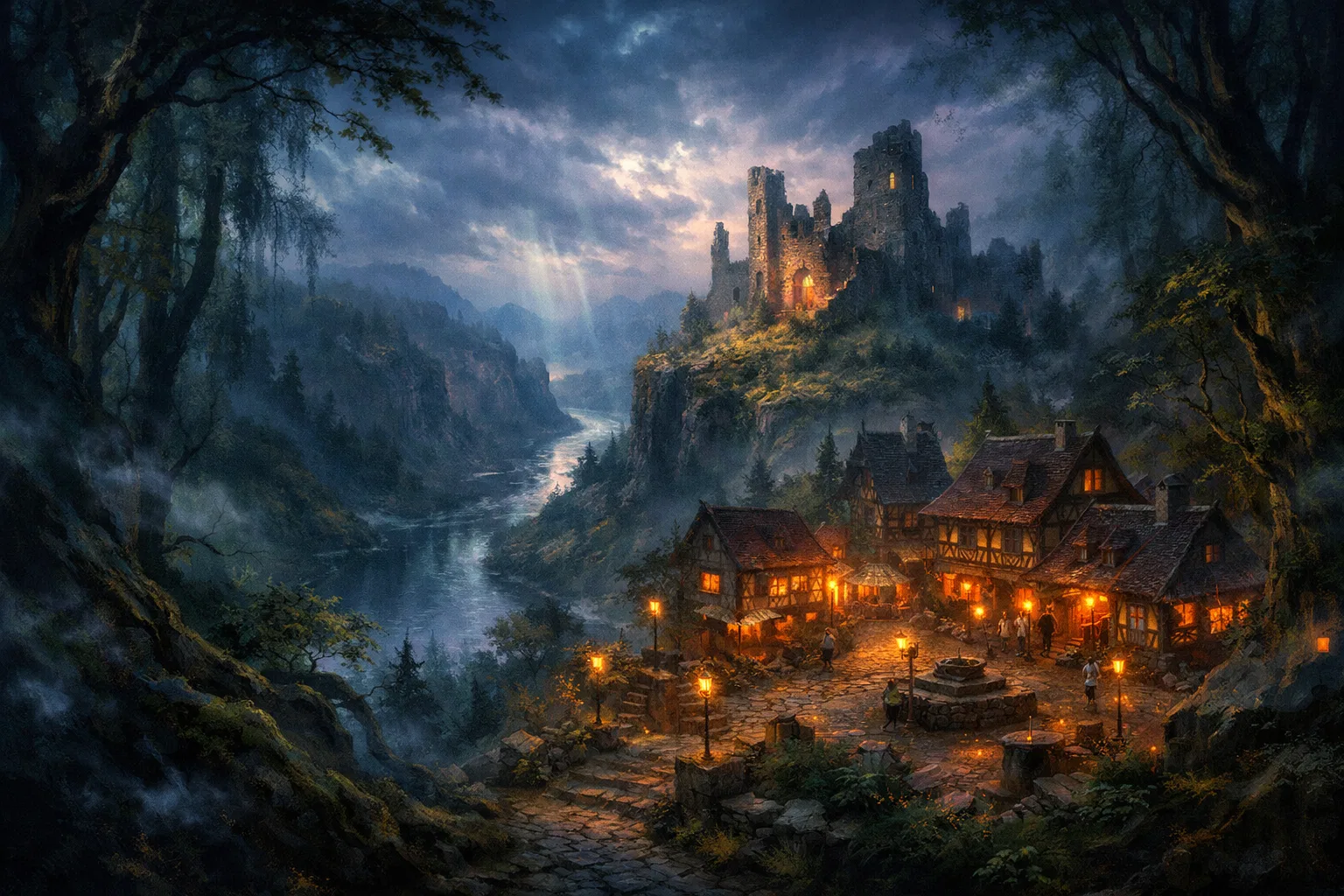
Germany’s folklore is not a single ancient storybook but a layered culture of tales, places and customs: Grimm fairy tales collected from family and regional storytelling, heroic legends such as the dragon-slayer Siegfried, Rhine myths such as the Lorelei, witch-night festivals in the Harz Mountains, household spirits, haunted castles, seasonal rites and local minority traditions. Its best-known export is the Brothers Grimm, but the deeper picture is more interesting: German folklore is a meeting point between oral tradition, medieval manuscript culture, Christian festival calendars, nineteenth-century Romanticism, tourism and modern popular culture. UNESCO’s Memory of the World programme recognises the Grimms’ Children’s and Household Tales as one of the most widely distributed works in German cultural history, while the medieval Song of the Nibelungs and many living customs show that Germany’s legendary culture is much broader than fairy tales alone.[UNESCO]unesco.orgOpen source on unesco.org.
Why German folklore feels so recognisable
For many readers, “German folklore” first means forests, castles, witches, wolves, clever youngest sons, cursed princesses and moral tests. That image is real, but it is partly the result of nineteenth-century collecting and editing. Jacob and Wilhelm Grimm began gathering tales at a time when scholars, writers and national movements across Europe were looking for older “people’s traditions” that could be written down before they disappeared. Their Children’s and Household Tales first appeared in 1812 and grew through later editions, becoming a world-famous literary object as much as a record of oral storytelling.[NEH]neh.govOpen source on neh.gov.
The Grimms did not simply record untouched peasant speech in a neutral notebook. They worked with informants, manuscripts, earlier printed material and editorial judgement. UNESCO’s nomination materials point out that the collection helped create the idea of a genuinely German folk voice, even though its sources and literary shaping were more complex than that national myth suggests. That is why modern readers should treat Grimm tales as both folklore evidence and crafted literature: they preserve story patterns, motifs and regional claims, but they also show how educated collectors turned oral and family traditions into books.[UNESCO]media.unesco.orggermany grimm revgermany grimm rev
This double nature explains their power. A tale such as “Hansel and Gretel” feels old because it speaks in the language of hunger, abandonment, forest danger and child survival. “Snow White” and “Rapunzel” feel archetypal because they use familiar folktale patterns: the persecuted heroine, the dangerous older woman, the locked-away girl, the enchanted threshold. Yet the versions most people know today are usually filtered several times over: through Grimm editions, children’s publishing, theatre, Disney, schoolbooks, tourism and online retellings.
The Brothers Grimm changed folklore into world literature
The Grimms’ achievement was not only that they collected memorable stories. They helped make folk narrative seem worthy of serious study. The Children’s and Household Tales are listed by UNESCO’s Memory of the World register, with the Grimms’ annotated personal copies recognised in 2005. UNESCO describes the work as the first systematic compilation and scholarly documentation of a broad fairy-tale tradition in Europe and beyond, translated into more than 160 languages and dialects.[UNESCO]unesco.orgOpen source on unesco.org.
Their fame can make German folklore look narrower than it is. The Grimms also published German Legends in 1816 and 1818, a large collection of short legendary accounts involving ghosts, dwarfs, sacred places, historical memories, marvels and local anecdotes. Unlike fairy tales, legends usually claim a stronger connection to a named place, date, family, ruin, road or church. A fairy tale begins in a flexible “once upon a time”; a legend says, in effect, “this happened here”. Project Gutenberg’s record of German Legends describes it as a two-volume collection of 579 summaries drawing on oral and literary sources.[Project Gutenberg]gutenberg.orgOpen source on gutenberg.org.
That difference matters for Germany. The country’s folklore landscape is intensely local. A castle ruin may have its white lady; a mining district may have underground spirits; a river bend may have a dangerous woman’s song; a town may preserve a story of vanished children. The Grimms gave German folklore an international brand, but German legendary culture remains rooted in particular places.
Fairy tales, legends and myths are not the same thing
A useful way to understand Germany’s traditions is to separate three overlapping forms.
Fairy tales are wonder stories. They often include magic helpers, impossible tasks, talking animals, enchanted objects and moral reversals. They are not usually tied to a precise historical date. Many Grimm tales belong here, including “The Frog King”, “Rumpelstiltskin”, “The Bremen Town Musicians” and “Frau Holle”.[Deutsche Märchenstraße]deutsche-maerchenstrasse.comOpen source on deutsche-maerchenstrasse.com.
Legends are place-bound and often pretend to historical memory. The Pied Piper of Hamelin, the Lorelei on the Rhine and ghostly castle stories work this way. They may be impossible to verify, but their force comes from being attached to a recognisable location. Hamelin’s official tourism site presents the Pied Piper through the Grimm version, Goethe, Browning, Brecht and historical theories, showing how one local legend can become a town identity.[hameln.de]hameln.deThe Legend of the Pied PiperThe Legend of the Pied Piper
Mythic and heroic material sits closer to gods, origins and epic memory. The Song of the Nibelungs, written down around 1200, belongs to medieval heroic literature rather than household fairy tale. It tells of Siegfried, Kriemhild, murder, revenge and the destruction of the Burgundians, drawing on older oral heroic tradition. UNESCO calls it the most famous heroic poem in Middle High German and compares its cultural importance with other major world epics.[UNESCO]unesco.orgOpen source on unesco.org.
The categories blur in real life. Frau Holle is a Grimm fairy-tale figure, a weather saying and, for some scholars and antiquarian writers, a trace of older female supernatural belief. The Lorelei is now often treated like an old Rhine legend, but its best-known form is a Romantic literary creation shaped by Clemens Brentano and Heinrich Heine. German folklore is full of these mixtures.
Famous German legends and what they reveal
The Pied Piper of Hamelin asks whether a fairy tale hides a real loss
The Pied Piper is one of Germany’s strangest internationally famous legends. In the familiar version, a colourful rat-catcher clears Hamelin of rats, is cheated of his payment, and takes revenge by leading the town’s children away with his pipe. Hamelin’s official version of the Grimm text begins in 1284, when a “strange and wondrous figure” comes to the town and promises to rid it of rats and mice.[hameln.de]hameln.deBrothers Grimm "German LegendsBrothers Grimm "German Legends
The unsettling part is that the children’s disappearance appears to be older than the rat-catching episode. Cambridge University Library’s language collections blog summarises the common scholarly view that the legend is based on a remembered event on 26 June 1284, when 130 children were said to have left Hamelin; early evidence included a church window from around 1300, later destroyed but described and copied.[Languages across Borders]languagecollections-blog.lib.cam.ac.ukLanguages across Borders The mystery of the Pied PiperLanguages across Borders The mystery of the Pied Piper
No single explanation has won. Theories include migration, recruitment for eastern settlement, epidemic memory, disaster, crusading movements or symbolic storytelling. The value of the legend is not that it gives a neat answer, but that it shows how a town can preserve a trauma-shaped story for centuries, then turn it into theatre, tourism, civic identity and global children’s literature.
The Lorelei shows how Romantic poetry can become “ancient” folklore
The Lorelei is often imagined as a timeless Rhine siren: a beautiful woman on a cliff whose song distracts boatmen and sends them to destruction. The physical place is real. The Lorelei rock rises above a narrow bend of the Rhine near St Goarshausen, a stretch long associated with dramatic scenery, echoes, currents and Romantic travel. Koblenz tourism describes the rock as about 132 metres above the Rhine, while Rhineland-Palatinate tourism identifies it as a world-famous symbol of Rhine Romanticism.[Rhein & Mosel City Tours]visit-koblenz.deOpen source on visit-koblenz.de.
Yet the familiar woman is not simply a prehistoric water spirit. The modern legend was strongly shaped by literature. Deutschland.de traces the woman of Lorelei to Clemens Brentano’s 1801 ballad and then to Heinrich Heine’s 1824 poem, in which a woman sits above the river combing her hair and singing.[Germany]deutschland.deGermany The Siren Song of the LoreleiGermany The Siren Song of the Lorelei
This is a classic German folklore pattern: landscape, danger, older motifs and literary Romanticism combine until a relatively modern poem feels like ancient tradition. The Lorelei matters because it shows how folklore is not only inherited; it is also made, repeated, sung, localised and believed into cultural memory.
The Nibelungs turn heroic legend into contested national memory
The Song of the Nibelungs belongs to Germany’s medieval literary heritage, but its story-world reaches back to older heroic legend. The poem centres on Siegfried, Kriemhild, Hagen, betrayal and revenge. It was written down around or shortly after 1200 and survives in medieval manuscripts and fragments from the thirteenth to sixteenth centuries.[UNESCO]media.unesco.orgmemory of the world registermemory of the world register
Its afterlife is complicated. The Nibelungen Museum in Worms explains that the poem’s rediscovery in the eighteenth century sparked major interest, but that enthusiasm later took political and nationalist forms, including misuse during the Weimar and Nazi periods. The same source also notes modern artistic afterlives in literature, painting, film, theatre and music, including Richard Wagner’s Ring cycle and Fritz Lang’s film treatment.[nibelungenmuseum.de]nibelungenmuseum.deOpen source on nibelungenmuseum.de.
For a folklore reader, the Nibelungs are a warning against treating old legends as harmless decorative heritage. Heroic stories can be reinterpreted as art, regional pride, national myth or ideology. Their meaning changes according to who is telling them and why.
Creatures, spirits and household beings
German folklore is rich in beings that are neither gods nor modern monsters. They are closer to the practical supernatural: things that haunt houses, mines, forests, bedsides and weather.
The kobold is one of the most flexible. Encyclopedia.com describes kobolds as German sprites or fairies of two broad kinds: household spirits that help with chores if properly fed and treated, and underground spirits associated with caves and mines. This mix of helpfulness and danger is typical of household folklore. A kobold is not purely evil; it is a being that must be respected, bargained with or carefully ignored.[Encyclopedia.com]encyclopedia.comOpen source on encyclopedia.com.
Frau Holle is another key figure. In the Grimm tale, she rewards the diligent girl and punishes the lazy one. In regional tradition, she is also linked with snow: the familiar explanation is that when she shakes out her bedding, feathers fall as snow. A recent academic thesis on the figure notes that the modern fairy-tale Frau Holle is connected in scholarship to older traditions surrounding Holda, with the oldest record of Holda traced to the eleventh century in that study’s summary of the evidence.[Wikipedia]WikipediaFrau HolleFrau Holle
Other figures vary by region and genre: dwarfs in mountains, wild hunts in winter skies, white ladies in castles, water beings in rivers, nightmare creatures, mine spirits and devilish tempters. The important point is not to flatten them into a single bestiary. German folk beings usually make sense in relation to a place or anxiety: dangerous work underground, the moral economy of the household, the risks of travel, the fear of drowning, the mystery of winter weather or the memory of religious change.
Witches, Walpurgis Night and the Harz Mountains
Few German folklore images are as vivid as Walpurgis Night in the Harz Mountains: witches, devils, bonfires, costumes and the Brocken, the highest peak in the range. Modern tourism presents it as a colourful spring festival, especially on 30 April, with celebrations in places such as Thale, Schierke, Braunlage and Wernigerode. The official Harz tourism site describes Walpurgis Night as celebrated in many places across the region with witches, devils, tradition and modern festival culture.[Harzinfo]harzinfo.deOpen source on harzinfo.de.
The tradition is a blend. It is associated with the eve of May Day, with springtime fire customs, with the Christian Saint Walpurga, with older seasonal fears and with literary fame. Harz regional material notes that Goethe’s Faust helped make the Brocken’s witches’ gathering nationally famous, while Germany’s tourism site connects the Brocken, Walpurgis Night and Goethe’s Faust in the modern walking route known as the Harz Witches’ Trail.[Harz Abenteuer Wandern]harz-abenteuer-wandern.deHarz Abenteuer Wandern Walpurgis Night in the Harz MountainsHarz Abenteuer Wandern Walpurgis Night in the Harz Mountains
This is also where responsible folklore writing needs care. Witch costumes and festival play are not the same as the historical persecution of people accused of witchcraft. Recent German press coverage of Walpurgis celebrations has noted criticism from historians who warn against trivialising witch trials; one report stated that roughly 35,000 people in Germany were victims of witch trials in the sixteenth and seventeenth centuries.[DIE WELT]welt.deDIE WELTWas es mit der Walpurgisnacht auf sich hatTrotz der Feierfreude gibt es kritische Stimmen: Der Historiker Kai Lehmann mahnt, die Geschichte der Hexenverfolgung nicht zu trivialisi…
Walpurgis Night therefore has two faces. It is a living, enjoyable regional festival and tourist spectacle. It is also attached to a darker history of fear, accusation and violence. Good interpretation can hold both truths without turning either into melodrama.
Seasonal customs and living heritage
German folklore is not only old texts. It survives in performance, costume, procession, food, song, craft and seasonal rhythm. Germany adopted the UNESCO Convention for the Safeguarding of the Intangible Cultural Heritage in 2013, and the German Commission for UNESCO describes the national register as a way to preserve, foster and promote the diversity of living heritage in Germany.[Deutsche UNESCO-Kommission]unesco.deOpen source on unesco.de.
Carnival is one of the most visible examples. In many German regions, carnival turns the social order upside down through masks, satire, processions and local characters. It is not simply entertainment; it is a ritualised season of disguise, noise, mockery and community identity. Deutschland.de presents carnival alongside other German intangible cultural heritage traditions such as bread culture and regional crafts.[Germany]deutschland.deGermany Intangible cultural heritage in GermanyGermany Intangible cultural heritage in Germany
The Lusatian Sorbs, a Slavic minority in eastern Germany, show why folklore should not be treated as only majority German culture. Domowina, the federation of Lusatian Sorbs, notes that the social customs and festivals of the Lusatian Sorbs throughout the year were included in Germany’s intangible cultural heritage list in 2014. These include annual customs such as carnival, Easter customs, Walpurgis Night bonfires, maypoles, harvest customs and Christmas customs.[domowina.de]domowina.deOpen source on domowina.de.
This living-heritage frame changes the reader’s understanding. Folklore is not just “old stories people used to believe”. It is also what communities choose to practise, adapt and transmit now.
Sacred and haunted landscapes
Germany’s folklore often attaches itself to landscapes that already feel charged: the Rhine, the Harz, the Black Forest, the Alps and their foothills, castle ruins, medieval towns, mines, caves and old roads. These places become story engines. A dangerous river bend becomes the Lorelei. A misty mountain becomes a witches’ meeting place. A town street becomes the route of vanished children.
The German Fairy Tale Route shows how strongly folklore and place are now linked in public culture. The route connects places associated with the Brothers Grimm and famous stories, running through towns, castles, villages and landscapes that use fairy-tale heritage for tourism. Its official material says the route has invited visitors since 1975 to follow in the footsteps of the Grimms from Hanau, their birthplace, towards Bremen and the Bremen Town Musicians.[Deutsche Märchenstraße]deutsche-maerchenstrasse.comImageflyer Deutsche Maerchenstrasse 2020 ENImageflyer Deutsche Maerchenstrasse 2020 EN
This does not mean every tourist site preserves an untouched ancient belief. Folklore tourism often combines authentic local association, literary memory, civic branding and modern staging. That is not a failure; it is part of how folklore lives. The useful question is not “is this pure?” but “what layer are we looking at: oral tradition, literary text, local memory, festival performance, museum interpretation or modern marketing?”
How old is German folklore?
Some elements are medieval or older, but exact age depends on the tradition. The Song of the Nibelungs was written down around 1200 but draws on older heroic material. The Pied Piper legend has medieval evidence around Hamelin and later literary expansion. The Grimms’ famous fairy-tale collection is early nineteenth-century in printed form, even when individual motifs are much older. The Lorelei, in her best-known form, is nineteenth-century Romantic literature attached to an older landscape.[unesco.org]media.unesco.orgmemory of the world registermemory of the world register
This makes “ancient German folklore” a risky phrase. Some stories preserve old motifs; some are medieval; some are early modern; some are Romantic inventions; some are modern revivals; some are internet-era reinterpretations of older figures. Germany’s folklore is best understood as a long conversation rather than a sealed inheritance from a single pagan past.
The same caution applies to claims about pre-Christian survivals. It is reasonable to say that Christian festivals, older seasonal customs and later folk beliefs often blended. It is less safe to claim that every witch fire, household spirit or winter custom is a direct survival of a named ancient Germanic religion. Folklore often preserves patterns of feeling and practice more clearly than it preserves clean historical origins.
German folklore today
Today, German folklore appears in museums, schoolbooks, tourism, festivals, novels, games, films, music, local branding and online myth lists. Some forms remain closely tied to place: Hamelin performs the Pied Piper; the Harz stages Walpurgis; Worms interprets the Nibelungs; the Rhine markets the Lorelei; Grimm towns use fairy-tale identity. Other forms travel globally, detached from their German settings: Snow White, Rapunzel, Rumpelstiltskin and the Frog King circulate as international children’s culture.
Modern reinterpretation can be creative, but it can also blur evidence. Internet lists of “German monsters” often mix genuine regional beings, literary figures, pan-European folklore, fantasy gaming and invented names. A reliable approach is to ask four questions: Is the figure attested in older collections or local tradition? Is it tied to a region, custom or text? Did a writer create or reshape it? Is the modern version mainly from tourism, film, gaming or social media?
Germany’s folklore remains compelling because it lets readers see culture being made. A medieval poem becomes a national epic, then a politically contested symbol, then a museum subject. A dangerous Rhine cliff becomes a Romantic siren. A local disappearance becomes the Pied Piper. Family and oral tales become world literature through the Grimms. Seasonal rites become heritage festivals. The result is not a museum of dead superstition, but a living map of how people use stories to explain danger, landscape, morality, memory and belonging.
Amazon book picks
Further Reading
Books and field guides related to Why German Folklore Still Feels So Familiar. Use these as the next step if you want deeper reading beyond the article.
The Complete Fairy Tales of the Brothers Grimm
The single most influential collection associated with German folklore.
Norse Mythology
Introduces mythic material closely related to broader Germanic traditions.
eBay marketplace picks
Marketplace Samples
Live-tested eBay searches with available results related to this page.

Endnotes
1.
Source: unesco.org
Link:https://www.unesco.org/en/memory-world/kinder-und-hausmarchen-childrens-and-household-tales
2.
Source: unesco.org
Link:https://www.unesco.org/en/memory-world/song-nibelungs-heroic-poem-mediaeval-europe
3.
Source: unesco.de
Link:https://www.unesco.de/en/sites/intangible-cultural-heritage/
4.
Source: neh.gov
Link:https://www.neh.gov/humanities/2015/marchapril/feature/how-the-grimm-brothers-saved-the-fairy-tale
5.
Source: media.unesco.org
Title: germany grimm rev
Link:https://media.unesco.org/sites/default/files/webform/mow001/germany_grimm_rev.pdf
6.
Source: gutenberg.org
Link:https://www.gutenberg.org/ebooks/76558
7.
Source: Wikipedia
Title: Frau Holle
Link:https://en.wikipedia.org/wiki/Frau_Holle
8.
Source: hameln.de
Title: The Legend of the Pied Piper
Link:https://www.hameln.de/en/thepiedpiper/thepiedpiper
9.
Source: hameln.de
Title: Brothers Grimm “German Legends”
Link:https://www.hameln.de/en/thepiedpiper/thepiedpiper/brothers-grimm-pied-piper
10.
Source: nibelungenmuseum.de
Link:https://www.nibelungenmuseum.de/nibelungenmuseum-en/Nibelungenlied/
11.
Source: deutschland.de
Title: Germany The Siren Song of the Lorelei
Link:https://www.deutschland.de/en/the-siren-song-of-the-lorelei
12.
Source: media.unesco.org
Title: memory of the world register
Link:https://media.unesco.org/sites/default/files/webform/mow001/germany_song_of_the_nibelungs.pdf
13.
Source: encyclopedia.com
Link:https://www.encyclopedia.com/science/encyclopedias-almanacs-transcripts-and-maps/kobolds
14.
Source: harzinfo.de
Link:https://www.harzinfo.de/en/events-in-the-harz/walpurgis-in-the-harz
15.
Source: harz-abenteuer-wandern.de
Title: Harz Abenteuer Wandern Walpurgis Night in the Harz Mountains
Link:https://www.harz-abenteuer-wandern.de/en/walpurgisnacht-im-harz/
16.
Source: germany.travel
Title: Travel The Harz Witches’ Trail
Link:https://www.germany.travel/en/nature-outdoor-activities/harz-witches-trail.html
17.
Source: welt.de
Title: DIE WELTWas es mit der Walpurgisnacht auf sich hat
Link:https://www.welt.de/newsticker/dpa_nt/infoline_nt/panorama_nt/article69f167b3622ae392e46e233b/was-es-mit-der-walpurgisnacht-auf-sich-hat.html
Source snippet
Trotz der Feierfreude gibt es kritische Stimmen: Der Historiker Kai Lehmann mahnt, die Geschichte der Hexenverfolgung nicht zu trivialisi...
18.
Source: deutschland.de
Title: Germany Intangible cultural heritage in Germany
Link:https://www.deutschland.de/en/topic/culture/intangible-cultural-heritage-in-germany
19.
Source: domowina.de
Link:https://www.domowina.de/en/lusatian-sorbs/intangible-cultural-heritage/
20.
Source: domowina.de
Link:https://www.domowina.de/en/responsibilities/projects/heritage-lusatia/
21.
Source: Wikipedia
Title: German folklore
Link:https://en.wikipedia.org/wiki/German_folklore
22.
Source: Wikipedia
Title: Walpurgis Night
Link:https://en.wikipedia.org/wiki/Walpurgis_Night
23.
Source: Wikipedia
Title: Deutsche Sagen
Link:https://en.wikipedia.org/wiki/Deutsche_Sagen
24.
Source: Wikipedia
Title: Grimms’ Fairy Tales
Link:https://en.wikipedia.org/wiki/Grimms%27_Fairy_Tales
25.
Source: Wikipedia
Title: Pied Piper of Hamelin
Link:https://en.wikipedia.org/wiki/Pied_Piper_of_Hamelin
26.
Source: Wikipedia
Link:https://en.wikipedia.org/wiki/Kobold
27.
Source: Wikipedia
Title: Lists of Intangible Cultural Heritage elements
Link:https://en.wikipedia.org/wiki/Lists_of_Intangible_Cultural_Heritage_elements
28.
Source: Wikipedia
Link:https://en.wikipedia.org/wiki/Faust
29.
Source: Wikipedia
Link:https://en.wikipedia.org/wiki/Nibelungenlied
30.
Source: ich.unesco.org
Link:https://ich.unesco.org/en/lists
31.
Source: ich.unesco.org
Link:https://ich.unesco.org/doc/src/32430.pdf
32.
Source: ich.unesco.org
Link:https://ich.unesco.org/
33.
Source: ich.unesco.org
Title: germany DE
Link:https://ich.unesco.org/en/state/germany-DE
34.
Source: unesco.de
Link:https://www.unesco.de/staette/nibelungenlied/
35.
Source: unesco.de
Title: Memory of the World
Link:https://www.unesco.de/en/sites/memory-of-the-world/
36.
Source: germany.travel
Link:https://www.germany.travel/en/inspiring-germany/regional-traditions.html
37.
Source: goethe.de
Link:https://www.goethe.de/prj/ger/en/wow/umw/25600638.html
38.
Source: deutschland.de
Title: intangible cultural heritage in germany
Link:https://www.deutschland.de/en/topic/life/lifestyle-cuisine/intangible-cultural-heritage-in-germany
39.
Source: deutsche-maerchenstrasse.com
Link:https://www.deutsche-maerchenstrasse.com/en/discover/cities-villages-regions/translate-to-english-hanau
40.
Source: languagecollections-blog.lib.cam.ac.uk
Title: Languages across Borders The mystery of the Pied Piper
Link:https://languagecollections-blog.lib.cam.ac.uk/2024/03/19/the-mystery-of-the-pied-piper/
41.
Source: visit-koblenz.de
Link:https://www.visit-koblenz.de/en/region/middle-rhine-valley/loreley
42.
Source: worms-erleben.de
Link:https://www.worms-erleben.de/experience/entdecken-und-staunen/kulturprofile/nibelungen/nibelungenlied.php
43.
Source: deutsche-maerchenstrasse.com
Title: Imageflyer Deutsche Maerchenstrasse 2020 EN
Link:https://www.deutsche-maerchenstrasse.com/fileadmin/Mediendatenbank/Bilder/Prospekte/Imageflyer_Deutsche-Maerchenstrasse_2020__EN.pdf
44.
Source: deutsche-maerchenstrasse.com
Link:https://www.deutsche-maerchenstrasse.com/en/start
45.
Source: deutsche-maerchenstrasse.com
Link:https://www.deutsche-maerchenstrasse.com/en/destinationnews/detail/hintergrund-presse-informationen
46.
Source: deutsche-maerchenstrasse.com
Link:https://www.deutsche-maerchenstrasse.com/en/discover/cities-villages-regions/translate-to-english-kassel
47.
Source: deutsche-maerchenstrasse.com
Link:https://www.deutsche-maerchenstrasse.com/fileadmin/Mediendatenbank/Bilder/Prospekte/imagebroschuere_jp.pdf
48.
Source: deutsche-maerchenstrasse.com
Link:https://www.deutsche-maerchenstrasse.com/fileadmin/Mediendatenbank/Bilder/Prospekte/imagebroschuere_cn.pdf
49.
Source: deutsche-maerchenstrasse.com
Link:https://www.deutsche-maerchenstrasse.com/en/package/fuehrung-museum-brueder-grimm-haus
50.
Source: deutsche-maerchenstrasse.com
Title: Main Cycle Tour 01
Link:https://www.deutsche-maerchenstrasse.com/en/start/tour/main-cycle-tour-01-stage-hanau-steinau
51.
Source: deutsche-maerchenstrasse.com
Link:https://www.deutsche-maerchenstrasse.com/fileadmin/Mediendatenbank/Bilder/Prospekte/SalesGuide_2025-26.pdf
52.
Source: germanicmythology.com
Title: Frau Holle
Link:https://www.germanicmythology.com/original/FRAUHOLLE_TIMM.html
53.
Source: mythus.fandom.com
Link:https://mythus.fandom.com/wiki/Kobold
54.
Source: unescoicdh.org
Link:https://www.unescoicdh.org/eng/sub.php?code1=00000004&code2=00000056&listCnt=10&menukey=289&mod=view&no=9137&page=3&scode=00000005
55.
Source: unescoicdh.org
Link:https://www.unescoicdh.org/eng/print.php?listCnt=10&menukey=289&mod=view&no=16033&page=32&scode=00000005
56.
Source: sites.pitt.edu
Link:https://sites.pitt.edu/~dash/hameln.html
57.
Source: beeclassifieds.beenews.com
Link:https://beeclassifieds.beenews.com/learn/238/5TW/34UWXe/Folklore
58.
Source: abcnews.com
Link:https://abcnews.com/International/grimms-cast-spell-world/story?id=18028907
59.
Source: meta.wikimedia.org
Link:https://meta.wikimedia.org/wiki/Wiki_Loves_Living_Heritage/Intangible_Cultural_Heritage_of_Germany/list
60.
Source: blb-karlsruhe.de
Title: unesco weltdokumentenerbe
Link:https://www.blb-karlsruhe.de/sammlungen/unesco-weltdokumentenerbe-nibelungenlied/unesco-weltdokumentenerbe
61.
Source: historymedieval.com
Title: The Pied Piper of Hamelin
Link:https://historymedieval.com/the-piped-piper-of-hamelin/
62.
Source: fromplacetoplace.travel
Link:https://fromplacetoplace.travel/germany/rhineland-palatinate/upper-middle-rhine-valley/loreley/
Additional References
63.
Source: youtube.com
Title: Kobolds: Origin Stories from German Folklore
Link:https://www.youtube.com/watch?v=jzR8RyNk2ig
Source snippet
This documentary on Grimm's Fairy Tales provides comprehensive coverage of the cultural origins and folklore traditions in Germany mentio...
64.
Source: reddit.com
Link:https://www.reddit.com/r/folklore/comments/1qffz0z/theory_frau_holle_as_a_suicide_narrative_and/
65.
Source: academia.edu
Link:https://www.academia.edu/78334799/The_Grimm_Brothers_and_the_Quest_for_Legends_in_Nineteenth_Century_Finnish_Folklore_Studies
66.
Source: researchgate.net
Link:https://www.researchgate.net/publication/385492581_Introducing_mythical_creatures_in_Grimm%27s_fairy_tales_to_Sri_Lanka_German_language_learners_A_case_Study
67.
Source: facebook.com
Link:https://www.facebook.com/Uyghursbookshelf/posts/mythical-beasts-of-germanygermanys-folklore-is-filled-with-fascinating-mythical-/1369069301689178/
68.
Source: facebook.com
Link:https://www.facebook.com/GermanyinSingapore/posts/when-winter-heaves-its-final-sigh-the-witches-gather-on-the-night-of-april-30th-/1405202828300501/
69.
Source: instagram.com
Link:https://www.instagram.com/p/DXt2wfwkjqg/
70.
Source: fairytalez.com
Link:https://fairytalez.com/region/german/
71.
Source: linnys-art.com
Link:https://linnys-art.com/en/german-folklore/
72.
Source: facebook.com
Link:https://www.facebook.com/germanlifemag/posts/mythological-creatures-exist-throughout-the-world-but-lets-take-a-look-at-one-th/2600370296691530/
Topic Tree
Follow this branch
Related pages 192
- Afghan Folklore
- Albanian Folklore
- Algerian Folklore
- Australian Folklore
- Azerbaijan Folklore
- +187 more in sidebar