Why Trinbago Folklore Still Haunts the Night
Folklore in Trinidad and Tobago is not a single old storybook tradition. It is a living mixture of African, Indian, European, Indigenous Caribbean and wider diaspora inheritances, reshaped in villages, Carnival yards, family warnings, children’s stories, religious festivals, stage performances and modern horror retellings.
Page outline Jump by section
Introduction
The most important thing to understand is that these traditions are not merely “ghost stories”. They are cultural memory in narrative form: warnings about wandering after dark, respect for rivers and forests, suspicion of hidden glamour, jokes about survival, and performances that keep older speech, costume and ritual knowledge visible in public life.
Why Trinidad and Tobago folklore feels so mixed
Trinidad and Tobago’s folklore reflects the country’s history of forced migration, indenture, colonial rule, religious pluralism and creole creativity. NALIS lists soucouyants, Anansi, raakhas, douens and lagahoo among the figures preserved through Caribbean oral and written tradition, while also pointing readers to local works such as A Dictionary of Trinidad and Tobago Folklore, Folk Stories and Legends of Trinidad, and Folklore and Legends of Trinidad & Tobago.[nalis.gov.tt]nalis.gov.ttOpen source on nalis.gov.tt.
This mixed inheritance matters because many Trinbagonian beings are hybrids. A creature may carry an African-Caribbean moral function, a French-derived name, a Christianised warning about the soul, and a local landscape setting. The lagahoo, for example, is related to the French werewolf term, while the soucouyant belongs to a wider Caribbean family of night-flying, blood-drinking witch figures. Carnival characters such as the Midnight Robber also blend African storytelling, colonial parody, masquerade, costume craft and public performance.[nalis.gov.tt]nalis.gov.ttOpen source on nalis.gov.tt.
The result is a folklore landscape where the supernatural is often practical. Stories tell children not to answer voices in the dark, warn adults not to follow strangers, and teach respect for places that feel socially or spiritually charged: rivers, crossroads, forests, old trees, ravines, cemeteries and lonely roads.
The famous night figures
The most widely recognised supernatural figures in Trinidad and Tobago tend to be nocturnal. They move at the edge of ordinary life: outside windows, along roads, near forests, under large trees, or in the voice of someone familiar.
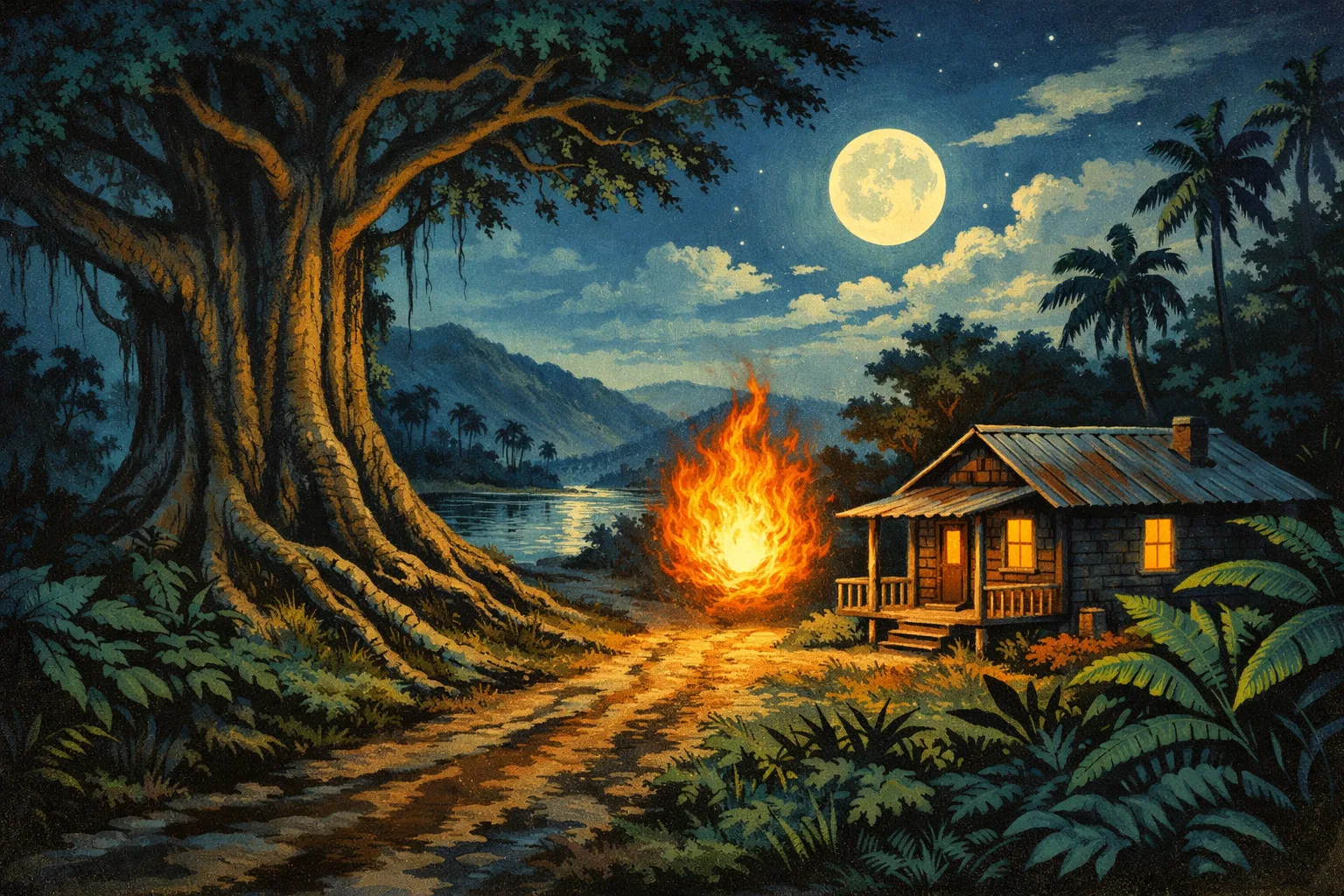
The soucouyant is usually described as an old woman by day who removes her skin at night, becomes a ball of fire, slips into houses through tiny openings and feeds on blood. Caribbean retellings often include ways to expose or trap her, such as scattering grains that she must count, or salting the hidden skin so she cannot resume human form. The figure is part of a wider Caribbean pattern, but Trinidad and Tobago remains one of the places most strongly associated with the tale.[Wikipedia]WikipediaOpen source on wikipedia.org.
The douen is one of the most memorable child-centred warnings. It is usually described as the spirit of a child, often with backward-facing feet, hidden face and a talent for luring living children away by calling them in a familiar voice. The detail of the reversed feet is more than a creepy visual: it turns tracking and direction into a trap, making the forest itself feel deceptive.[Wikipedia]WikipediaOpen source on wikipedia.org.
La Diablesse is the dangerous woman of the road: glamorous from a distance, but with a hidden deathly face and a concealed cloven foot. In many versions she leads men astray, especially at night or in lonely places. The tale is often read as a warning about seduction, vanity, male overconfidence and the danger of judging by appearances.[tntisland.com]tntisland.comOpen source on tntisland.com.
The lagahoo is a shape-shifting night being related to werewolf and vampire traditions. In Trinidad and Tobago it is often placed near the soucouyant in lists of folk terrors, but it is less fixed in public memory than the soucouyant, douen or La Diablesse. That slipperiness is part of the tradition: the lagahoo belongs to a world where bodies change, names shift and one Caribbean island’s creature has cousins elsewhere.[nalis.gov.tt]nalis.gov.ttcaribbean folklore part 3caribbean folklore part 3
These figures survive because they are easy to adapt. They work as bedtime warnings, village gossip, theatre characters, horror-film material and symbols of older rural knowledge. Their details vary from teller to teller, but the emotional core stays recognisable: the night is not empty, beauty may hide danger, and children should not wander.
Forests, rivers and beings that guard the landscape
Trinidad and Tobago folklore is strongly tied to place. The forest is not just scenery; it is a moral space. Rivers are not just water; they may be watched. Large trees are not just botanical landmarks; they can be treated as homes of spirits or ancestral presences.
Papa Bois is usually understood as a guardian of the forest and its animals. He is often imagined as an old, powerful, shape-shifting figure who punishes those who harm wildlife or disrespect the woods. Mama D’Leau, or Mama D’Lo in some spellings, is associated with rivers and water. Modern Caribbean retellings describe her as a water-linked shapeshifter and protector, especially in stories where men damage rivers or forests.[CaribbeanReads]caribbeanreads.comCaribbean Reads Mama D'loCaribbean Reads Mama D'lo
These figures matter today because they can be read in environmental terms without reducing them to modern slogans. Older stories about Papa Bois and Mama D’Leau taught caution, restraint and respect long before “conservation” became the usual public language. They also show that Trinbagonian folklore often makes the non-human world socially alive: forests, rivers and animals are not passive resources, but parts of a watched landscape.
The silk cotton tree has a similar charge in Caribbean belief. Tobago tourism writing describes the tree as woven into local folklore and spiritual belief, regarded as a home for ancestral spirits or jumbies, and treated with reverence and caution.[tourtobagotravel.com]tourtobagotravel.comsilk cotton treesilk cotton tree Such accounts should be read as folklore and heritage, not botanical fact, but they help explain why certain trees can carry a deep sense of warning, memory and sacred presence.
Anansi and the clever survivor
Not all folklore in Trinidad and Tobago is frightening. Anansi, the trickster spider of West African origin, is one of the great figures of Caribbean storytelling. NALIS includes Anansi under several names, including Kwaku Anansi, Brer Anansi and Bo Nancy, among the characters preserved in Caribbean folklore.[nalis.gov.tt]nalis.gov.ttOpen source on nalis.gov.tt.
Anansi stories are often funny, sharp and morally complicated. Anansi may be greedy, lazy, brilliant, shameless or unexpectedly wise. He wins not because he is strong, but because he can talk, scheme and improvise. In a Caribbean context shaped by slavery, plantation hierarchy and colonial control, the appeal is obvious: the small, hungry, apparently powerless figure can still outwit larger forces.
For a modern reader, Anansi is a reminder that folklore is not only about monsters. It is also about social intelligence: how people survive unfair systems, mock authority, expose foolishness and pass on practical wisdom through laughter. That makes Anansi a natural internal link between Trinidad and Tobago folklore, West African traditions, Caribbean children’s literature and oral storytelling.
Indo-Caribbean spirits and sacred performance
Trinidad and Tobago folklore cannot be understood only through African-Caribbean figures. Indo-Caribbean traditions brought by indentured workers from India are also central to the country’s belief culture and performance heritage.
NALIS’s guide to Indian Caribbean folklore lists beings such as the raakhas, churile, saapin and Dee Baba. The raakhas is described as a dangerous newborn creature with animal-like features, long nails, teeth and a threatening voice; the churile is described as the spirit of a pregnant woman who died in childbirth or during pregnancy.[nalis.gov.tt]nalis.gov.ttOpen source on nalis.gov.tt. These are not simply imported stories frozen in time. In Trinidad and Tobago they became part of a local Indo-Caribbean imaginative world shaped by plantation life, childbirth fears, karma, household ritual and family storytelling.
Ramleela is another crucial strand. It is a public folk-theatre performance of the Ramayana, staged in Trinidad communities as a prelude to Divali. A Caribbean Library Journal article notes that several communities in Trinidad have performed Ramleela annually for about 171 years, tracing it to the arrival of indentured labourers from India in 1845.[UWI St. Augustine Journals]journals.sta.uwi.eduSt. Augustine JournalsSt. Augustine Journals The same article records Derek Walcott’s famous praise for the Ramleela in Felicity, Trinidad, where he saw the local performance not as a diminished copy, but as a branch of a larger epic language.[UWI St. Augustine Journals]journals.sta.uwi.eduSt. Augustine JournalsSt. Augustine Journals
Hosay adds another layer. NALIS explains that Hosay in Trinidad developed from Muharram observances brought by indentured workers from India; although rooted in Shi’ite Islam, it was also participated in by Hindus and evolved into a wider Trinidad observance. Its first noted observance was in San Fernando in 1847, with evidence for Chaguanas and St James by 1865.[nalis.gov.tt]nalis.gov.ttHosay – NALIS – National Library and Information System AuthorityHosay – NALIS – National Library and Information System Authority
These traditions show that folklore, ritual and theatre overlap. A monster story told at home, a religious procession, and a staged epic may seem different, but all preserve inherited narrative in local form.

Carnival as public folklore
Carnival is not folklore in the narrow sense of a ghost story, but traditional Carnival characters are one of Trinidad and Tobago’s most powerful public folklore systems. They turn old social types, supernatural beings, colonial satire and street performance into moving theatre.
NALIS describes Jab Molassie as a devil-mas figure whose name combines French patois words for devil and molasses. His costume may include horns, chains, pitchfork, grease, tar, mud or coloured dyes, and his wild dance is accompanied by imps and rhythm.[nalis.gov.tt]nalis.gov.ttOpen source on nalis.gov.tt. The same NALIS Carnival guide describes the Midnight Robber as one of traditional Carnival’s most beloved characters, known for extravagant “Robber Talk” derived from African griot storytelling and shaped by colonial speech patterns.[nalis.gov.tt]nalis.gov.ttOpen source on nalis.gov.tt.
The Moko Jumbie is especially important because the supernatural idea is built into the performance itself. NALIS explains that “Moko” is linked to West African tradition and that “jumbie”, meaning ghost, was added by freed slaves; the height of the stilts was associated with seeing evil sooner, and the Moko Jumbie was felt to protect the village.[nalis.gov.tt]nalis.gov.ttOpen source on nalis.gov.tt.
Carnival keeps folklore visible in ways that books cannot. A child may not read an old collection of legends, but can still see a stilt-walker, devil, robber or Pierrot Grenade in performance. The Prime Minister’s Best Village Trophy Competition also helps keep folk characters, ceremonies, customs, Anansi stories and festival heritage on stage rather than locked away as archive material.[guardian.co.tt]guardian.co.ttOpen source on guardian.co.tt.
How old and well-attested are these traditions?
The evidence for Trinidad and Tobago folklore is uneven, because much of it lived first in oral tradition. That does not make it unimportant; it means the record is scattered across libraries, local publications, newspaper features, performance practice, family memory, school projects, Carnival institutions, festival archives and modern retellings.
Some traditions are well-attested through institutional sources. NALIS preserves public guides and bibliographies pointing to older collections by writers such as Mohammed Pharouk Alladin, Gerard Besson, Archibald Chauharjasingh, Carlton Ottley and others.[nalis.gov.tt]nalis.gov.ttOpen source on nalis.gov.tt. Carnival characters are documented through NALIS and the National Carnival Commission, while Ramleela and Hosay have strong scholarly and institutional records.[ncctt.org]ncctt.orgTraditional Mas CharactersTraditional Mas Characters[UWI St. Augustine Journals]journals.sta.uwi.eduSt. Augustine JournalsSt. Augustine Journals[nalis.gov.tt]nalis.gov.ttHosay – NALIS – National Library and Information System AuthorityHosay – NALIS – National Library and Information System Authority
Other details are more fluid. Exact origin claims for creatures such as the douen, soucouyant or La Diablesse should be handled carefully. A neat statement such as “this creature comes from one single culture” is usually too simple. Names, motifs and moral meanings have moved through African, French Creole, Catholic, Indian, British colonial and local village worlds. The stronger claim is not that every detail has a single birthplace, but that Trinidad and Tobago became one of the places where these figures took especially recognisable form.
Folklore today: memory, theatre, tourism and horror
Today, Trinidad and Tobago folklore lives in several overlapping worlds. It appears in children’s books, school lessons, social media posts, Carnival performances, folklore month features, horror shorts, local art, tourism writing and community theatre. Simply Trini Cooking, for example, presents folklore as part of everyday cultural inheritance and names soucouyant, Mama D’Leau, La Diablesse, Papa Bois, douen, Gumbo Glisse and lagahoo among popular Trinidad figures.[Simply Trini Cooking]simplytrinicooking.comfolklore of trinidad tobagofolklore of trinidad tobago
Modern reinterpretation can be valuable, but it also changes the material. A horror film may make La Diablesse more frightening and visual; a tourist page may make the silk cotton tree more picturesque; a school presentation may simplify complex origins into a tidy list. None of these uses is automatically wrong, but readers should recognise the difference between older oral tradition, institutional heritage summary, literary adaptation and internet-era folklore.
The most durable Trinbagonian folklore survives because it still answers present questions. What should children fear? What happens if a stranger calls your name? Why do people treat certain trees or rivers with caution? Why does Carnival still include devils, robbers and ghosts? Why do old stories travel so well into theatre, film and popular culture?
The answer is that Trinidad and Tobago’s folklore is both inherited and inventive. It remembers ancestral worlds, but it also gives new generations a vivid language for danger, wit, beauty, warning, resistance and belonging.
Amazon book picks
Further Reading
Books and field guides related to Why Trinbago Folklore Still Haunts the Night. Use these as the next step if you want deeper reading beyond the article.
Caribbean Folk Tales and Legends
Places Trinbagonian stories within regional traditions.

Rise of the Jumbies
First published 2017. Subjects: Children's fiction, Missing persons, fiction, Blacks, fiction, Caribbean area, fiction, Horror stories.
eBay marketplace picks
Marketplace Samples
Live-tested eBay searches with available results related to this page.


Endnotes
1.
Source: nalis.gov.tt
Link:https://www.nalis.gov.tt/blog/caribbean-folklore-part-1/
2.
Source: nalis.gov.tt
Link:https://www.nalis.gov.tt/resources/tt-content-guide/carnival/
3.
Source: Wikipedia
Link:https://en.wikipedia.org/wiki/Soucouyant
4.
Source: Wikipedia
Link:https://en.wikipedia.org/wiki/Douen
5.
Source: tntisland.com
Link:https://www.tntisland.com/folklore.html
6.
Source: nalis.gov.tt
Title: caribbean folklore part 3
Link:https://www.nalis.gov.tt/blog/caribbean-folklore-part-3/
7.
Source: caribbeanreads.com
Title: Caribbean Reads Mama D’lo
Link:https://www.caribbeanreads.com/mamadlo/
8.
Source: tourtobagotravel.com
Title: silk cotton tree
Link:https://www.tourtobagotravel.com/home/post/1555/silk-cotton-tree
9.
Source: nalis.gov.tt
Link:https://www.nalis.gov.tt/resources/tt-content-guide/indian-caribbean-folklore/
10.
Source: journals.sta.uwi.edu
Title: St. Augustine Journals
Link:https://journals.sta.uwi.edu/ojs/index.php/clj/article/download/8861/7283/14110
11.
Source: nalis.gov.tt
Title: Hosay – NALIS – National Library and Information System Authority
Link:https://www.nalis.gov.tt/resources/tt-content-guide/hosay/
12.
Source: guardian.co.tt
Link:https://www.guardian.co.tt/article-6.2.449709.def134bc4c
13.
Source: ncctt.org
Title: Traditional Mas Characters
Link:https://ncctt.org/traditional-mas-characters/
14.
Source: nalis.gov.tt
Title: caribbean folklore part 2
Link:https://www.nalis.gov.tt/blog/caribbean-folklore-part-2/
15.
Source: Wikipedia
Title: Trinidad and Tobago
Link:https://en.wikipedia.org/wiki/Trinidad_and_Tobago
16.
Source: Wikipedia
Title: La Diablesse
Link:https://en.wikipedia.org/wiki/La_Diablesse
17.
Source: Wikipedia
Link:https://en.wikipedia.org/wiki/Trinidad
18.
Source: Wikipedia
Title: Papa Bois
Link:https://en.wikipedia.org/wiki/Papa_Bois
19.
Source: Wikipedia
Title: List of Trinidad and Tobago Carnival character costumes
Link:https://en.wikipedia.org/wiki/List_of_Trinidad_and_Tobago_Carnival_character_costumes
20.
Source: Wikipedia
Link:https://en.wikipedia.org/wiki/Anansi
21.
Source: Wikipedia
Link:https://en.wikipedia.org/wiki/Hosay
22.
Source: mccd.gov.tt
Link:https://mccd.gov.tt/folklore-characters-takes-stage-at-miss-la-reine-rive/
23.
Source: tntisland.com
Link:https://www.tntisland.com/carnivalcharacters.html
24.
Source: mcrhrdi.gov.in
Title: Group 7 Ralila Cultrural Heritage
Link:https://www.mcrhrdi.gov.in/mes2022/week6/syndicate%20presentations/Group%207%20Ralila%20Cultrural%20Heritage.pdf
25.
Source: uwispace.sta.uwi.edu
Link:https://uwispace.sta.uwi.edu/bitstreams/b55d4d5b-baa7-4d42-84ef-bdf2dcac92fe/download
26.
Source: archivespace.sta.uwi.edu
Title: archival objects
Link:https://archivespace.sta.uwi.edu/repositories/2/archival_objects/6660
27.
Source: ncctt.org
Link:https://ncctt.org/category/traditional-mas-characters/page/4/
28.
Source: ncctt.org
Link:https://ncctt.org/category/traditional-mas-characters/
29.
Source: guardian.co.tt
Link:https://www.guardian.co.tt/article-6.2.384798.e3f7338027
30.
Source: caribbeanreads.com
Link:https://www.caribbeanreads.com/soucouyant/
31.
Source: natt.gov.tt
Link:https://www.natt.gov.tt/
32.
Source: youtube.com
Link:https://www.youtube.com/watch?v=iDK6NyXe5PI
Source snippet
Trinidad's Most Chilling Folklore: The Legend of Maria...
33.
Source: simplytrinicooking.com
Title: folklore of trinidad tobago
Link:https://www.simplytrinicooking.com/folklore-of-trinidad-tobago/
34.
Source: ich.unesco.org
Link:https://ich.unesco.org/en/lists
35.
Source: traditionalcarnivaltt.wordpress.com
Title: midnight robber
Link:https://traditionalcarnivaltt.wordpress.com/traditional-carnival-characters/midnight-robber/
36.
Source: pt.slideshare.net
Title: folklore in trinidad and tobago
Link:https://pt.slideshare.net/slideshow/folklore-in-trinidad-and-tobago/248334833
37.
Source: slideshare.net
Link:https://www.slideshare.net/slideshow/folklore-in-trinidad-and-tobago/248334833
38.
Source: youtube.com
Link:https://www.youtube.com/watch?v=jYvqodJRQXA
39.
Source: visittrinidad.tt
Title: traditional carnival characters
Link:https://visittrinidad.tt/blog/traditional-carnival-characters/
40.
Source: pure.knaw.nl
Link:https://pure.knaw.nl/portal/files/472910/Anansi.pdf
41.
Source: ebsco.com
Link:https://www.ebsco.com/research-starters/literature-and-writing/anansi
42.
Source: dublinliteraryaward.ie
Link:https://dublinliteraryaward.ie/the-library/books/soucouyant/
Additional References
43.
Source: youtube.com
Title: The Legends of Trinidad Carnival: Traditional Mas Characters | Calypso to Zess
Link:https://www.youtube.com/watch?v=zmpdhxBPcbE
Source snippet
The Legend of the Socouyant - A Trinbagonian Folklore...
44.
Source: youtube.com
Title: Trinidad’s Most Chilling Folklore: The Legend of Maria
Link:https://www.youtube.com/watch?v=RJ9yR_6ZsOk
Source snippet
The Legends of Trinidad Carnival: Traditional Mas Characters | Calypso to Zess...
45.
Source: instagram.com
Link:https://www.instagram.com/p/CVk9luaL2Ym/
46.
Source: imdb.com
Link:https://www.imdb.com/title/tt38594079/
47.
Source: facebook.com
Link:https://www.facebook.com/NALISMorugaTT/videos/folklore-of-trinidad-and-tobago/1262875067402007/
48.
Source: caribbeanentertainmenthub.com
Link:https://caribbeanentertainmenthub.com/caribbean-folklore-with-illustration
49.
Source: river-stories.com
Link:https://river-stories.com/caribbean-folklore-folktales-fables-ananse/
50.
Source: facebook.com
Link:https://www.facebook.com/NALISTT/posts/coming-soon-live-reading-and-dramatisation-of-anansi-and-the-10-dragons-at-the-r/10151169591054955/
51.
Source: facebook.com
Link:https://www.facebook.com/PlanningTT/posts/on-the-tuesday-before-carnival-the-nationaltrusttt-invites-you-to-nelson-island-/2920581657999847/
52.
Source: facebook.com
Link:https://www.facebook.com/NRCTT/posts/divali-added-to-unescos-intangible-cultural-heritage-of-humanity-list-jai-shree-/1193012249601504/
Topic Tree
Follow this branch
Related pages 192
- Afghan Folklore
- Albanian Folklore
- Algerian Folklore
- Australian Folklore
- Azerbaijan Folklore
- +187 more in sidebar