Where Kyrgyzstan's Legends Still Live
Kyrgyzstan’s folklore is best understood as a mountain-and-steppe tradition carried through oral performance, sacred landscapes, household craft and post-Soviet cultural revival. Its central story is the great heroic cycle of Manas, Semetey and Seytek: a vast oral epic about unity, warfare, migration, kinship and the survival of a people.
Page outline Jump by section
Introduction
Kyrgyzstan’s folklore is best understood as a mountain-and-steppe tradition carried through oral performance, sacred landscapes, household craft and post-Soviet cultural revival. Its central story is the great heroic cycle of Manas, Semetey and Seytek: a vast oral epic about unity, warfare, migration, kinship and the survival of a people. Around it sit other living traditions: improvised singers, sacred mountains and springs, protective and dangerous spirits, felt carpets full of symbolic designs, seasonal festivals, horse games and local legends attached to lakes, valleys and burial places. UNESCO describes the Manas trilogy as expressing the historical memory of the Kyrgyz people and the unification of scattered tribes, while Sulaiman-Too in Osh is recognised as a sacred mountain where Islamic and older forms of mountain veneration meet.[UNESCO Intangible Cultural Heritage]ich.unesco.orgUNESCO Intangible Cultural HeritageKyrgyz epic trilogy: Manas, Semetey, SeytekThe Kyrgyz epic trilogy of Manas, Semetey and Seytek descri…
The result is not a single “mythology book” with one fixed canon. Kyrgyz folklore is a living field: performed by specialists, reshaped by politics, remembered through family practice, commercialised for tourism, and still debated where older sacred customs meet modern religious ideas.[Cabinet Office]cabinet.ox.ac.ukCabinet Office Orozbakov’s Manas (Kyrgyzstan) | cabinetCabinet Office Orozbakov’s Manas (Kyrgyzstan) | cabinet
Why Manas sits at the centre
The Manas epic is the great cultural anchor of Kyrgyz folklore. It is not simply an old poem about a warrior hero; in modern Kyrgyzstan it functions as a national memory-bank, a performance tradition, a symbol of statehood and a language for talking about unity. UNESCO’s listing of the Kyrgyz epic trilogy describes Manas, his son Semetey and grandson Seytek as a cycle preserved by epic tellers of different ages and genders, with narrators often understanding their calling through a prophetic dream from the epic heroes themselves.[UNESCO Intangible Cultural Heritage]ich.unesco.orgUNESCO Intangible Cultural HeritageKyrgyz epic trilogy: Manas, Semetey, SeytekThe Kyrgyz epic trilogy of Manas, Semetey and Seytek descri…
At the story level, Manas gathers and defends the Kyrgyz people against powerful enemies. The trilogy continues through later generations, turning the epic into a saga of succession, loyalty, betrayal and renewal. That matters because the epic’s emotional centre is not just heroic combat, but the question of how a scattered people survives. This is why Manas can appear at once in oral recitation, school culture, public monuments, airport names and political symbolism. A 2026 Novastan analysis describes Manas in Kyrgyzstan as “a national reference point, a school subject, a monument, an airport name, a political symbol and a language of identity”.[Novastan France]novastan.orgOpen source on novastan.org.
The epic is also difficult to date cleanly. Kyrgyz tradition often treats Manas as very ancient, while scholars are more cautious because oral transmission changes over time and the written record is much later. A manuscript-linked Oxford project notes that a major early written version of Manas, produced in 1922–26 from the performer Sagımbay Orozbakov, sits at the meeting point of oral culture, literacy, Soviet cultural policy and emerging national identity. That is a useful warning for readers: Manas is old as a tradition, but any particular text of Manas is also a historical product of the performer, the scribe, the politics and the moment of recording.[Cabinet Office]cabinet.ox.ac.ukCabinet Office Orozbakov’s Manas (Kyrgyzstan) | cabinetCabinet Office Orozbakov’s Manas (Kyrgyzstan) | cabinet

Oral storytelling is performance, not just preservation
Kyrgyz folklore has survived largely because it was performed. The art of the akyns, Kyrgyz epic tellers, combines singing, improvisation and musical composition, and UNESCO notes that such epics are performed at religious and private festivities, seasonal ceremonies and national celebrations. This means Kyrgyz oral tradition is not merely a library of inherited plots; it is a public art of timing, memory, voice, gesture and social presence.[UNESCO Intangible Cultural Heritage]ich.unesco.orgOpen source on unesco.org.
That performance culture also helps explain why variants matter. In a written literary tradition, a reader may expect one authoritative text. In a strong oral tradition, the opposite is often true: respected tellers carry recognisable story worlds while adapting emphasis, sequence, moral tone and detail. The Oxford account of Orozbakov’s Manas shows exactly this tension. His recorded version was not a neutral fossil of the past; it was shaped by oral training, patronage, scribal recording, reformist literacy, Soviet-era cultural collection and later nation-building.[Cabinet Office]cabinet.ox.ac.ukCabinet Office Orozbakov’s Manas (Kyrgyzstan) | cabinetCabinet Office Orozbakov’s Manas (Kyrgyzstan) | cabinet
For a folklore reader, this makes Kyrgyzstan especially interesting. The “same” legend may be an old oral motif, a Soviet-era edited text, a museum display, a tourist retelling, a schoolbook version or a fresh performance. None of those forms is automatically false, but they are not the same kind of evidence. A living performance can tell us how a community values a story now, while an archive manuscript can show how one performer and one collector fixed a moving oral tradition onto paper at a particular moment.
Sacred mountains, springs and the geography of belief
Kyrgyz folklore is strongly tied to landscape. Mountains, wells, caves, stones, graves and springs are not only scenic places; many are treated as meaningful sites where stories, healing hopes and religious practice gather. The clearest example is Sulaiman-Too in Osh, Kyrgyzstan’s sacred mountain and a UNESCO World Heritage Site. UNESCO describes it as dominating the Fergana Valley, standing at Silk Road crossroads, and containing ancient places of worship, caves with petroglyphs, later mosques and a network of paths linking cult places.[UNESCO World Heritage Centre]whc.unesco.orgWorld Heritage Centre Sulaiman-Too Sacred MountainUNESCO World Heritage CentreSulaiman-Too Sacred Mountain - UNESCO World Heritage Centre…
Sulaiman-Too is important because it shows how Kyrgyz sacred geography layers beliefs rather than replacing them neatly. UNESCO states that veneration of the mountain blends Islamic and pre-Islamic beliefs, and notes that some cult sites are associated with cures for barrenness, headaches and back pain, as well as blessings of longevity. The mountain is therefore not just a historical monument; it is a living spiritual landscape where older mountain reverence, local healing practice and Muslim devotion have interacted for centuries.[UNESCO World Heritage Centre]whc.unesco.orgWorld Heritage Centre Sulaiman-Too Sacred MountainUNESCO World Heritage CentreSulaiman-Too Sacred Mountain - UNESCO World Heritage Centre…
That blend is not always uncontested. A Leiden Anthropology Blog account of holy sites in Kyrgyzstan describes local sacred places such as graves, hills and wells as sites of renewed interest after the Soviet collapse, when Kyrgyz spirituality and the Manas epic were drawn into national pride. It also records criticism from some Islamic voices who reject reverence for hills, water, wind or stones as improper worship. The folklore point is not to decide the theology, but to notice the tension: sacred-site traditions remain meaningful partly because they sit between ancestral memory, healing practice, landscape identity and contemporary religious debate.[Leiden Anthropology Blog]leidenanthropologyblog.nlLeiden Anthropology BlogBeards and holy sites: Competing over True Islam in Kyrgyzstan - Leidenanthropologyblog…
Spirits, danger and protection
Kyrgyz supernatural belief belongs to the wider Turkic and Central Asian world, where older ideas about sky, earth, ancestors, household protection and dangerous spirits have long interacted with Islam. One recurring figure across Turkic folklore is Albasty, commonly described in scholarship as a malevolent female being associated especially with danger around childbirth and the vulnerable period after birth. A 2019 scholarly article describes Albasty as one of the most commonly known malevolent beings among Turkic peoples from the Altai Mountains through the Caucasus and towards the Volga region.[Academy's Library Repository]real.mtak.huAcademy's Library Repository Albasty: A Female Demon of Turkic PeoplesAcademy's Library Repository Albasty: A Female Demon of Turkic Peoples
Protective figures also matter. Umay, a maternal and child-protecting figure in Turkic tradition, is linked in sources to fertility, children and family protection; the tradition is not uniquely Kyrgyz, but Kyrgyz accounts form part of this broader Turkic pattern. These figures should be presented carefully: they are not “characters” from a single Kyrgyz fantasy universe, but pieces of belief culture that vary across regions, languages, families and periods.[Wikipedia]WikipediaOpen source on wikipedia.org.
Modern readers sometimes look for monsters first, but Kyrgyz supernatural tradition is often more practical than monster-like. It asks: how do you protect a child, respect a place, interpret a dream, avoid spiritual danger, honour ancestors or seek blessing? That makes the folklore less like a bestiary and more like a map of ordinary anxieties: birth, illness, luck, travel, fertility, honour, hospitality and the risks of ignoring places or forces older than oneself.
Felt, hats and the symbolic home
Some of Kyrgyzstan’s most visible folk traditions are not stories told aloud but objects made and used in daily life. Felt carpets, yurt-making and white felt headwear carry symbolic meaning because Kyrgyz nomadic life historically depended on portable homes, wool, animal herding and seasonal movement. UNESCO lists ala-kiyiz and shyrdak felt carpets as Kyrgyz traditional felt arts in need of urgent safeguarding, noting that their creation fosters community unity and the transmission of knowledge, usually from older women to younger generations.[UNESCO Intangible Cultural Heritage]ich.unesco.orgala kiyiz and shyrdak art of kyrgyz traditional felt carpets 00693ala kiyiz and shyrdak art of kyrgyz traditional felt carpets 00693
The designs are not merely decorative. UNESCO-linked material describes Kyrgyz felt carpets as identity codes whose ornaments reflect ideas about earth, water, mountains, celestial bodies and fertility. A Saudi Aramco World feature similarly explains common shyrdak motifs such as ram’s-horn curls as symbols of abundance, good fortune and family, while rhombus patterns can echo the latticework of the yurt and the four directions or seasons.[ichLinks]ichlinks.comOpen source on ichlinks.com.
The ak-kalpak, the traditional white felt hat worn by Kyrgyz men, has also become a strong national symbol. UNESCO describes its craftsmanship as involving felting, cutting, sewing and embroidery, with the hat’s shape resembling a snow peak; its four sides are associated with four elements, edging lines with life, tassels with ancestry and memory, and patterns with the family tree.[UNESCO]unesco.orgdocument 4927document 4927
These crafts show how folklore can live in material form. A carpet motif, a felt hat or the structure of a yurt may not tell a plot in the way Manas does, but each preserves a worldview: mountains are close, ancestors matter, family continuity matters, and home is something made by skill, memory and cooperation.
Seasonal customs, games and public celebration
Kyrgyz folklore is also visible in public customs and festive practices. Nowruz, the spring festival celebrated across a wide region, marks the renewal of nature and includes ritual meals, family visits, new clothes and gifts for children. In Kyrgyzstan, as elsewhere in Central Asia, such seasonal celebration sits at the meeting point of household custom, regional identity and shared heritage beyond modern borders.[UNESCO]unesco.orgOpen source on unesco.org.
Kok boru, the traditional horse game, shows the more dramatic side of Kyrgyz heritage. UNESCO describes it as a horse-mounted team game in which players manoeuvre a goat’s carcass, now sometimes replaced by a mould in modern games, towards the opposing goal. Although it is a sport rather than a supernatural legend, it belongs on a folklore page because it performs older values: horsemanship, courage, team identity, pastoral skill and public spectatorship.[UNESCO Intangible Cultural Heritage]ich.unesco.orgOpen source on unesco.org.
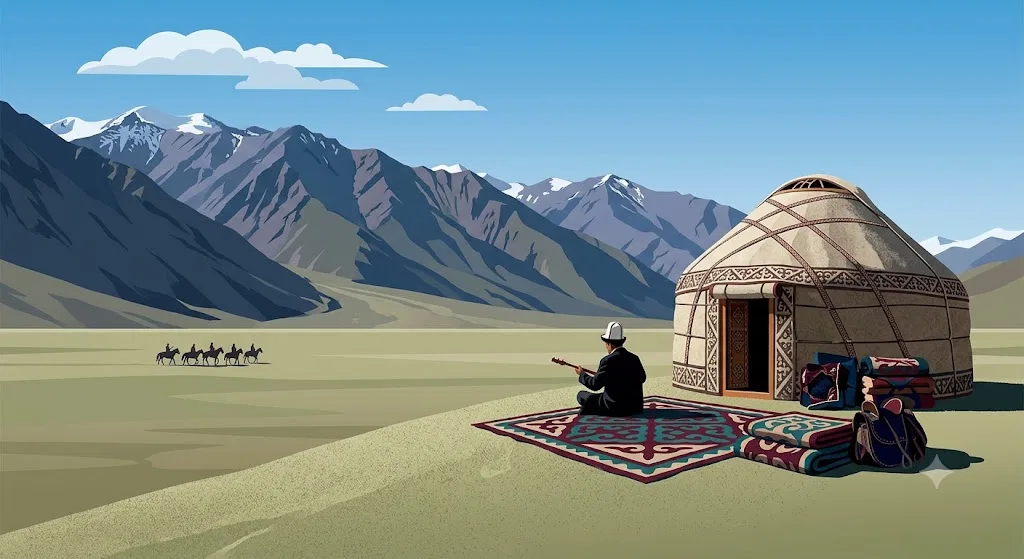
Yurts also belong in this living tradition. UNESCO’s listing for traditional knowledge and skills in making Kyrgyz, Kazakh and Karakalpak yurts describes the yurt as a portable dwelling whose creation fosters cooperation and creativity, and notes that ceremonies such as births, weddings and funerals are held in yurts. The yurt is therefore both an object and a ritual setting: a place where stories are told, guests are received, life-cycle events are marked and craft knowledge is handed down.[UNESCO Intangible Cultural Heritage]ich.unesco.orgOpen source on unesco.org.
Lakes, local legends and tourist retellings
Beyond the nationally celebrated traditions, Kyrgyzstan has many local legends attached to lakes, valleys, towers and roads. Issyk-Kul, the great mountain lake, is surrounded by stories of drowned settlements, tragic lovers, hidden cities and mysterious sounds. Travel and tourism sites often retell these legends in simplified form, and they can be memorable, but they should be read as popular and local narrative traditions rather than as firmly dated historical evidence.[DCAT-new]central-asia.comDCAT-new Legends of Issyk-Kul LakeDCAT-new Legends of Issyk-Kul Lake
That distinction matters because tourism can both preserve and flatten folklore. A legend told at a lakeside, in a guidebook or at a yurt camp may keep a story circulating, but it may also merge variants, remove awkward details or turn a complex local tradition into a romantic anecdote for visitors. The same issue appears with sacred sites: visitor-facing summaries often list places such as Sulaiman-Too, Tash-Rabat, Burana Tower and Issyk-Kul as folklore landscapes, but the strength of evidence varies from site to site.[Mars Travel Stan]marstravelstan.comOpen source on marstravelstan.com.
For readers, the useful approach is to ask what kind of story is being offered. Is it an oral tradition recorded from local narrators? A modern tourism tale? A museum interpretation? A Soviet-era literary retelling? A sacred-site belief still practised today? Kyrgyz folklore is richest when those forms are not collapsed into one undifferentiated “legend”.
Old tradition, Soviet editing and post-independence revival
Kyrgyz folklore has changed sharply over the last century. Oral epics were performed long before Soviet rule, but Soviet institutions collected, edited, classified and sometimes ideologically reshaped them. The Oxford account of Orozbakov’s Manas shows how a performer’s oral material became a manuscript, then a scholarly and literary monument, while later Soviet politics affected what could be printed, defended or revised.[Cabinet Office]cabinet.ox.ac.ukCabinet Office Orozbakov’s Manas (Kyrgyzstan) | cabinetCabinet Office Orozbakov’s Manas (Kyrgyzstan) | cabinet
After independence in 1991, Manas and other heritage forms gained new national importance. Kyrgyzstan’s 1995 “Manas 1000” celebration, four years after independence, turned the epic into a major state-building and cultural tourism event; scholarship on those celebrations argues that Manas became a symbol of Kyrgyz self-image, spiritual unity and independence.[University of Strathclyde]pureportal.strath.ac.ukUniversity of Strathclyde Kyrgyzstan's 'Manas' Epos Millennium CelebrationsUniversity of Strathclyde Kyrgyzstan's 'Manas' Epos Millennium Celebrations
The same revival can be seen in craft. Recent reporting on Kyrgyz felting describes women-led craft groups and designers presenting felt not only as a practical material, but as a way to reclaim identity after Soviet-era marginalisation of some traditional practices. This modern revival does not simply “restore” an unchanged past. It reinterprets older skills for museums, fashion, tourism, export markets and national pride.[Vogue]vogue.comMeet the Women Artisans Keeping Kyrgyzstan's Traditional Art of Felting AliveFounded in 1998 by Chinara Makashova and her aunt Roza, Tumar began as a survival strategy after the Soviet collapse but evolved into a m…
How to read Kyrgyz folklore today
The most important thing to remember is that Kyrgyz folklore is both ancient-facing and modern-facing. Manas points back to heroic origins, but it is also used in schools, state symbolism and contemporary cultural politics. Sulaiman-Too preserves ancient cult places and Islamic worship, but it is also a protected World Heritage Site vulnerable to modern development. Felt carpets carry inherited symbols, but they are also part of women’s livelihoods, design markets and heritage branding.[novastan.org]novastan.orgOpen source on novastan.org.
A good reader should therefore avoid two mistakes. The first is treating every tradition as a timeless survival from the deep past. The second is dismissing modern retellings as “inauthentic” simply because they have changed. Kyrgyz folklore has always lived through performance, adaptation and place-based practice. Its power lies precisely in that movement between memory and reinvention.
Kyrgyzstan’s folklore is most vivid when seen as a connected cultural landscape: the bard reciting Manas, the sacred mountain above Osh, the felt patterns inside a yurt, the spring festival meal, the horse game in a public arena, the lake legend retold to travellers, and the family or community deciding which old customs still speak to the present.

Amazon book picks
Further Reading
No matched book cards were available for Where Kyrgyzstan's Legends Still Live, so this fallback keeps a direct Amazon reading path visible.
Topical books
Kyrgyz national identity books
Browse books, explainers and reference titles related to this topic.
Search AmazonRelated search
Kyrgyz national identity guide
Browse books, explainers and reference titles related to this topic.
Search AmazonRelated search
Oral Tradition Performance books
Browse books, explainers and reference titles related to this topic.
Search AmazonEndnotes
1.
Source: ich.unesco.org
Link:https://ich.unesco.org/en/RL/kyrgyz-epic-trilogy-manas-semetey-seytek-00876
Source snippet
UNESCO Intangible Cultural HeritageKyrgyz epic trilogy: Manas, Semetey, SeytekThe Kyrgyz epic trilogy of Manas, Semetey and Seytek descri...
2.
Source: whc.unesco.org
Title: World Heritage Centre Sulaiman-Too Sacred Mountain
Link:https://whc.unesco.org/en/list/1230/
Source snippet
UNESCO World Heritage CentreSulaiman-Too Sacred Mountain - UNESCO World Heritage Centre...
3.
Source: novastan.org
Link:https://novastan.org/en/kyrgyzstan/manas-kyrgyz-epic-national-identity/
4.
Source: ich.unesco.org
Link:https://ich.unesco.org/en/RL/art-of-akyns-kyrgyz-epic-tellers-00065
5.
Source: Wikipedia
Link:https://en.wikipedia.org/wiki/Umay
6.
Source: ich.unesco.org
Title: ala kiyiz and shyrdak art of kyrgyz traditional felt carpets 00693
Link:https://ich.unesco.org/en/USL/ala-kiyiz-and-shyrdak-art-of-kyrgyz-traditional-felt-carpets-00693
7.
Source: ichlinks.com
Link:https://ichlinks.com/archive/materials/photosV.do?ichDataUid=13864979739515099460&nation=KG
8.
Source: unesco.org
Title: document 4927
Link:https://www.unesco.org/archives/multimedia/document-4927
9.
Source: ich.unesco.org
Link:https://ich.unesco.org/en/RL/ak-kalpak-craftsmanship-traditional-knowledge-and-skills-in-making-and-wearing-kyrgyz-men-s-headwear-01496
10.
Source: unesco.org
Link:https://www.unesco.org/en/days/nowruz
11.
Source: ich.unesco.org
Link:https://ich.unesco.org/en/RL/nawrouz-novruz-nowrouz-nowrouz-nawrouz-nauryz-nooruz-nowruz-navruz-nevruz-nowruz-navruz-02097
12.
Source: ich.unesco.org
Link:https://ich.unesco.org/en/RL/kok-boru-traditional-horse-game-01294
13.
Source: ich.unesco.org
Link:https://ich.unesco.org/en/RL/traditional-knowledge-and-skills-in-making-kyrgyz-kazakh-and-karakalpak-yurts-turkic-nomadic-dwellings-02284
14.
Source: central-asia.com
Title: DCAT-new Legends of Issyk-Kul Lake
Link:https://www.central-asia.com/post/legends-of-issyk-kul-lake
15.
Source: vogue.com
Title: Meet the Women Artisans Keeping Kyrgyzstan’s Traditional Art of Felting Alive
Link:https://www.vogue.com/article/kyrgyzstan-traditional-felting-women-artisans
Source snippet
Founded in 1998 by Chinara Makashova and her aunt Roza, Tumar began as a survival strategy after the Soviet collapse but evolved into a m...
16.
Source: Wikipedia
Title: Epic of Manas
Link:https://en.wikipedia.org/wiki/Epic_of_Manas
17.
Source: Wikipedia
Title: Sulayman Mountain
Link:https://en.wikipedia.org/wiki/Sulayman_Mountain
18.
Source: Wikipedia
Title: Encyclopædia Britannica
Link:https://en.wikipedia.org/wiki/Encyclop%C3%A6dia_Britannica
19.
Source: Wikipedia
Title: List of Intangible Cultural Heritage elements in Kyrgyzstan
Link:https://en.wikipedia.org/wiki/List_of_Intangible_Cultural_Heritage_elements_in_Kyrgyzstan
20.
Source: Wikipedia
Title: Al Basty
Link:https://en.wikipedia.org/wiki/Al_Basty
21.
Source: Wikipedia
Title: Zarlik and Munglik
Link:https://en.wikipedia.org/wiki/Zarlik_and_Munglik
22.
Source: Wikipedia
Title: The Golden Headed Fish
Link:https://en.wikipedia.org/wiki/The_Golden-Headed_Fish
23.
Source: Wikipedia
Link:https://en.wikipedia.org/wiki/Tengri
24.
Source: Wikipedia
Link:https://en.wikipedia.org/wiki/Shyrdak
25.
Source: Wikipedia
Title: Ak kalpak
Link:https://en.wikipedia.org/wiki/Ak-kalpak
26.
Source: ich.unesco.org
Title: kyrgyzstan KG
Link:https://ich.unesco.org/en/state/kyrgyzstan-KG
27.
Source: unesco.org
Link:https://www.unesco.org/en
28.
Source: unesco.org
Link:https://www.unesco.org/en/countries/kg/lists-and-nominations
29.
Source: ich.unesco.org
Link:https://ich.unesco.org/en/video/49118
30.
Source: ich.unesco.org
Link:https://ich.unesco.org/en/video/41044
31.
Source: ich.unesco.org
Link:https://ich.unesco.org/doc/src/33535.pdf
32.
Source: ich.unesco.org
Title: search 00795
Link:https://ich.unesco.org/en/search-00795?call=film&id=41044&include=film_inc.php&width=700
33.
Source: unesco.org
Title: almaty development capacities field intangible cultural heritage
Link:https://www.unesco.org/en/articles/unesco-almaty-development-capacities-field-intangible-cultural-heritage
34.
Source: ich.unesco.org
Link:https://ich.unesco.org/en/video/19616
35.
Source: ich.unesco.org
Title: kyrgyzstan KG
Link:https://ich.unesco.org/en/state/kyrgyzstan-KG?info=periodic-reporting
36.
Source: ich.unesco.org
Title: safeguarding of the art of the akyns kyrgyz epic tellers 00021
Link:https://ich.unesco.org/en/projects/safeguarding-of-the-art-of-the-akyns-kyrgyz-epic-tellers-00021?projectID=00021&project_id=00021
37.
Source: ich.unesco.org
Title: photo pop up 00973
Link:https://ich.unesco.org/en/photo-pop-up-00973?photoID=05213
38.
Source: ich.unesco.org
Title: photo pop up 00973
Link:https://ich.unesco.org/en/photo-pop-up-00973?photoID=05208
39.
Source: ich.unesco.org
Link:https://ich.unesco.org/doc/src/Signed%20periodic%20report%20-%20Periodic%20report-67393.docx
40.
Source: ich.unesco.org
Link:https://ich.unesco.org/xml-list.php
41.
Source: unesco.org
Link:https://www.unesco.org/en/memory-world/manuscript-kyrgyz-epic-manas-narrator-sagymbay-orozbakov
42.
Source: ich.unesco.org
Link:https://ich.unesco.org/doc/src/41637.pdf
43.
Source: unesco.org
Title: document 4378
Link:https://www.unesco.org/archives/multimedia/document-4378
44.
Source: unesco.org
Title: preservation and promotion traditional kyrgyz felt carpets ala kiyiz and shyrdak
Link:https://www.unesco.org/en/articles/preservation-and-promotion-traditional-kyrgyz-felt-carpets-ala-kiyiz-and-shyrdak
45.
Source: ich.unesco.org
Title: 10 representative list 00748
Link:https://ich.unesco.org/en/10-representative-list-00748?id=00998&include=slideshow_inc.php
46.
Source: ich.unesco.org
Link:https://ich.unesco.org/en/video/36618
47.
Source: unesco.org
Title: document 3669
Link:https://www.unesco.org/archives/multimedia/document-3669
48.
Source: ichlinks.com
Link:https://ichlinks.com/archive/elements/elementsV.do?elementsUid=13829896117332900074
49.
Source: cabinet.ox.ac.uk
Title: Cabinet Office Orozbakov’s Manas (Kyrgyzstan) | cabinet
Link:https://www.cabinet.ox.ac.uk/orozbakov-s-manas-kyrgyzstan-0
50.
Source: leidenanthropologyblog.nl
Link:https://www.leidenanthropologyblog.nl/articles/beards-and-holy-sites-competing-over-true-islam-in-kyrgyzstan
Source snippet
Leiden Anthropology BlogBeards and holy sites: Competing over True Islam in Kyrgyzstan - Leidenanthropologyblog...
51.
Source: real.mtak.hu
Title: Academy’s Library Repository Albasty: A Female Demon of Turkic Peoples
Link:https://real.mtak.hu/128220/1/article-p413.pdf
52.
Source: marstravelstan.com
Link:https://marstravelstan.com/kyrgyz-legends
53.
Source: pureportal.strath.ac.uk
Title: University of Strathclyde Kyrgyzstan’s ‘Manas’ Epos Millennium Celebrations
Link:https://pureportal.strath.ac.uk/files-asset/65094740/strathprints007660.pdf
54.
Source: advantour.com
Link:https://www.advantour.com/kyrgyzstan/culture/intangible-cultural-heritage-unesco.htm
55.
Source: facebook.com
Link:https://www.facebook.com/unesco/photos/traditional-knowledge-and-skills-in-making-kyrgyz-and-kazakh-yurts-turkic-nomadi/10152865409378390/
56.
Source: edition.fi
Link:https://edition.fi/kalevalaseura/catalog/book/763
57.
Source: qazinform.com
Title: unesco adds central asian yurt tradition to its heritage list da5c68
Link:https://qazinform.com/news/unesco-adds-central-asian-yurt-tradition-to-its-heritage-list-da5c68
58.
Source: archive.unesco-ichcap.org
Link:https://archive.unesco-ichcap.org/kor/ek/sub8/pdf_file/08/05_TRILOGY%20OF%20THE%20EPIC%20%E2%80%98MANAS.%20SEMETEY.%20SEYTEK%E2%80%99%20AS%20NATIONAL%20IDENTITY%20OF%20KYRGYZ%20PEOPLE.pdf
59.
Source: ichlinks.geunnam.com
Link:https://ichlinks.geunnam.com/archive/materials/photosV.do?ichDataUid=13829540849518102289&nation=KG
60.
Source: en.sarykyz.com
Link:https://en.sarykyz.com/unesco
61.
Source: eurasia.travel
Link:https://eurasia.travel/kyrgyzstan/unesco-intangible/
62.
Source: historiskmuseum.no
Title: The Manas epic
Link:https://www.historiskmuseum.no/english/exhibitions/exhibitions-archive/kyrgyzstan/the-manas-epic/
Additional References
63.
Source: youtube.com
Title: Kyrgyz epic trilogy: Manas, Semetey, Seytek
Link:https://www.youtube.com/watch?v=kMDklwoLf34
Source snippet
The Epic of Manas: A Night of Stories on the Kyrgyz Steppe...
64.
Source: youtube.com
Title: The Epic of Manas: A Night of Stories on the Kyrgyz Steppe
Link:https://www.youtube.com/watch?v=6PvUO5sB5xc
Source snippet
The Sacred Mountain of Osh ~ Suleiman-Too | Kyrgyzstan Travel...
65.
Source: youtube.com
Title: Kyrgyzstan-Making Ala-Kiyiz, the Method of Making Shyrdak
Link:https://www.youtube.com/watch?v=3xDDYxTuveE
Source snippet
Ala-kiyiz and Shyrdak, art of Kyrgyz traditional felt carpets...
66.
Source: facebook.com
Link:https://www.facebook.com/XinhuaNewsAgency/videos/revival-of-ancient-epic-manas/970856431850367/
67.
Source: academia.edu
Link:https://www.academia.edu/127117787/Personal_Experience_Stories_at_the_Crossroad_of_Archaeology_and_Folklore
68.
Source: researchgate.net
Link:https://www.researchgate.net/publication/327334340_The_Transfer_of_Tradition_into_the_Contemporary_World_Turkish_Folk_Stories
69.
Source: researchgate.net
Link:https://www.researchgate.net/publication/277090837Kyrgyzstan%27s%27manas%27_epos_millennium_celebrations_post-colonial_resurgence_of_Turkic_culture_and_the_strategic_marketing_of_cultural_tourism
70.
Source: scribd.com
Link:https://www.scribd.com/document/263437150/Monster-Notes
71.
Source: archive.aramcoworld.com
Link:https://archive.aramcoworld.com/issue/200906/shyrdak.and.the.art.of.felt.htm
72.
Source: centralasia-travel.com
Link:https://www.centralasia-travel.com/en/publication/issyk_kul_legends
Amazon book picks
Further Reading
Books and field guides related to Where Kyrgyzstan's Legends Still Live. Use these as the next step if you want deeper reading beyond the article.
Central Asia
Provides historical context for the cultural memory reflected in Kyrgyz legends.
The Silk Roads
Explains the broader Eurasian setting in which Central Asian traditions developed.
Oral Epics of Central Asia
Places Manas and related traditions within the wider Central Asian oral world.
Topic Tree
Follow this branch
Related pages 192
- Afghan Folklore
- Albanian Folklore
- Algerian Folklore
- Australian Folklore
- Azerbaijan Folklore
- +187 more in sidebar