Why Marshallese Legends Still Follow the Sea
Marshall Islands folklore is best understood as a living ocean tradition: stories carried by memory, song, chant, canoe travel, family authority and named places across low coral atolls.
Page outline Jump by section
Why Marshallese folklore is so tied to the sea
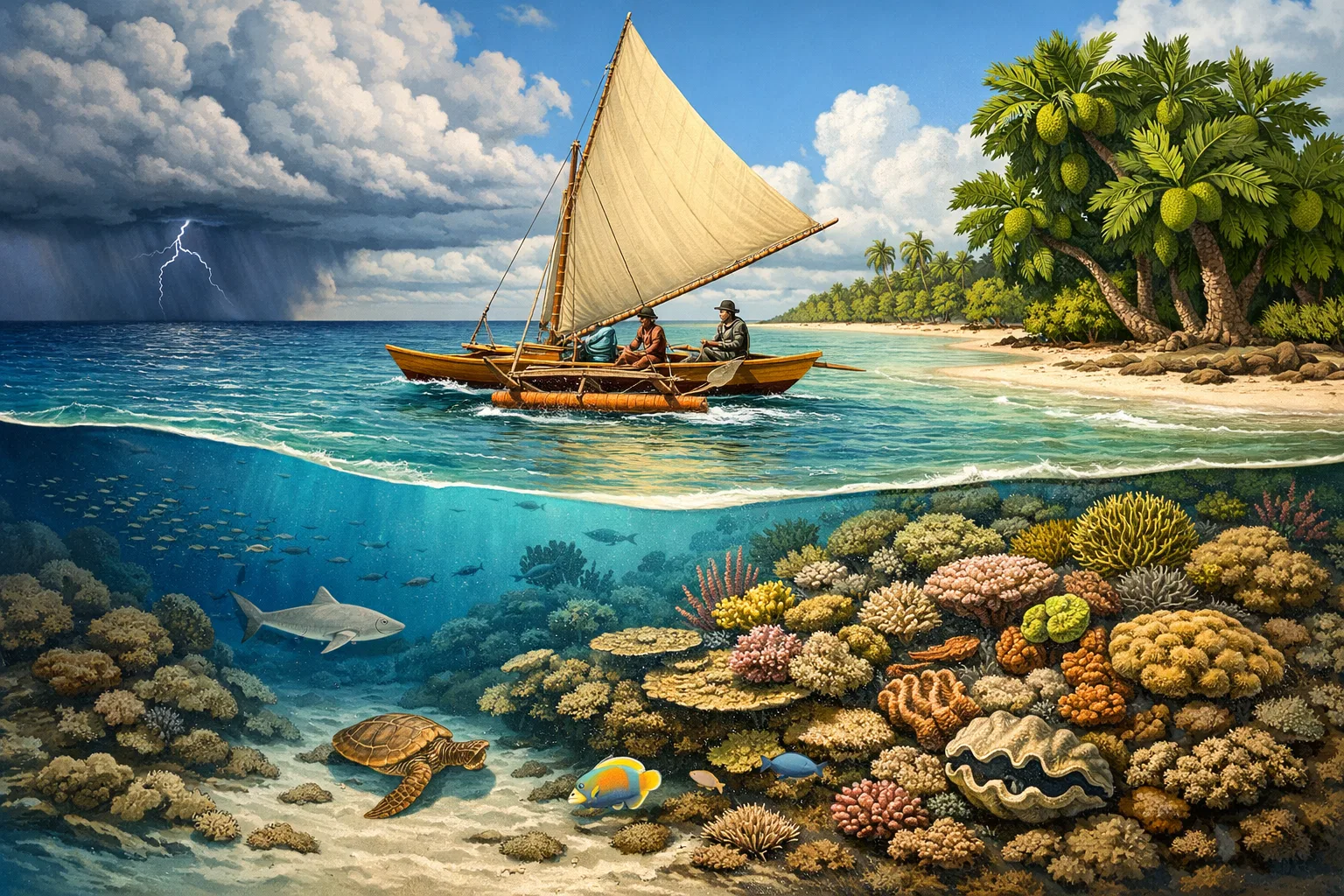
The geography of the Marshall Islands shapes nearly every part of its folklore. The country is made up of 29 atolls and a small number of islands spread across a vast ocean space, traditionally organised in the Ralik and Ratak chains. A Marshall Islands Story Project introduction, written by Marshallese students in consultation with elders, notes that oral tradition remembered the ancestral domain as a “large expanse of ocean”, while also describing land, clan and chiefly authority as central to social life.[mistories.org]mistories.orgMarshall Islands Story ProjectMarshall Islands Story Project
That combination matters. In many folklore traditions, forests, mountains or castles form the natural stage for supernatural events. In the Marshall Islands, the stage is more often a reef, lagoon, canoe, breadfruit tree, fishing ground, beach, channel, atoll or distant island. Stories explain how useful plants arrived, why a reef is dangerous, why a place should be avoided, how a canoe gained its sail, or how a clever being tricked a chief. The supernatural world is not detached from daily life; it is embedded in food, navigation, kinship, land and the moral rules of island society.[marshall.csu.edu.au]marshall.csu.edu.auJane Downing & Dirk H.R. Spennemann, Marshallese Legends and TraditionsJane Downing & Dirk H.R. Spennemann, Marshallese Legends and Traditions
Traditional navigation also blurs the boundary between practical knowledge and oral tradition. Marshallese navigators used stars, waves, currents, environmental signs and stick charts, and recent maritime research records navigators explaining chants that encode signs in water, birds, fish and directions.[mistories.org]mistories.orgMarshall Islands Story ProjectMarshall Islands Story Project Canoes of the Marshall Islands, the cultural organisation also known as Waan Aelõñ in Majel, describes navigational chants as integral to many Marshallese folktales.[canoesmarshallislands.com]canoesmarshallislands.comOpen source on canoesmarshallislands.com.
Letao, the trickster at the centre of many stories
The best-known recurring figure in Marshallese legendary tradition is Letao, usually presented as a trickster. In the Digital Micronesia collection of Marshallese legends, the Letao cycle has its own chapter, including stories of Letao and the Great Mother Turtle, Letao giving fire to people, Letao and his brother Jemeliwut, and Letao in relation to canoes, fire, animals and social disorder.[marshall.csu.edu.au]marshall.csu.edu.auJane Downing & Dirk H.R. Spennemann, Marshallese Legends and TraditionsJane Downing & Dirk H.R. Spennemann, Marshallese Legends and Traditions
A useful example comes from the Marshall Islands Story Project’s recorded tale “A Story of Letao, the Trickster and What He Did in Kiribiti”. The storyteller introduces Letao in a canoe-racing context: a chief in Majuro owns an exceptionally fast canoe, and Letao decides to build a rival craft. He is described as part human and part unknown being, a liminal figure whose oddness gives him power. The story then turns into classic trickster theatre: Letao makes a shining canoe, attracts the chief’s attention, hides in plain sight, and later uses his own body as a deceptive mooring point so that a fleet of canoes drifts away.[mistories.org]mistories.orgMarshall Islands Story ProjectMarshall Islands Story Project
Letao’s importance is not just that he is mischievous. Tricksters often test the rules of a society by breaking them. In Marshallese stories, Letao’s tricks touch on chiefly authority, canoe prestige, social intelligence and the danger of being too easily impressed. The humour is part of the teaching. A reader should not treat Letao as a simple “god of mischief” in a modern fantasy sense; the sources preserve him as a flexible oral figure whose episodes vary by storyteller, island and performance context.[Google Books]books.google.comBooks Marshall Islands Legends and StoriesBooks Marshall Islands Legends and Stories
Giants, monsters and dangerous places
Marshallese folklore includes giants, ghosts, demons, spirit beings and sea creatures, but they usually appear in stories with a local or moral purpose rather than as isolated monsters. The Digital Micronesia table of contents gives a sense of the range: creation legends, origins of islands and places, Letao stories, tales of social customs, animal tales and oral history sit side by side.[marshall.csu.edu.au]marshall.csu.edu.auJane Downing & Dirk H.R. Spennemann, Marshallese Legends and TraditionsJane Downing & Dirk H.R. Spennemann, Marshallese Legends and Traditions
One vivid example is “The Story of Aao”. In this tale, a chief wants a special shining quality or good fortune for his son. The only source lies near Jemo Island, in the throat of a great Mother Eel, a dangerous being described as mother of fish, giant eels and human beings. The story then sends a giant across the ocean between named atolls, turning the geography of the Marshall Islands into a mythic landscape.[marshall.csu.edu.au]marshall.csu.edu.auJane Downing & Dirk H.R. Spennemann, Marshallese Legends and TraditionsJane Downing & Dirk H.R. Spennemann, Marshallese Legends and Traditions
That story shows how Marshallese legend can make a place memorable. Jemo, Ebon, Jaluit, Ailinglaplap, Namu, Kwajalein, Rongelap and Likiep are not anonymous scenery; they become points on a legendary map. The giant’s journey also reflects a recognisably atoll-based imagination: distance, channels, reefs and ocean passages matter. Even supernatural beings must move through a real maritime world.[marshall.csu.edu.au]marshall.csu.edu.auJane Downing & Dirk H.R. Spennemann, Marshallese Legends and TraditionsJane Downing & Dirk H.R. Spennemann, Marshallese Legends and Traditions
The Marshall Islands Cultural and Historic Preservation Office gives official recognition to this link between stories and places. Its criteria for national cultural and historic landmarks include cultural value where a site is important to Marshallese heritage through legends, stories, pre-war sites or shelters, and sacred value where a property is considered sacred or subject to restrictions linked with cultural leaders.[michpo.org]michpo.orgCHPO - Eligibility Criteria…
Origin stories for food, plants and daily life
Many Marshallese legends explain why vital things exist: breadfruit, coconut, taro, bananas, boats, sails, islands and reefs. This is not a minor category. On low atolls, dependable food plants and fishing knowledge are matters of survival, so stories about their origins carry cultural weight.
The Digital Micronesia collection includes stories such as “Tobolar, the first coconut”, “Origin of the coconut tree”, “Origin of the breadfruit” and “Origin of taro”.[marshall.csu.edu.au]marshall.csu.edu.auJane Downing & Dirk H.R. Spennemann, Marshallese Legends and TraditionsJane Downing & Dirk H.R. Spennemann, Marshallese Legends and Traditions In “Origin of the breadfruit”, the story begins with the idea that the only breadfruit in the Marshall Islands grew on Jelbon Islet in Mili Atoll. A youngest brother, mocked by his siblings, survives a frightening encounter and plants both a branch of the breadfruit tree and the foot of the brother who had treated him kindly; from these grow breadfruit trees, including one with superior fruit.[marshall.csu.edu.au]marshall.csu.edu.auJane Downing & Dirk H.R. Spennemann, Marshallese Legends and TraditionsJane Downing & Dirk H.R. Spennemann, Marshallese Legends and Traditions
To a modern reader, that story may sound strange or severe. In context, it belongs to a wider pattern in which origin tales link food, kinship, moral behaviour and place. The mocked child, the dead brother, the stolen fruit and the new tree all form a compact lesson about value, neglect and transformation. These tales are not botanical explanations in a scientific sense; they are cultural explanations for why the foods that sustain life are tied to memory, sacrifice and social conduct.[marshall.csu.edu.au]marshall.csu.edu.auJane Downing & Dirk H.R. Spennemann, Marshallese Legends and TraditionsJane Downing & Dirk H.R. Spennemann, Marshallese Legends and Traditions
Spirits, old religion and Christianity today
Marshallese supernatural belief changed deeply after Christian missions arrived in the nineteenth century. A Marshall Islands Story Project culture introduction states that Christianity was introduced by Protestant missionaries in 1857 and that, before this, Marshallese religion included gods, spirits, death, afterlife, rituals and magic.[mistories.org]mistories.orgMarshall Islands Story ProjectMarshall Islands Story Project The Micronesian Seminar similarly describes Christianity spreading rapidly in the late nineteenth century and supplanting many older religious practices.[Micronesian Seminar]micsem.orgMicronesian Seminar Religion in the Marshall Islands – Micronesian SeminarMicronesian Seminar Religion in the Marshall Islands – Micronesian Seminar
Older belief accounts include a high god, other gods and spirits, spirits appearing in dreams, possession by spirits, ancestral dead who might return, and dangerous spirits associated with sickness or misfortune. The Marshall Islands Story Project introduction says some spirits were thought to possess bodies, some were considered good and some evil, and that the dead could remain near the living, sometimes protecting or frightening them.[mistories.org]mistories.orgMarshall Islands Story ProjectMarshall Islands Story Project
The important point for a folklore page is continuity as well as change. Micronesian Seminar’s account argues that the old spirit world did not disappear entirely: some places such as reefs may still be feared because of old nature spirits, and some forms of divination have been adapted into Christian practice, such as seeking guidance by opening the Bible to a random verse.[Micronesian Seminar]micsem.orgMicronesian Seminar Religion in the Marshall Islands – Micronesian SeminarMicronesian Seminar Religion in the Marshall Islands – Micronesian Seminar This does not mean all Marshallese today hold the same beliefs. It means that older categories of spirits, danger, place and supernatural causation remain part of cultural memory, even within a strongly Christian society.[U.S. Department of State]2021-2025.state.govmarshall islandsmarshall islands
Storytelling, authority and who has the right to tell
Marshallese folklore was traditionally oral, and that matters for how readers should judge the evidence. Before writing became common, stories, chants and songs were used to teach history, survival skills and social values.[mistories.org]mistories.orgMarshall Islands Story ProjectMarshall Islands Story Project Modern collections can preserve important material, but they are not the same thing as a live performance by an elder with permission, audience, voice, gesture and local context.
Daniel A. Kelin’s Marshall Islands Legends and Stories is one of the most accessible modern English-language collections. Its publisher describes it as preserving 50 stories recorded from 18 storytellers on eight islands and atolls, including origin stories, demons, tricksters, disobedient children, wronged husbands, foolish suitors and reunited families.[Bess Press]besspress.comOpen source on besspress.com. Google Books gives the same broad description and notes that the tales relay traditional Marshallese values and customs.[Google Books]books.google.comBooks Marshall Islands Legends and StoriesBooks Marshall Islands Legends and Stories
The Marshall Islands Story Project is another important modern preservation effort. It gathers life stories and traditional tales from Marshallese elders, involves Marshallese students in the preservation process, and archives material in audio, video and text in both English and Marshallese.[mistories.org]mistories.orgMarshall Islands Story ProjectMarshall Islands Story Project This is especially valuable because folklore is not just “content”. It is also a relationship between elders, students, families, islands and permission.
That point affects modern retellings online. Some recent web pages present smooth, dramatic versions of Marshallese myths, but not all clearly distinguish old oral tradition from creative rewriting. For a careful reader, the safer approach is to privilege named collections, cultural institutions, elder recordings, academic work and official heritage bodies over anonymous or highly polished internet retellings that lack provenance.
Folklore as a map of land, rank and kinship
Marshallese stories often carry social information. The Marshall Islands Story Project introduction describes a matrilineal society in which land belonged to the clan, rights to land were inherited through the mother, and chiefs, nobles and workers occupied recognised social tiers.[mistories.org]mistories.orgMarshall Islands Story ProjectMarshall Islands Story Project This matters because legends are not merely entertainment; they can help explain why a place, lineage, title or custom matters.
Chiefly authority appears frequently in stories, sometimes as sacred power, sometimes as an object of trickster mockery. The same introduction says high chiefs were treated with exceptional respect and had responsibilities for community work, sailing expeditions and war.[mistories.org]mistories.orgMarshall Islands Story ProjectMarshall Islands Story Project In the Letao canoe story, the trickster’s actions make more sense when the reader understands the prestige of a chief’s canoe and the social drama of outwitting chiefly power without directly confronting it.[mistories.org]mistories.orgMarshall Islands Story ProjectMarshall Islands Story Project
Official heritage practice also recognises this relationship between place, story and authority. The Cultural and Historic Preservation Office has a National Register of Places and Sites and a National Register of Knowledge Holders; its criteria include people recognised for specialised cultural practices such as canoe construction, mat weaving, storytelling and mentorship.[michpo.org]michpo.orgCHPO - Eligibility Criteria… In other words, the country’s heritage system treats storytelling knowledge itself as a form of cultural expertise.
Canoes, chants and the revival of practical tradition
Canoe tradition is one of the clearest places where folklore, skill and modern cultural revival meet. Stories about canoes appear throughout Marshallese legend, but canoe knowledge is also practical engineering, navigation, apprenticeship and social identity. A 2025 report on intangible cultural heritage and sustainable communities describes Waan Aelõñ in Majel incorporating canoe building, fibreglass technology, carpentry, woodworking and life-skills education into its programmes, while canoe races have become celebrated cultural events in the Republic of the Marshall Islands.[irci.jp]irci.jpOpen source on irci.jp.
This revival is not nostalgic decoration. The same report links canoe work to youth training, public cultural pride and newer interest in wind-powered sustainable sea transport as low-lying atoll communities face climate-related threats.[irci.jp]irci.jpOpen source on irci.jp. That gives Marshallese folklore an unusually contemporary edge: old canoe stories and chants belong to a present-day conversation about education, identity, transport and environmental resilience.
Navigation chants show why “folklore” should not be dismissed as fanciful. In a maritime culture, a chant can be a memory system. Research on Marshallese and Yapese seafaring records navigators discussing a Marshallese navigational chant that identifies signs for atolls, including ocean features, birds, fish and other environmental markers.[Springer]link.springer.comThe Role of Canoe-Building and Navigation in Yapese and Marshallese Seafaring Systems | Journal of Maritime Archaeology | Springe… Such material sits at the border of oral literature and technical knowledge, which is precisely why it is so culturally important.

What is well attested, and what should be treated carefully
The Marshall Islands has a rich folklore record, but not every claim found online deserves equal confidence. The strongest evidence comes from recorded elder testimony, named collections, cultural heritage offices, academic work and long-standing archives. The Digital Micronesia collection, the Marshall Islands Story Project, Kelin’s collected stories, Micronesian Seminar writing on religion, and Cultural and Historic Preservation Office materials together give a fairly strong basis for describing the main patterns: oral transmission, Letao tales, origin stories, spirits, place-based legends, canoe lore and the continuing role of knowledge holders.[edu.au]marshall.csu.edu.auJane Downing & Dirk H.R. Spennemann, Marshallese Legends and TraditionsJane Downing & Dirk H.R. Spennemann, Marshallese Legends and Traditions
What is thinner is the evidence for any single, fixed “Marshallese mythology” in the way readers might expect from Greek or Norse myth books. Marshallese tradition is local, oral and variant-rich. A tale may belong to one atoll, one family line, one storyteller, one performance setting or one chiefly permission structure. That makes it more accurate to speak of Marshallese legends and oral traditions than of a closed canon.
It is also worth being cautious with supernatural labels. “Demon”, “ghost”, “spirit”, “monster” and “god” often appear in English translations, but they may flatten older categories of beings and powers. Good public writing should explain the story without pretending that English folklore categories fit perfectly. The safest framing is to treat these beings as figures in Marshallese tradition: culturally meaningful, locally remembered, and historically transformed by translation, missionisation and modern media.
What Marshall Islands’ folklore preserves for later generations
Marshall Islands folklore matters because it preserves ways of knowing that are inseparable from atoll life. It remembers how to behave towards chiefs and kin, how to respect places, how to think about the dead, how to treat food and land as inherited responsibilities, and how to understand the ocean as both route and danger. Its most memorable stories are lively: tricksters steal canoes, giants wade between atolls, eels guard shining luck, children mock demons, and plants grow out of loss. But behind that liveliness is a serious cultural function.
Today, the tradition survives through elders, families, churches, schools, archives, books, museums, cultural offices, canoe programmes and diaspora memory. The Marshall Islands Cultural and Historic Preservation Office’s mandate is to preserve the cultural and historic heritage of the Republic, and the Marshall Islands Story Project continues the work of gathering stories from elders with student involvement.[michpo.org]michpo.orgOpen source on michpo.org. For readers outside the country, the most respectful approach is to enjoy the stories without stripping them from place, voice and authority. In Marshallese tradition, a legend is rarely just a fantasy. It is often a map, a warning, a memory, a joke, a genealogy, a lesson and a claim of belonging all at once.
Amazon book picks
Further Reading
Books and field guides related to Why Marshallese Legends Still Follow the Sea. Use these as the next step if you want deeper reading beyond the article.
The Hero with a Thousand Faces
Helps readers compare Marshallese stories with world myth traditions.
eBay marketplace picks
Marketplace Samples
Example marketplace items related to this page. Use the search link to explore similar finds on eBay.
Endnotes
1.
Source: mistories.org
Title: Marshall Islands Story Project
Link:https://mistories.org/intro.php
2.
Source: mistories.org
Title: Marshall Islands Story Project
Link:https://mistories.org/
3.
Source: marshall.csu.edu.au
Title: Jane Downing & Dirk H.R. Spennemann, Marshallese Legends and Traditions
Link:https://marshall.csu.edu.au/Marshalls/html/legends/legends2.html
4.
Source: michpo.org
Link:https://www.michpo.org/national-registers/eligibility-criteria
Source snippet
CHPO - Eligibility Criteria...
5.
Source: link.springer.com
Link:https://link.springer.com/article/10.1007/s11457-025-09456-4
Source snippet
The Role of Canoe-Building and Navigation in Yapese and Marshallese Seafaring Systems | Journal of Maritime Archaeology | Springe...
6.
Source: canoesmarshallislands.com
Link:https://www.canoesmarshallislands.com/2014/10/traditional-navigation-chant-2/
7.
Source: mistories.org
Title: Marshall Islands Story Project
Link:https://mistories.org/tales-Laneab-text.php
8.
Source: books.google.com
Title: Books Marshall Islands Legends and Stories
Link:https://books.google.com/books/about/Marshall_Islands_Legends_and_Stories.html?id=oTM7edNmLOIC
9.
Source: marshall.csu.edu.au
Title: Jane Downing & Dirk H.R. Spennemann, Marshallese Legends and Traditions
Link:https://marshall.csu.edu.au/Marshalls/html/legends/le-1-4.html
10.
Source: marshall.csu.edu.au
Title: Jane Downing & Dirk H.R. Spennemann, Marshallese Legends and Traditions
Link:https://marshall.csu.edu.au/Marshalls/html/legends/le-1-10.html
11.
Source: 2021-2025.state.gov
Title: marshall islands
Link:https://2021-2025.state.gov/reports/2019-report-on-international-religious-freedom/marshall-islands/
12.
Source: irci.jp
Link:https://www.irci.jp/wp_files/wp-content/uploads/2025/05/ICHandSC_8_Nagaoka-and-Kelen.pdf
13.
Source: michpo.org
Link:https://www.michpo.org/
14.
Source: irci.jp
Title: Marshall Islands Cultural and Historic Preservation Office
Link:https://www.irci.jp/rdb/item/3560
15.
Source: marshall.csu.edu.au
Title: csu.edu.au Marshallese Legends and Traditions
Link:https://marshall.csu.edu.au/Marshalls/html/legends/le-2-1.html
16.
Source: marshall.csu.edu.au
Title: csu.edu.au Marshallese Legends and Traditions
Link:https://marshall.csu.edu.au/Marshalls/html/legends/le-3-0.html
17.
Source: marshall.csu.edu.au
Title: csu.edu.au Marshallese Legends and Traditions
Link:https://marshall.csu.edu.au/Marshalls/html/legends/le-int-0.html
18.
Source: marshall.csu.edu.au
Title: csu.edu.au Marshallese Legends and Traditions
Link:https://marshall.csu.edu.au/Marshalls/html/legends/le-5-2.html
19.
Source: marshall.csu.edu.au
Title: csu.edu.au Marshallese Legends and Traditions
Link:https://marshall.csu.edu.au/Marshalls/html/legends/le-1-3.html
20.
Source: marshall.csu.edu.au
Title: csu.edu.au Marshallese Legends and Traditions
Link:https://marshall.csu.edu.au/Marshalls/html/legends/le-4-2.html
21.
Source: marshall.csu.edu.au
Title: csu.edu.au Marshallese Legends and Traditions
Link:https://marshall.csu.edu.au/Marshalls/html/legends/le-2-3.html
22.
Source: marshall.csu.edu.au
Title: csu.edu.au Marshallese Legends and Traditions
Link:https://marshall.csu.edu.au/Marshalls/html/legends/le-3-5.html
23.
Source: marshall.csu.edu.au
Link:https://marshall.csu.edu.au/Marshalls/html/legends/fn-le-1-2.html
24.
Source: marshall.csu.edu.au
Link:https://marshall.csu.edu.au/Marshalls/html/tattoo/footnotes-motifs.html
25.
Source: marshall.csu.edu.au
Title: csu.edu.au Marshallese Legends and Traditions
Link:https://marshall.csu.edu.au/Marshalls/html/legends/le-1-8.html
26.
Source: marshall.csu.edu.au
Link:https://marshall.csu.edu.au/Marshalls/html/legends/frame-le-int.html
27.
Source: marshall.csu.edu.au
Link:https://marshall.csu.edu.au/Marshalls/html/RMILAW/RMI_HPO_Law.html
28.
Source: books.google.com
Title: Stories from the Marshall Islands
Link:https://books.google.com/books/about/Stories_from_the_Marshall_Islands.html?id=yUSHbrkbYSwC
29.
Source: books.google.com
Title: Marshall Islands Legends and Stories
Link:https://books.google.com/books/about/Marshall_Islands_Legends_and_Stories.html?id=RGFywPZj8h0C
30.
Source: canoesmarshallislands.com
Link:https://www.canoesmarshallislands.com/category/canoes/
31.
Source: 2009-2017.state.gov
Link:https://2009-2017.state.gov/outofdate/bgn/marshallislands/99069.htm
32.
Source: micsem.org
Title: Micronesian Seminar Religion in the Marshall Islands – Micronesian Seminar
Link:https://micsem.org/article/religion-in-the-marshall-islands/
33.
Source: besspress.com
Link:https://besspress.com/products/marshall-island-legends-pb
34.
Source: amazon.com
Title: Marshall Islands Legends and Stories
Link:https://www.amazon.com/Marshall-Islands-Legends-Stories-Daniel/dp/1573061409?tag=searcht-20
35.
Source: Wikipedia
Title: Oral tradition
Link:https://en.wikipedia.org/wiki/Oral_tradition
36.
Source: everyculture.com
Title: Marshall Islands
Link:https://www.everyculture.com/Oceania/Marshall-Islands-Religion-and-Expressive-Culture.html
37.
Source: howlingfrog.blogspot.com
Title: marshall islands legends and stories
Link:https://howlingfrog.blogspot.com/2017/12/marshall-islands-legends-and-stories.html
Additional References
38.
Source: youtube.com
Title: Legend of Lakdid and his Mother, Marshall Islands
Link:https://www.youtube.com/watch?v=6HEsIksjUho
Source snippet
Marshall Islands folklore legends stories Ancient Marshallese Legend - A Tale of Color - Animation Nuith Morales...
39.
Source: youtube.com
Title: Legend of Lōñberan Who Built His Canoe in Kiribati, Marshall Islands
Link:https://www.youtube.com/watch?v=y_dZhZMcZBk
Source snippet
4 Legend of Lajiminemōn, Marshall Islands...
40.
Source: youtube.com
Link:https://www.youtube.com/watch?v=JCXYvJTS4bU
Source snippet
3 Legend of Lōñberan Who Built His Canoe in Kiribati, Marshall Islands...
41.
Source: youtube.com
Title: Ancient Marshallese Legend
Link:https://www.youtube.com/watch?v=TGEXiOLz8Vo
42.
Source: researchgate.net
Link:https://www.researchgate.net/publication/237725529_PRESERVATION_AND_REVITALIZATION_OF_INTANGIBLE_CULTURAL_HERITAGE_A_Perspective_from_Cultural_Anthropological_Research_on_In_digenous_Navigation_in_the_Republic_of_the_Marshall_Islands
43.
Source: atomicatolls.org
Link:https://www.atomicatolls.org/anthropology-of-the-marshall-island
44.
Source: mcstrmi.org
Link:https://mcstrmi.org/research/culture-and-heritage/
45.
Source: facebook.com
Link:https://www.facebook.com/groups/281886105961506/posts/2043712423112190/
46.
Source: oceanianfolktales.com
Link:https://oceanianfolktales.com/category/micronesian-folktales/marshall-islands-folktales/
47.
Source: infomarshallislands.com
Link:https://www.infomarshallislands.com/resources-3/books-about-rmi/marshall-islands-legends-and-stories/
Topic Tree
Follow this branch
Related pages 192
- Afghan Folklore
- Albanian Folklore
- Algerian Folklore
- Australian Folklore
- Azerbaijan Folklore
- +187 more in sidebar