Within Iraqi Folklore
Are Iraq's Spirits Monsters or Protectors?
Iraqi spirit lore turns fear into story, from jinn and grave-haunting ghouls to amulets used against worse dangers.
On this page
- Jinn, ghouls and dangerous places
- Qarina, ogres and folktale fear
- Pazuzu and the logic of protection
Page outline Jump by section
Introduction
Iraqi spirit lore asks a question that appears across many traditions: are unseen beings always enemies, or can some of them offer protection? In Iraq, stories about jinn, grave-haunting ghouls and protective spirits sit at the meeting point of Islamic belief, Arabic folklore and much older Mesopotamian ideas about danger and defence. Rather than dividing the supernatural neatly into good and evil, many Iraqi traditions imagine a world of powerful beings whose effects depend on place, behaviour and circumstance. A lonely ruin, a desert track, a graveyard or an abandoned house could be imagined as dangerous territory, while prayers, amulets and protective figures were thought to guard against unseen harm. These traditions reveal how generations of Iraqis explained misfortune, illness, fear and uncertainty, while also creating stories that remain memorable in literature, popular culture and everyday conversation.[medievalists.net]medievalists.netDemons, Djinns, and Devils of the Medieval Islamic WorldOctober 31, 2020 — 31 Oct 2020 — Pazuzu, like the later djinn of the Muslim perio…

Jinn, ghouls and dangerous places
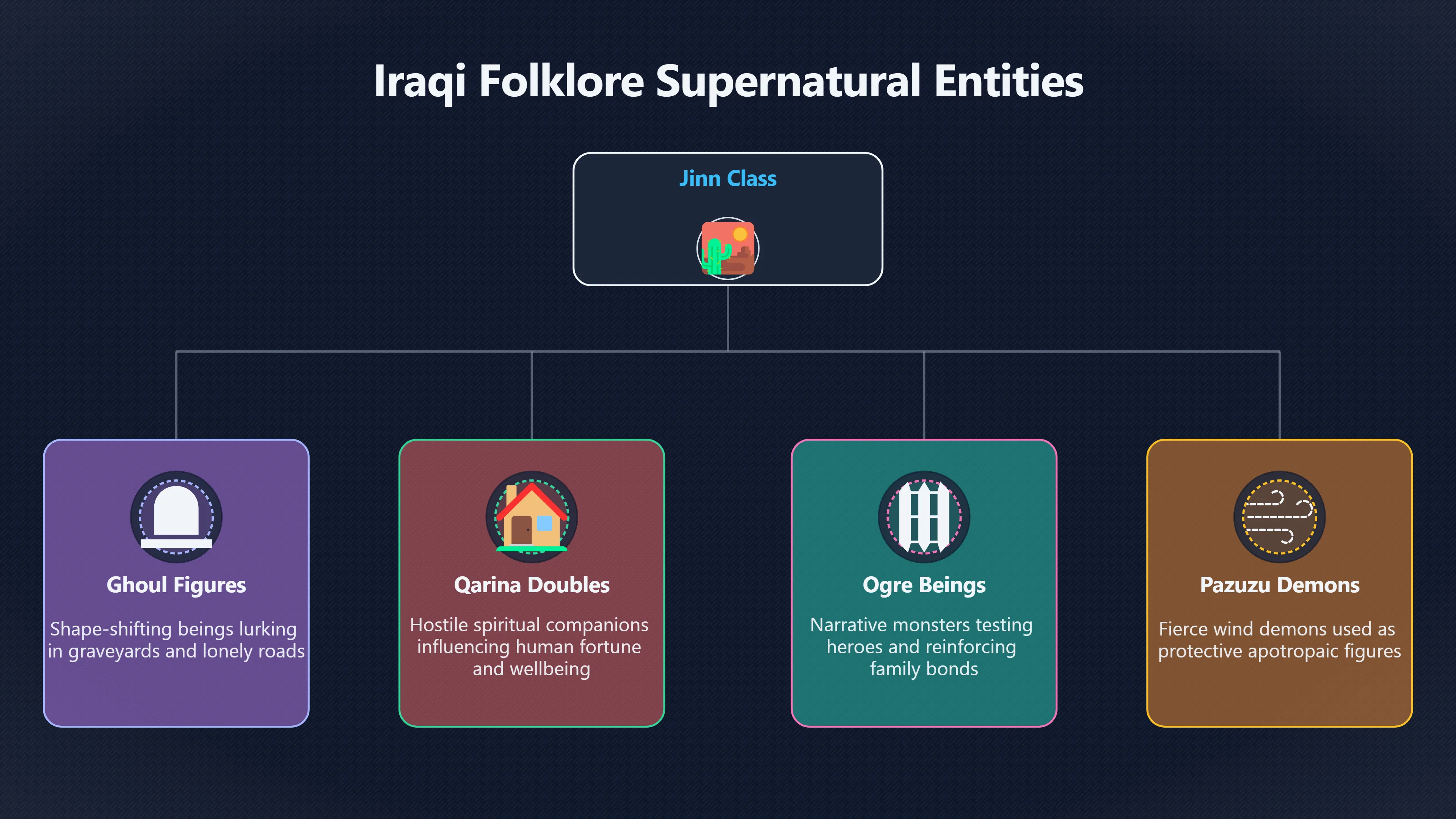
Among the most familiar supernatural beings in Iraq are jinn. In Islamic tradition, jinn are neither angels nor humans but a separate class of intelligent beings capable of choice. They can be virtuous, indifferent or harmful. Because belief in jinn is rooted in Islamic scripture as well as folklore, stories about them occupy a space between religion and popular tradition rather than existing purely as fairy tales.[Scribd]scribd.comJinn WikipediaUnderstanding Jinn in Islamic Mythology | PDF31 Dec 2025 — Jinn, or djinn, are invisible creatures in Islamic mythology, accountabl…
In Iraqi storytelling, jinn are often associated with liminal places: deserts, ruins, isolated waterways, old buildings and locations people avoid after dark. Such settings matter because folklore frequently uses geography to express risk. A dangerous landscape becomes easier to remember when it is populated by supernatural beings. A warning not to travel alone at night, wander into ruins or approach unknown places can become a story about jinn rather than a practical lecture.
One of the most feared figures linked to this world is the ghoul. Originating in Arabic tradition long before modern horror fiction, the ghoul is commonly portrayed as a shape-shifting being that lurks in wilderness areas, graveyards and lonely roads. Stories describe it deceiving travellers by changing appearance, luring victims away from safety and sometimes feeding on the dead or the living. Medieval Arabic literature connected ghouls with deserts and remote regions, making them embodiments of the fear of becoming lost beyond the protection of community.[wikipedia.org]WikipediaOpen source on wikipedia.org.
For Iraqi audiences, the ghoul was not simply a monster. It represented genuine anxieties: getting lost in the desert, travelling at night, encountering strangers, or venturing into places associated with death. Like many folk creatures, it turned practical dangers into memorable narrative form.
Qarina, ogres and folktale fear
Not every threatening spirit in Iraqi tradition appears as a graveyard monster. Folktales collected in Iraq and neighbouring Arab regions also feature malevolent companion spirits, female supernatural attackers and ogre-like beings that threaten families, children or isolated individuals.
One recurring idea across Arabic folklore is the belief in a hostile spiritual double or companion, often referred to in wider Middle Eastern traditions as a qarina. Accounts differ greatly from region to region, but the general theme is that an unseen being may influence human fortune, relationships or wellbeing. In storytelling, such figures often provide explanations for misfortune that seems personal rather than random. A string of bad luck, unexplained illness or domestic conflict could be interpreted through the language of spirit interference rather than chance. While beliefs vary, the qarina illustrates how folklore transforms everyday anxieties into identifiable supernatural actors.
Iraqi folktales also preserve ogre-like creatures whose role is less theological and more narrative. These beings often occupy the same space as giants, witches and child-eating monsters in European fairy tales. They create fear, establish danger and test heroes. Their exact appearance changes from story to story, but their purpose remains consistent: they stand between the protagonist and safety, wealth, marriage or wisdom.
What makes these figures culturally significant is not whether people literally expected to meet them. Folklore uses monsters as social tools. Ogre stories warn children against wandering, reinforce family bonds and dramatise the triumph of cleverness over brute force. In this sense, Iraqi supernatural beings are often moral actors as much as frightening ones.

Pazuzu and the logic of protection
The most surprising figure in Iraqi spirit lore may be Pazuzu. To modern audiences familiar with horror films, Pazuzu is often remembered as a terrifying demon. Yet in ancient Mesopotamia—the land that includes much of modern Iraq—his role was far more complicated. Archaeological evidence shows that people wore amulets bearing his image and placed representations of him in homes for protection.[britishmuseum.org]britishmuseum.orgBritish MuseumamuletThis head was probably suspended close to a woman in labour, for protection against the female demon Lamashtu. A 'bro…
Pazuzu was associated with destructive winds, disease and misfortune, making him a dangerous being in his own right. Yet Mesopotamian protective magic operated on a distinctive principle: a frightening force could be used against an even greater threat. Pazuzu was believed to repel the feared female demon Lamashtu, who was associated with dangers surrounding pregnancy, childbirth and infants. Amulets depicting Pazuzu have been found across Mesopotamian contexts, and museum collections preserve examples specifically connected with protecting mothers and babies.[britishmuseum.org]britishmuseum.orgBritish MuseumamuletThis head was probably suspended close to a woman in labour, for protection against the female demon Lamashtu. A 'bro…
This reveals an important pattern in Iraqi supernatural history. Protective power was not always imagined as gentle or angelic. Sometimes protection came from harnessing a frightening figure against another frightening figure. Scholars describe such objects as apotropaic, meaning they were intended to ward off harm. The logic resembles placing a fierce guardian at a doorway: the guardian itself may be intimidating, but that is precisely why it can defend the household.[wikipedia.org]WikipediaOpen source on wikipedia.org.
The idea survived long after the ancient Mesopotamian religions disappeared. Although later Iraqi beliefs became shaped primarily by Islam and Arabic folklore, the broader habit of using prayers, charms, inscriptions and protective objects against unseen dangers remained remarkably persistent. The forms changed, but the underlying concern—how to defend oneself from invisible harm—continued.
Why spirits can be both monsters and protectors
The most distinctive feature of Iraqi spirit lore is its refusal to separate the supernatural into simple categories. A ghoul is dangerous, but it also teaches caution. A jinn may be harmful, helpful or simply indifferent. Pazuzu was feared yet invoked for protection. Even protective practices often acknowledged the reality of danger rather than pretending it did not exist.[medievalists.net]medievalists.netDemons, Djinns, and Devils of the Medieval Islamic WorldOctober 31, 2020 — 31 Oct 2020 — Pazuzu, like the later djinn of the Muslim perio…
This complexity reflects Iraq’s layered cultural history. Ancient Mesopotamian protective magic, Arabic storytelling traditions and Islamic understandings of the unseen world all contributed to a folklore in which spirits are not merely monsters to defeat. They are mechanisms for explaining uncertainty, mapping dangerous places, protecting vulnerable people and expressing fears that are difficult to describe in ordinary language.
Today, many Iraqis regard such stories as folklore rather than literal accounts, while others continue to treat some beliefs about jinn and spiritual protection seriously within religious frameworks. Either way, the stories remain influential because they address enduring human concerns: fear of the unknown, vulnerability to illness, the dangers of isolation and the hope that some protective force stands between people and harm.

Amazon book picks
Further Reading
Books and field guides related to Are Iraq's Spirits Monsters or Protectors?. Use these as the next step if you want deeper reading beyond the article.
Myths from Mesopotamia
Includes ancient traditions connected to demons, protective powers and supernatural forces.
Legends of the Fire Spirits
Directly addresses the supernatural beings central to Iraqi spirit traditions.
The Arabian Nights
Contains many famous tales involving jinn, magic and supernatural encounters.
The Dictionary of Demons
Provides broader context for figures such as Pazuzu and related entities.
eBay marketplace picks
Marketplace Samples
Live-tested eBay searches with available results related to this page.
Endnotes
1.
Source: medievalists.net
Link:https://www.medievalists.net/2020/10/demons-djinns-devils/
Source snippet
Demons, Djinns, and Devils of the Medieval Islamic WorldOctober 31, 2020 — 31 Oct 2020 — Pazuzu, like the later djinn of the Muslim perio...
Published: October 31, 2020
2.
Source: Wikipedia
Link:https://en.wikipedia.org/wiki/Ghoul
3.
Source: scribd.com
Title: Jinn Wikipedia
Link:https://www.scribd.com/document/974876935/Jinn-Wikipedia
Source snippet
Understanding Jinn in Islamic Mythology | PDF31 Dec 2025 — Jinn, or djinn, are invisible creatures in Islamic mythology, accountabl...
4.
Source: medium.com
Link:https://medium.com/teatime-history/al-ghoul-devilish-arabian-monster-6876c0a5b442
Source snippet
Al-Ghoul: Devilish Arabian MonsterGhouls were the demons or enchantresses of genies that hurt human beings by eating or spoiling their fo...
5.
Source: Wikipedia
Link:https://en.wikipedia.org/wiki/Pazuzu
6.
Source: brewminate.com
Title: Meet the Demons of Ancient Mesopotamia
Link:https://brewminate.com/meet-the-demons-of-ancient-mesopotamia/
Source snippet
May 11, 2021 — Pazuzu's presence on amulets shows that his fearful strength could be used to keep away other harmful demons. Although a p...
Published: May 11, 2021
7.
Source: Wikipedia
Title: British people
Link:https://en.wikipedia.org/wiki/British_people
Source snippet
British peopleThe population of the UK stands at around 67 million, with around 50 million being White British. This includes 44.4 mil...
8.
Source: britishmuseum.org
Link:https://www.britishmuseum.org/collection/object/W
Source snippet
British MuseumamuletThis head was probably suspended close to a woman in labour, for protection against the female demon Lamashtu. A 'bro...
9.
Source: britishmuseum.org
Link:https://www.britishmuseum.org/collection/object/W
Source snippet
figurePazuzu was a prominent demonic figure, named and depicted for the first time in the Assyrian period. Complete figures show him with...
10.
Source: britishmuseum.org
Link:https://www.britishmuseum.org/collection/object/W
Source snippet
plaque; amuletCopper alloy Lamashtu plaque, magical tablet for the sick; reverse has demon (possibly Pazuzu), and obverse has horse and r...
11.
Source: britishmuseum.org
Link:https://www.britishmuseum.org/collection/object/W
Source snippet
amuletDescription: Lamashtu amulet with incomplete cuneiform inscription; representation of the demon Lamashtu standing on an ass sucklin...
12.
Source: britishmuseum.org
Link:https://www.britishmuseum.org/collection/object/W_Rm-II-445
Source snippet
amuletDescription: Glazed composition amulet representing the head of the demon Pazuzu; made in a press-mould with smoothed flat back wit...
13.
Source: reddit.com
Link:https://www.reddit.com/r/UrbanMyths/comments/1gh5zox/pazuzu_a_real_and_terrifying_ancient_mesopotamian/
Source snippet
a real and terrifying ancient Mesopotamian entity...Pazuzu's name was associated with terrifying storms, famine, and diseases, which mad...
Additional References
14.
Source: facebook.com
Link:https://www.facebook.com/BahraniHistory/posts/al-ghoul-devilish-arabian-monsterhow-a-supernatural-creature-preoccupied-the-liv/1177430391238131/
Source snippet
Al-Ghoul: Devilish Arabian Monster How a supernatural...The Ghoul is an inferior but fiendish type of Jinn who is opposed to tra...
15.
Source: facebook.com
Link:https://www.facebook.com/ToledoMuseum/posts/spellbound-secrets-i-am-pazuzu-son-of-hanpu-king-of-the-evil-wind-demons-this-ne/1382949717194604/
Source snippet
Ancient Pazuzu amulet for protectionThe fierce wind demon Pazuzu was believed to guard against darker forces, especially the child-harmin...
16.
Source: deliriumsrealm.com
Link:https://www.deliriumsrealm.com/pazuzu/
Source snippet
Pazuzu: How an Ancient Wind Demon Became a Horror IconPazuzu represents the ambivalence and paradox of evil, as he can be both a destroye...
17.
Source: reddit.com
Link:https://www.reddit.com/r/todayilearned/comments/g0op2a/til_that_pazuzu_the_demon_in_the_exorcist_in/
Source snippet
TIL that Pazuzu, the demon in The Exorcist, in ancient...TIL that Pazuzu, the demon in The Exorcist, in ancient Mesopotamia was actually...
18.
Source: facebook.com
Link:https://www.facebook.com/groups/historyandarchaeologicalmysteriesofancientwo/posts/665963171893557/
Source snippet
despite his terrifying appearance as a hybrid with a dog-like...Read more...
19.
Source: instagram.com
Link:https://www.instagram.com/reel/DOxzG6WjRnZ/?hl=en
Source snippet
ke most evil spirits, he was often invoked as a protector. Ancient...
20.
Source: facebook.com
Link:https://www.facebook.com/groups/archeologyandcivilizations/posts/9109859105774199/
Source snippet
the original work courtesy of the Louvre Museum. The demon Pazuzu...
21.
Source: instagram.com
Link:https://www.instagram.com/reel/Cxf2cQsrUjy/?hl=en
Source snippet
its) and were said to be the offspring of Iblīs, the prince of...
22.
Source: youtube.com
Title: Pazuzu: The Demon Babylon Summoned to Guard Its Children
Link:https://www.youtube.com/watch?v=qUdkykRTSXQ
Source snippet
This Arabic Folklore Ghoul Origins Video provides a scholarly look into the shapeshifting entities that populate the regional legends, wi...
23.
Source: dahenneman.com
Title: Mythical Creatures and Legends
Link:https://dahenneman.com/2019/04/15/mythicalcreaturemonday-ghul-or-ghoul/
Source snippet
Ghul or Ghoul of the Jinn15 Apr 2019 — A ghul (ghoul) is a shape-shifter that feeds on the flesh of humans, and according to Middle Easte...
Topic Tree