Within Moroccan Folklore
Why Is Aisha Qandisha So Feared?
Aisha Qandisha is Morocco's most famous spirit, moving between water legend, jinn belief, possession ritual and modern horror.
On this page
- The spirit near water
- Possession, illness and taboo
- From oral warning to horror icon
Page outline Jump by section
Introduction
Aisha Qandisha is probably the most feared and recognisable supernatural figure in Moroccan tradition. She appears in stories as a beautiful woman who lures men, yet her beauty conceals something disturbing: animal legs, a connection to dangerous waters, and the power to drive victims into madness, illness or possession. Across Morocco, details differ from region to region, but a consistent theme runs through the legend. Aisha Qandisha represents the fear that desire can overwhelm judgement and lead people into physical, moral or spiritual danger. Rather than being a simple monster, she sits at the crossroads of folklore, beliefs about spirits, ritual healing, gender anxieties and modern horror culture.[Wikipedia]WikipediaAisha QandichaAisha Qandicha

Her story survives because it answers questions that have concerned communities for generations: Why do people make reckless choices? How should young men behave around temptation? What causes sudden illness, obsession or unexplained psychological distress? In Moroccan tradition, Aisha Qandisha became one powerful way of discussing those fears.[ResearchGate]researchgate.netResearchGate(PDF) Spirit-Induced Illness In Moroccan Folk Belief A…This article examines the cultural and symbolic functions of spirit…
Why Is Aisha Qandisha So Feared?
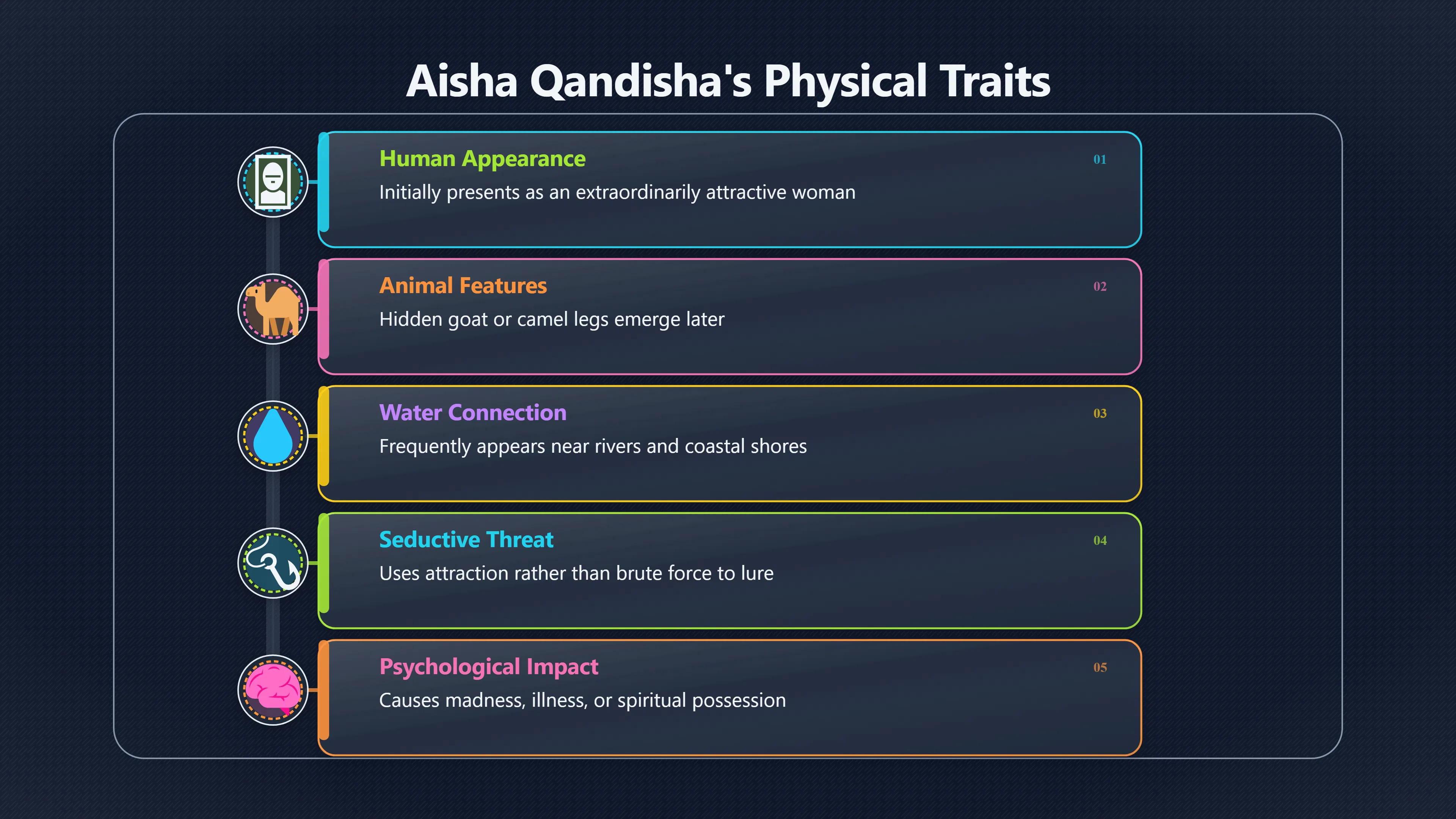
Unlike many anonymous spirits, Aisha Qandisha has a distinct identity. She is not merely one jinn among many but a named being with a recognisable personality and appearance. Most accounts describe her as extraordinarily attractive when first encountered. Only later does her true nature emerge through animal features, often goat or camel legs hidden beneath flowing clothing.[Wikipedia]WikipediaAisha QandichaAisha Qandicha
The fear she inspires comes from this combination of attraction and danger. The threat is not brute force but seduction. Men who follow her are said to become lost, mentally disturbed, possessed or even dead. In folklore terms, she belongs to a broad family of supernatural female figures found around the world, yet the Moroccan version is deeply rooted in local beliefs about spirits, morality and unseen forces.[Wikipedia]WikipediaAisha QandichaAisha Qandicha
Many stories also emphasise that victims willingly approach her. The lesson is important: disaster arrives not because someone is attacked unexpectedly but because desire overrides caution. That moral dimension helps explain why the legend remained useful as both a warning tale and a supernatural explanation for misfortune.
The Spirit Near Water
One of the most striking features of the tradition is Aisha Qandisha’s connection to water. Across numerous regional variants, she is associated with rivers, streams, marshes, springs, canals, lakes and the sea. Different communities identify different locations, but water remains a remarkably stable element of the legend.[Wikipedia]WikipediaAisha QandichaAisha Qandicha
This connection works on several levels.
First, water is physically dangerous. Before modern infrastructure, rivers, canals and isolated shorelines could be genuinely hazardous places, especially at night. Stories warning people away from such locations served a practical purpose.
Second, water occupies a special place in many Moroccan beliefs about spirits. Certain places are regarded as liminal zones where the human world and the unseen world seem unusually close. Aisha Qandisha’s presence at riverbanks and shorelines reflects this wider supernatural geography.[Wikipedia]WikipediaAisha QandichaAisha Qandicha
Third, water reinforces the theme of temptation. Calm surfaces conceal hidden depths. In many retellings, a man encounters a beautiful woman alone near water, approaches her, and only gradually discovers that something is terribly wrong. The landscape itself mirrors the story’s central warning: appearances can deceive.
Possession, Illness and Taboo
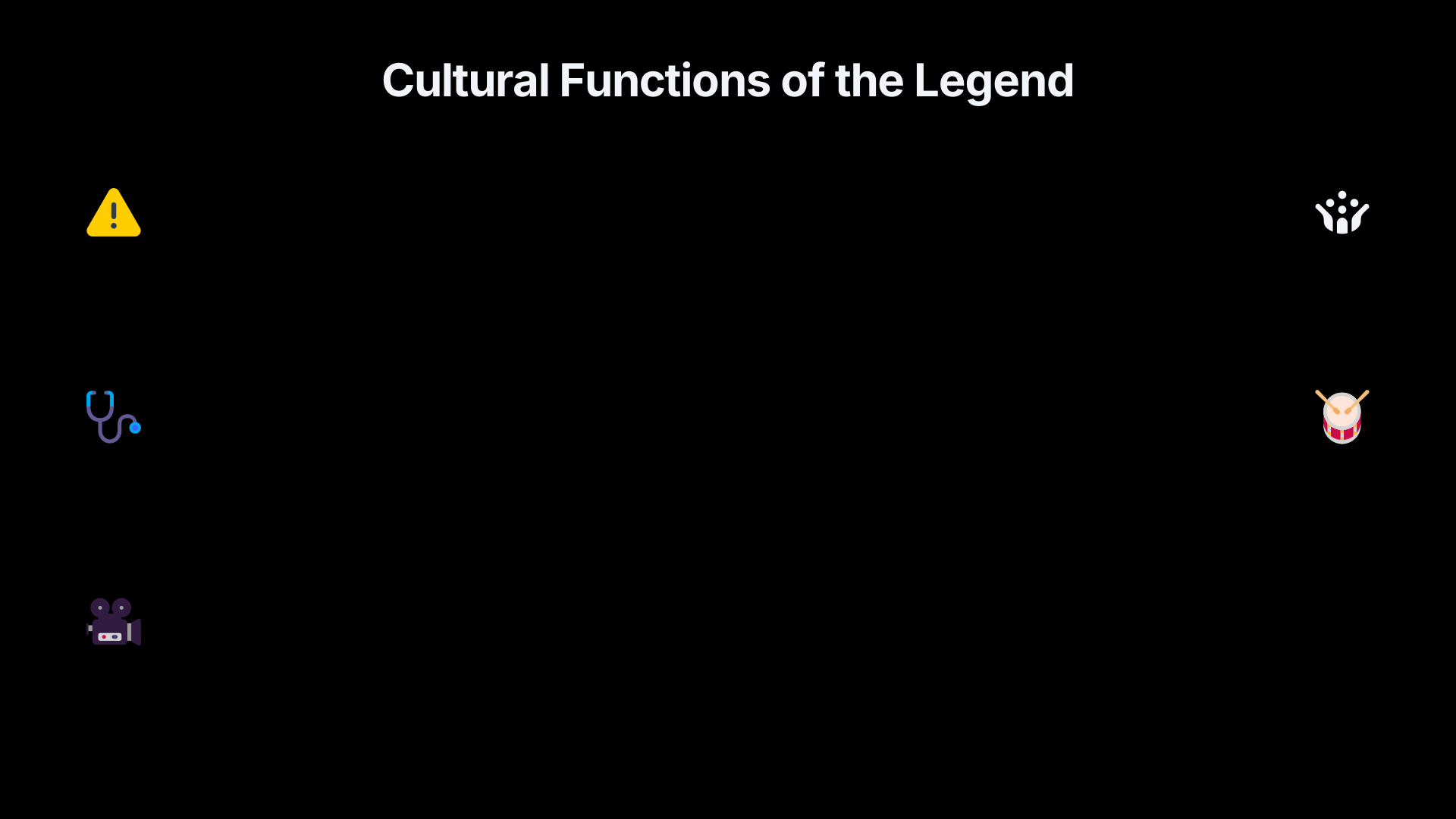
Aisha Qandisha is not only a character in frightening stories. She also appears in traditions surrounding spirit possession and illness. Ethnographic and folkloric studies describe beliefs that she can afflict people with psychological disturbance, strange behaviour, persistent misfortune or symptoms interpreted as spirit possession.[ResearchGate]researchgate.netResearchGate(PDF) Spirit-Induced Illness In Moroccan Folk Belief A…This article examines the cultural and symbolic functions of spirit…
In this context, the legend becomes more than entertainment. It helps communities make sense of experiences that otherwise seem difficult to explain. Traditional interpretations may connect unusual behaviour, emotional crises or sudden changes in personality to the influence of a spirit. Scholars have noted that figures such as Aisha Qandisha often function as cultural frameworks through which suffering, anxiety and social tension are understood.[ResearchGate]researchgate.netResearchGate(PDF) Spirit-Induced Illness In Moroccan Folk Belief A…This article examines the cultural and symbolic functions of spirit…
The themes associated with her are revealing:
- Sexual transgression and forbidden desire.
- Fear of uncontrolled impulses.
- Anxiety about relationships between men and women.
- Concerns about social boundaries and proper behaviour.
- The possibility that hidden forces can affect health and wellbeing.[ResearchGate]researchgate.netResearchGate(PDF) Spirit-Induced Illness In Moroccan Folk Belief A…This article examines the cultural and symbolic functions of spirit…
Seen this way, Aisha Qandisha is less a simple villain than a symbolic figure through whom communities discuss subjects that are difficult, embarrassing or frightening.
Why Desire Sits at the Centre of the Legend
The enduring power of Aisha Qandisha comes from the way she transforms desire into a supernatural threat. In many stories, attraction itself becomes dangerous. Beauty is not presented as harmless; it is a test.
This does not mean the tradition is simply anti-romantic or anti-female. Rather, it reflects broader social concerns about self-control, reputation and vulnerability. Folklore often externalises inner fears by turning them into monsters. Aisha Qandisha gives a face to anxieties about temptation and loss of control.[Untold Mag]untoldmag.orgthe myth of aicha qandisha reclaiming her as a feminist figureUntold MagThe myth of Aicha Qandisha: a feminist figure to rehabilitate?31 Jul 2024 — Often portrayed as half-woman, half-camel, this fig…
Modern commentators have increasingly examined the gender politics of the legend. Some interpret her as evidence of patriarchal fears surrounding female sexuality. Others view her as a figure of resistance who punishes male arrogance and predatory behaviour. These readings are modern interpretations rather than traditional explanations, but they show how adaptable the character remains.[Untold Mag]untoldmag.orgthe myth of aicha qandisha reclaiming her as a feminist figureUntold MagThe myth of Aicha Qandisha: a feminist figure to rehabilitate?31 Jul 2024 — Often portrayed as half-woman, half-camel, this fig…
The very ambiguity of the figure helps keep her relevant. She can be read as a demon, an avenger, a warning, a victim, a spirit of nature or a symbol of social anxiety, depending on the storyteller and audience.
Did Aisha Qandisha Begin as a Real Person?
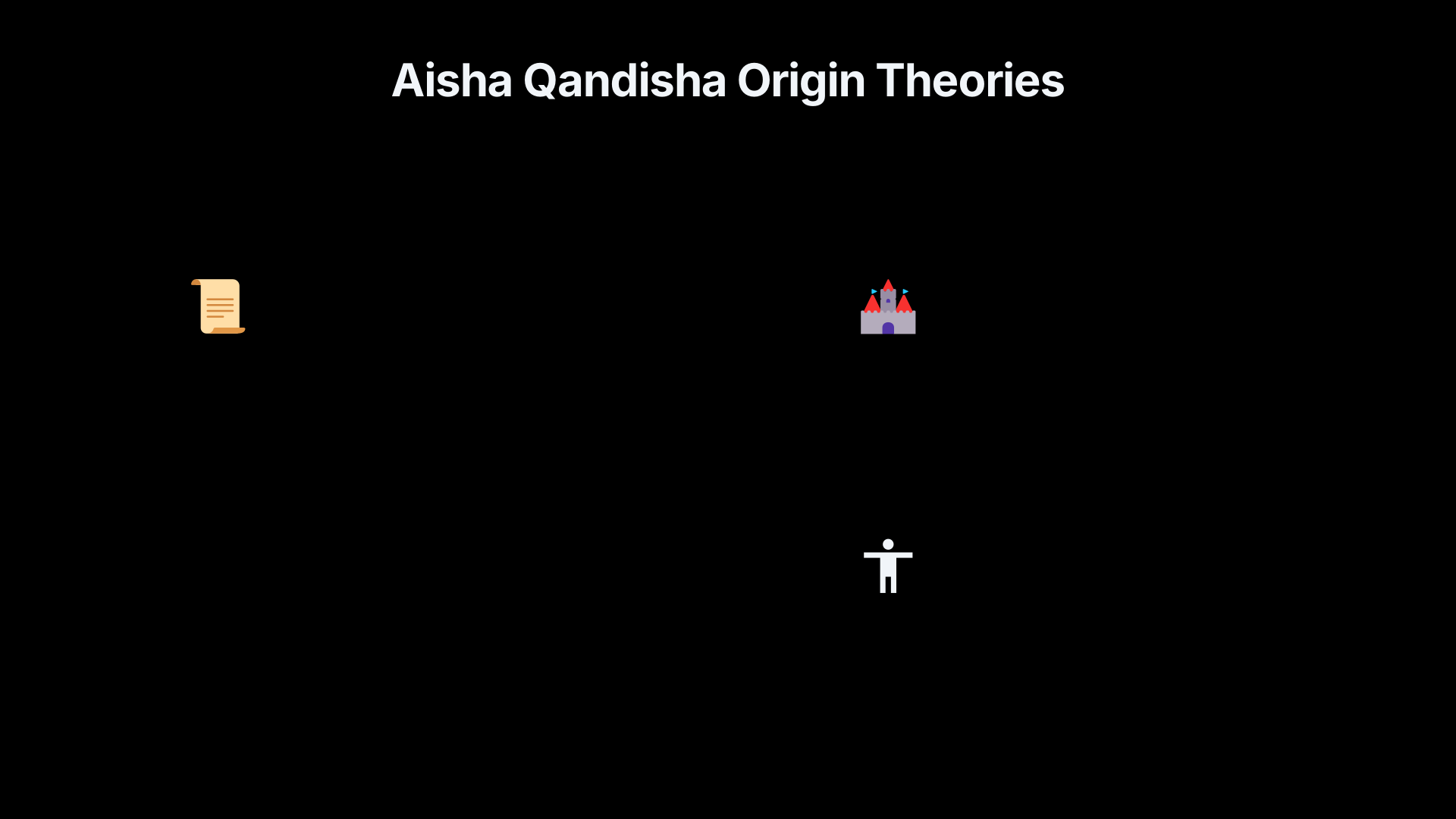
The origins of the legend remain uncertain. Early twentieth-century scholar Edward Westermarck proposed connections to ancient Mediterranean and Near Eastern religious traditions, but many of his specific identifications are no longer accepted by modern scholarship.[Wikipedia]WikipediaAisha QandichaAisha Qandicha
Another popular theory links Aisha Qandisha to stories about a historical woman who resisted Portuguese occupation along Morocco’s Atlantic coast. According to later retellings, she supposedly used her beauty to lure enemy soldiers into ambushes. Over time, the tale suggests, memory transformed a human figure into a supernatural one. While this explanation is widely repeated, firm historical evidence remains limited.[Wikipedia]WikipediaAisha QandichaAisha Qandicha
What matters folklorically is not whether a single origin can be proven. Like many famous legends, Aisha Qandisha appears to have absorbed influences from multiple periods and communities. Her story evolved because people continued finding new meanings in her.
From Ritual Presence to Horror Icon
Aisha Qandisha did not remain confined to oral storytelling. She became part of ritual and musical traditions associated with spirit possession, particularly within communities connected to healing ceremonies and trance practices. Sources discussing Gnawa and related traditions note the broader role of named spirits within possession and healing frameworks, where music, rhythm and altered states of consciousness are used to address spiritual affliction.[afropop.org]afropop.orgdeborah kapchan on the gnawa of moroccoAfropop WorldwideDeborah Kapchan on the Gnawa of Morocco8 Dec 2023 — Scholar and author Deborah Kapchan discusses the histroy and practic…
In the twentieth and twenty-first centuries, she also moved into literature, film, music and popular culture. Horror creators found her especially appealing because she already possessed many qualities associated with modern supernatural villains: a memorable appearance, an unsettling blend of attraction and terror, and a reputation known across Morocco.[Wikipedia]WikipediaAisha QandichaAisha Qandicha
Yet modern horror often simplifies her. Traditional accounts are richer and more ambiguous than the straightforward monster of many films and internet retellings. In folklore, she is simultaneously a warning figure, a spirit associated with place, an explanation for misfortune, a participant in ritual culture and a symbol of social fears.
What the Legend Reveals About Moroccan Folklore
Aisha Qandisha endures because she embodies several of the most important themes in Moroccan supernatural tradition at once: the power of unseen forces, the dangers hidden within everyday landscapes, the possibility of spirit possession, and the tension between desire and self-control.[researchgate.net]researchgate.netResearchGate(PDF) Spirit-Induced Illness In Moroccan Folk Belief A…This article examines the cultural and symbolic functions of spirit…
Her story also demonstrates how Moroccan folklore rarely draws sharp boundaries between tale, belief, ritual and social commentary. A frightening encounter beside a river, a warning told to children, a possession narrative, a healing ceremony and a horror film can all belong to the same cultural life of the legend.
For that reason, Aisha Qandisha remains far more than a ghost story. She is one of Morocco’s most enduring ways of talking about temptation, vulnerability and the risks that appear when desire seems stronger than judgement.[Wikipedia]WikipediaAisha QandichaAisha Qandicha
Amazon book picks
Further Reading
Books and field guides related to Why Is Aisha Qandisha So Feared?. Use these as the next step if you want deeper reading beyond the article.
Moroccan Folktales
Most likely source lane for stories surrounding Aisha Qandisha and related folklore.
Legends of the Fire Spirits
Aisha Qandisha is commonly understood within wider jinn and spirit traditions.
The Arabian Nights
Contains many tales of temptation, spirits and supernatural encounters.
eBay marketplace picks
Marketplace Samples
Live-tested eBay searches with available results related to this page.

Endnotes
1.
Source: Wikipedia
Title: Aisha Qandicha
Link:https://en.wikipedia.org/wiki/Aisha_Qandicha
2.
Source: researchgate.net
Link:https://www.researchgate.net/publication/395844879_Spirit-Induced_Illness_In_Moroccan_Folk_Belief_A_Comparative_Study_Of_Aisha_Qandisha_And_The_Grave_Mule
Source snippet
ResearchGate(PDF) Spirit-Induced Illness In Moroccan Folk Belief A...This article examines the cultural and symbolic functions of spirit...
3.
Source: theaspd.com
Link:https://theaspd.com/index.php/ijes/article/view/9578/6870
Source snippet
View of Spirit-Induced Illness In Moroccan Folk Belief A...Two particularly prominent figures in Moroccan spiritual folklore are Aisha Q...
4.
Source: Wikipedia
Title: Aisha Kandisha
Link:https://es.wikipedia.org/wiki/Aisha_Kandisha
5.
Source: afropop.org
Title: deborah kapchan on the gnawa of morocco
Link:https://www.afropop.org/articles/deborah-kapchan-on-the-gnawa-of-morocco
Source snippet
Afropop WorldwideDeborah Kapchan on the Gnawa of Morocco8 Dec 2023 — Scholar and author Deborah Kapchan discusses the histroy and practic...
6.
Source: penn.museum
Link:https://www.penn.museum/sites/expedition/moroccan-gnawa-and-transglobal-trance/
Source snippet
Moroccan Gnawa and Transglobal TranceThe Gnawa are ritual musicians who were brought to Morocco mostly as slaves in the 15th and 16th cen...
7.
Source: untoldmag.org
Title: the myth of aicha qandisha reclaiming her as a feminist figure
Link:https://untoldmag.org/the-myth-of-aicha-qandisha-reclaiming-her-as-a-feminist-figure/
Source snippet
Untold MagThe myth of Aicha Qandisha: a feminist figure to rehabilitate?31 Jul 2024 — Often portrayed as half-woman, half-camel, this fig...
8.
Source: genies.fandom.com
Title: Aisha Qandisha
Link:https://genies.fandom.com/wiki/Aisha_Qandisha
Source snippet
Qandisha | DemonologyBeautiful young woman with legs of a goat, camel, or donkey; sometimes a wizened hag with pendulous breasts; hybrid...
9.
Source: theaspd.com
Link:https://theaspd.com/index.php/ijes/article/view/9578
Source snippet
Spirit-Induced Illness In Moroccan Folk Belief A...10 Sept 2025 — This article examines the cultural and symbolic functions of spirit-in...
Additional References
10.
Source: soufflesmonde.com
Link:https://www.soufflesmonde.com/posts/decolonizing-gnawa-music
Source snippet
Decolonizing Gnawa MusicProminent feminists like Fatima Mernissi argued that the folk belief in Aicha Kandisha, a “repugnant female demon...
11.
Source: medium.com
Link:https://medium.com/entropies/i-saw-aicha-kandisha-and-i-am-cursed-to-never-forget-34da199284db
Source snippet
I Saw Aicha Kandisha, And I Am Cursed To Never ForgetDepicted with the legs of a goat and a bewitching beauty that belies her true nature...
12.
Source: reddit.com
Link:https://www.reddit.com/r/Morocco/comments/1g4gdpv/looking_for_infostories_on_the_aisha_qandicha/
Source snippet
Looking for info/stories on the Aisha Qandicha: r/MoroccoAn ancient Berber Godess, Aisha Kandisha with goat's legs that avenges the popu...
13.
Source: journals.library.columbia.edu
Title: Library Journals View of Witches | Al-ʿUsur al-Wusta
Link:https://journals.library.columbia.edu/index.php/alusur/article/view/uw33saif/uw33saif
Source snippet
of Witches | Al-ʿUsur al-Wusta... spirit realm. The story of Aisha Qandisha is rooted in Morocco's layered geography, where Amazigh, Arab...
14.
Source: academia.edu
Link:https://www.academia.edu/145334876/WOMEN_IN_THE_GNAWA_COMMUNITY_IN_MOROCCO_PSYCHOTHERAPY_SPIRITS_POSSESSION_AND_HEALING_Author_s_Szerz%C5%91_k
Source snippet
rituals and traditions in healing the sick from various diseases by...Read more...
15.
Source: instagram.com
Link:https://www.instagram.com/p/DNBX72-oYWz/?hl=en
Source snippet
al woman. In folklore, she appears as an extraordinarily...Read more...
16.
Source: facebook.com
Link:https://www.facebook.com/Berit.Aicha/posts/aicha-kandicha-also-known-as-aisha-or-qandisha-is-a-complex-mythical-figure-from/10164078182099890/
Source snippet
is a female spirit or jinn believed to live in desolate...Read more...
17.
Source: humanitiesartsandsociety.org
Link:https://humanitiesartsandsociety.org/magazine/the-gnawa-of-morocco-liminal-expansion-in-african-spirituality/
Source snippet
piritual and cultural history of Northern Africa.Read more...
18.
Source: instagram.com
Link:https://www.instagram.com/p/DNBX72-oYWz/
Source snippet
ces. She appears as a woman with camel feet, revealing her...
19.
Source: sarahmaxresearch.com
Title: aisha qandisha the jinn of the rivers
Link:https://sarahmaxresearch.com/2022/02/06/aisha-qandisha-the-jinn-of-the-rivers/
Source snippet
AISHA QANDISHA: THE JINN OF THE RIVERSFeb 6, 2022 — Some people in Morocco think that this water jinn is actually the emanation of Moroc...
Topic Tree