Where Venezuela's Spirits Still Walk
Venezuela’s folklore is not a single mythology with one tidy cast of gods. It is a living mixture of Indigenous oral traditions, Catholic ritual, African and Caribbean influence, plains storytelling, literary retellings, devotional practice and modern ghost lore.
Page outline Jump by section
What makes Venezuelan folklore distinctive?
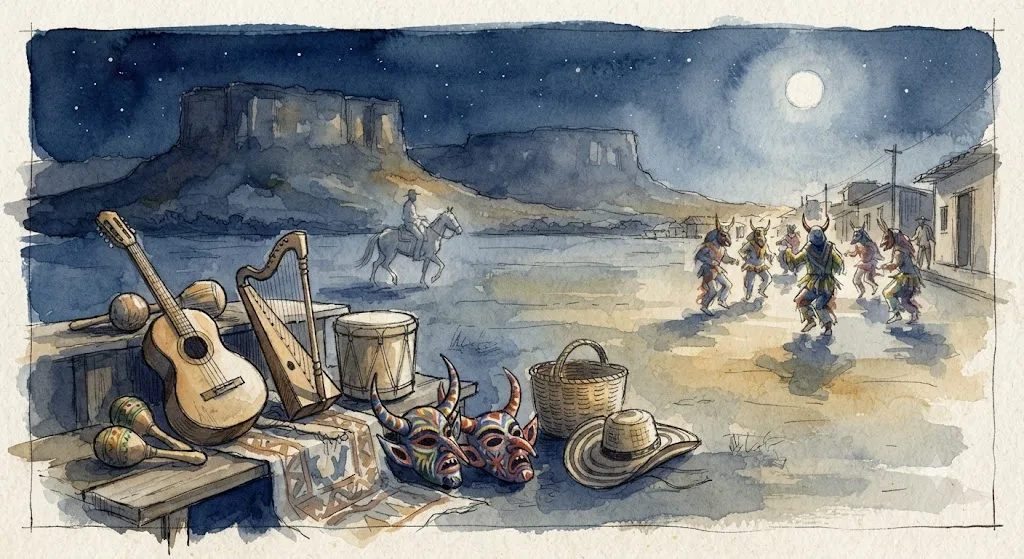
Venezuelan folklore is shaped by geography as much as by belief. The country stretches from Caribbean coast and central valleys to the Orinoco, the plains and the dramatic table mountains of the south-east. Each of these landscapes has generated different kinds of traditional story. The plains are central to tales of riders, night roads, cattle work, singing contests and terrifying warnings. The south-eastern highlands carry Indigenous sacred geography, especially among Pemón communities. Coastal and central regions preserve public Catholic festivals in which devils, saints, music and vows are performed in the street. The mining town of El Callao preserves a carnival memory linked to Afro-Antillean history and Caribbean movement. UNESCO’s intangible heritage listings for Venezuela help show this breadth, from Dancing Devils and El Callao Carnival to Mapoyo oral tradition, llano work songs and joropo.[UNESCO ICH]ich.unesco.orgOpen source on unesco.org.
The most useful way to understand the country’s folklore is to separate three overlapping layers. First are old oral traditions and local belief systems, especially Indigenous cosmologies and regional rural legends. Second are public rituals: festivals, pilgrimages, devotional dances and musical practices that continue in community settings. Third are literary and media retellings, where oral material becomes a poem, a schoolbook story, a horror podcast, a tourist script or a national symbol. The same figure may move between all three layers. A frightening night spirit may begin as a regional cautionary tale, become a printed legend, and then become a social-media horror character.
That movement does not make the tradition “fake”. Folklore often survives precisely because it adapts. The important distinction is whether a story is being presented as old oral tradition, a modern literary version, a devotional practice, a tourist-friendly summary or a recent internet invention. In Venezuela, the strongest traditions usually leave traces across several settings: oral accounts, community performance, regional identity, school culture, music, literature or heritage recognition.
The plains: where ghosts, singers and moral warnings travel at night
The Venezuelan plains are one of the country’s great folklore regions. They are associated with cattle culture, horsemen, work songs, joropo music, improvised verse and lonely roads after dark. UNESCO describes Colombian-Venezuelan llano work songs as unaccompanied vocal practices tied to herding and milking; the songs preserve individual and collective stories of the plains people, but the tradition is now considered vulnerable because social, ecological and demographic changes have altered the conditions in which it was transmitted.[UNESCO ICH]ich.unesco.orgOpen source on unesco.org.
This matters for legends because the plains are not just a backdrop. They provide the social world that makes the stories work: isolated travellers, cattle ranches, night journeys, honour, danger, gossip, drinking, courtship and the fear of being alone beyond the safety of the settlement. The plains are also the setting of joropo, a Venezuelan form that combines music, poetry, singing and dance, with songs often telling stories about love, nature, humour and daily life. UNESCO’s 2025 inscription of joropo in Venezuela underlines that this is not only entertainment but a living expressive system through which stories circulate.[UNESCO ICH]ich.unesco.orgOpen source on unesco.org.
The most famous supernatural figures from this world are not abstract monsters. They behave like warnings. They punish excess, betrayal, violence, arrogance or wandering into danger. That is why many Venezuelan legends feel less like remote mythology and more like stories told close to home: “Do not go that way at night”; “do not betray your family”; “do not let drink, jealousy or pride rule you”; “do not answer every challenge”.
El Silbón: the whistling spirit of punishment and distance
El Silbón, “the Whistler”, is one of Venezuela’s most recognisable ghost legends. He is usually associated with the plains and is often described as a cursed figure carrying bones, announcing himself by a whistle. In many tellings, his whistle reverses normal distance: if it sounds close, he is far away; if it sounds far away, he is dangerously near. Modern retellings vary, but the core pattern is stable enough to be widely recognised: a family tragedy, a curse, a wandering spirit, and a sound that turns the night landscape into a warning system. A Venezuelan writer’s account for The Wild Hunt describes the legend as a family tragedy whose details change by country and version, but which is especially remembered as frightening childhood folklore.[The Wild Hunt]wildhunt.orgThe Wild Hunt Column: El Silbón, a Venezuelan Legend About the AncestorsThe Wild Hunt Column: El Silbón, a Venezuelan Legend About the Ancestors
The story is often told as a moral tale about violence and revenge. In one common version, a young man kills his father after a terrible family conflict and is cursed by his grandfather to wander forever with his father’s bones. Other versions emphasise punishment of drunkards, womanisers or irresponsible men. The protections vary too: dogs, whips, prayer and other ritual defences appear in retellings. These differences are typical of oral legend. A printed summary may make the legend seem fixed, but living folklore usually carries several competing versions at once.[The Wild Hunt]wildhunt.orgThe Wild Hunt Column: El Silbón, a Venezuelan Legend About the AncestorsThe Wild Hunt Column: El Silbón, a Venezuelan Legend About the Ancestors
What makes El Silbón especially effective is the sound. Unlike a monster that must be seen, he is first heard. The whistle turns darkness, distance and uncertainty into the centre of the fear. In a plains environment where a traveller may be far from neighbours, the legend makes the open landscape feel inhabited by judgement. It also connects well with other Latin American warning figures, but it should not be flattened into a generic “boogeyman”. Its Venezuelan force lies in its llanero setting, its link to family violence, and its transformation of a human crime into an endless haunting.
La Sayona: betrayal, gossip and the dangerous woman in white
La Sayona is another major Venezuelan legend, especially associated with the plains. She is commonly described as a female spectre who punishes unfaithful men. The figure overlaps in some readers’ minds with other Latin American wandering women, but her Venezuelan story has its own emotional centre: jealousy, rumour, betrayal, motherhood and the irreversible damage caused by rage. In one Venezuelan retelling, a woman hears that her husband has betrayed her with her mother, kills in anger, and is cursed to roam the plains punishing unfaithful men.[The Wild Hunt]wildhunt.orgThe Wild Hunt Column: La Sayona, a legend about revenge, treason and motherhoodThe Wild Hunt Column: La Sayona, a legend about revenge, treason and motherhood
The story is powerful because its moral is not simply “men should be faithful”. It is also a warning about gossip, suspicion and revenge. The woman’s violence does not restore order; it traps her outside ordinary human life. Some versions give her a name, while others avoid doing so. Some describe her as beautiful before she reveals a monstrous face; others stress her cry, cloak, or ability to appear in different forms. These variations show how the legend can shift between ghost story, cautionary tale, gendered warning and family tragedy.[The Wild Hunt]wildhunt.orgThe Wild Hunt Column: La Sayona, a legend about revenge, treason and motherhoodThe Wild Hunt Column: La Sayona, a legend about revenge, treason and motherhood
Modern readers should be cautious about treating La Sayona as a single ancient myth with one “correct” plot. Much of what circulates online is a simplified horror version. The older folkloric value lies in how the tale works socially: it dramatises the fear that desire, rumour and revenge can destroy kinship. Like El Silbón, La Sayona turns the night road into a moral place. Her story is frightening not only because she may appear to men, but because she represents a household catastrophe that never ends.
Florentino and the Devil: when folklore becomes literature and national memory
Not all Venezuelan supernatural tradition is a ghost story. One of the country’s most important legendary narratives is the contest between Florentino and the Devil, a plains tale in which a singer faces Satan in a duel of improvised verse. The story belongs to the oral world of the llanos, but its best-known form is literary: the Venezuelan poet Alberto Arvelo Torrealba produced the celebrated version that helped stabilise the tale for modern readers. A 2024 academic discussion describes the legend as emerging from a colonial mixture of Indigenous and Christian cosmologies, with an obscure oral origin and a standard literary version that developed through Torrealba’s work.[Cambridge University Press & Assessment]cambridge.orgOpen source on cambridge.org.
The story’s appeal is easy to grasp. Florentino is challenged to sing against a mysterious stranger. The contest lasts through the night. The stranger is revealed as the Devil, and Florentino survives through verbal skill, courage and religious invocation. The form matters as much as the plot: the battle is a sung duel, not a sword fight. It celebrates improvisation, memory, rhythm and wit as powers strong enough to resist evil.[Cambridge University Press & Assessment]cambridge.orgOpen source on cambridge.org.
This is a good example of how folklore and literature feed each other. The tale did not become important only because it was written down; it was already rooted in oral performance culture. But the literary version made it easier to teach, quote, adapt and treat as a symbol of Venezuelan identity. It also shows how Christian imagery entered regional folklore without erasing local texture. The Devil is a recognisable Catholic figure, but the stage is the Venezuelan plain, and the weapon is llanero song.
María Lionza: Venezuela’s great living spirit tradition
María Lionza is one of the most important figures in Venezuelan belief culture because she is not merely a story character. She is the focus of a living devotional and spiritual movement centred on mountains, pilgrimage, trance, healing, offerings and a complex spirit world. Her tradition is usually described as a blend of Indigenous, Catholic and African elements. Reuters reported in 2024 that the fire ritual honouring María Lionza had been recognised by the Venezuelan government as cultural heritage, and described the devotion as one that began in the early twentieth century from a combination of Indigenous, Catholic and African beliefs.[Reuters]reuters.comOpen source on reuters.com.
Her sacred geography is strongly linked to Sorte Mountain in Yaracuy. In popular legend, María Lionza is connected with nature, fertility, harmony and spiritual power, and is often represented riding a tapir. The 2024 Reuters account of the “baile en candela” described worshippers running barefoot over hot coals, cleansing in a nearby river, smoking tobacco and honouring spirits of the dead, with the ritual now devoted to María Lionza.[Reuters]reuters.comOpen source on reuters.com.
The tradition is sometimes called a “cult” in English-language reporting, but that word can sound harsher than intended. In plain terms, it is a Venezuelan popular religious movement with mediums, spirits, pilgrimage and healing practices. Anthropological work has treated María Lionza devotion as a major site for understanding Venezuelan identity, possession and ideas of an authentic or autochthonous past.[JSTOR]jstor.orgOpen source on jstor.org.
María Lionza is also a good example of why folklore should not be reduced to “old stories”. Her tradition includes mythic narrative, but it also includes ritual, bodies, fire, river water, statues, mountains and public heritage politics. It continues to change as devotees, state institutions, journalists, scholars and tourists interpret it. The result is a living national tradition rather than a museum piece.
Sacred landscapes: Pemón mountains, Mapoyo memory and the Orinoco world
Venezuela’s Indigenous oral traditions are essential to the country’s folklore, but they should not be treated as decorative “myths” detached from living communities. In the Gran Sabana and Canaima region, Pemón traditions connect story to mountains, waterfalls and territory. A UNDP account describes Pemón folklore in which the table mountains are home to gods, and notes that older beliefs survive in the Canaima National Park region alongside long-standing Catholic influence.[Exposure]stories.undp.orgOpen source on undp.org.
The landscape itself carries meaning. The dramatic table mountains, or tepuis, are not just scenic features for tourists. In Pemón tradition they are part of a sacred geography. Research on Canaima National Park highlights how even the park’s name is culturally charged: Iokiñe Rodríguez notes that “Canaima” has troubling associations in Pemón language and that a name linked to Makunaimö, the Pemón cultural hero, would have better reflected Indigenous understandings of the place. The same study argues that conservation designations have often failed to respect Pemón values and rights, even when they protect land from some forms of destruction.[ResearchGate]researchgate.netResearch Gate(PDF) Canaima National Park: Spirit of Evil?Research Gate(PDF) Canaima National Park: Spirit of Evil?
The Mapoyo tradition offers another kind of sacred geography. UNESCO’s description of Mapoyo oral tradition emphasises that it is linked to symbolic reference points within ancestral territory along the Orinoco in Venezuelan Guayana, and that it carries social structure, knowledge, cosmogony and historical memory. Its inscription on the Urgent Safeguarding List points to a serious issue: oral traditions can be nationally important while also being endangered at community level.[UNESCO ICH]ich.unesco.orgOpen source on unesco.org.
This is one of the most important distinctions for readers. Some Venezuelan folklore is widely visible because it appears in festivals, songs or online horror. Other traditions may be more fragile, tied to elders, language, land and everyday narration. The fact that a tradition is less famous internationally does not make it less important. In many cases, it may be more urgent.
Devils in the street: Catholic festivals with older echoes
Venezuela’s public ritual calendar includes some of the country’s most memorable folklore. The Dancing Devils of Corpus Christi are among the clearest examples. In small communities along Venezuela’s central coast, masked dancers dressed as devils move backwards in penitence while a Catholic official carries the Blessed Sacrament. UNESCO describes the use of string and percussion instruments, maracas carried by worshippers to ward off evil spirits, and the participation of adults, young men and children in the ritual.[UNESCO ICH]ich.unesco.orgOpen source on unesco.org.
The attraction of the Dancing Devils is not simply the visual drama of masks. The ritual stages a theological and social idea: evil is present, embodied and noisy, but it is made to submit. The dancers’ backward movement matters because it expresses defeat and penitence rather than demonic triumph. This is folklore as public performance, where belief, costume, music, vow and community identity meet in the street.
El Callao Carnival shows a different route into Venezuelan tradition. UNESCO links the Carnival of El Callao to emancipation celebrations in French-speaking Caribbean islands and describes parades of historical and fantasy characters, music, dancing and concerts running from January to March. The festival reinforces local identity and encourages younger generations to discover their heritage.[UNESCO]unesco.orgEl Carnaval de El Callao | Intangible HeritageEl Carnaval de El Callao | Intangible Heritage
These festivals are useful reminders that Venezuelan folklore is not only about fear. It is also about belonging. Masks, music and ritual action make history visible. They turn memory into something performed by bodies in public space, not merely told in words.
Haunted places, tourist retellings and modern media
Modern Venezuelan folklore is increasingly shaped by tourism, migration, schools, social media and horror entertainment. Canaima and the tepui landscapes are often marketed through wonder and mystery. María Lionza’s mountain rituals attract photographers and journalists. El Silbón and La Sayona circulate through podcasts, short videos, horror blogs and Halloween-style lists, sometimes detached from their regional and moral context.
This is not automatically a loss. Popular retellings can keep names alive and introduce younger audiences to traditions they might otherwise not encounter. But they can also flatten complicated beliefs into generic “scary Latin American legends”. El Silbón becomes merely a monster with a whistle; La Sayona becomes just a vengeful woman in white; María Lionza becomes an exotic image without her devotional community; Pemón sacred geography becomes a fantasy landscape for visitors.
A careful reader should ask three questions when encountering a Venezuelan legend online:
- Where is the story placed? A plains legend, an Orinoco oral tradition, a Yaracuy pilgrimage and a coastal Catholic festival belong to different worlds.
- What kind of source is telling it? A community ritual, a UNESCO heritage file, an academic article, a literary poem, a tourist blog and a horror video do not carry the same kind of evidence.
- What has changed in the retelling? Violence, sexuality, Christian imagery, Indigenous identity and national symbolism are often exaggerated, softened or rearranged depending on the audience.
The best modern retellings do not pretend that folklore is frozen. They show how traditions change while still respecting their local roots.
How old and well-attested are Venezuela’s major traditions?
The answer depends on the tradition. Some Venezuelan folklore is old in oral form but difficult to date precisely. El Silbón and La Sayona are widely recognised, but their accessible evidence is often made of retellings, school memories, popular collections and regional testimony rather than a single early document. That does not make them unimportant; it means they should be described as oral legends with multiple versions, not as fixed ancient myths.
Florentino and the Devil is better documented as a bridge between oral tradition and literature. Its oral roots are placed in the colonial llanos, while its most influential modern form is tied to Alberto Arvelo Torrealba’s literary treatment in the twentieth century.[Cambridge University Press & Assessment]cambridge.orgOpen source on cambridge.org.
María Lionza is comparatively well attested as a twentieth-century Venezuelan popular religious movement, even though legends about her may be set in earlier Indigenous or colonial time. The difference matters: the mythic biography may speak in the language of deep ancestry, while the organised devotional movement is usually discussed by scholars and journalists as a modern syncretic tradition.[Reuters]reuters.comOpen source on reuters.com.
UNESCO-listed traditions such as the Dancing Devils, El Callao Carnival, Mapoyo oral tradition, llano work songs and joropo have strong institutional documentation, though that does not mean UNESCO “created” their importance. Rather, UNESCO recognition records and publicises practices already valued by communities and the state.[UNESCO ICH]ich.unesco.orgOpen source on unesco.org.
The most honest summary is this: Venezuela has a rich and well-attested field of living tradition, but individual legends vary in documentary depth. Some are securely documented through heritage institutions and scholarship; others are best approached as widely circulated oral legends whose exact origins remain uncertain.
Why Venezuelan folklore still matters today
Venezuelan folklore matters because it preserves more than colourful stories. It carries arguments about land, morality, ancestry, survival and national identity. El Silbón and La Sayona warn that family violence, betrayal and revenge do not end neatly. Florentino and the Devil celebrates wit, courage and song as defences against evil. María Lionza shows how Venezuelans have created a distinctive popular spirituality from Indigenous, Catholic and African elements. Pemón and Mapoyo traditions remind readers that land is not just territory but memory, language and sacred reference. Public festivals such as the Dancing Devils and El Callao Carnival turn belief and history into shared performance.[wildhunt.org]wildhunt.orgThe Wild Hunt Column: El Silbón, a Venezuelan Legend About the AncestorsThe Wild Hunt Column: El Silbón, a Venezuelan Legend About the Ancestors
These traditions also show why folklore should be treated carefully. It is tempting to sort material into “real old myth” and “modern invention”, but Venezuela’s belief culture rarely fits that binary. A story may be old in theme, modern in wording, regional in origin and national in later meaning. A ritual may combine Catholic liturgy with local vows and older ideas of protection. A mountain may be a tourist attraction, a World Heritage landscape and an Indigenous sacred place at the same time.
For curious readers, the reward is a richer picture of Venezuela than a list of monsters can provide. Venezuelan folklore is a map of how people have made sense of danger, beauty, loneliness, moral failure, sacred power and belonging. It lives in whistles on the plains, masks on Corpus Christi, songs of cattle work, fire at Sorte, stories along the Orinoco and mountains that are never merely mountains.
Amazon book picks
Further Reading
Books and field guides related to Where Venezuela's Spirits Still Walk. Use these as the next step if you want deeper reading beyond the article.
Open Veins of Latin America
Provides historical context for the cultural world that shaped folklore.
The Penguin Book of Latin American Folktales
Introduces folklore motifs found across Latin America, including Venezuela.
Myths and Legends of Latin America
Provides regional context for Venezuelan legends and spirits.
eBay marketplace picks
Marketplace Samples
Live-tested eBay searches with available results related to this page.
Endnotes
1.
Source: ich.unesco.org
Link:https://ich.unesco.org/en/RL/venezuela-s-dancing-devils-of-corpus-christi-00639
2.
Source: ich.unesco.org
Link:https://ich.unesco.org/en/RL/carnival-of-el-callao-a-festive-representation-of-a-memory-and-cultural-identity-01198
3.
Source: ich.unesco.org
Link:https://ich.unesco.org/en/USL/mapoyo-oral-tradition-and-its-symbolic-reference-points-within-their-ancestral-territory-00983
4.
Source: ich.unesco.org
Link:https://ich.unesco.org/en/RL/joropo-in-venezuela-02092
5.
Source: ich.unesco.org
Link:https://ich.unesco.org/en/USL/colombian-venezuelan-llano-work-songs-01285
6.
Source: ich.unesco.org
Link:https://ich.unesco.org/en/decisions/12.COM/11.A.2
7.
Source: ich.unesco.org
Link:https://ich.unesco.org/en/decisions/20.COM/7.B.1
8.
Source: cambridge.org
Link:https://www.cambridge.org/core/journals/comparative-studies-in-society-and-history/article/devil-and-florentino-specters-of-petropopulism-in-venezuela/2213650405212C781D1EAF12866681B6
9.
Source: reuters.com
Link:https://www.reuters.com/world/americas/venezuela-recognizes-fiery-ritual-honoring-goddess-cultural-heritage-2024-10-14/
10.
Source: jstor.org
Link:https://www.jstor.org/stable/2661219
11.
Source: stories.undp.org
Link:https://stories.undp.org/another-kind-of-gold-mine
12.
Source: researchgate.net
Title: Research Gate(PDF) Canaima National Park: Spirit of Evil?
Link:https://www.researchgate.net/publication/271847785_Canaima_National_Park_Spirit_of_Evil
13.
Source: ich.unesco.org
Link:https://ich.unesco.org/en/decisions/9.COM/9.A.8
14.
Source: unesco.org
Title: El Carnaval de El Callao | Intangible Heritage
Link:https://www.unesco.org/archives/multimedia/document-4356
15.
Source: unesco.org
Title: document 3769
Link:https://www.unesco.org/archives/multimedia/document-3769
16.
Source: ich.unesco.org
Link:https://ich.unesco.org/es/video/11136
17.
Source: ich.unesco.org
Title: 16520 EN.doc
Link:https://ich.unesco.org/doc/src/16520-EN.doc
18.
Source: ich.unesco.org
Link:https://ich.unesco.org/en/video/11136
19.
Source: ich.unesco.org
Title: diablos danzantes de venezuela 00639
Link:https://ich.unesco.org/es/RL/diablos-danzantes-de-venezuela-00639
20.
Source: ich.unesco.org
Title: 16388 ES
Link:https://ich.unesco.org/doc/src/16388-ES.pdf
21.
Source: ich.unesco.org
Link:https://ich.unesco.org/en/lists
22.
Source: ich.unesco.org
Link:https://ich.unesco.org/en/video/22186
23.
Source: ich.unesco.org
Title: oral traditions and expressions 00053
Link:https://ich.unesco.org/en/oral-traditions-and-expressions-00053
24.
Source: ich.unesco.org
Title: what is intangible heritage 00003
Link:https://ich.unesco.org/en/what-is-intangible-heritage-00003
25.
Source: ich.unesco.org
Title: 36227 EN.doc
Link:https://ich.unesco.org/doc/src/36227-EN.doc
26.
Source: ich.unesco.org
Title: safeguarding of nkhonde tumbuka and chewa proverbs and folktales 00431
Link:https://ich.unesco.org/en/project-education/safeguarding-of-nkhonde-tumbuka-and-chewa-proverbs-and-folktales-00431
27.
Source: ich.unesco.org
Title: 42924 EN.doc
Link:https://ich.unesco.org/doc/src/42924-EN.doc
28.
Source: ich.unesco.org
Title: venezuela bolivarian republic of VE
Link:https://ich.unesco.org/en/state/venezuela-bolivarian-republic-of-VE
29.
Source: ich.unesco.org
Title: ITH 15 10.CO M 10.b EN.doc
Link:https://ich.unesco.org/doc/src/ITH-15-10.COM-10.b_EN.doc
30.
Source: ich.unesco.org
Title: ITH 15 10.CO M Decisions EN.doc
Link:https://ich.unesco.org/doc/src/ITH-15-10.COM-Decisions_-EN.doc
31.
Source: ich.unesco.org
Link:https://ich.unesco.org/doc/src/34878.pdf?v=1472479368
32.
Source: ich.unesco.org
Link:https://ich.unesco.org/doc/src/34030.pdf?v=1465564227
33.
Source: ich.unesco.org
Link:https://ich.unesco.org/en/video/41020
34.
Source: ich.unesco.org
Link:https://ich.unesco.org/en/video/36652
35.
Source: ich.unesco.org
Title: venezuela republica bolivariana de VE
Link:https://ich.unesco.org/es/estado/venezuela-republica-bolivariana-de-VE?cp=VE&info=elementos-en-las-listas&topic=fr-etat
36.
Source: ich.unesco.org
Link:https://ich.unesco.org/en/Decisions/11.COM/10.b.36
37.
Source: ich.unesco.org
Link:https://ich.unesco.org/es/listas
38.
Source: ich.unesco.org
Title: photo pop up 00973
Link:https://ich.unesco.org/en/photo-pop-up-00973?photoID=11119
39.
Source: ich.unesco.org
Title: 10b representative list 00891
Link:https://ich.unesco.org/en/10b-representative-list-00891?id=01198&include=slideshow_inc.php
40.
Source: ich.unesco.org
Title: work songs of the llanos of colombia and venezuela 01285
Link:https://ich.unesco.org/en/USL/work-songs-of-the-llanos-of-colombia-and-venezuela-01285?call=film&id=41020&include=film_inc.php&width=700
41.
Source: ich.unesco.org
Link:https://ich.unesco.org/en/home?id=41020&include=film_inc.php
42.
Source: ich.unesco.org
Title: photo pop up 00973
Link:https://ich.unesco.org/en/photo-pop-up-00973?photoID=10331
43.
Source: whc.unesco.org
Link:https://whc.unesco.org/document/154052
44.
Source: jstor.org
Link:https://www.jstor.org/stable/43597532
45.
Source: 2017-2021.state.gov
Title: a democratic crisis in venezuela
Link:https://2017-2021.state.gov/a-democratic-crisis-in-venezuela/
46.
Source: wildhunt.org
Title: The Wild Hunt Column: El Silbón, a Venezuelan Legend About the Ancestors
Link:https://wildhunt.org/2019/11/column-el-silbon-a-venezuelan-legend-about-the-ancestors.html
47.
Source: Wikipedia
Title: El Silbón
Link:https://en.wikipedia.org/wiki/El_Silb%C3%B3n
48.
Source: wildhunt.org
Title: The Wild Hunt Column: La Sayona, a legend about revenge, treason and motherhood
Link:https://wildhunt.org/2020/04/column-la-sayona-a-legend-about-revenge-treason-and-motherhood.html
49.
Source: Wikipedia
Link:https://en.wikipedia.org/wiki/Sayona
50.
Source: reutersconnect.com
Link:https://www.reutersconnect.com/item/suben-a-3342-los-muertos-por-los-terremotos-en-venezuela/dGFnOnJldXRlcnMuY29tLDIwMjY6bmV3c21sX09XTFRBQ0xFUDlXNUFDVlBEOERNUlBPNDRXTFgzUw
51.
Source: wildhunt.org
Title: Column: María Lionza
Link:https://wildhunt.org/2020/07/maria-lionza-the-venezuelan-queen-of-the-spirits.html
52.
Source: ehrafworldcultures.yale.edu
Link:https://ehrafworldcultures.yale.edu/cultures/ss18/summary
53.
Source: Wikipedia
Title: Dancing devils of Corpus Christi
Link:https://en.wikipedia.org/wiki/Dancing_devils_of_Corpus_Christi
54.
Source: Wikipedia
Title: María Lionza
Link:https://en.wikipedia.org/wiki/Mar%C3%ADa_Lionza
55.
Source: Wikipedia
Link:https://en.wikipedia.org/wiki/Venezuela
56.
Source: Wikipedia
Link:https://en.wikipedia.org/wiki/Joropo
57.
Source: Wikipedia
Title: Canaima National Park
Link:https://en.wikipedia.org/wiki/Canaima_National_Park
58.
Source: facebook.com
Link:https://www.facebook.com/unesco/photos/the-oral-tradition-of-the-mapoyo-and-its-symbolic-points-of-reference-within-the/10152863073958390/
59.
Source: villains.fandom.com
Title: La Sayona
Link:https://villains.fandom.com/wiki/La_Sayona
60.
Source: world-heritage-datasheets.unep-wcmc.org
Title: canaima national park
Link:https://world-heritage-datasheets.unep-wcmc.org/datasheet/output/site/canaima-national-park
61.
Source: hrw.org
Link:https://www.hrw.org/americas/venezuela
62.
Source: freedomhouse.org
Link:https://freedomhouse.org/country/venezuela
Additional References
63.
Source: youtube.com
Link:https://www.youtube.com/watch?v=7wABQlMXbzM
Source snippet
El Silbón: The Haunting Whistler of Venezuela...
64.
Source: youtube.com
Title: Venezuela’s Dancing Devils of Corpus Christi
Link:https://www.youtube.com/watch?v=rIZ3J24rk-8
Source snippet
VENEZUELA I went to Sorte Mountain to ask what no one dares to, MARIA LIONZA Documentary...
65.
Source: youtube.com
Title: La Sayona: Venezuela’s Vengeful Spirit
Link:https://www.youtube.com/watch?v=qpCaC02wE0Q
Source snippet
VENEZUELA 4K: Exploring the Heaven on Earth | Epic Cinematic Documentary...
66.
Source: anthrobase.com
Link:https://www.anthrobase.com/Txt/A/Andrade_G_E_01.htm
67.
Source: instagram.com
Link:https://www.instagram.com/reel/DVI8_O5CTM4/
68.
Source: movimientos.org.uk
Link:https://movimientos.org.uk/latest/callao-calypso/
69.
Source: facebook.com
Link:https://www.facebook.com/cVIBINg/posts/the-baile-en-candela-is-one-of-venezuelas-most-remarkable-spiritual-traditions-b/1050091010886029/
70.
Source: gmvivavenezuela.com
Link:https://gmvivavenezuela.com/diablos-danzantes-de-corpus-christi-patrimonio-cultural-inmaterial-de-la-humanidad-y-simbolo-de-la-identidad-venezolana/
71.
Source: instagram.com
Link:https://www.instagram.com/reel/DPrhdTxjOxH/?hl=en
72.
Source: instagram.com
Link:https://www.instagram.com/reel/DRmv1G9iNBR/
Topic Tree
Follow this branch
Related pages 192
- Afghan Folklore
- Albanian Folklore
- Algerian Folklore
- Australian Folklore
- Azerbaijan Folklore
- +187 more in sidebar