Where Ivory Coast's Invisible World Appears
Ivory Coast folklore is not a single national mythology with one fixed pantheon.
Page outline Jump by section
Introduction
The safest way to understand Ivory Coast’s legendary culture is therefore not to ask “What monster do Ivorians believe in?” but “When does the invisible world appear, who is allowed to speak for it, and what does it do for the community?” In Ivory Coast, the supernatural often enters public life through performance, sound, carved forms, ritual experts and protected places rather than through written myths. That makes the country especially rich for readers interested in folklore as a social practice: stories are sung, danced, carved, guarded, argued over, displayed in museums and sometimes reclaimed after colonial removal.
Why Ivory Coast folklore is so diverse
Ivory Coast sits at a cultural crossroads. Its peoples are commonly grouped into broad language-and-culture families such as Akan, Mandé, Kru and Gur or Voltaic communities, but those labels hide much local variation. Minority Rights Group notes French as the official language alongside widely spoken local languages including Dioula and Baoulé, and describes many native dialects and communities including Krou, Manding, Voltaic peoples, Dan, Guro and Gagu.[Minority Rights Group]minorityrights.orgOpen source on minorityrights.org.
That diversity matters because many Ivorian traditions are local, initiated and place-based. A mask seen in one village is not automatically “the same belief” as a mask seen elsewhere. Some practices are attached to particular communities, such as the Guro communities associated with Zaouli, the Tagbana community of Afounkaha associated with Gbofe, or the Atchan people associated with the Djidji Ayôkwé drum. Others belong to wider cultural zones: Akan-related storytelling and ritual worlds connect parts of Ivory Coast with Ghana, while Dan traditions extend into Liberia and Senufo cultural life spans several West African countries.[unesco.org]ich.unesco.orgOpen source on unesco.org.
This also explains why “Ivorian folklore” is often better documented through art history, performance studies, museum catalogues, UNESCO heritage files and travel accounts than through neat collections of myths. Oral stories exist, but the most visible public evidence is often a mask, a dance, a sacred grove, a diviner’s figure, a ceremonial horn ensemble or a returned ritual object.
Masks are not just decoration
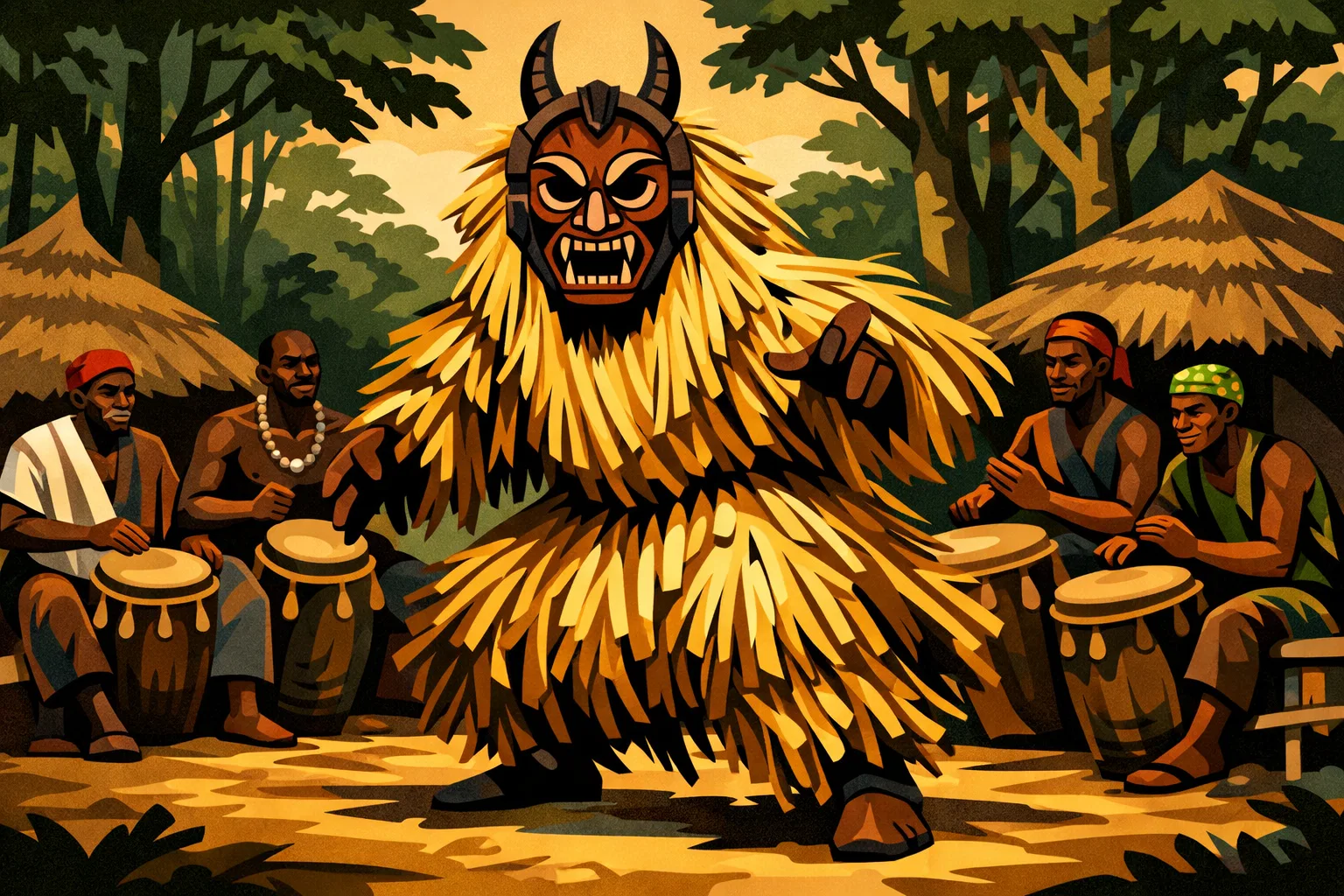
For many readers, the first image that comes to mind is the Ivorian mask. That is understandable: masks from Baule, Dan, Guro, Senufo, Guéré, Wobé and other communities are among the country’s best-known cultural forms. Yet the word “mask” can mislead. In many traditions, the carved face is only one part of a larger event involving costume, music, dance, initiation, secrecy, gender rules, sacrifice, social rank and a trained performer.
A useful rule is this: in older Ivorian ritual settings, the mask is often less an object than a controlled appearance. It may represent or host a spirit, bring ancestors into public attention, enforce moral behaviour, mark life passages, entertain, heal tensions or transform danger into order. A Bradt account of Dan traditions in Godufu, for example, describes a “Forest of Masks” beside the village where ancestors’ spirits are believed to dwell, with sacrifices, drumming, singing and masked dances used to placate powers that affect the fortunes of the living.[Bradt Guides]bradtguides.comBradt Guides Art and tradition: the masks of Ivory CoastBradt Guides Art and tradition: the masks of Ivory Coast
The same source describes a Generations Festival in October, connected with boys returning after months in the Forest of Masks, where they have learned skills associated with manhood. This is folklore in the strong sense: not a story preserved in isolation, but a social drama in which landscape, spirits, elders, young people, music and public memory all meet.[Bradt Guides]bradtguides.comBradt Guides Art and tradition: the masks of Ivory CoastBradt Guides Art and tradition: the masks of Ivory Coast
Museum and heritage sources make the same caution from another direction. A Cleveland Museum of Art entry on a Baule kple kple mask explains that it belongs to a sequence within the Goli dance, with pairs of masks appearing in order and young boys performing a rapid stamping dance. The Smithsonian’s Eliot Elisofon Photographic Archives similarly describes the Baule Goli sequence as four pairs of masks appearing two by two in a fixed order.[Cleveland Museum of Art]clevelandart.orgOpen source on clevelandart.org.
Baule spirits, diviners and the bush
Among the Baule peoples of central Ivory Coast, one of the clearest documented spirit traditions concerns diviners and nature spirits. The Metropolitan Museum of Art describes Baule diviners as people selected by spirits, known as asye usu, to act as mediums through whom important insights into human problems can be communicated. The carved figures used in this practice are not merely portraits; they are treated as attractive resting places for spirits drawn from the bush into the human settlement.[The Metropolitan Museum of Art]metmuseum.orgThe Metropolitan Museum of Art Male figure for a komien (trance divinerThe Metropolitan Museum of Art Male figure for a komien (trance diviner
This is a striking idea because it turns sculpture into negotiation. The bush is imagined as powerful, unruly and spiritually charged, while the village is the world of social order. The diviner’s figure offers beauty, composure and human refinement as a way to invite volatile powers into a form where they can communicate. Smarthistory’s discussion of Baule diviner’s figures explains that these beings are considered associated with untamed nature and are drawn by the dazzling beauty of the sculptures into sharing spiritual insight through the diviner.[Smarthistory]smarthistory.orgOpen source on smarthistory.org.
For folklore readers, this gives Baule spirit belief a very different texture from a simple “ghost story”. The spirit is not just a frightening presence. It is a force that may disturb human life, but it can also become a source of knowledge if approached through the correct ritual specialist, object, offering and performance. The tradition is also a reminder that some of the world’s most admired African sculptures were made for active relationships with unseen powers, not originally for gallery walls.
Baule masquerade adds another layer. Goli performances, now strongly associated with Baule identity, involve a sequence of masks with gendered and symbolic pairings. Museum descriptions focus on choreography, order and performance roles rather than reducing the masks to static “creatures”. That matters because the folklore lives in the event: who appears first, who dances, who watches, what occasion calls the performance, and what kind of power the community recognises in the mask.[Cleveland Museum of Art]clevelandart.orgOpen source on clevelandart.org.
Senufo bush spirits and initiation worlds
In northern Ivory Coast, Senufo traditions are often discussed through initiation, divination, sacred groves and powerful mask forms. The Senufo cultural world extends beyond Ivory Coast, so country-level writing should be careful: not every Senufo practice belongs only to Ivory Coast, and not every Ivorian Senufo community practises identically. Still, the Ivorian north, especially around Korhogo, is one of the best-known regions for Senufo art and ritual culture.
A Pacific Lutheran University African art resource describes the Poro society as making specialised masks used to connect with gods, ancestors and bush spirits. It identifies the Kponyungo, often called a funeral head mask or “firespitter”, as a well-known Senufo mask used in funerals.[Pacific Lutheran University]plu.eduOpen source on plu.edu.
The Senufo spirit world is often described in terms of a boundary between village and bush. A useful published summary, drawing on scholarship by Anita Glaze and Anja Veirman, describes bush spirits as beings connected with wild spaces such as water sources, rocks and mountains, often invisible to humans and involved in human activities because farming, hunting and water-gathering all cross into their domains.[Wikipedia]WikipediaOpen source on wikipedia.org.
That boundary makes Senufo folklore feel practical as well as mythic. The question is not only “What spirits exist?” but “How do people live near land that is not wholly theirs to command?” Offerings, initiation, divination, music, sculpture and masked performance become ways of managing relations with powers that pre-date, surround or challenge village life.
Senufo divination also has a performative dimension. The World Encyclopedia of Puppetry Arts notes that one Senufo divinatory method uses wooden statuettes representing anthropomorphic or zoomorphic ancestors, sometimes with backwards-pointing feet that distinguish bush spirits from humans; through the diviner, usually female, the figures communicate with the beyond, and animation or ventriloquism can make the consultation a spectacle.[World Encyclopedia of Puppetry Arts]wepa.unima.orgOpen source on unima.org.
Zaouli: a modern mask with deep cultural force
Zaouli is one of Ivory Coast’s most famous masked performances, and it is also one of the best examples of why folklore is not always ancient. UNESCO identifies Zaouli as a popular music and dance of the Guro communities in Côte d’Ivoire, inscribed on the Representative List of the Intangible Cultural Heritage of Humanity in 2017. It describes Zaouli as a homage to feminine beauty, inspired by two masks, with the name linked to “Zaouli, the daughter of Djela”.[ICH UNESCO]ich.unesco.orgOpen source on unesco.org.
Unlike traditions presented as immemorial, Zaouli is widely described as having emerged in the mid-twentieth century. A common account says the mask was created in the 1950s and inspired by a young Guro woman; even where origin stories vary, the key point is that Zaouli shows how a relatively recent creation can become heritage.[Wikipedia]WikipediaOpen source on wikipedia.org.
For a folklore page, Zaouli is valuable because it complicates the idea of “authenticity”. A tradition does not need to be prehistoric to matter. Zaouli has become a public symbol of Guro identity, artistry and community continuity. UNESCO’s decision text notes that there are several types of Zaouli masks, each translating a specific legend, and that practitioners include sculptors, craftspeople, instrumentalists, singers, dancers and community bearers.[ICH UNESCO]ich.unesco.orgOpen source on unesco.org.
The dance is also modern media-friendly. Clips of Zaouli circulate widely online because the footwork is astonishingly fast and precise. That visibility can be helpful, but it can also flatten the tradition into a viral spectacle. The fuller folklore context includes the mask’s beauty, the musicians’ role, local legends, apprenticeship, performance occasions and community ownership.
Dan forest masks and the sacred landscape
In western Ivory Coast, Dan and related traditions are strongly associated with forested ritual spaces and powerful masked performance. Dan communities also live across the border in Liberia, so their folklore belongs to a shared regional world rather than a neat national container. Even so, Dan masks are central to how many outsiders encounter Ivorian spiritual art.
The key idea is again that masks may be treated as more than carved wood. Bradt’s discussion of Godufu says local Dan people believe ancestral spirits dwell in a sacred Forest of Masks, and that those spirits influence the living. That description connects the mask directly to a protected landscape: the forest is not just a backdrop but the dwelling-place of powers that require ritual attention.[Bradt Guides]bradtguides.comBradt Guides Art and tradition: the masks of Ivory CoastBradt Guides Art and tradition: the masks of Ivory Coast
This sacred-forest pattern appears across several Ivorian traditions. The United Nations Sustainable Development Group has described Côte d’Ivoire’s sacred forests as culturally and ecologically important places, highlighting preservation efforts and the link between local communities and forest protection.[UNSDG]unsdg.un.orgprotecting sacred forests cote divoire people and planetprotecting sacred forests cote divoire people and planet
For folklore readers, sacred forests are among Ivory Coast’s most important “haunted places”, though that phrase should be used carefully. They are not haunted-house attractions. They are protected ritual landscapes where access may be restricted, trees and resources may be governed by taboo, and ancestors or spirits are understood to remain active. In some communities, secrecy is part of the tradition itself, so public accounts only show the outer edge of what local people know.
Spider tricksters and Akan storytelling
Akan-related communities in Ivory Coast share cultural links with Ghana, and this matters for spider-trickster folklore. The famous spider trickster usually known in English as Anansi or Ananse is most strongly associated with Akan and especially Asante traditions in Ghana, but variants and related names circulate more widely across West Africa and the Atlantic diaspora.[KNAW]pure.knaw.nlOpen source on knaw.nl.
For Ivory Coast, the point is not to claim Anansi as exclusively Ivorian. It is more accurate to say that Akan-speaking and Akan-related cultural zones, including parts of eastern and central Ivory Coast, belong to a broader storytelling world in which spider-trickster tales, animal fables and moral tales travel across borders. The Anansi figure is typically small, clever, greedy, funny, dangerous and instructive: he wins through language, deception and timing rather than strength.[Mythopia]mythopia.ioAnansi Spider StoriesAnansi Spider Stories
These tales matter because they show a different side of folklore from masks and sacred forests. Masked ritual often works through secrecy, hierarchy and controlled power; trickster tales often work through laughter, reversal and sharp intelligence. A spider can expose arrogance, mock authority, survive danger and teach children that cleverness has both uses and costs.
The Atlantic afterlife of Anansi is also important. Scholarship and public folklore writing trace Anansi tales into Caribbean and African-diaspora traditions, where the trickster became a symbol of survival under unequal power. That does not make every Caribbean Anansi tale Ivorian, but it shows how West African oral traditions could migrate, adapt and remain meaningful far from their original settings.[KNAW]pure.knaw.nlOpen source on knaw.nl.
Gbofe: when horns speak like language
Not all Ivorian folklore is visual. Gbofe, associated especially with the Tagbana community of Afounkaha, shows how sound can carry story, status and ritual meaning. UNESCO’s archive describes Gbofe as a form of music performed at major social events by orchestral groups including dancers, singers, two drums and six transverse trumpets. The songs praise chiefs and leaders, but also express social criticism and themes such as love, death and gratitude through proverbs, parables and topical commentary.[UNESCO]unesco.orgdocument 3542document 3542
A UNESCO photo note adds an especially vivid detail: the Gbofe horns, made from long roots covered with cowhide, reproduce words of the Tagbana language, with female choirs and drummers responding to the horns. This makes Gbofe part music, part speech and part communal memory.[ICH UNESCO]ich.unesco.orgICH UNESCOPhoto pop-upICH UNESCOPhoto pop-up
Gbofe is folklore because it carries moral language in ceremonial form. It is not just “traditional music” as entertainment. It can praise, correct, mourn, instruct and bind the community through sound. UNESCO also notes that children learn directly from parents and experienced practitioners, while the number of new practitioners has become a concern.[UNESCO]unesco.orgdocument 3542document 3542
That vulnerability is a recurring theme in Ivorian intangible heritage. Traditions that once moved naturally from elders to children can weaken under migration, war, schooling changes, religious change, urban life and the economics of performance. Documentation helps, but it cannot fully replace apprenticeship within the community.
The Djidji Ayôkwé and the return of a sacred voice
One of the most important recent events in Ivorian cultural memory is the return of the Djidji Ayôkwé, a sacred talking drum associated with the Atchan people. UNESCO reported that an official ceremony took place in Paris at the Musée du quai Branly - Jacques Chirac for the return of the drum to Côte d’Ivoire, and that UNESCO allocated funds to support its enhancement and promotion.[UNESCO]unesco.orgOpen source on unesco.org.
The drum’s story is not simply museum news. It sits at the meeting point of folklore, sacred authority, colonial history and restitution. UNESCO’s French account states that French authorities seized the drum in Adjamé in 1916 during a punitive expedition intended to break Atchan resistance, after which it was transferred to France and later entered museum collections.[UNESCO]unesco.orgOpen source on unesco.org.
The Musée du quai Branly’s restitution page records the legal and conservation process, including a 2024 deposit agreement, a French law adopted in July 2025 allowing restitution, collaboration between French and Ivorian museum teams, and involvement of Atchan community representatives.[Musée du quai Branly]m.quaibranly.frOpen source on quaibranly.fr.
When the drum arrived back in Abidjan in March 2026, reporting by Reuters and Le Monde described it as Côte d’Ivoire’s first official restitution from France and as a sacred object used historically to transmit messages, including warnings connected with colonial forced labour and resistance.[Reuters]reuters.comIvory Coast welcomes 'talking drum', first artifact sent back from FranceIvory Coast welcomes 'talking drum', first artifact sent back from France
For folklore readers, the Djidji Ayôkwé matters because it shows that an object can be a voice. Talking drums are not “mythical” in the sense of imaginary; they are real technologies of sound embedded in sacred and political meaning. The return of the drum is therefore not only the return of a museum piece. It is the return of a communicative ancestor-object to the landscape, people and memory that gave it meaning.
Sacred forests, ancestors and living places
Across Ivory Coast, sacred forests are among the most important settings for belief culture. They can be associated with ancestors, initiation, masks, local spirits, taboos, medicinal knowledge, ritual specialists and ecological protection. The UN’s account of sacred forest protection in Côte d’Ivoire frames these places as valuable both for people and for the environment, which is a modern conservation language for something older: the idea that certain landscapes are not ordinary property.[UNSDG]unsdg.un.orgprotecting sacred forests cote divoire people and planetprotecting sacred forests cote divoire people and planet
Travel and heritage accounts should be read cautiously because they may simplify restricted traditions for outsiders. Still, they repeatedly show the same pattern: sacred forests are places where the visible and invisible meet. In Dan Godufu, the Forest of Masks is described as the dwelling place of ancestral spirits. In Agni-related tourist accounts, sacred forests and Komian priestesses are presented as central to ritual life. In Senufo areas, initiation and mask practices are often linked with bush or forest spaces.[Bradt Guides]bradtguides.comBradt Guides Art and tradition: the masks of Ivory CoastBradt Guides Art and tradition: the masks of Ivory Coast
The folklore importance of such places is twofold. First, they localise the supernatural: spirits are not abstract beings floating anywhere, but powers tied to forests, water, rocks, villages and ancestral histories. Second, they regulate behaviour: who may enter, what may be cut, what may be seen, and which ritual obligations must be observed.
Modern readers may be tempted to translate all of this into “animism”, but that word is too blunt if used lazily. In Ivory Coast, as elsewhere, traditional religion and folklore often coexist with Islam and Christianity, and people may move between inherited customs, public heritage, private belief and modern religious identities in complex ways. A mask performance can be art, tourism, ancestral duty, social memory and spiritual event all at once, depending on who is watching and who is performing.
What is old, what is modern, and what is made for outsiders?
Ivory Coast’s folklore is sometimes presented as if every mask or dance were ancient and unchanged. That is not accurate. Some traditions are old and locally guarded; some are modern inventions that became culturally powerful; some have changed through migration, colonial disruption, urbanisation, tourism, museum collecting and state heritage programmes.
Zaouli is the clearest example of a modern tradition with deep cultural force. Its commonly cited origin in the 1950s does not make it fake; it shows that folklore can be created, adopted, formalised and cherished within living memory. UNESCO recognition in 2017 then gave it a new international status, changing how outsiders encounter it and how communities may present it.[unesco.org]ich.unesco.orgOpen source on unesco.org.
Goli also shows change. Museum and art-historical accounts describe structured Baule performance sequences, while broader summaries often note that Goli was adopted and developed through contact with neighbouring groups. Its power now lies partly in that history of borrowing and reworking: the mask tradition became a major Baule form not by staying frozen, but by being absorbed into local ritual and performance life.[Smithsonian Institute]si.eduOpen source on si.edu.
Tourism adds another layer. Ivory Coast is marketed internationally as a land of masks and dances, with itineraries promising access to ceremonies, masked performances and sacred landscapes. Such encounters can support local performers and make heritage visible, but they can also encourage simplified explanations or staged versions tailored to visitors.[Last Places]lastplaces.comOpen source on lastplaces.com.
Museum display creates a different transformation. A Baule diviner’s figure or Senufo mask in a museum is often beautifully lit, labelled and preserved, but separated from the songs, secrecy, offerings, trance, fear, humour and community knowledge that once activated it. Good museum labels help by explaining spirit, divination and performance contexts, but the visitor still sees an object after it has moved from ritual life into art history.[The Metropolitan Museum of Art]metmuseum.orgThe Metropolitan Museum of Art Male figure for a komien (trance divinerThe Metropolitan Museum of Art Male figure for a komien (trance diviner
How Ivory Coast folklore is understood today
Today, Ivory Coast’s folklore lives in several overlapping worlds. In villages and initiated communities, some traditions remain restricted, practical and spiritually charged. In cities and schools, they may become cultural memory, performance heritage or national identity. In museums, they become art and evidence. Online, they become videos, travel images, short explanations and sometimes decontextualised spectacle.
UNESCO inscriptions for Zaouli and Gbofe show one official route for safeguarding living heritage. These programmes can bring recognition and preservation support, but they also translate local practice into international heritage language: “community bearers”, “transmission”, “safeguarding” and “representative lists”. That language is useful, but it can sound much tidier than lived tradition.[ICH UNESCO]ich.unesco.orgOpen source on unesco.org.
The return of the Djidji Ayôkwé shows another modern route: restitution. Here the issue is not only preserving a practice, but repairing a broken relationship between a sacred object, its community and its country. The drum’s return in 2026 turned folklore into a public political event: a sacred communicator became a symbol of memory, justice and renewed connection.[unesco.org]unesco.orgOpen source on unesco.org.
For curious readers, the main takeaway is that Ivory Coast’s folklore is strongest when approached as living cultural practice rather than as a list of monsters. Its most distinctive supernatural traditions often ask social questions: How should a village treat its ancestors? Who can speak with bush spirits? What must be hidden, revealed or danced? When does a mask become a person? How can a drum speak for a people? Those questions make Ivorian folklore vivid, but they also require respect for local ownership, secrecy and change.
Amazon book picks
Further Reading
Books and field guides related to Where Ivory Coast's Invisible World Appears. Use these as the next step if you want deeper reading beyond the article.
A History of the African People
Places Ivorian traditions within wider regional history.
African Religions and Philosophy
Provides essential context for spirit traditions across West Africa.
African Mythology: A to Z
Introduces major mythic and folkloric themes relevant to Ivory Coast.
eBay marketplace picks
Marketplace Samples
Live-tested eBay searches with available results related to this page.
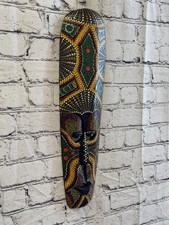
Endnotes
1.
Source: landinfo.no
Link:https://www.landinfo.no/asset/514/1/514_1.pdf
Source snippet
Report Côte d'Ivoire: Ethnicity, Ivoirité and Conflict2 Nov 2006 — None of the main four clusters of ethnic groups are only found in Côte...
2.
Source: ich.unesco.org
Link:https://ich.unesco.org/en/RL/zaouli-popular-music-and-dance-of-the-guro-communities-in-cote-d-ivoire-01255
3.
Source: unesco.org
Link:https://www.unesco.org/en/articles/return-djidji-ayokwe-emblematic-example-cultural-cooperation-between-france-and-cote-divoire
4.
Source: unesco.org
Title: document 3542
Link:https://www.unesco.org/archives/multimedia/document-3542
5.
Source: smarthistory.org
Link:https://smarthistory.org/pair-of-diviners-figures/
6.
Source: Wikipedia
Link:https://en.wikipedia.org/wiki/Sandobele
7.
Source: ich.unesco.org
Link:https://ich.unesco.org/en/Decisions/12.COM/11.b.8
8.
Source: Wikipedia
Link:https://en.wikipedia.org/wiki/Zaouli
9.
Source: unsdg.un.org
Title: protecting sacred forests cote divoire people and planet
Link:https://unsdg.un.org/latest/stories/protecting-sacred-forests-cote-divoire-people-and-planet
10.
Source: pure.knaw.nl
Link:https://pure.knaw.nl/portal/files/472910/Anansi.pdf
11.
Source: mythopia.io
Title: Ananse Stories
Link:https://mythopia.io/tagged/1/ananse
12.
Source: mythopia.io
Title: Anansi Spider Stories
Link:https://mythopia.io/tagged/405/anansi-tales
13.
Source: ich.unesco.org
Title: ICH UNESCOPhoto pop-up
Link:https://ich.unesco.org/en/photo-pop-up-00973?photoID=00166
14.
Source: unesco.org
Link:https://www.unesco.org/fr/articles/restitution-du-djidji-ayokwe-un-exemple-emblematique-de-cooperation-culturelle-entre-la-france-et-la
15.
Source: reuters.com
Title: Ivory Coast welcomes ‘talking drum’, first artifact sent back from France
Link:https://www.reuters.com/world/africa/ivory-coast-welcomes-talking-drum-first-artifact-sent-back-france-2026-03-13/
16.
Source: ich.unesco.org
Link:https://ich.unesco.org/en/lists
17.
Source: ich.unesco.org
Link:https://ich.unesco.org/en/video/41021
18.
Source: ich.unesco.org
Link:https://ich.unesco.org/en/RL/gbofe-of-afounkaha-the-music-of-the-transverse-trumps-of-the-tagbana-community-00005
19.
Source: ich.unesco.org
Link:https://ich.unesco.org/en/video/41498
20.
Source: ich.unesco.org
Link:https://ich.unesco.org/en/video/19813
21.
Source: ich.unesco.org
Link:https://ich.unesco.org/es/00555
22.
Source: ich.unesco.org
Link:https://ich.unesco.org/en/13COM?call=film&id=41496&include=film_inc.php&width=700
23.
Source: smarthistory.org
Link:https://smarthistory.org/religion-and-the-spiritual-realm/
24.
Source: archive.org
Link:https://archive.org/details/treasuryofafrica00cour
25.
Source: archive.org
Link:https://archive.org/details/anansiboxofstori0000kren
26.
Source: Wikipedia
Link:https://en.wikipedia.org/wiki/Anansi
27.
Source: Wikipedia
Title: Traditional African masks
Link:https://en.wikipedia.org/wiki/Traditional_African_masks
28.
Source: Wikipedia
Title: Lists of Intangible Cultural Heritage elements
Link:https://en.wikipedia.org/wiki/Lists_of_Intangible_Cultural_Heritage_elements
29.
Source: Wikipedia
Title: Goli (dance)
Link:https://en.wikipedia.org/wiki/Goli_%28dance%29
30.
Source: Wikipedia
Title: Ivory Coast
Link:https://en.wikipedia.org/wiki/Ivory_Coast
31.
Source: Wikipedia
Title: Djidji Ayokwe
Link:https://fr.wikipedia.org/wiki/Djidji_Ayokwe
32.
Source: unesco.at
Link:https://www.unesco.at/en/culture/intangible-cultural-heritage/news?cHash=60334305e4849e444f37a3f744c51f79&tx_news_pi1%5Baction%5D=detail&tx_news_pi1%5Bcontroller%5D=News&tx_news_pi1%5Bnews%5D=2216
33.
Source: minorityrights.org
Link:https://minorityrights.org/country/cote-divoire/
34.
Source: bradtguides.com
Title: Bradt Guides Art and tradition: the masks of Ivory Coast
Link:https://www.bradtguides.com/masks-ivory-coast/
35.
Source: clevelandart.org
Link:https://www.clevelandart.org/print/art/1975.155
36.
Source: si.edu
Link:https://www.si.edu/object/archives/components/sova-eepa-1973-001-ref28817
37.
Source: metmuseum.org
Title: The Metropolitan Museum of Art Male figure for a komien (trance diviner)
Link:https://www.metmuseum.org/art/collection/search/310825
38.
Source: metmuseum.org
Title: The Metropolitan Museum of Art Baule artist
Link:https://www.metmuseum.org/art/collection/search/312316
39.
Source: plu.edu
Link:https://www.plu.edu/africanartcollection/masks/firespitter/learn-more-firespitter/
40.
Source: wepa.unima.org
Link:https://wepa.unima.org/en/cote-divoire/
41.
Source: m.quaibranly.fr
Link:https://m.quaibranly.fr/fr/collections/provenances/restitution-du-tambour-parleur-dit-djidji-ayokwe-a-la-cote-divoire
42.
Source: bradtguides.com
Title: behind the mask exploring the heart of the ivory coast
Link:https://www.bradtguides.com/behind-the-mask-exploring-the-heart-of-the-ivory-coast/
43.
Source: lastplaces.com
Link:https://lastplaces.com/en/trips/tribal-trip-to-ivory-coast-december-2025/
44.
Source: africa.si.edu
Link:https://africa.si.edu/collection?edan_fq%5B0%5D=-object_type%3A%22Manuscripts%22&edan_fq%5B1%5D=-metadata_usage%3A%22CC0%22&edan_fq%5B2%5D=-date%3A%221900s%22&edan_fq%5B3%5D=-topic%3A%22Funerary%22&edan_fq%5B4%5D=-metadata_usage%3A%22Not+determined%22&page=2
45.
Source: africa.si.edu
Link:https://africa.si.edu/collection?edan_fq%5B0%5D=-topic%3A%22Household%22&edan_fq%5B1%5D=-set_name%3A%22NMAfA%2C+Pavilion+Gallery%22&edan_fq%5B2%5D=-date%3A%221700s%22&edan_fq%5B3%5D=-set_name%3A%22NMAfA%2C+Second+Level+Concourse%22&edan_fq%5B4%5D=-object_type%3A%22Sculpture%22&page=6
46.
Source: africa.si.edu
Link:https://africa.si.edu/archives?edan_fq%5B%5D=-date%3A%221970s%22&edan_fq%5B%5D=-topic%3A%22Cultural+landscapes%22&edan_fq%5B%5D=-topic%3A%22Masks%22&edan_fq%5B%5D=date%3A%221980s%22
47.
Source: africa.si.edu
Link:https://africa.si.edu/collection?edan_fq%5B0%5D=-place%3A%22Tanzania%22&edan_fq%5B1%5D=-metadata_usage%3A%22Not+determined%22&edan_fq%5B2%5D=-set_name%3A%22Ceramics+at+the+National+Museum+of+African+Art%22&page=3
48.
Source: si.edu
Link:https://www.si.edu/object/female-figure%3Anmafa
49.
Source: youtube.com
Link:https://www.youtube.com/watch?v=pT-NvGBa1zA
50.
Source: unesco.diplomatie.gouv.ci
Link:https://unesco.diplomatie.gouv.ci/details_actualite.php?lang=en&num=96
51.
Source: clevelandart.org
Link:https://www.clevelandart.org/art/1931.204
52.
Source: zyama.com
Link:https://www.zyama.com/baule/pics..htm
Additional References
53.
Source: lemonde.fr
Link:https://www.lemonde.fr/en/le-monde-africa/article/2026/03/14/talking-drum-returns-to-cote-d-ivoire-110-years-after-it-was-looted-by-french-colonizers_6751423_124.html
Source snippet
The return was the result of a long process initiated in 2018, supported by French President Emmanuel Macron’s 2021 pledge. It included d...
54.
Source: youtube.com
Title: Senufo Panther Dance and Poro Society Folklore
Link:https://www.youtube.com/watch?v=2OAD5LJj2Jo
Source snippet
This African Zaouli Dance video provides an authentic look into the traditional Guro mask dance and the living storytelling traditions de...
55.
Source: facebook.com
Link:https://www.facebook.com/AFRIESC2063/posts/african-intangible-cultural-heritagethe-gbofe-is-mainly-performed-in-the-village/749802657188979/
56.
Source: reddit.com
Link:https://www.reddit.com/r/AfricanHistory/comments/mzhb3e/anansi_the_spider_trickster_is_a_popular_figure/
57.
Source: scribd.com
Link:https://www.scribd.com/document/672085095/Art-and-Oracle-African-Art-and-Rituals-of-Divination
58.
Source: etsy.com
Link:https://www.etsy.com/ca/listing/4348595315/baoule-goli-kple-kple-mask-handcarved
59.
Source: randafricanart.com
Link:https://www.randafricanart.com/Baule_Goli_mask.html
60.
Source: hamillgallery.com
Link:https://www.hamillgallery.com/BAULE/BauleSculpture.html
61.
Source: facebook.com
Link:https://www.facebook.com/groups/147119783294511/posts/1357928208880323/
62.
Source: globespots.com
Link:https://www.globespots.com/country/cote-divoire/2/
Topic Tree
Follow this branch
Related pages 192
- Afghan Folklore
- Albanian Folklore
- Algerian Folklore
- Australian Folklore
- Azerbaijan Folklore
- +187 more in sidebar