Within Italian Folklore
Were the Benandanti Witches or Protectors?
The benandanti of Friuli are unusually well documented visionary figures who claimed to fight witches in spirit for the fertility of the fields.
On this page
- Spirit battles for the crops
- What the Inquisition records reveal
- The debate over ancient survivals
Page outline Jump by section
Introduction
The benandanti of Friuli occupy a unique place in Italian folklore because they are not known mainly through legends told centuries later. Instead, they appear in detailed records created by church investigators during the late sixteenth and seventeenth centuries. According to their own testimony, the benandanti were not witches at all. They described themselves as protectors of their communities who left their bodies in spirit during certain nights of the year and fought malevolent witches to safeguard crops, livestock and fertility. What makes the tradition remarkable is that the evidence comes from inquisitorial interrogations in which villagers explained their beliefs in their own words before church authorities gradually reinterpreted those beliefs through the framework of witchcraft. The surviving records provide one of the clearest windows into an early modern European visionary tradition and have become a famous case study in both folklore and history.[Wikipedia]WikipediaThe Night BattlesOctober 13, 2024 — The Night Battles: Witchcraft and Agrarian Cults in the Sixteenth and… Considering the benandanti to be "a fertilit…

Were the Benandanti Witches or Protectors?
The earliest testimonies portray the benandanti as defenders rather than servants of evil. They believed that certain people were marked from birth, often by being born with a caul, the membrane covering the head at birth. In local belief this sign indicated a special destiny and supernatural responsibility.[Wikipedia]WikipediaBenandantiIn Ginzburg's interpretation of the evidence, the benandanti was a "fertility cult… The Night Battles: Witchcraft and Agrari…
When questioned by church officials, benandanti explained that on particular nights their spirits travelled from their sleeping bodies. Men often described joining supernatural battles, while women more commonly reported attending visionary gatherings or feasts. These journeys were understood as real experiences with practical consequences for the community. A successful struggle meant healthy harvests and abundance; defeat meant crop failure and hardship.[Wikipedia]WikipediaBenandantiIn Ginzburg's interpretation of the evidence, the benandanti was a "fertility cult… The Night Battles: Witchcraft and Agrari…
What stands out in the records is the moral reversal of the usual witchcraft story. The benandanti did not claim to curse fields. They claimed to protect them. They did not describe themselves as servants of the Devil. They presented themselves as loyal Christians carrying out a necessary task for the common good. Early inquisitors often seemed uncertain how to classify such claims because they did not fit established categories of heresy or witchcraft.[Wikipedia]WikipediaThe Night BattlesOctober 13, 2024 — The Night Battles: Witchcraft and Agrarian Cults in the Sixteenth and… Considering the benandanti to be "a fertilit…
Spirit Battles for the Crops
The most famous element of the tradition is the series of nocturnal battles that gave Carlo Ginzburg’s landmark study its title, The Night Battles. According to testimony preserved in the records, benandanti fought witches in spirit form during seasonal periods connected with agricultural fertility.[Wikipedia]WikipediaThe Night BattlesOctober 13, 2024 — The Night Battles: Witchcraft and Agrarian Cults in the Sixteenth and… Considering the benandanti to be "a fertilit…
Several recurring features appear in the accounts:
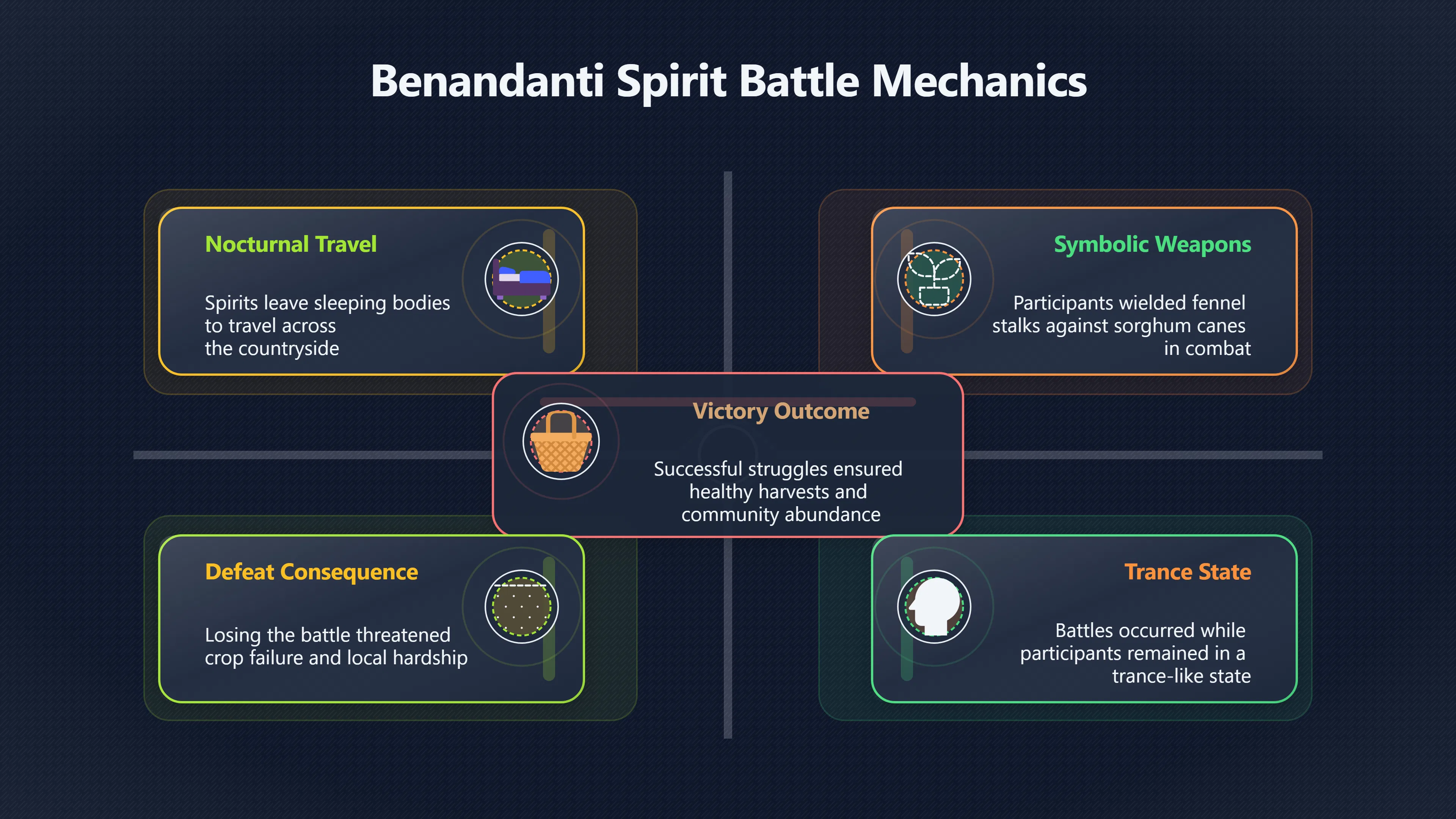
- The battles took place while participants lay asleep or in a trance-like state.
- Spirits left the body and travelled across the countryside.
- Benandanti fought on behalf of the community’s harvest.
- Victory promised fertile fields and plentiful crops.
- Defeat threatened scarcity and agricultural disaster.[Wikipedia]WikipediaThe Night BattlesOctober 13, 2024 — The Night Battles: Witchcraft and Agrarian Cults in the Sixteenth and… Considering the benandanti to be "a fertilit…
One of the most memorable details is the description of combat with symbolic agricultural weapons. Benandanti reported fighting with fennel stalks, while their opponents wielded sorghum or similar canes. The symbolism linked the conflict directly to the agricultural cycle rather than to ordinary warfare.[֎]axismundi.blogi benandanti friuliani e gli antichi culti europei della fertilitaBehind the stories of these mysterious conferences and nocturnal battles we clearly see a…Read more…
To modern readers, these stories may resemble dreams, visions or ecstatic experiences. Whatever their origin, the participants themselves treated them as genuine events affecting the material world. The importance of the harvest in a largely rural society helps explain why such beliefs carried real social significance.
What the Inquisition Records Reveal
The surviving evidence comes largely from inquisitorial investigations in Friuli beginning in the 1570s. Historians consider these records unusually valuable because they preserve long exchanges between villagers and church authorities. Rather than a brief accusation, many cases reveal a dialogue in which inquisitors tried to understand beliefs that initially seemed unfamiliar even to them.[Wikipedia]WikipediaThe Night BattlesOctober 13, 2024 — The Night Battles: Witchcraft and Agrarian Cults in the Sixteenth and… Considering the benandanti to be "a fertilit…
One early and influential case involved Paolo Gasparutto, questioned in 1575. During interrogation he described the nocturnal journeys of the benandanti and their role in protecting crops. His testimony helped reveal a wider network of people who shared similar beliefs. Other cases followed, gradually providing a picture of a local visionary tradition rather than isolated individual experiences.[enchantedpodcast.net]enchantedpodcast.netEnchanted History of Magic These Who Are Goodbattles to defend the season's harvest from witches. In this episode… Witchcraft Trials.” Religions 10, no. 5 (2019): 326. Sato, Jun…
The records also reveal a subtle change over time. Initially, some inquisitors treated the claims as strange popular beliefs rather than evidence of witchcraft. However, church authorities increasingly interpreted spirit travel, nocturnal assemblies and supernatural combat through the established model of the witches’ sabbath. Once questioned within that framework, witnesses often began to describe their experiences using language that more closely resembled accepted demonological ideas.[wikipedia.org]WikipediaThe Night BattlesOctober 13, 2024 — The Night Battles: Witchcraft and Agrarian Cults in the Sixteenth and… Considering the benandanti to be "a fertilit…
This gradual shift is one of the most important findings in the evidence. The records suggest that inquisitors did not simply discover a ready-made witch cult. Instead, a local folk tradition was progressively redefined through the assumptions of learned witchcraft theory. By the seventeenth century, the distinction between benandanti and witches had become increasingly blurred in official eyes.[Wikipedia]WikipediaThe Night BattlesOctober 13, 2024 — The Night Battles: Witchcraft and Agrarian Cults in the Sixteenth and… Considering the benandanti to be "a fertilit…
The Debate Over Ancient Survivals
The benandanti became internationally famous because of the interpretation offered by the Italian historian Carlo Ginzburg. Working from the Friulian trial records, he argued that the tradition might preserve fragments of a much older fertility cult centred on the protection of crops and seasonal abundance. He also drew comparisons with visionary traditions elsewhere in Europe, including stories of spirit journeys and supernatural defenders of fertility.[Wikipedia]WikipediaThe Night BattlesOctober 13, 2024 — The Night Battles: Witchcraft and Agrarian Cults in the Sixteenth and… Considering the benandanti to be "a fertilit…
This interpretation proved highly influential but also controversial. Critics accepted the importance of the records while questioning whether the evidence was strong enough to prove survival from a pre-Christian cult. Historians such as Norman Cohn and Ronald Hutton argued that similarities between traditions do not necessarily demonstrate a continuous ancient religion. They suggested that the surviving documents may show a local early modern belief system without requiring a direct line back to pagan antiquity.[wikipedia.org]WikipediaBenandantiIn Ginzburg's interpretation of the evidence, the benandanti was a "fertility cult… The Night Battles: Witchcraft and Agrari…
As a result, modern scholarship generally agrees on several points:
- The benandanti were a genuine and well-documented Friulian tradition.
- Participants described visionary journeys and battles linked to agricultural fertility.
- Inquisitorial records preserve these beliefs in unusual detail.
- Church authorities gradually reinterpreted the tradition as witchcraft.
The larger question of whether the tradition represents the survival of a very ancient fertility cult remains debated.[Wikipedia]WikipediaThe Night BattlesOctober 13, 2024 — The Night Battles: Witchcraft and Agrarian Cults in the Sixteenth and… Considering the benandanti to be "a fertilit…
Why the Benandanti Matter in Italian Folklore
Many European witchcraft traditions are known only through accusations made by authorities. The benandanti are different because the records capture a moment before complete assimilation into the stereotype of the witch. Their testimony offers a rare glimpse of how ordinary rural people explained dreams, visions, harvest anxiety and communal responsibility in their own terms.[Wikipedia]WikipediaThe Night BattlesOctober 13, 2024 — The Night Battles: Witchcraft and Agrarian Cults in the Sixteenth and… Considering the benandanti to be "a fertilit…
Within Italian folklore, the benandanti therefore represent more than a curious witch-trial episode. They show how local beliefs could coexist with Christianity, how church authorities reshaped popular traditions, and how fragile the boundary between protector and witch could become. The Friulian night battles remain one of the best-documented supernatural traditions in Italy, not because anyone proved the battles happened, but because the surviving evidence allows modern readers to see a folk belief system being recorded, questioned and transformed in real time.[Wikipedia]WikipediaThe Night BattlesOctober 13, 2024 — The Night Battles: Witchcraft and Agrarian Cults in the Sixteenth and… Considering the benandanti to be "a fertilit…
Amazon book picks
Further Reading
Books and field guides related to Were the Benandanti Witches or Protectors?. Use these as the next step if you want deeper reading beyond the article.
The Witch
Explains changing ideas about witchcraft that shaped interpretations of the Benandanti.
Witchcraft in Europe, 400-1700
Provides primary-source context for inquisitorial records.
The Witch-Hunt in Early Modern Europe
Explains the broader witch-hunt environment surrounding Benandanti cases.
eBay marketplace picks
Marketplace Samples
Live-tested eBay searches with available results related to this page.



Endnotes
1.
Source: Wikipedia
Title: The Night Battles
Link:https://en.wikipedia.org/wiki/The_Night_Battles
Source snippet
October 13, 2024 — The Night Battles: Witchcraft and Agrarian Cults in the Sixteenth and... Considering the benandanti to be "a fertilit...
Published: October 13, 2024
2.
Source: Wikipedia
Link:https://en.wikipedia.org/wiki/Benandanti
Source snippet
BenandantiIn Ginzburg's interpretation of the evidence, the benandanti was a "fertility cult... The Night Battles: Witchcraft and Agrari...
3.
Source: Wikipedia
Title: Carlo Ginzburg
Link:https://en.wikipedia.org/wiki/Carlo_Ginzburg
4.
Source: jstor.org
Title: The Night Battles
Link:https://www.jstor.org/stable/25022410
Source snippet
Witchcraft & Agrarian Cults in the...by HCE Midelfort · 1986 · Cited by 1 — The book is problematic, however, in both respects. As a por...
5.
Source: jstor.org
Link:https://www.jstor.org/stable/1061939
Source snippet
Some Observations on European Witchcraftby M Eliade · 1975 · Cited by 100 — In other words, the witch orgies could not be truly classifie...
6.
Source: crazyalchemist.com
Title: Crazy Alchemist Benandanti: Italian Witch-Hunters or Witches?
Link:https://www.crazyalchemist.com/bestiary/benandanti/
Source snippet
BestiaryTheir manuals covered heresy, blasphemy, and witchcraft, but they had no category for people who claimed to fight witches on be...
7.
Source: axismundi.blog
Title: i benandanti friuliani e gli antichi culti europei della fertilita
Link:https://axismundi.blog/en/2016/05/05/i-benandanti-friuliani-e-gli-antichi-culti-europei-della-fertilita/
Source snippet
Behind the stories of these mysterious conferences and nocturnal battles we clearly see a...Read more...
8.
Source: enchantedpodcast.net
Title: Enchanted History of Magic These Who Are Good
Link:https://enchantedpodcast.net/episodes/409
Source snippet
battles to defend the season's harvest from witches. In this episode... Witchcraft Trials.” Religions 10, no. 5 (2019): 326. Sato, Jun...
9.
Source: hbs.edu
Title: 22 041 791c97a5 9ac0 4a1b 972b 05bb55849db7
Link:https://www.hbs.edu/ris/Publication%20Files/22-041_791c97a5-9ac0-4a1b-972b-05bb55849db7.pdf
Source snippet
The intervention of inquisitors... ancient fertility cult, and (b) that the sabbat described in the witchcraft...Read more...
Additional References
10.
Source: deliriumsrealm.com
Link:https://www.deliriumsrealm.com/night-battles-benandanti/
Source snippet
How the Benandanti Fought Witches During the SabbathHe is a Russian emigre and a practicing pagan. Category: Witchcraft & MagicTag: Witch...
11.
Source: lemonde.fr
Link:https://www.lemonde.fr/en/obituaries/article/2026/06/17/italian-historian-carlo-ginzburg-founding-figure-of-microhistory-has-died_6754597_15.html
Source snippet
Born in Turin in 1939 into a culturally rich and politically active family, Ginzburg was deeply shaped by early experiences of political...
12.
Source: weirditaly.com
Link:https://weirditaly.com/2022/01/10/the-benandanti-witchcraft-and-agrarian-cults-between-16th-and-17th-centuries-in-italy/
Source snippet
The Benandanti: Witchcraft and Agrarian Cults10 Jan 2022 — A trial for heresy of two peasants reveals a pagan-shamanic peasant cult based...
13.
Source: journals.uchicago.edu
Link:https://www.journals.uchicago.edu/doi/pdfplus/10.1086/462721
Source snippet
Chicago JournalsSome Observations on European WitchcraftIn other words, the witch orgies could not be truly classified among the orgiasti...
14.
Source: animaloci.org
Title: Anima Loci Convention of witches
Link:https://animaloci.org/convention-of-witches/
Source snippet
Convention of witches - Anima LociKeywords: Friuli Friuli Venezia Giulia Italy Witchcraft. On Thursdays... [8] In these words by Osterma...
15.
Source: resobscura.substack.com
Title: a very deep history of halloween
Link:https://resobscura.substack.com/p/a-very-deep-history-of-halloween
Source snippet
very deep history of Halloween - by Benjamin BreenAt the end of the book, Ginzburg argues that these benandanti were likely a survival fr...
16.
Source: spiritspodcast.com
Title: Episode 111: The Benandanti
Link:https://spiritspodcast.com/episodes/benandanti
Source snippet
Spirits Podcast9 Jan 2019 — According to Gasparotto, the Benandanti were witches who practice witchcraft across the countryside around Ve...
17.
Source: amazon.co.uk
Link:https://www.amazon.co.uk/Night-Battles-Carlo-Ginzburg-ebook/dp/B00FYU2BA8?tag=searcht-20
Source snippet
The Night Battles: Witchcraft and Agrarian Cults in the...The "Benandante" (what these people referred to themselves as) were part of (a...
18.
Source: courses.washington.edu
Title: Benandanti transcripts
Link:https://courses.washington.edu/hsteu305/Benandanti%20transcripts.PDF
Source snippet
of Trial againstInterrogated if he had heard about or knew personally anyone who was a witch ora benandante, he replied: Of witches I do...
19.
Source: earlymoderneurope.fandom.com
Link:https://earlymoderneurope.fandom.com/wiki/Ginzburg%2C_Night_Battles
Source snippet
fandom.comGinzburg, Night Battles | Early Modern Europe Wiki - FandomThe benandanti's approach, however, was residual form fertility cult...
Topic Tree