Within Micronesian Folklore
The Hero Who Ended Saudeleur Rule
Isokelekel's story explains how a legendary hero, divine offence and political change meet in Pohnpeian memory.
On this page
- The arrival of Isokelekel and his followers
- Why the Saudeleur order lost legitimacy
- Myth, history and chiefly descent
Page outline Jump by section
Introduction
Among the most important stories in Pohnpeian tradition is the tale of Isokelekel, the heroic outsider who defeated the Saudeleur rulers and transformed the political order of Pohnpei. More than a simple conquest narrative, the story explains why an older centralised system of rule collapsed, why chiefly authority on Pohnpei is organised differently today, and how divine power, morality and political legitimacy became intertwined in local memory. Oral traditions place the fall of the Saudeleur dynasty around the late sixteenth or early seventeenth century, linking it to the arrival of Isokelekel and his followers from a distant homeland often identified as Katau or associated with Kosrae.[unesco.org]whc.unesco.orgUNESCO World Heritage Centre1503.pdfOral traditions place the downfall of the Page 8 7 Saudeleur around 1600 AD when Isokelekel, son of t…
For many Pohnpeians, the story is not merely a legend about the distant past. It remains a foundational account of how the island’s present social order came into being and why power should be balanced rather than concentrated in a single ruler.[micronesica.org]micronesica.orgThe Saudeleur to Nahnmwarki Transformationby JE BATH · 1990 · Cited by 26 — Tradition tells that, when grown, lsokelekel came to Pohnpei…
The Arrival of Isokelekel and His Followers
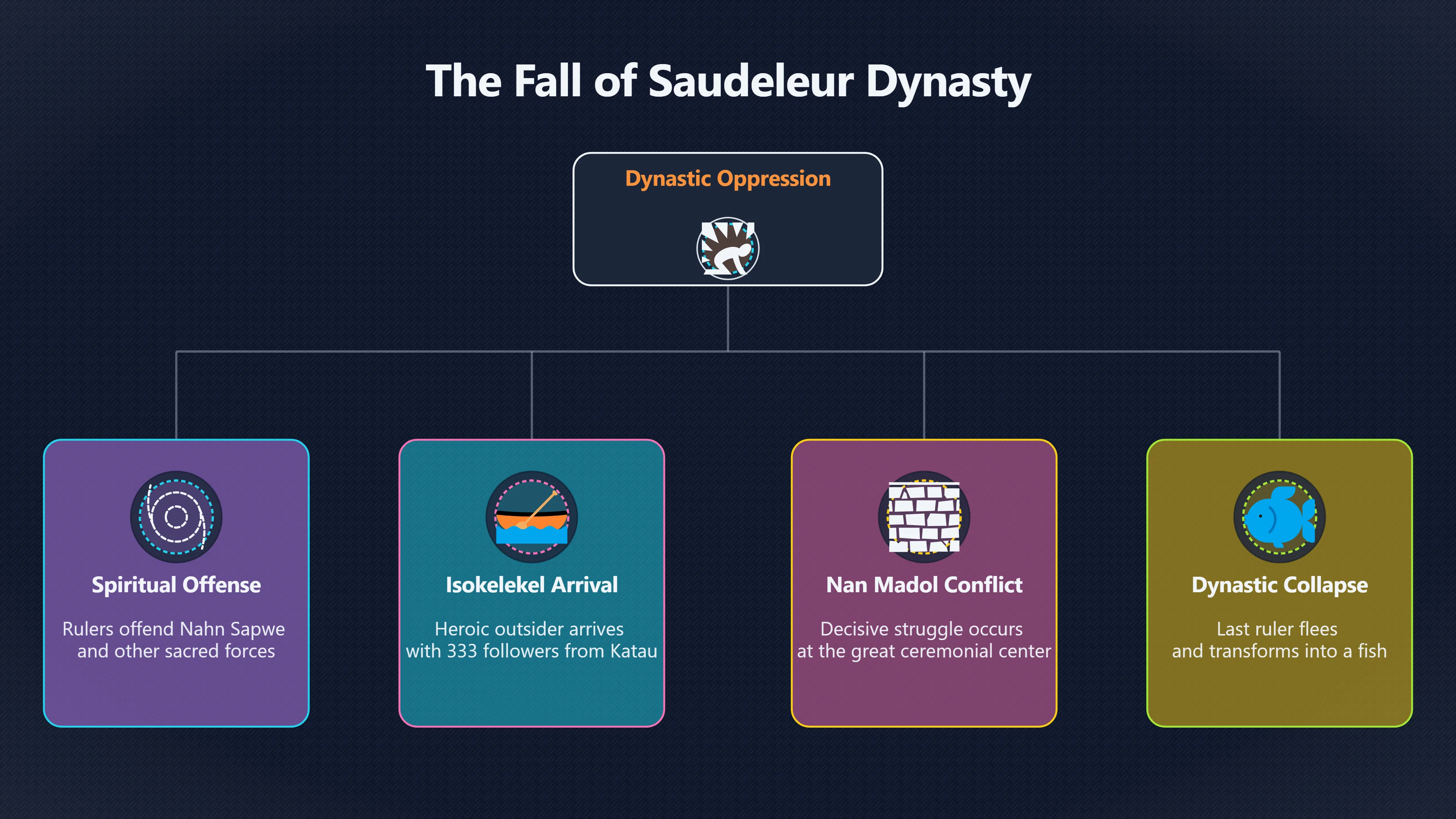
The best-known versions of the tradition describe Isokelekel as a semi-divine figure whose father was the thunder god Nahn Sapwe. The god had been insulted or wronged by the Saudeleur ruler, creating a supernatural justification for vengeance. In these accounts, Isokelekel grows up knowing that he is destined to challenge the dynasty that governs Pohnpei.[Wikipedia]WikipediaOpen source on wikipedia.org.
When the time came, Isokelekel set sail with a force traditionally numbered at 333 men, women and children. The exact route differs between versions, reflecting the flexibility of oral tradition, but the voyage itself is central. Like many Pacific heroic narratives, it presents long-distance seafaring as both a practical achievement and a sign of supernatural favour.[micronesica.org]micronesica.orgThe Saudeleur to Nahnmwarki Transformationby JE BATH · 1990 · Cited by 26 — Tradition tells that, when grown, lsokelekel came to Pohnpei…
The landing on Pohnpei does not always begin with immediate warfare. Some versions describe hospitality, negotiations and the gradual building of local alliances. Others portray deliberate provocation designed to trigger conflict. What remains consistent is the idea that many Pohnpeians were willing to support the newcomers because dissatisfaction with Saudeleur rule had already become widespread.[Wikipedia]WikipediaSaudeleur dynastySaudeleur dynasty
The decisive struggle is often located around Nan Madol, the great ceremonial centre of the Saudeleur state. Different oral accounts disagree on tactical details, but they generally end with the defeat of the ruling dynasty and the flight of the last Saudeleur leader. In one famous version, the defeated ruler retreats inland and transforms into a fish, leaving the human world behind altogether.[Wikipedia]WikipediaSaudeleur dynastySaudeleur dynasty
Why the Saudeleur Order Lost Legitimacy
The Isokelekel cycle is not only a victory story. It is also an explanation for why a ruling system deserved to fall.
Pohnpeian traditions consistently portray the Saudeleur government as becoming increasingly oppressive. The dynasty is remembered as highly centralised, demanding labour, tribute and obedience from communities across the island. Over time, these obligations are said to have become excessive and arbitrary.[Wikipedia]WikipediaSaudeleur dynastySaudeleur dynasty
Equally important are the dynasty’s spiritual failings. Many versions insist that the rulers offended powerful supernatural forces. Some accounts focus on the insult to Nahn Sapwe; others describe broader disrespect toward gods, priests or sacred practices. In the logic of the story, political abuse and religious offence reinforce one another. The Saudeleur lose legitimacy not simply because they rule harshly, but because they have disrupted the proper relationship between human authority and the sacred world.[Wikipedia]WikipediaOpen source on wikipedia.org.
This theme helps explain why the narrative remains culturally powerful. The downfall is presented as morally inevitable. Divine forces, ordinary people and even elements of the natural world are sometimes described as turning against the dynasty. The message is that authority depends on right conduct, not merely on military strength.[Wikipedia]WikipediaOpen source on wikipedia.org.
A Story About Political Change
One reason the legend has attracted scholarly attention is that it appears to preserve memories of genuine social transformation.
Archaeological evidence confirms that Nan Madol served as the ceremonial and political centre of the Saudeleur state, while oral traditions remember a later shift toward a different political arrangement. Following Isokelekel’s victory, authority is said to have become more decentralised under the Nahnmwarki system of regional chiefs. That system, in modified form, remained influential into the colonial era and continues to shape traditional leadership today.[nach.gov.fm]nach.gov.fmFSM Office of National ArchivesNan Madol, East Site of Temwen Island, Temwen IslandNan Madol was the ceremonial and political seat of the…
Researchers do not treat every detail of the story as literal history. The divine ancestry, supernatural interventions and symbolic episodes belong to the realm of mythic tradition. Yet many scholars argue that the narrative may preserve cultural memories of real migrations, conflicts and political restructuring. Rather than asking whether the story is entirely true or entirely fictional, they examine how oral tradition preserves historical meaning through symbolic storytelling.[academia.edu]academia.eduPohnpei's history is divided into four distinct periods…Read more…
The repeated appearance of an outsider hero is especially significant. In Pohnpeian mythology, important changes are often associated with arrivals from beyond the island. Isokelekel embodies this pattern: a foreign figure who restores balance and introduces a new political order.[Wikipedia]WikipediaOpen source on wikipedia.org.
Myth, History and Chiefly Descent
The continuing importance of Isokelekel is visible in claims of ancestry and chiefly identity.
Many traditional leaders on Pohnpei trace their descent to Isokelekel and his followers. As a result, the story is not merely about a distant heroic age; it helps explain present-day relationships among clans, titles and districts. Genealogies connect living communities to the legendary conqueror, giving the narrative continuing social relevance.[Wikipedia]WikipediaOpen source on wikipedia.org.
The tradition also helps explain the transition between major periods of Pohnpeian history. Oral accounts divide the past into distinct eras: the age of Saudeleur rule and the age that followed under the Nahnmwarki chiefs. Isokelekel stands at the boundary between these worlds, functioning as both conqueror and founder.[Wikipedia]WikipediaOpen source on wikipedia.org.
Because the story remains embedded in local identity, there is no single authoritative version. Researchers have documented numerous variations, reflecting differences in district traditions, clan affiliations and local perspectives. These variations are not usually seen as flaws. Instead, they demonstrate how oral traditions adapt while preserving a shared understanding of a pivotal event.[Wikipedia]WikipediaOpen source on wikipedia.org.
How the Story Is Understood Today
Today, Isokelekel is remembered as one of the great culture heroes of Micronesia. His story is closely associated with Nan Madol, now one of the Federated States of Micronesia’s most famous historic landscapes. Visitors often encounter the ruins through two overlapping lenses: archaeology reveals the physical remains of the Saudeleur state, while oral tradition explains why the site occupies such an important place in cultural memory.[nach.gov.fm]nach.gov.fmFSM Office of National ArchivesNan Madol, East Site of Temwen Island, Temwen IslandNan Madol was the ceremonial and political seat of the…
For modern audiences, the legend continues to resonate because it combines several themes at once: the arrival of a heroic stranger, divine justice, resistance to oppressive rule and the founding of a new social order. Whether approached as folklore, historical memory or political myth, the story of Isokelekel remains one of the central narratives through which Pohnpei explains its past and understands the origins of its traditional leadership.[wiley.com]onlinelibrary.wiley.comWiley Online LibraryOn the Use of Micronesian Oral Traditions to Interpret Sea…Jan 28, 2026 — It was the island's pre-eminent culture…
Amazon book picks
Further Reading
Books and field guides related to The Hero Who Ended Saudeleur Rule. Use these as the next step if you want deeper reading beyond the article.
On the Road of the Winds
Provides historical context for Pohnpei and the Saudeleur era.
eBay marketplace picks
Marketplace Samples
Live-tested eBay searches with available results related to this page.


Endnotes
1.
Source: whc.unesco.org
Link:https://whc.unesco.org/uploads/nominations/1503.pdf
Source snippet
UNESCO World Heritage Centre1503.pdfOral traditions place the downfall of the Page 8 7 Saudeleur around 1600 AD when Isokelekel, son of t...
2.
Source: micronesica.org
Link:https://micronesica.org/sites/default/files/supp02-23ed.pdf
Source snippet
The Saudeleur to Nahnmwarki Transformationby JE BATH · 1990 · Cited by 26 — Tradition tells that, when grown, lsokelekel came to Pohnpei...
3.
Source: Wikipedia
Link:https://en.wikipedia.org/wiki/Isokelekel
4.
Source: Wikipedia
Link:https://en.wikipedia.org/wiki/Pohnpei
5.
Source: Wikipedia
Title: Saudeleur dynasty
Link:https://en.wikipedia.org/wiki/Saudeleur_dynasty
6.
Source: academia.edu
Link:https://www.academia.edu/35482488/Nan_Madol_from_the_Perspective_of_Archaeology_and_Oral_Tradition
Source snippet
Pohnpei's history is divided into four distinct periods...Read more...
7.
Source: onlinelibrary.wiley.com
Link:https://onlinelibrary.wiley.com/doi/10.1002/arco.70019
Source snippet
Wiley Online LibraryOn the Use of Micronesian Oral Traditions to Interpret Sea...Jan 28, 2026 — It was the island's pre-eminent culture...
8.
Source: smarthistory.org
Title: nan madol
Link:https://smarthistory.org/nan-madol/
Source snippet
“In the space between things”20 Aug 2018 — Oral histories of Nan Madol describe great birds or giants moving the basalt rocks into place...
9.
Source: nach.gov.fm
Link:https://nach.gov.fm/nan-madol-east-site-of-temwen-island-temwen-island/
Source snippet
FSM Office of National ArchivesNan Madol, East Site of Temwen Island, Temwen IslandNan Madol was the ceremonial and political seat of the...
10.
Source: habeleinstitute.org
Title: Nan Madol
Link:https://habeleinstitute.org/wiki/Nan_Madol
Source snippet
21 Mar 2026 — According to Pohnpeian oral traditions, Nan Madol became the center. The overthrow of the Saudeleur is attributed to the wa...
11.
Source: metmuseum.org
Title: nan madol
Link:https://www.metmuseum.org/essays/nan-madol
Source snippet
The Metropolitan Museum of ArtNan Madol1 Oct 2002 — For example, oral traditions make references to small canals cut into the islets, all...
12.
Source: nps.gov
Title: nan madol
Link:https://www.nps.gov/places/nan-madol.htm
Source snippet
6 Jan 2020 — Pohnpeian oral history says that Isokelekel was a demigod and the vengeful son of the Pohnpeian storm god Nahn Sapwe, who ha...
13.
Source: heritagedaily.com
Title: Nan Madol
Link:https://www.heritagedaily.com/2020/07/nan-madol-capital-of-the-saudeleur-dynasty/134102
Source snippet
Capital of the Saudeleur Dynasty5 Jul 2020 — The city thrived until AD 1628, when Isokelekel, a semi-mythical hero warrior from the islan...
Additional References
14.
Source: neh.gov
Link:https://www.neh.gov/sites/default/files/inline-files/Peterson%20Sample.pdf
Source snippet
Narrative Section of a Successful ApplicationOral histories and community knowledge have preserved accounts of early migration among isla...
15.
Source: facebook.com
Link:https://www.facebook.com/groups/archeologyandcivilizations/posts/9700167400076697/
Source snippet
Nan Madol, Federated States of MicronesiaAfter the fall of the Saudeleur Dynasty, Nan Madol was abandoned and fell into disrepair. Oral t...
16.
Source: reddit.com
Link:https://www.reddit.com/r/AskHistory/comments/15lqvge/what_is_known_about_nan_madol_in_micronesia/
Source snippet
What is known about Nan Madol in Micronesia?: r/AskHistoryIt was the capitol of the Saudeleur dynasty, but that dynasty is shrouded in m...
17.
Source: facebook.com
Title: legend of isokelekelin this video the late mr madias pelep traditional title lah
Link:https://www.facebook.com/PasifikaRenaissance/posts/legend-of-isokelekelin-this-video-the-late-mr-madias-pelep-traditional-title-lah/1834820427311200/
Source snippet
◆Legend of Isokelekel◆ In this video, the late Mr. Madias...In 1628, the warrior hero Isokelekel led an invasion of Pohnpei and defeated...
18.
Source: researchgate.net
Link:https://www.researchgate.net/publication/308978355_Earliest_direct_evidence_of_monument_building_at_the_archaeological_site_of_Nan_Madol_Pohnpei_Micronesia_identified_using_230ThU_coral_dating_and_geochemical_sourcing_of_megalithic_architectural_stone
Source snippet
Pohnpei Island, is believed to have constructed Nan Madol (McCoy et al., 2016).Read more...
19.
Source: facebook.com
Title: Legend of Isokelekel In this video, the late Mr
Link:https://www.facebook.com/PasifikaRenaissance/videos/legend-of-isokelekelin-this-video-the-late-mr-madias-pelep-traditional-title-lah/1285823802868773/
Source snippet
Madias Pelep...1927, 90 years old) narrates the legend of Isokelekel, the Pohnpeian cultural hero, who overthrew the Saudeleur Dynasty a...
20.
Source: alternatehistory.com
Title: wi saudeleur dynasty survives.520851
Link:https://www.alternatehistory.com/forum/threads/wi-saudeleur-dynasty-survives.520851/
Source snippet
WI: Saudeleur dynasty survives?24 Nov 2021 — However, the Saudeleur Dynasty didn't last, as around 1628, according to Pohnpeian legend, a...
21.
Source: explorersweb.com
Title: exploration mysteries nan madol
Link:https://explorersweb.com/exploration-mysteries-nan-madol/
Source snippet
Exploration Mysteries: Nan MadolJun 11, 2025 — Oral tradition says that the Saudeleurs worshipped the god of thunder, Nahnsapwe. They mad...
22.
Source: dnagenics.com
Link:https://www.dnagenics.com/ancestry/sample/view/cinematic/id/i30478?srsltid=AfmBOopKxdoDz91prtLPlCQ49OEOurqNmyPUKd_sYYw7ltBuRQnFR0zm
Source snippet
A man buried in Federated States of Micronesia in...Oral traditions and folklore from Pohnpei recount stories of the Saudeleurs' rule, I...
23.
Source: youtube.com
Title: Legend of Isokelekel, Pohnpei
Link:https://www.youtube.com/watch?v=12K15aqITo4
Source snippet
Legend of Isokelekel: Micronesia's Greatest Mythical Warrior...
Topic Tree