Within Finnish Folklore
What Spirits Lived in Finland's Landscape?
Finnish folklore often treats forests, lakes and homes as places watched by spirits that demand respect and caution.
On this page
- Haltija guardians of place and home
- Metsanpeitto and the forest's cover
- Respect, fear and everyday rules
Page outline Jump by section
Introduction
In Finnish folk belief, the landscape was not empty. Forests, lakes, farmyards, saunas and even individual rocks could be understood as places inhabited by unseen beings. Rather than imagining spirits living in a distant supernatural realm, many traditions placed them directly within everyday surroundings. People entering a forest, building a house or tending livestock were thought to be sharing space with local guardian powers whose goodwill could bring success and whose anger could bring confusion, illness or misfortune. This worldview helped explain the unpredictability of life in a heavily forested country and encouraged respectful behaviour towards both nature and the home. Traditional accounts collected from across Finland describe guardian spirits, sacred places and a mysterious condition known as “the forest’s cover”, in which people seemed to become lost in a hidden version of the landscape.[Wikipedia]WikipediaOpen source on wikipedia.org.

Haltija Guardians of Place and Home
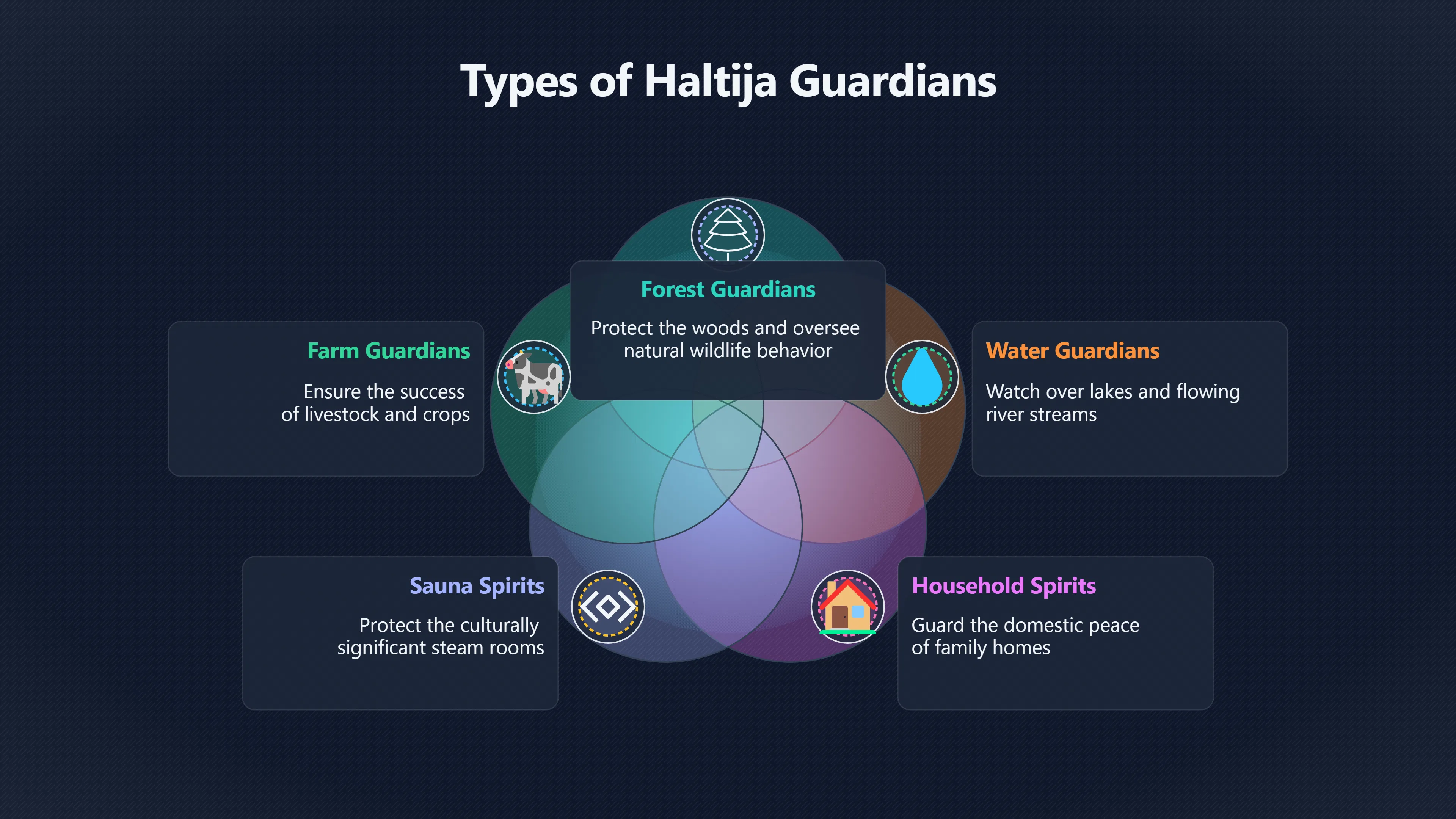
One of the most important ideas in Finnish folk belief was the haltija, a guardian spirit associated with a particular place, community, building, natural feature or even species of animal. Unlike major mythological gods, a haltija was local. It belonged to a specific place and watched over that place’s wellbeing. Finnish folklore archives and later folklore studies describe forest guardians, water guardians, household guardians and spirits attached to farms, mills and saunas.[Wikipedia]WikipediaOpen source on wikipedia.org.
The relationship between humans and these guardians was often practical rather than devotional. A farmer wanted livestock to thrive. A hunter wanted success in the woods. A family wanted peace in the household. Respecting the local spirit was therefore part of maintaining a good relationship with the environment.
Traditional customs reflected this belief. When a new house was built, offerings might be left for the spirit of the land. Certain trees, stones or corners of a property could be treated with special respect because they were associated with protective powers. Forest spirits could assist people who behaved properly but were also believed capable of punishing arrogance, wastefulness or disrespect.[Wikipedia]WikipediaOpen source on wikipedia.org.
These beliefs reveal an important feature of Finnish folklore: nature was not viewed simply as a resource. The forest had its own agency, personality and guardians. Entering it required courtesy, much as entering another person’s home would require good manners.[Sidetracked]sidetracked.comMyths of the North – A Journey into Finnish FolkloreThey held an animistic belief that assigned spirits to every individual tree, stream, stone, person, animal, lake, and flower…
Spirits Were Part of the Landscape
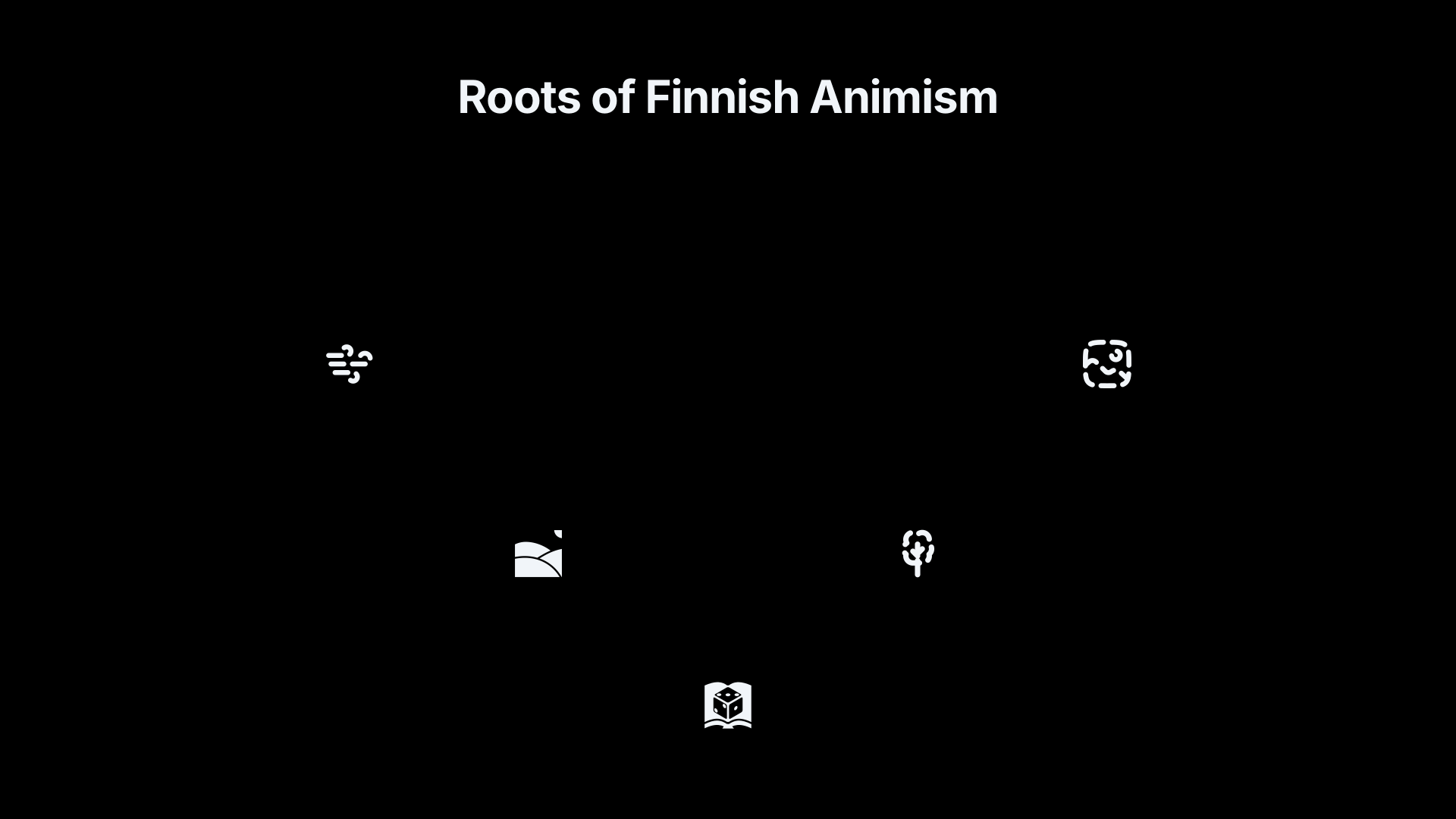
Folklore scholars often describe Finnish traditional religion as strongly animistic, meaning that natural places were understood to possess living spiritual qualities. Forests, streams, lakes, stones and hills were not merely physical objects. They could contain powers collectively associated with the idea of väki, a term that could refer both to supernatural forces and to the beings connected with them.[Wikipedia]WikipediaOpen source on wikipedia.org.
This helps explain why stories about spirits were tied so closely to particular locations. A spirit was not simply a wandering creature. It often belonged to a specific place and embodied the character of that place itself.[Wikipedia]WikipediaOpen source on wikipedia.org.
Metsänpeitto and the Forest’s Cover
Among the most distinctive ideas in Finnish folklore is metsänpeitto, usually translated as “the forest’s cover” or “the forest’s veil”. According to traditional belief, a person or animal could become trapped within a hidden layer of the forest and effectively disappear from ordinary reality.[Wikipedia]WikipediaOpen source on wikipedia.org.
Stories describe people wandering into familiar woods and suddenly finding that nothing looked right. Paths vanished. Landmarks became unrecognisable. Sounds disappeared. Some accounts describe an eerie silence in which birds stopped singing and normal forest noises ceased altogether. Others tell of victims wandering in circles despite knowing the terrain well.[Wikipedia]WikipediaOpen source on wikipedia.org.
The most remarkable feature of the tradition is that the missing person was often believed to be physically close to searchers while remaining unseen. Folklore accounts suggest that someone under the forest’s cover could become invisible or appear blended into the landscape like a stone or tree. Meanwhile, the lost person might hear search parties without being able to reach them.[Wikipedia]WikipediaOpen source on wikipedia.org.
In practical terms, the tradition may have offered a cultural explanation for the very real dangers of becoming disoriented in dense woodland. Finland’s forests can be vast and confusing, especially before modern mapping and navigation technologies. Yet the folklore interpretation transformed a frightening experience into a story about crossing a boundary between the ordinary world and a hidden one.[Wikipedia]WikipediaOpen source on wikipedia.org.
How People Escaped the Forest’s Cover
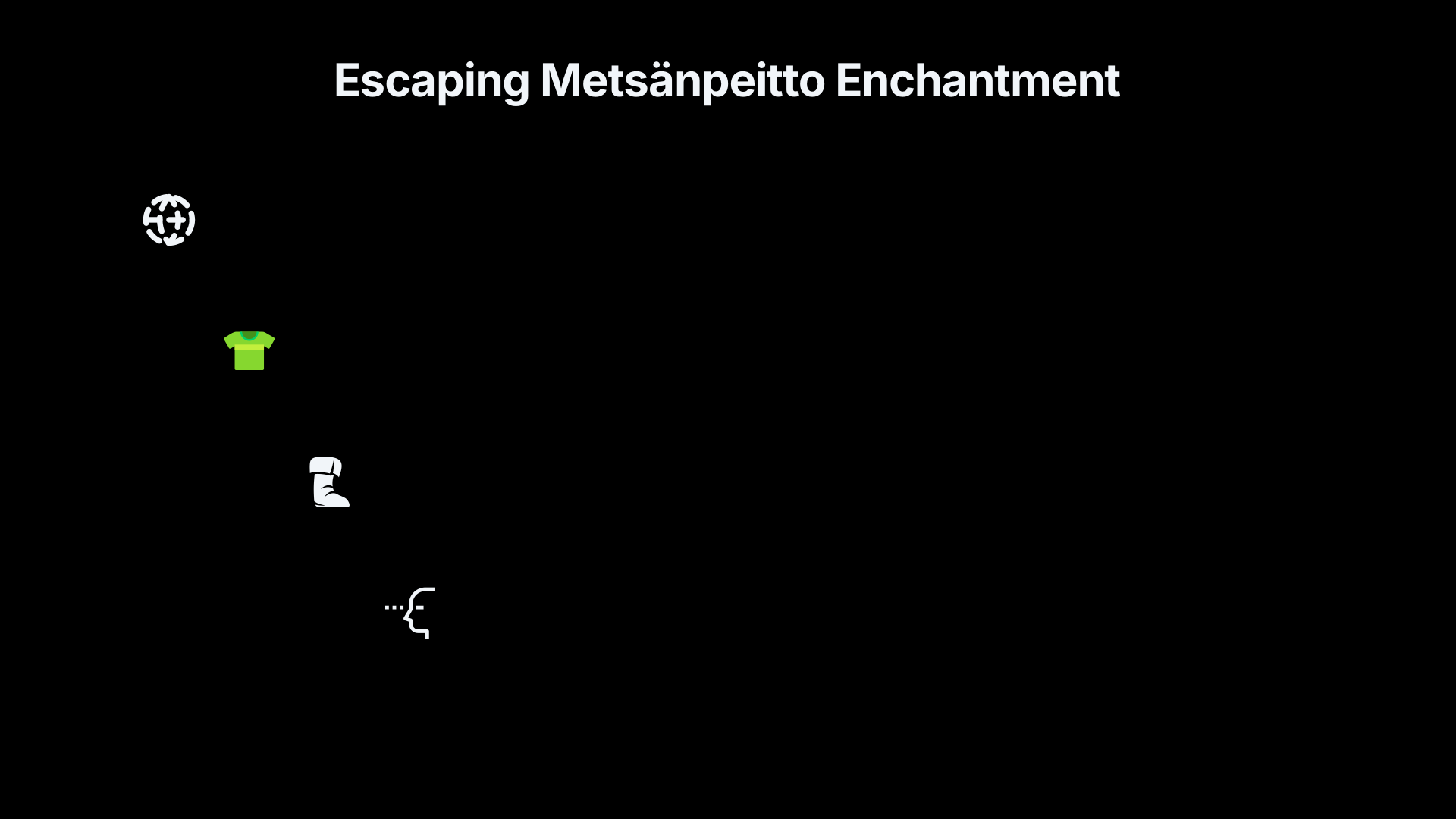
Traditional remedies varied by region, but many involved deliberately breaking the enchantment. Folklore records describe actions intended to reverse the altered relationship between person and landscape. Turning clothing inside out, changing shoes from one foot to the other, or otherwise doing something unusual were among the methods said to restore normal perception. The logic behind such practices was that an inversion in human behaviour might undo the inversion created by the forest.[Wikipedia]WikipediaOpen source on wikipedia.org.
Whether understood as a supernatural event, a cautionary tale or a symbolic explanation for getting lost, metsänpeitto remains one of the most memorable examples of Finland’s belief in hidden places that coexist with the visible landscape.[Wikipedia]WikipediaOpen source on wikipedia.org.
Sacred Groves, Stones and Hidden Boundaries
Not every spirit place was dangerous. Some were sacred. Before Christianity became dominant, certain forests, groves, stones and hills were treated as special locations where people made offerings or communicated with supernatural powers. Among the best-known terms associated with these places is hiisi, which originally referred to a sacred site, often connected with woodland settings and ritual activity. Later Christian traditions frequently reinterpreted such places as frightening or demonic.[Wikipedia]WikipediaBaltic Finnic paganismPlaces where sacrifices were given to ancestors were called Hiisi (= sacred forest, also a kind of open air temple…
These sacred locations were important because they represented points where the human and spirit worlds were believed to meet. Offerings could be left there to seek good fortune, protection or success in hunting and farming. Sacred trees in particular appear repeatedly in historical descriptions of Finnish folk religion.[Wikipedia]WikipediaBaltic Finnic paganismPlaces where sacrifices were given to ancestors were called Hiisi (= sacred forest, also a kind of open air temple…
Such places were not necessarily marked by temples or buildings. A striking boulder, an isolated grove or a prominent hill could become spiritually significant through local tradition. This attachment of meaning to specific landscape features helped create a map of hidden significance layered over the visible countryside.[Out in the Nature]outinthenature.comOut in the NatureUnlocking the secrets of Finnish mythology and sacred sites9 Apr 2024 — The ancient Finns considered certain natural sit…
Respect, Fear and Everyday Rules
Belief in spirits was not only about extraordinary encounters. It shaped everyday behaviour. Many customs encouraged people to act carefully in places associated with unseen powers. Loud boasting, unnecessary damage to the forest or disrespectful conduct in important spaces could be viewed as risky because it might offend local guardians.[Wikipedia]WikipediaOpen source on wikipedia.org.
The home provided a parallel example. Household spirits were believed to watch over domestic life, but their protection depended on proper conduct. The sauna, one of the most culturally important spaces in Finland, was also associated with its own guardian spirit in many traditions. Behaviour in these spaces therefore carried both practical and supernatural significance.[Wikipedia]WikipediaOpen source on wikipedia.org.
Viewed together, these beliefs created a moral geography. Certain places deserved respect because they were inhabited, protected or watched. The landscape was not merely terrain; it was a community that included human beings and invisible neighbours.[Sidetracked]sidetracked.comMyths of the North – A Journey into Finnish FolkloreThey held an animistic belief that assigned spirits to every individual tree, stream, stone, person, animal, lake, and flower…
How These Traditions Are Understood Today
Most modern Finns do not literally organise daily life around forest guardians or the forest’s cover. Yet these traditions remain culturally influential. Folklore archives, museums, literature, fantasy fiction and heritage tourism continue to draw on stories of guardian spirits and enchanted forests. The idea that nature deserves respect also resonates strongly with contemporary Finnish attitudes towards forests and outdoor life.[Rukapalvelu]rukapalvelu.fihow do finnish forest spirits influence modern wilderness experiencesHow do Finnish forest spirits influence modern wilderness…31 May 2026 — Finnish forest spirits, primarily known as haltija…
Modern retellings often emphasise the symbolic meaning of these traditions. The haltija can be seen as expressing responsibility towards a place, while metsänpeitto captures the unsettling experience of losing one’s bearings in a vast landscape. Even when interpreted metaphorically, the stories preserve an older way of seeing the world: one in which forests were alive with presence, hidden places existed just beyond ordinary perception, and every journey into the wilderness required humility.[wikipedia.org]WikipediaOpen source on wikipedia.org.
Amazon book picks
Further Reading
Books and field guides related to What Spirits Lived in Finland's Landscape?. Use these as the next step if you want deeper reading beyond the article.
Finnish Folk Belief: A Reader
Directly addresses guardian spirits, sacred places and folk belief.
eBay marketplace picks
Marketplace Samples
Live-tested eBay searches with available results related to this page.

Endnotes
1.
Source: Wikipedia
Link:https://en.wikipedia.org/wiki/Haltija
2.
Source: Wikipedia
Link:https://en.wikipedia.org/wiki/Mets%C3%A4npeitto
3.
Source: Wikipedia
Link:https://en.wikipedia.org/wiki/Baltic_Finnic_paganism
Source snippet
Baltic Finnic paganismPlaces where sacrifices were given to ancestors were called Hiisi (= sacred forest, also a kind of open air temple...
4.
Source: sidetracked.com
Title: Myths of the North – A Journey into Finnish Folklore
Link:https://www.sidetracked.com/myths-of-the-north/
Source snippet
They held an animistic belief that assigned spirits to every individual tree, stream, stone, person, animal, lake, and flower...
5.
Source: rukapalvelu.fi
Title: how do finnish forest spirits influence modern wilderness experiences
Link:https://rukapalvelu.fi/en/how-do-finnish-forest-spirits-influence-modern-wilderness-experiences/
Source snippet
How do Finnish forest spirits influence modern wilderness...31 May 2026 — Finnish forest spirits, primarily known as haltija...
Published: May 2026
6.
Source: Wikipedia
Title: Finnish language
Link:https://en.wikipedia.org/wiki/Finnish_language
Source snippet
Finnish languageFinnish is a Finnic language of the Uralic language family, spoken by the majority of the population in Finland and by...
7.
Source: Wikipedia
Link:https://en.wikipedia.org/wiki/Finns
Source snippet
FinnsFinns or Finnish people are a Baltic Finnic ethnic group native to Finland. Finns are traditionally divided into smaller regional...
8.
Source: folklore.ee
Link:https://www.folklore.ee/folklore/vol12/spirits.htm
Source snippet
The Waters and Water Spirits in Votian Folk BeliefIn this article I intend to focus on the belief reports, legends and descriptions of cu...
9.
Source: finland.fi
Link:https://finland.fi/life-society/where-does-finnish-come-from/
Source snippet
languages...
10.
Source: outinthenature.com
Link:https://www.outinthenature.com/unlocking-the-secrets-of-finnish-mythology-and-sacred-sites/
Source snippet
Out in the NatureUnlocking the secrets of Finnish mythology and sacred sites9 Apr 2024 — The ancient Finns considered certain natural sit...
11.
Source: the-war-of-the-sword.fandom.com
Link:https://the-war-of-the-sword.fandom.com/wiki/Haltija
Source snippet
The War of the Sword Wiki - FandomA haltija (haltia) is a spirit, gnome, or elf-like creature in Finnish mythology that guards, helps...
Additional References
12.
Source: learnfinnished.com
Link:https://www.learnfinnished.com/finnish-me
Source snippet
Finnish MeFinnish Me is a self-paced online course for beginner and intermediate Finnish learners. Study whenever and wherever you want w...
13.
Source: vaki.fi
Link:https://vaki.fi/vaki-natureservices/
Source snippet
Nature Services | Lapin VäkiIn Finnish mythology, väki is the pulsing energy of nature – the wind rustling in the forest, the wisdom hidd...
14.
Source: youtube.com
Link:https://www.youtube.com/%40FinnishPod101
Source snippet
Learn Finnish with FinnishPod101.comIn this 25-lesson series, you'll learn all about the holidays celebrated in Finland! Perfect for any...
15.
Source: youtube.com
Link:https://www.youtube.com/watch?v=D1w6su0YTtc
16.
Source: finnishcourses.fi
Link:https://finnishcourses.fi/
17.
Source: littlewomen.medium.com
Link:https://littlewomen.medium.com/finnish-mythology-forest-blanket-3152ce2f2028
Source snippet
Finnish Mythology: Forest Blanket | by Niina PekantytärIn Finnish folklore, there is a similar concept called metsänpeitto, the for...
18.
Source: reddit.com
Link:https://www.reddit.com/r/Missing411/comments/mon2r5/being_covered_by_the_forest_possible_explanation/
Source snippet
lklore. It is used to describe people or domestic animals...Read more...
19.
Source: youtube.com
Link:https://www.youtube.com/watch?v=HWLdVE1q-sc
Source snippet
Tonttu & Haltia: The Guardians of Finnish FolkloreIn Finnish folklore, Tonttu and Haltia are key spirits that watch over nature and homes...
20.
Source: facebook.com
Link:https://www.facebook.com/groups/281886105961506/posts/808351073315004/
Source snippet
lore. It is used to describe people or domestic animals...Read more...
21.
Source: library.oapen.org
Title: 9789522228499 myth and menatlity REVISED
Link:https://library.oapen.org/bitstream/id/48e12359-6e54-43da-8934-9db38632fd1f/9789522228499_myth_and_menatlity-REVISED.pdf
Source snippet
and MentalityCited by 43 — The primary research data is drawn from the Finnish Literature Society folklore archive's folk belief category...
Topic Tree