Within Djibouti Folklore
Why the Issa Origin Story Matters
The Issa origin story links clan memory, Islamic holiness and local shrine tradition in one of Djibouti's clearest folklore anchors.
On this page
- Aqiil Abuu Taalib and sacred descent
- Shrines, hymns and clan belonging
- How Islamic language reshaped local memory
Page outline Jump by section
Introduction
Among the many traditions that connect folklore, religion and community identity in Djibouti, few are as important as the Issa story of sacred ancestry. The Issa, one of the country’s largest Somali communities, preserve traditions that trace their origin to a revered ancestor named Aqiil Abuu Taalib. In oral accounts, hymns and shrine-centred devotion, he is remembered not merely as a distant forefather but as a holy figure whose presence links local clan history to the wider Islamic world. The tradition matters because it explains who the Issa are, where they believe they come from, and why particular sacred places continue to hold cultural meaning. Rather than separating folklore from religion, the Issa origin story shows how genealogy, sanctity and collective memory became woven together in Djibouti’s cultural landscape.[EveryCulture]everyculture.comDjiboutians - Introduction, Location, Language, Folklore…The Somali Issa have a creation myth that portrays their common a…
Why the Issa Origin Story Matters
For many societies in the Horn of Africa, ancestry is not simply a record of biological descent. Genealogies can function as historical memory, social organisation and statements of identity. Among the Issa, traditions surrounding Aqiil Abuu Taalib occupy this role. Accounts recorded in ethnographic and cultural reference works describe him as a holy man who came from Arabia and became the ancestor of the Issa people. His story therefore places the community within both a local Horn of Africa setting and a wider Islamic sacred geography.[EveryCulture]everyculture.comDjiboutians - Introduction, Location, Language, Folklore…The Somali Issa have a creation myth that portrays their common a…
This type of sacred genealogy is common across parts of the Horn of Africa, where clans often preserve traditions linking themselves to respected Muslim ancestors. Such narratives are not usually understood as folklore in the sense of fairy tales. Instead, they act as living traditions that explain belonging, authority and moral heritage. The Issa example is especially significant in Djibouti because the community forms a major part of the country’s population and has played a central role in its modern political and cultural life.[IRB-CISR]irb-cisr.gc.caResponses to Information RequestsSources report that in Djibouti, approximately half of the population has roots in the Somali et…
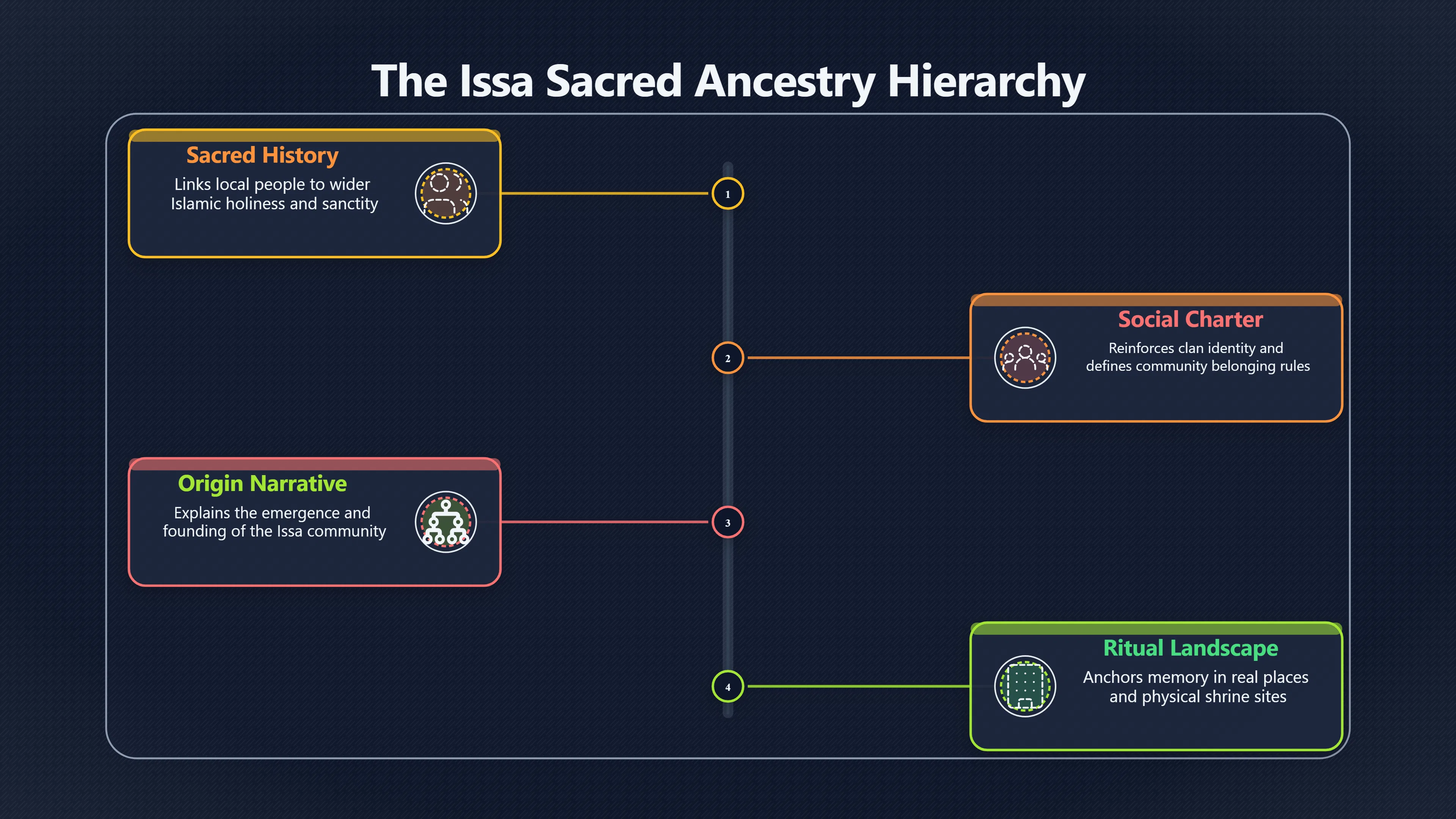
For readers interested in folklore, the key point is that the story operates on several levels at once:
- It is an origin narrative explaining the emergence of a community.
- It is a sacred history linking local people to Islamic holiness.
- It is a social charter that reinforces clan identity.
- It is attached to real places, rituals and remembered landscapes rather than existing only as a spoken tale.[EveryCulture]everyculture.comDjiboutians - Introduction, Location, Language, Folklore…The Somali Issa have a creation myth that portrays their common a…
Aqiil Abuu Taalib and Sacred Descent
The best-known version of the tradition presents Aqiil Abuu Taalib as a saintly ancestor from Arabia. Sources describing Issa folklore note that he is remembered as a holy man whose arrival established the lineage from which the community descends. The emphasis on Arabian origins is significant. Throughout the Islamic history of the Horn of Africa, claims of descent from respected Arab ancestors often carried religious prestige and helped connect local communities to the broader Muslim world.[EveryCulture]everyculture.comDjiboutians - Introduction, Location, Language, Folklore…The Somali Issa have a creation myth that portrays their common a…
Modern historians and anthropologists generally approach such genealogies as cultural traditions rather than straightforward historical records. Their importance lies less in proving a literal migration and more in showing how communities understood themselves. In the Issa case, sacred descent provides a bridge between pastoral Somali society and the universal language of Islam. The ancestor becomes both clan founder and religious figure.[ArcAdiA]arcadia.sba.uniroma3.itArc Adi AANSomalia, Djibouti, eastern Ethiopia. They are composed of four major clans, Isaq, Issa, Gadabursi and…Read more…
This dual role helps explain the durability of the tradition. Political borders have shifted repeatedly across Djibouti, Somalia and Ethiopia, yet Issa communities continue to share genealogical memories that cross those boundaries. The story therefore functions as a cultural map linking scattered populations through a common sacred ancestor.[ArcAdiA]arcadia.sba.uniroma3.itArc Adi AANSomalia, Djibouti, eastern Ethiopia. They are composed of four major clans, Isaq, Issa, Gadabursi and…Read more…
Shrines, Hymns and Clan Belonging
One reason the Issa origin tradition stands out within Djibouti’s folklore is that it is attached to ritual practice. Cultural descriptions of Djiboutian society record that hymns are sung in honour of Aqiil Abuu Taalib and that a shrine associated with him exists in Djibouti. The shrine is connected to traditions that describe his appearance as miraculous, making it more than a simple memorial site.[EveryCulture]everyculture.comDjiboutians - Introduction, Location, Language, Folklore…The Somali Issa have a creation myth that portrays their common a…
The combination of sacred place and sacred song is important. Oral traditions often survive most effectively when they are tied to regular acts of remembrance. Hymns preserve stories through performance, while shrines anchor memory in the landscape. Together they transform ancestry from an abstract genealogy into something people can visit, honour and celebrate.[everyculture.com]everyculture.comDjiboutians - Introduction, Location, Language, Folklore…The Somali Issa have a creation myth that portrays their common a…
In many Muslim societies, saintly shrines serve as places where communal identity is reinforced. Visitors may remember ancestors, seek blessings, commemorate local history or participate in shared rituals. Although practices vary widely and interpretations differ among Muslims, the broader pattern of saint veneration and shrine visitation is well documented across Africa and the wider Islamic world. The Issa shrine tradition fits into this larger religious landscape while remaining distinctly tied to local clan memory.[Ssoar]ssoar.infoDimensions of Locality: Muslim Saints, their Place and SpaceThe shrines of Muslim saints can be found in a number of similar forms a…
For the Issa, the shrine tradition also helps answer a practical social question: who belongs to the community? Shared reverence for a founding ancestor becomes a visible symbol of common descent and collective history.
How Islamic Language Reshaped Local Memory
The Issa origin story illustrates a broader process visible throughout the Horn of Africa: older systems of kinship memory becoming expressed through Islamic concepts and vocabulary. Over centuries, local traditions were not abandoned but reinterpreted through the language of saints, holy ancestry and religious legitimacy.[ArcAdiA]arcadia.sba.uniroma3.itArc Adi AANSomalia, Djibouti, eastern Ethiopia. They are composed of four major clans, Isaq, Issa, Gadabursi and…Read more…
This does not mean the tradition is simply an imported Arabian story. The shrine’s location in Djibouti, the continued role of clan identity and the use of oral performance all root the narrative firmly in local experience. What changed was the framework through which memory was explained. Ancestral history became sacred history. Clan founders became holy men. Genealogies became part of a wider Islamic narrative stretching beyond the Horn of Africa.[EveryCulture]everyculture.comDjiboutians - Introduction, Location, Language, Folklore…The Somali Issa have a creation myth that portrays their common a…
Anthropologists studying Somali societies have frequently noted the importance of genealogy in organising social relationships. The Issa tradition shows how such genealogies could acquire religious meaning as well as social function. In this sense, the story is not merely about the distant past. It is about how communities continually reinterpret the past to fit changing religious and cultural worlds.[ArcAdiA]arcadia.sba.uniroma3.itArc Adi AANSomalia, Djibouti, eastern Ethiopia. They are composed of four major clans, Isaq, Issa, Gadabursi and…Read more…

Between History, Folklore and Faith
A modern reader may ask whether Aqiil Abuu Taalib was a historical person, a legendary ancestor or a saintly figure created through oral tradition. The available evidence does not allow a simple answer. The tradition survives primarily through communal memory, genealogical narratives and religious practice rather than through extensive contemporary historical documentation.[EveryCulture]everyculture.comDjiboutians - Introduction, Location, Language, Folklore…The Somali Issa have a creation myth that portrays their common a…
That uncertainty is part of what makes the tradition valuable from a folklore perspective. Folklore often occupies the space between documented history and meaningful belief. The power of the Issa origin story lies not in whether every detail can be verified, but in how the narrative has shaped identity, ritual and belonging across generations.
In Djibouti’s folklore landscape, where oral tradition frequently carries more weight than written mythological texts, the story of Aqiil Abuu Taalib remains one of the clearest examples of sacred ancestry becoming a living cultural institution. Through hymns, pilgrimage, genealogy and collective memory, the Issa origin tradition continues to connect people, place and faith in a way that few other Djiboutian narratives do.[everyculture.com]everyculture.comDjiboutians - Introduction, Location, Language, Folklore…The Somali Issa have a creation myth that portrays their common a…
eBay marketplace picks
Marketplace Samples
Live-tested eBay searches with available results related to this page.


Endnotes
1.
Source: everyculture.com
Link:https://www.everyculture.com/wc/Costa-Rica-to-Georgia/Djiboutians.html
Source snippet
Djiboutians - Introduction, Location, Language, Folklore...The Somali Issa have a creation myth that portrays their common a...
2.
Source: encyclopedia.com
Link:https://www.encyclopedia.com/humanities/encyclopedias-almanacs-transcripts-and-maps/djiboutians
3.
Source: irb-cisr.gc.ca
Link:https://www.irb-cisr.gc.ca/en/country-information/rir/Pages/index.aspx?doc=457521
Source snippet
Responses to Information RequestsSources report that in Djibouti, approximately half of the population has roots in the Somali et...
4.
Source: ssoar.info
Link:https://www.ssoar.info/ssoar/bitstream/document/70054/1/70054_1.pdf
Source snippet
Dimensions of Locality: Muslim Saints, their Place and SpaceThe shrines of Muslim saints can be found in a number of similar forms a...
5.
Source: arcadia.sba.uniroma3.it
Title: Arc Adi AAN
Link:https://arcadia.sba.uniroma3.it/bitstream/2307/4150/1/Clanship_%20conflict%20and%20refugees_An%20introduction%20to%20Somalis%20in%20the%20Horn%20of%20Africa.pdf
Source snippet
Somalia, Djibouti, eastern Ethiopia. They are composed of four major clans, Isaq, Issa, Gadabursi and...Read more...
Additional References
6.
Source: 101lasttribes.com
Link:https://www.101lasttribes.com/tribes/dir.html
Source snippet
Dir peopleThe Dir are one of the six primary clans of the Somali people of Somalia. They are also considered to be the oldest Somali stoc...
7.
Source: academia.edu
Link:https://www.academia.edu/128118359/THE_GREATEST_MAN_IN_HISTORY_MUHAMMAD_PBUH_Prophet_of_Islam_VOL_II_EXPANDED_2nd_EDITION
Source snippet
659 Truce between Caliph Ali ibn Abu Talib and Muawiya ibn Abu Sufyan. 661 Caliph Ali ibn Abu Talib is assassinated.Read more...
8.
Source: facebook.com
Link:https://www.facebook.com/groups/omniglot/posts/10159060344069666/
Source snippet
aale and Dir lineage of Issak, Gadabursi and Issa clans in Somaliland and Djibouti.Read more...
9.
Source: scribd.com
Link:https://www.scribd.com/document/579215470/Issa-clan-Wikipedia
Source snippet
Overview of the Issa Clan History | PDF | Africa | Ethiopia13 Aug 2025 — The Issa clan is a predominantly Somali clan living primarily in...
10.
Source: facebook.com
Link:https://www.facebook.com/jeptengwe.teriki/posts/the-tomb-of-sheikh-ishaaq-the-founding-father-of-the-isaaq-clan-of-the-somali-tr/3854586918118423/
Source snippet
jibouti. The image provides a glimpse into the lives of...Read more...
11.
Source: ecoi.net
Title: “Information on the Issa and the Issaq
Link:https://www.ecoi.net/en/document/1098508.html
Source snippet
[SOM4718]”...Mar 15, 1990 — According to the DOS report for 1988, Djibouti is made up predominantly of the Issa, the ethnic group of the...
12.
Source: youtube.com
Link:https://www.youtube.com/watch?v=kJeMOTXxmMk
Source snippet
in the Somali Region of Ethiopia mainly in Sitti...
13.
Source: ecoi.net
Title: bsvec1 unhcr2000
Link:https://www.ecoi.net/en/file/local/1413573/bsvec1_unhcr2000.pdf
Source snippet
GENEALOGICAL TABLE OF SOMALI CLANS15 Mar 2004 — Ethiopia, Djibouti, Somalia, Kenya. 1. -Madahwayn. 2. -Isse. 3... Ethiopia. NB: 1/ Latin...
14.
Source: coursehero.com
Link:https://www.coursehero.com/file/124989473/Dir-clan-Wikipediapdf/
Source snippet
Dir clan The Dir Somali8 Jan 2022 — The Dir were supporters of Imam Ahmad ibn Ibrahim al-Ghazi during his 16th century conquest of Abyssi...
15.
Source: Wikipedia
Title: Issa (clan)
Link:https://en.wikipedia.org/wiki/Issa_%28clan%29
Source snippet
Issa (clan)The Issa (/ˈiːsɑː/; also spelled Esa, or Aysa) (Somali: Ciise, Arabic: عيسى) is a northern Somali clan, a sub-division of...
Topic Tree