Where India's Stories Still Walk
India’s folklore is not one tradition but a vast, multilingual field of stories, ritual performances, local deities, ghosts, heroic legends, sacred landscapes and seasonal customs.
Page outline Jump by section
Introduction
The best way to understand folklore in India is to hold two facts together. First, some stories have travelled for centuries through manuscripts, translations and print. Second, many of the most meaningful traditions are local: a village guardian, a regional ghost, a family tale, a festival route, a sacred grove, a night-long performance, or a story told differently from one language community to another.
Why Indian folklore cannot be reduced to one mythology
India has 22 scheduled languages recognised in the Constitution, and many more languages, dialects and speech communities beyond that formal list. That linguistic scale matters because folklore travels by voice: through lullabies, riddles, songs, proverbs, ritual chants, festival recitations, local theatre and family storytelling. A tale told in Bengali, Tamil, Kannada, Malayalam, Rajasthani, Khasi or Marathi may share a plot with a Sanskrit story, but it often carries local humour, caste memory, landscape, food, animals, gods, ghosts and social tensions that make it feel entirely its own.[language.census.gov.in]language.census.gov.inConcepts and DefinitionsConcepts and Definitions
This is why Indian folklore often sits between categories that modern readers separate too neatly. A story may be religious and entertaining at once. A spirit may be feared in one context and worshipped in another. A heroic figure may be remembered as a warrior, a protector of livestock, a village deity and a character in a painted performance. A sacred place may be explained by ecology, ancestral memory and supernatural warning all at the same time.
Folklore scholarship on India has long stressed this mixture of oral and written tradition. A. K. Ramanujan’s well-known collection, Folktales from India, brought together 110 oral tales from 22 Indian languages, a useful reminder that “Indian folktale” is not a single canon but a field of variants, borrowings and local performances.[Internet Archive]archive.orgfolktalesfromind0000unse a1f8folktalesfromind0000unse a1f8 Sahapedia’s discussion of Indian folkloristics similarly points to the importance of ethnographic approaches: studying who tells the story, when, where, for whom, and with what social meaning, rather than treating every tale as a fixed literary text.[Sahapedia]sahapedia.orgOpen source on sahapedia.org.
The old story-books that shaped world folklore
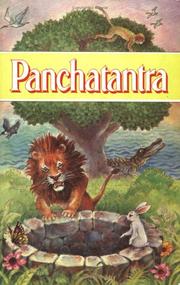
India’s written story traditions are among the most influential in world literature, but they are also deeply connected to older oral storytelling. The Panchatantra is the classic example. It is a collection of interlinked animal fables and political wisdom tales, usually framed as instruction for princes. Its stories of clever jackals, foolish lions, talking birds, tricksters and dangerous friendships have travelled through Sanskrit, Persian, Arabic, Latin and European retellings, eventually becoming part of global fable culture.[Internet Archive]archive.orgryder 1925 panchatantra englishryder 1925 panchatantra english
The Panchatantra matters to folklore because it shows how a tale can be both literary and oral. The stories were written down, translated and copied, but their power lies in their performable shape: a compact plot, memorable animal characters, a practical lesson and enough wit to survive retelling. Readers may recognise this pattern from fables across the world, yet many of those routes pass through Indian narrative traditions.
The Jataka stories, linked to accounts of the Buddha’s previous lives, are another major bridge between moral teaching and folktale. Older English collections of Indian fairy tales noted that the Jatakas often begin with a present incident and then turn to a “story of the past”, where a folk narrative becomes a moral example.[Internet Sacred Text Archive]sacred-texts.comOpen source on sacred-texts.com. The exact history of any single tale can be hard to prove, but the broader point is clear: Indian story culture often uses nested storytelling, where one tale opens into another, and moral judgement emerges through listening rather than through a simple lecture.
The Vikram and Vetal cycle is one of the most memorable examples of this frame-story habit. A king carries a corpse inhabited by a spirit; the spirit tells him a story ending in a moral or legal puzzle; if the king knows the answer and stays silent, he is cursed, but if he speaks, the spirit escapes and the cycle begins again. Sahapedia describes these linked tales as deeply placed in Indian oral tradition and notes their elastic quality: they expand, shift and change with each telling.[Sahapedia]sahapedia.orgOpen source on sahapedia.org. For modern readers, Vikram and Vetal shows that Indian folklore is often less interested in a single “monster” than in the act of judgement: what is justice, who is loyal, when is cleverness admirable, and when is silence impossible?

Performance keeps stories alive
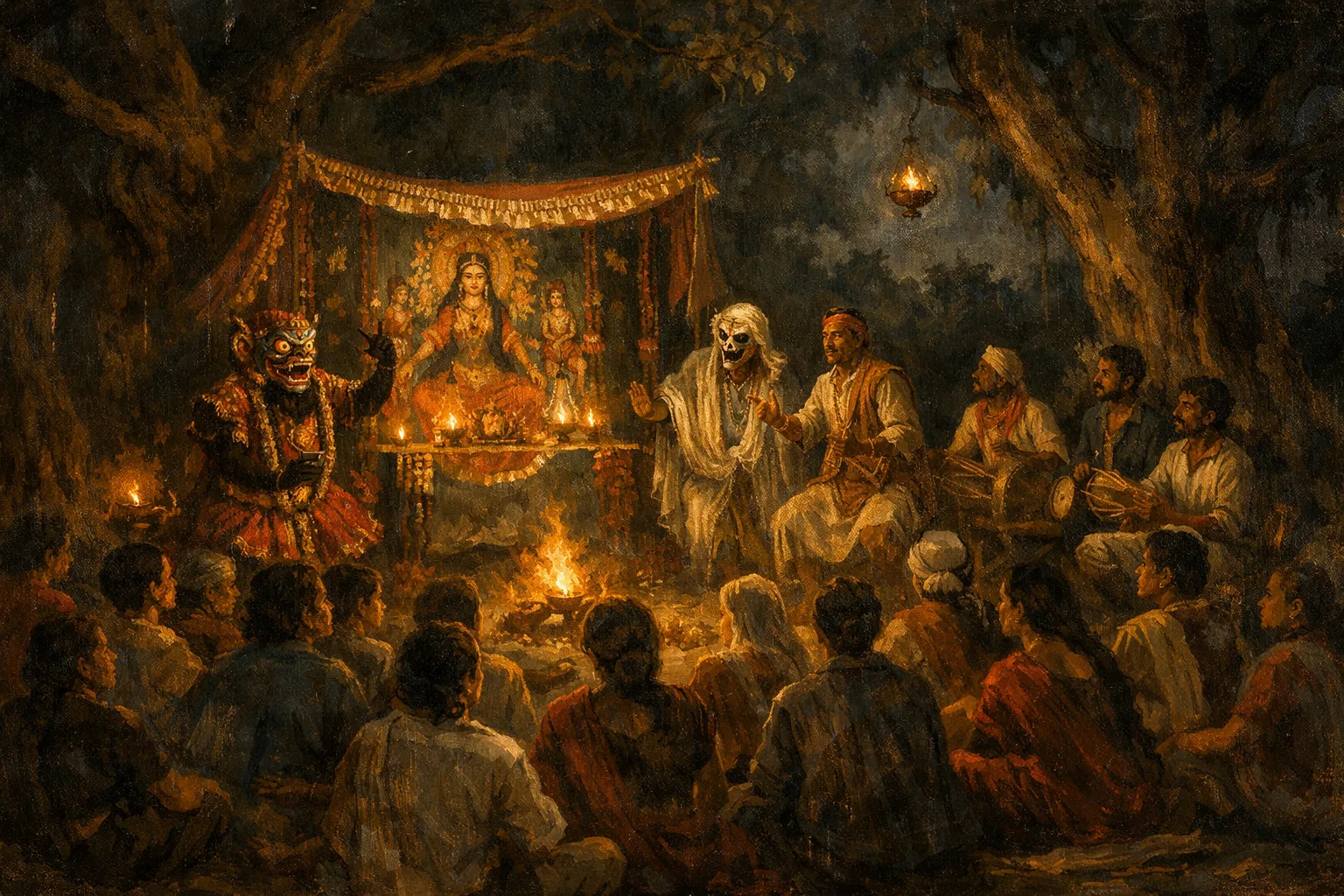
Many Indian legends are not mainly encountered as bedtime stories or printed tales. They are heard in public, watched in costume, sung at night, painted onto portable shrines, or performed during festivals. This is where the line between folklore, theatre, devotion and community memory becomes especially thin.
Ramlila, the traditional performance of the Ramayana, is one of the clearest examples. UNESCO describes it as a staged sequence of scenes using song, narration, recital and dialogue, performed across northern India during the autumn festival season. Representative traditions include those of Ayodhya, Ramnagar and Benares, Vrindavan, Almora, Satna and Madhubani.[UNESCO Intangible Cultural Heritage]ich.unesco.orgOpen source on unesco.org. Although the Ramayana is a major literary and religious epic, Ramlila is also folklore in action: local communities cast roles, remember lines, gather audiences, interpret characters and renew the story each year.
Ramman, from the Garhwal Himalayas in Uttarakhand, shows how local ritual theatre can combine epic material with village-specific sacred life. UNESCO describes it as a religious festival and ritual theatre involving complex rituals, recitation of a version of the Rama epic, local legends, songs and masked performances. The Indian Ministry of Culture connects the festival with Saloor-Dungra villages and the local deity Bhumiyal Devta, emphasising that community roles are built into the tradition.[UNESCO Intangible Cultural Heritage]ich.unesco.orgOpen source on unesco.org. This is not folklore as distant entertainment; it is a way of organising memory, status, duty and sacred protection.
Rajasthan offers another powerful model: the heroic oral epic performed with a painted textile. The epic of Pabuji is a long heroic narrative normally performed at night and linked to religious devotion. Sahapedia notes that Pabuji, remembered as a medieval Rathore prince, is regarded as a deity by some pastoral communities, especially Rebari groups, and that performance is a chief ritual mode of worship.[Sahapedia]sahapedia.orgOpen source on sahapedia.org. Archive material from the Rupayan Sansthan records performances of the “Epic of Pabu”, preserving a tradition that depends on singers, visual art and local patronage rather than on a single fixed text.[Internet Archive]archive.orgdni.ncaa.RS 190 MDVdni.ncaa.RS 190 MDV
These examples change how a reader should approach Indian folklore. The “story” is not always the whole object. The full tradition may include the costume, the season, the route through a village, the painted backdrop, the ritual specialist, the audience’s expectations and the belief that performance itself does something in the world.
Spirits, ghosts and dangerous women
India has a rich and regionally varied ghost lore, but it should not be flattened into a list of monsters. Many beings called ghosts, demons, spirits or deities occupy unstable positions. They may express anxieties about death, childbirth, gender injustice, pollution, land, caste, kinship or unfinished obligations. Some are feared as dangerous; others are ritually managed, appeased or transformed into protectors.
One broad North Indian category is the restless spirit or ghost associated with improper death, unfinished desire or social disorder. Older scholarship on ghosts and demons in Indian folklore notes that the term often translated as “ghost” can cover a wider range of malignant or troubling spirits, and that classification is difficult because regional names, functions and stories overlap.[Academia]academia.eduOpen source on academia.edu. That difficulty is not a weakness in the tradition. It shows that folk belief is practical and local: people name what troubles them in the terms their community understands.
The churel is one of the most widely discussed female ghost figures in North Indian and wider South Asian folklore. She is often linked to a woman who died during pregnancy, childbirth, impurity, neglect or traumatic circumstances, and stories about her frequently turn on male fear of female anger, sexuality and revenge. Some popular descriptions exaggerate her into horror imagery, but the deeper folklore pattern is social: a wronged or improperly treated woman returns as a dangerous presence.[Wikipedia]WikipediaOpen source on wikipedia.org.
Kerala’s yakshi traditions carry a related but distinct charge. Academic work on medieval Kerala yakshi tales notes that the yakshi can appear as a seductive, dangerous female being, sometimes associated with trees, illusion and revenge, while also retaining older links to fertility and vegetation spirits.[rupkatha.com]rupkatha.comThe Yakshi Tales of Medieval KeralaThe Yakshi Tales of Medieval Kerala Modern Malayalam literature and cinema have reshaped the yakshi into a recognisable gothic figure, but the older story pattern is more complicated than “female vampire”. She may be a sign of desire, danger, injustice, local landscape and the fear that beauty itself can be a disguise.
Spirit traditions in coastal Karnataka and neighbouring regions show another side of Indian supernatural belief. Bhoota Kola, associated with Tulu-speaking communities, is based on guardian spirits who protect villages and are invoked through ritual performance. Sahapedia describes the tradition as involving spirits that once walked the land as humans, with local households and communities maintaining ritual relationships with them.[Sahapedia]sahapedia.orgOpen source on sahapedia.org. In such cases, the supernatural is not merely frightening. It becomes part of justice, memory and local governance, because the spirit may be approached for advice, blessing or dispute resolution.
Sacred landscapes: forests, rivers, hills and haunted places
Indian folklore is strongly tied to place. A hill may be sacred because a deity rested there; a tree may be avoided because a spirit lives in it; a riverbank may host seasonal rites; a fort may gather ghost stories after political violence; a forest may be protected by ancestral rules stronger than written signage. These traditions often mix ecological knowledge with sacred warning.
The sacred groves of Meghalaya are a striking example. The Meghalaya Biodiversity Board explains that sacred groves in the Khasi and Jaintia Hills are based on traditional religious belief and are protected through community practice.[megbiodiversity.nic.in]megbiodiversity.nic.insacred grovessacred groves Mawphlang Sacred Grove, often discussed in travel and conservation writing, is especially famous for the rule that nothing should be removed from the forest. Recent reporting on Meghalaya’s sacred groves links Mawphlang’s protection to Khasi ancestral memory, ritual practice and a worldview in which forest, water and ancestry are inseparable.[India Water Portal]indiawaterportal.orgIndia Water Portal Inside Meghalaya's sacred groves where community careIndia Water Portal Inside Meghalaya's sacred groves where community care
For folklore readers, the important point is not whether every warning story is literally believed in the same way by every visitor. The rule itself is part of the tradition. “Do not take even a leaf” works as a supernatural warning, a moral instruction and a conservation practice. This is one of the ways folklore can shape behaviour without needing to look like modern environmental policy.
Haunted places in India often work differently. Colonial hill stations, old schools, forts, forests, beaches and roads attract ghost stories partly because they combine dramatic scenery with memories of death, isolation or social change. Recent popular travel writing still circulates legends around places such as Dow Hill near Kurseong, Dumas Beach in Gujarat and Jatinga in Assam, sometimes blending local rumour with tourism-friendly mystery.[The Times of India]timesofindia.indiatimes.comThe Times of India Most mysterious forests in India and the legends around them1. Dow Hill Forest, Kurseong (West Bengal): Known for ghost sightings and a haunted "Death Road," this misty forest is picturesque by… These accounts should be read carefully: they are useful evidence of modern folklore and tourist retelling, not proof of supernatural events. Their popularity shows how old ghost-story habits adapt to photography, listicles, social media and weekend travel.
Festivals turn myth into public culture
India’s ritual calendar is one of the main engines of living folklore. Seasonal festivals do not only commemorate myths; they stage them, decorate them, sing them, sell them, argue about them and adapt them to contemporary city life.
Durga Puja in Kolkata is a powerful example of myth becoming public art. UNESCO inscribed the festival on the Representative List of the Intangible Cultural Heritage of Humanity in 2021, describing the worship of the mother-goddess Durga and the months of artisanal work that go into sculpting images before the festival.[UNESCO]unesco.orgOpen source on unesco.org. The Indian Ministry of Culture describes Durga Puja as a ten-day festival in which images are ritually enlivened and later immersed, while also stressing its blend of devotion, art, community and social participation.[culture.gov.in]culture.gov.inintangible cultural heritageintangible cultural heritage
For a folklore reader, Durga Puja is not only about the goddess defeating a demon. It is also about neighbourhood creativity, temporary architecture, clay modelling, procession, homecoming, public gathering and the annual remaking of a shared story. Recent reporting on idol-makers shows how artisans craft the goddess’s expression, dress and presence for installation in homes and community pavilions before immersion.[AP News]apnews.comOpen source on apnews.com. The myth gives the festival its sacred centre, but the living tradition includes labour, artistry, sound, food, crowds and urban memory.
Garba of Gujarat, inscribed by UNESCO in 2023 and listed by India’s Ministry of Culture, offers another form of seasonal folklore: devotional circular dance around a lamp-lit pot or goddess image during the Navaratri season.[culture.gov.in]culture.gov.inintangible cultural heritageintangible cultural heritage It is not a “legend” in the narrow sense, but it belongs firmly within folklore because it transmits embodied knowledge: steps, songs, gendered participation, community belonging and devotion to feminine power.
Kumbh Mela, listed by the Ministry of Culture as an Indian intangible cultural heritage element, shows the scale at which pilgrimage, sacred geography and oral teaching can operate. The ministry describes it as a massive peaceful congregation held cyclically at Allahabad, Haridwar, Ujjain and Nashik, involving river bathing, ritual specialists, astronomy and oral traditions.[culture.gov.in]culture.gov.inintangible cultural heritageintangible cultural heritage Here folklore is not a small tale at the fireside; it is a moving sacred landscape, renewed through bodies, routes, stories and ritual timings.
Folk heroes, local deities and the blurred line between history and legend
A recurring feature of Indian folklore is the human figure who becomes more than human. A warrior, pastoral protector, saint, wronged woman, bard, ancestor or local ruler may enter oral tradition and gradually become a deity, guardian or moral exemplar. These figures are often difficult to place neatly in “history” or “myth”, because their importance lies in the way communities remember and use them.
Pabuji of Rajasthan is a good example. Some sources connect him to medieval Rajput history, while living performance traditions treat him as a protector and divine figure for pastoral communities. Sahapedia’s account stresses the religious purpose of epic performance, while educational material on the Pabuji tradition notes that he is widely worshipped as a patron protector of livestock and camel drivers among rural groups.[Sahapedia]sahapedia.orgOpen source on sahapedia.org. The historical question matters, but it is not the only question. For the communities that perform his epic, Pabuji’s value lies in protection, identity, memory and obligation.
Rajasthan’s painted storytelling traditions show how material art can carry oral epic. A painted cloth or portable shrine is not simply an illustration; it helps organise performance, sequence and sacred presence. The National Museum of India describes a Rajasthani folk tradition that draws on Hindu epics, mythology, local folklore and the aspirations of patrons, pointing to the way visual art, story and social memory overlap.[nationalmuseumindia.gov.in]nationalmuseumindia.gov.inOpen source on nationalmuseumindia.gov.in.
This pattern appears across India. Local deities may be connected to a hill, a disease, a cattle route, a caste group, a village boundary or a founding ancestor. Their stories often preserve memories of conflict and settlement, but they also change as communities change. A legend may become more devotional, more political, more touristic or more cinematic depending on who retells it and why.
Folklore in print, archives and modern media
Indian folklore has never been frozen in an ancient past. It has moved from oral performance into manuscripts, colonial collections, children’s books, school texts, archives, television, comics, horror films, streaming series, tourism campaigns and social media.
Colonial-era collection is part of this story, but it must be handled carefully. JSTOR’s summary of work on colonial collectors notes that Mary Frere’s Old Deccan Days, published in 1869, was the first collection of Indian folktales made by a British resident of colonial India.[JSTOR]jstor.orgTales of the Colonial British Collectors of Indian FolkloreTales of the Colonial British Collectors of Indian Folklore Such collections preserved valuable tales, but they also filtered them through colonial households, translation choices, class relations and Victorian expectations. A printed “Indian fairy tale” may therefore be both a source and a transformation.
Modern archiving offers different possibilities. The Rupayan Sansthan recordings of Rajasthan’s oral epic traditions preserve performance, sound, sequence and context in ways a printed plot summary cannot.[Internet Archive]archive.orgdni.ncaa.RS 190 MDVdni.ncaa.RS 190 MDV Bhasha Research and Publication Centre, founded in 1996, works on tribal languages, literature, history, culture, arts and crafts, with particular attention to marginalised communities.[Cultural Survival]culturalsurvival.orgbhasha research publication centerbhasha research publication center For folklore, this kind of documentation matters because endangered languages often carry endangered story-worlds.
Modern media can revive folklore but also simplify it. A spirit tradition may become horror content; a ritual may become spectacle; a regional goddess may become a generic “Indian mythological” character; a local ghost may be detached from the social conditions that made her meaningful. At the same time, popular media can send audiences back towards living traditions, archives and regional histories. The challenge for readers is to ask: is this an old oral belief, a literary retelling, a ritual practice, a tourist version, a film adaptation, or an internet-era reinvention?
How to read Indian folklore without flattening it
The safest way to approach Indian folklore is to treat each tradition as both a story and a social practice. Ask where it is told, who performs it, what language or region it belongs to, whether it is tied to a festival or sacred place, and whether the version you are reading comes from oral performance, manuscript literature, colonial collection, modern children’s publishing, tourism or film.
A few practical distinctions help:
Old does not always mean unchanged. Ramlila, Panchatantra tales and Vikram and Vetal stories have old roots, but every performance, translation and television version changes emphasis.[unesco.org]ich.unesco.orgOpen source on unesco.org.
Local does not mean minor. A village ritual, sacred grove or regional ghost may matter more intensely to its community than a nationally famous myth. Ramman and Mawphlang Sacred Grove show how local traditions can carry deep ritual and ecological meaning.[UNESCO Intangible Cultural Heritage]ich.unesco.orgOpen source on unesco.org.
A spirit is not always a “monster”. The yakshi, churel, guardian spirit and village deity belong to different moral worlds. Some warn, some punish, some protect, and some expose social fears around death, gender, land or injustice.[rupkatha.com]rupkatha.comThe Yakshi Tales of Medieval KeralaThe Yakshi Tales of Medieval Kerala
A festival is not just a myth in costume. Durga Puja, Garba, Ramlila and Kumbh Mela show how myth becomes public culture through art, movement, ritual timing, pilgrimage and community labour.[UNESCO]unesco.orgOpen source on unesco.org.
Why India’s folklore still matters
India’s folklore matters because it is one of the clearest ways to see how communities make meaning outside formal history books. It preserves moral puzzles, ecological rules, memories of migration, caste and pastoral life, ideas about gender and danger, seasonal rhythms, local gods, regional humour and the emotional geography of sacred places.
It also matters because it is changing quickly. Urbanisation, tourism, language loss, digital media and commercial entertainment can weaken some traditions while amplifying others. A night-long oral epic may become an archive recording; a ritual performance may become a film reference; a sacred grove may become a conservation case study; a ghost once tied to childbirth and social neglect may become a horror trope. None of those changes is automatically false, but each changes what the tradition does.
For curious readers, the richest view of Indian folklore comes from moving between scales: the globally travelled fable, the regional ghost, the village deity, the sacred forest, the public festival and the modern retelling. India’s folklore is not a single shelf of old stories. It is a living, contested, multilingual map of how people remember, fear, celebrate, warn, worship and explain the world around them.
eBay marketplace picks
Marketplace Samples
Live-tested eBay searches with available results related to this page.

Endnotes
1.
Source: ich.unesco.org
Link:https://ich.unesco.org/en/state/india-IN
2.
Source: culture.gov.in
Title: intangible cultural heritage
Link:https://culture.gov.in/intangible-cultural-heritage
3.
Source: language.census.gov.in
Title: Concepts and Definitions
Link:https://language.census.gov.in/infographics/data/showConceptsDefinitions
4.
Source: archive.org
Title: folktalesfromind0000unse a1f8
Link:https://archive.org/details/folktalesfromind0000unse_a1f8
5.
Source: sahapedia.org
Link:https://www.sahapedia.org/folkloristics-and-indian-folklore
6.
Source: archive.org
Title: ryder 1925 panchatantra english
Link:https://archive.org/details/ryder-1925-panchatantra-english
7.
Source: sites.pitt.edu
Link:https://sites.pitt.edu/~dash/panchatantra.html
8.
Source: sahapedia.org
Link:https://www.sahapedia.org/vikram-and-vetal-how-many-know-of-the-stories-within-story
9.
Source: ich.unesco.org
Link:https://ich.unesco.org/en/RL/ramlila-the-traditional-performance-of-the-ramayana-00110
10.
Source: unesco.org
Title: document 627
Link:https://www.unesco.org/archives/multimedia/document-627
11.
Source: ich.unesco.org
Link:https://ich.unesco.org/en/RL/ramman-religious-festival-and-ritual-theatre-of-the-garhwal-himalayas-india-00281
12.
Source: sahapedia.org
Link:https://www.sahapedia.org/the-epic-of-pabuji-western-rajasthan-0
13.
Source: archive.org
Title: dni.ncaa.RS 190 MDV
Link:https://archive.org/details/dni.ncaa.RS-190-MDV
14.
Source: academia.edu
Link:https://www.academia.edu/30897786/Demons_and_Ghosts_in_Indian_Folklore
15.
Source: Wikipedia
Link:https://en.wikipedia.org/wiki/Churel
16.
Source: academia.edu
Link:https://www.academia.edu/98427454/The_Vengeful_Spirit_Chudail_Oral_Traditions_and_the_Archaeology_of_Folklore
17.
Source: rupkatha.com
Title: The Yakshi Tales of Medieval Kerala
Link:https://rupkatha.com/V12/n3/v12n339.pdf
18.
Source: sahapedia.org
Link:https://www.sahapedia.org/how-guttumane-and-bhoota-kola-sustain-each-other-tulunadu
19.
Source: megbiodiversity.nic.in
Title: sacred groves
Link:https://megbiodiversity.nic.in/sacred-groves
20.
Source: unesco.org
Link:https://www.unesco.org/en/articles/durga-puja-inscribed-unesco-representative-list-intangible-cultural-heritage-humanity
21.
Source: nationalmuseumindia.gov.in
Link:https://www.nationalmuseumindia.gov.in/
22.
Source: jstor.org
Title: Tales of the Colonial British Collectors of Indian Folklore
Link:https://www.jstor.org/stable/j.ctt46nxsn.5?Search=yes&resultItemClick=true&searchText=%22Sadhana+Naithani%22&searchText=au%3A&searchUri=%2Fopen%2Fsearch%2F%3Ftheme%3Dopen%26amp%3Bsi%3D1%26amp%3Bpage%3D1%26amp%3BQuery%3Dau%253A%2522Sadhana%2BNaithani%2522%26amp%3Bso%3Dnew
23.
Source: Wikipedia
Title: List of Intangible Cultural Heritage elements in India
Link:https://en.wikipedia.org/wiki/List_of_Intangible_Cultural_Heritage_elements_in_India
24.
Source: Wikipedia
Title: Ramman (festival)
Link:https://en.wikipedia.org/wiki/Ramman_%28festival%29
25.
Source: Wikipedia
Title: Vetala Panchavimshati
Link:https://en.wikipedia.org/wiki/Vetala_Panchavimshati
26.
Source: Wikipedia
Link:https://en.wikipedia.org/wiki/Panchatantra
27.
Source: Wikipedia
Title: Kanjirottu Yakshi
Link:https://en.wikipedia.org/wiki/Kanjirottu_Yakshi
28.
Source: Wikipedia
Title: Buta Kola
Link:https://en.wikipedia.org/wiki/Buta_Kola
29.
Source: Wikipedia
Title: Languages with official recognition in India
Link:https://en.wikipedia.org/wiki/Languages_with_official_recognition_in_India
30.
Source: Wikipedia
Title: Languages of India
Link:https://en.wikipedia.org/wiki/Languages_of_India
31.
Source: sahapedia.org
Link:https://www.sahapedia.org/
32.
Source: sahapedia.org
Link:https://www.sahapedia.org/childrens-literature-kerala-traces-and-trajectories
33.
Source: sahapedia.org
Link:https://www.sahapedia.org/tag/oral-narratives
34.
Source: sahapedia.org
Link:https://www.sahapedia.org/childrens-texts-and-childhoods-kerala
35.
Source: sahapedia.org
Link:https://www.sahapedia.org/indian-folklife-28-folklore-and-environment-0
36.
Source: sahapedia.org
Link:https://www.sahapedia.org/the-fable-of-the-courtesan-the-ascetic-and-the-king
37.
Source: sahapedia.org
Link:https://www.sahapedia.org/tag/folk-traditions?page=1
38.
Source: sahapedia.org
Link:https://www.sahapedia.org/the-oral-historian-borunda-komal-kothari
39.
Source: sahapedia.org
Link:https://www.sahapedia.org/interpreting-indian-literatures-velcheru-narayana-rao-land-pastoralism-and-trade-three-ecological
40.
Source: sahapedia.org
Title: Oral traditions Subscribe to Oral traditions. Oral traditions. Displaying 1
Link:https://www.sahapedia.org/tag/oral-traditions
41.
Source: sahapedia.org
Link:https://www.sahapedia.org/tag/folk-tale
42.
Source: ich.unesco.org
Title: durga puja in kolkata 00703
Link:https://ich.unesco.org/en/RL/durga-puja-in-kolkata-00703
43.
Source: ich.unesco.org
Link:https://ich.unesco.org/en/RL/ramman-religious-festival-and-ritual-theatre-of-the-garhwal-himalayas-india-00281?RL=00281&id=01735&include=film_inc.php
44.
Source: ich.unesco.org
Link:https://ich.unesco.org/en/lists
45.
Source: ich.unesco.org
Title: photo pop up 00973
Link:https://ich.unesco.org/en/photo-pop-up-00973?photoID=00788
46.
Source: ich.unesco.org
Title: search 00795
Link:https://ich.unesco.org/en/search-00795?call=film&id=01735&include=film_inc.php&width=700
47.
Source: unesco.org
Link:https://www.unesco.org/en/articles/un-india-and-unesco-launch-guidelines-make-durga-puja-celebrations-west-bengal-more-accessible-and
48.
Source: unesco.org
Title: document 5613
Link:https://www.unesco.org/archives/multimedia/document-5613
49.
Source: ich.unesco.org
Title: preview show 2023 of durga puja art kolkata 00325
Link:https://ich.unesco.org/en/activities/preview-show-2023-of-durga-puja-art-kolkata-00325
50.
Source: ich.unesco.org
Link:https://ich.unesco.org/
51.
Source: censusindia.gov.in
Link:https://censusindia.gov.in/nada/index.php/catalog/42458/download/46089/C-16_25062018.pdf
52.
Source: pib.gov.in
Title: Press Release Page.aspx
Link:https://www.pib.gov.in/PressReleasePage.aspx?PRID=2200361
53.
Source: pib.gov.in
Title: Press Release Page.aspx
Link:https://www.pib.gov.in/PressReleasePage.aspx?PRID=2172657
54.
Source: pib.gov.in
Title: Press Note Details.aspx
Link:https://www.pib.gov.in/PressNoteDetails.aspx?ModuleId=2&NoteId=155013
55.
Source: pib.gov.in
Title: Press Release Page.aspx
Link:https://www.pib.gov.in/PressReleasePage.aspx?PRID=2223737&lang=1®=3
56.
Source: academia.edu
Link:https://www.academia.edu/77439755/Legends_and_Their_Cultural_Manifestations_The_Case_of_the_Legend_of_Yakshi_in_Kerala
57.
Source: academia.edu
Link:https://www.academia.edu/64875196/The_Epic_of_Pabuji_ki_par_in_Performance
58.
Source: academia.edu
Link:https://www.academia.edu/123671456/Ethnography_of_Wilderness_The_Sacred_Groves_in_the_Perception_of_the_Khasi_Jaintia_People
59.
Source: sangeetnatak.gov.in
Link:https://www.sangeetnatak.gov.in/sections/ICH
60.
Source: rajbhasha.gov.in
Title: languages included eighth schedule indian constitution
Link:https://rajbhasha.gov.in/en/languages-included-eighth-schedule-indian-constitution
61.
Source: library.gov.au
Title: oral history and folklore
Link:https://www.library.gov.au/discover/what-we-collect/oral-history-and-folklore
62.
Source: language.census.gov.in
Title: census.gov.in LINGUSTI C SURVEY OF INDIA
Link:https://language.census.gov.in/eLanguageDivision_VirtualPath/LSI_Reports/pdf/12.pdf
63.
Source: sahitya-akademi.gov.in
Link:https://sahitya-akademi.gov.in/aboutus/cotlit.jsp
64.
Source: mcrhrdi.gov.in
Link:https://www.mcrhrdi.gov.in/mes2022/week6/syndicate%20presentations/Group%207%20Ralila%20Cultrural%20Heritage.pdf
65.
Source: ignca.gov.in
Link:https://ignca.gov.in/divisionss/academic-unit/short-term-certification-course/folklore-and-intangible-cultural-heritage/
66.
Source: aud.delhi.gov.in
Title: folk oral indigenous popular cultures 0
Link:https://aud.delhi.gov.in/folk-oral-indigenous-popular-cultures-0
67.
Source: youtube.com
Link:https://www.youtube.com/watch?v=CIIUk8rwM2U
Source snippet
Ramlila - the Traditional Performance of the Ramayana...
68.
Source: youtube.com
Link:https://www.youtube.com/watch?v=89dtCI4oNzU
Source snippet
Connecting With The Supernatural: Bhoota Kola Ritual In Mangalore, Karnataka...
69.
Source: sacred-texts.com
Link:https://sacred-texts.com/hin/ift/ift31.htm
70.
Source: indiawaterportal.org
Title: India Water Portal Inside Meghalaya’s sacred groves where community care
Link:https://www.indiawaterportal.org/climate-change/climate/inside-meghalayas-sacred-groves-where-community-care-sustains-water-beyond-policy
71.
Source: timesofindia.indiatimes.com
Link:https://timesofindia.indiatimes.com/life-style/travel/destinations/why-is-it-forbidden-to-take-anything-from-this-sacred-forest-in-meghalaya/articleshow/128121059.cms
72.
Source: timesofindia.indiatimes.com
Title: The Times of India Most mysterious forests in India and the legends around them
Link:https://timesofindia.indiatimes.com/life-style/travel/destinations/most-mysterious-forests-in-india-and-the-legends-around-them/photostory/131470445.cms
Source snippet
1. **Dow Hill Forest, Kurseong (West Bengal)**: Known for ghost sightings and a haunted "Death Road," this misty forest is picturesque by...
73.
Source: apnews.com
Link:https://apnews.com/article/b898f8664b82701f1e87012a4a4d3f5f
74.
Source: culturalsurvival.org
Title: bhasha research publication center
Link:https://www.culturalsurvival.org/publications/cultural-survival-quarterly/bhasha-research-publication-center
75.
Source: instagram.com
Link:https://www.instagram.com/sahapedia/?hl=en
76.
Source: facebook.com
Link:https://www.facebook.com/Sahapedia/
77.
Source: youtube.com
Link:https://www.youtube.com/%40Sahapedia
78.
Source: thecreativelauncher.com
Link:https://www.thecreativelauncher.com/index.php/tcl/article/view/1336?articlesBySimilarityPage=15
79.
Source: granthaalayahpublication.org
Link:https://www.granthaalayahpublication.org/Arts-Journal/ShodhKosh/article/view/541/591
80.
Source: in.linkedin.com
Link:https://in.linkedin.com/company/sahapedia.org
81.
Source: en.wikisource.org
Link:https://en.wikisource.org/wiki/1911_Encyclop%C3%A6dia_Britannica/Folklore
82.
Source: journal.equinoxpub.com
Link:https://journal.equinoxpub.com/AISDC/article/view/25702
83.
Source: visionias.in
Title: unesco intangible cultural heritage list
Link:https://visionias.in/current-affairs/monthly-magazine/2026-01-28/culture/unesco-intangible-cultural-heritage-list
84.
Source: social.tresearch.ee
Link:https://social.tresearch.ee/index.php/JLLCS/article/view/21
85.
Source: sahapediaexperiences.org
Link:https://www.sahapediaexperiences.org/about-sahapedia
Additional References
86.
Source: youtube.com
Title: Vikramaditya and Vetal: The Dark Secret Behind the Legendary story
Link:https://www.youtube.com/watch?v=r54lXun11J8
Source snippet
THEYYAM - A Heroic Cult | Short Documentary...
87.
Source: youtube.com
Title: 283A-Indian Folklore: King of the Jungle
Link:https://www.youtube.com/watch?v=EcuwDrVfrqA
Source snippet
Vikramaditya and Vetal: The Dark Secret Behind the Legendary story...
88.
Source: researchgate.net
Link:https://www.researchgate.net/publication/349140591_Translating_Orality_Empowering_the_Indigenous_Culture_and_Literary_Traditions_in_India
89.
Source: researchgate.net
Link:https://www.researchgate.net/publication/394022844_Folklore_Oral_Histories_and_Traditions_and_Their_Importance_for_Ontological_Security_A_Tribal_Perspective_from_India
90.
Source: facebook.com
Link:https://www.facebook.com/IndiaInRussia/posts/ramman-festival-a-unique-heritage-of-uttarakhandthe-ramman-festival-is-a-traditi/1121079623389662/
91.
Source: booktrust.org.uk
Link:https://www.booktrust.org.uk/book-recommendations/bookfinder/animal-tales-from-india-ten-stories-from-the-panchatantra/
92.
Source: asianstudies.org
Link:https://www.asianstudies.org/wp-content/uploads/tales-of-pabuji-a-rajasthani-tradition.pdf
93.
Source: kidsgen.com
Link:https://www.kidsgen.com/stories/betal-pachisi/
94.
Source: facebook.com
Link:https://www.facebook.com/UdupiTourism/posts/bhoota-kola-bhoota-kola-also-known-as-bhootaradhane-is-a-traditional-spirit-wors/1017766867195130/
95.
Source: scribd.com
Link:https://www.scribd.com/doc/256223966/Bhuta-Kola
Topic Tree
Follow this branch
Related pages 192
- Afghan Folklore
- Albanian Folklore
- Algerian Folklore
- Australian Folklore
- Azerbaijan Folklore
- +187 more in sidebar