Where Slovenia's Legends Still Touch the Landscape
Slovenia’s folklore is not a single neat mythology but a layered tradition shaped by Alpine mountains, Karst caves, rivers, borderlands, Christian ritual calendars, Slavic narrative inheritance, and modern heritage work.
Page outline Jump by section
Introduction
For readers coming fresh to the subject, the key is to treat these traditions as living cultural narratives rather than as a fixed pagan “pantheon”. Some stories are old oral beliefs, some are nineteenth-century literary retellings, some are carefully safeguarded customs, and some are modern tourism or conservation symbols built from older motifs. The strongest evidence comes from ethnographic collections, museum and heritage records, historical writing, and local transmission rather than from internet-era monster lists. The Institute of Slovenian Ethnology records archives of folk narrative, field transcriptions and taped material, while the Slovene Ethnographic Museum frames Slovenian tradition as both everyday and festive heritage, linking past beliefs with modern public culture.[isn2.zrc-sazu.si]isn2.zrc-sazu.siOpen source on zrc-sazu.si.
Why Slovenian folklore feels so tied to landscape
Slovenian folklore often makes the natural world feel morally charged. Mountains are not just scenery; they are places where hunters are tested, fairies guard paths, and greed can destroy a paradise. Caves are not just geological formations; they are imagined as dragon homes, underworld passages, or places where strange creatures emerge after storms. Rivers and lakes can be beautiful but dangerous, and the beings associated with them often express a practical fear of drowning, flood, or seduction.
The Julian Alps are the clearest example. Triglav National Park presents its mountains as the setting of myths and folk legends about human relationships with nature, including Zlatorog and mountain fairy figures. Its own interpretation links the story’s lasting relevance to care for the landscape: the “kingdom” survives only while the area is respected and preserved.[Triglavski narodni park]tnp.siOpen source on tnp.si. This is not just a romantic tourist gloss. A modern scholarly discussion of the Zlatorog tale argues that the story has been popular since its collection and publication in the nineteenth century, and that it can be read as a narrative about human-nature interdependence and environmental ethics.[ResearchGate]researchgate.netResearch Gate Triglavska roža in Zlatorog med simboliko in stvarnostjoResearch Gate Triglavska roža in Zlatorog med simboliko in stvarnostjo
The Karst gives Slovenian folklore another texture. Its caves, springs and underground waters encouraged dragon and underworld stories long before modern biology explained the creatures living there. The famous olm, a blind cave amphibian, was linked historically with “baby dragon” beliefs because pale, serpentine animals sometimes appeared after heavy rain. Postojna Cave’s own account says that Johann Weikhard von Valvasor wrote about these “baby dragons” in 1689, while the European Commission’s Natura 2000 profile explains how the same creature has been recast today as a charismatic symbol for cave-habitat protection.[Postojna Cave Park]postojnska-jama.euOpen source on postojnska-jama.eu.
Zlatorog and the moral of the mountains
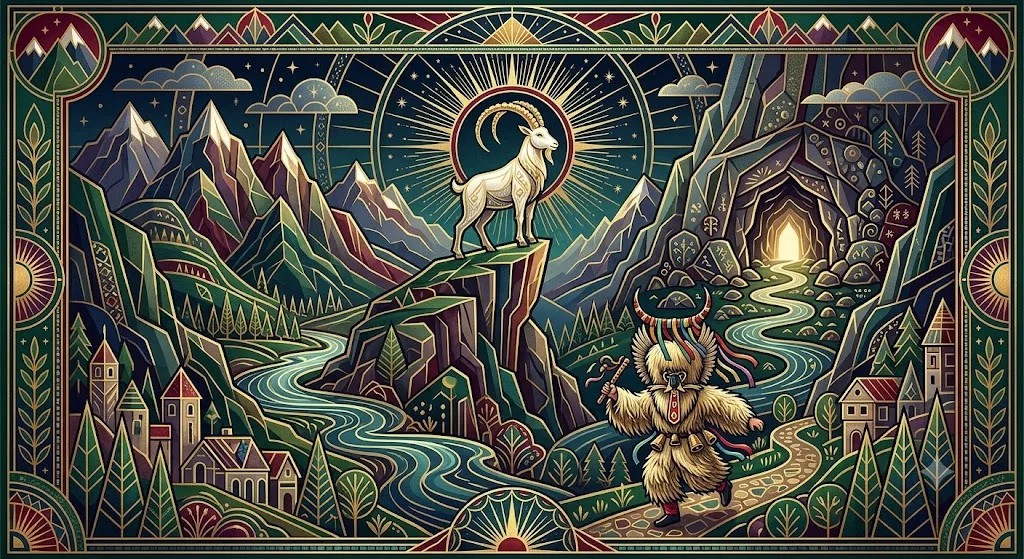
The most famous Slovenian legendary animal is Zlatorog, the golden-horned white mountain creature associated with the Triglav region. In common retellings, it lives among high pastures and cliffs, guarded or accompanied by benevolent mountain women. Its golden horns are linked with treasure, and when a hunter wounds it, drops of blood produce a healing mountain flower. The animal recovers, but the human attempt to possess its treasure brings ruin. Triglav National Park’s educational material tells the story through the “kingdom” of Zlatorog and the mountain world around Triglav, while the Triglav Fairy-Tale Trail version gives the familiar elements of white women, a white goat with golden horns, hidden treasure and the flower grown from Zlatorog’s blood.[Triglavski narodni park]tnp.siOpen source on tnp.si.
Zlatorog feels ancient because it is attached to mountain belief, but its modern fame also owes much to nineteenth-century collection and literary circulation. Monika Kropej’s work on Slovenian supernatural beings notes that the tale was transmitted to the German poet Rudolf Baumbach, who popularised it in the epic poem Zlatorog in 1877.[Academia]academia.eduOpen source on academia.edu. Another scholarly abstract on the Triglav rose and Zlatorog states that the tale has been highly popular in Slovenia and abroad since it was collected in the Julian Alps and published in 1868.[ResearchGate]researchgate.netResearch Gate Triglavska roža in Zlatorog med simboliko in stvarnostjoResearch Gate Triglavska roža in Zlatorog med simboliko in stvarnostjo
That distinction matters. Zlatorog is not simply a timeless “Slovenian god” or a modern mascot invented from nothing. It is better understood as a local mountain legend that passed through oral tradition, nineteenth-century antiquarian and literary publication, national culture, tourism, branding and environmental storytelling. Its power today comes from that mixture: it gives visitors a memorable story, gives Slovenes a recognisable symbol of Alpine heritage, and turns the mountain landscape into a moral drama about desire, loss and respect.
Kurent: the creature that still walks the villages
The Kurent is Slovenia’s most visible living folklore figure: a shaggy, bell-wearing Shrovetide character most strongly associated with Ptuj, the Drava Plain, Haloze and Slovenske Gorice. Unlike Zlatorog, which most people meet through story, the Kurent is encountered as performance. Groups move from house to house, ringing bells and making noise during the Carnival season. UNESCO describes the door-to-door rounds as a Shrovetide custom practised from Candlemas, 2 February, to Ash Wednesday, with groups of Kurenti and devils visiting homes, jumping, brandishing sticks and ringing bells.[Intangible Cultural Heritage]ich.unesco.orgOpen source on unesco.org.
The basic belief attached to the figure is clear: the Kurent drives away evil or winter and brings happiness, prosperity, fertility or spring. Slovenia’s official cultural presentation calls it the most recognisable Carnival character in the country, with records of its appearance dating back to 1880, and describes it as a symbol of Slovenian identity.[Slovenia]slovenia.siOpen source on slovenia.si. The national Intangible Cultural Heritage portal places the custom in the regions around Ptuj and explains that, according to folk belief, the Kurent drives away evil and brings happiness and prosperity.[Nesnovna kulturna dediščina Slovenije]nesnovnadediscina.siOpen source on nesnovnadediscina.si.
Kurent tradition also shows how folklore changes without simply disappearing. UNESCO notes that the rounds are practised not only in villages but, since the second half of the twentieth century, also in Ptuj; safeguarding now involves schools, kindergartens, formal courses and informal workshops.[UNESCO]unesco.orgdocument 4643document 4643 Ptuj’s modern Kurentovanje festival is a major public celebration, and local museum and visitor centres present the figure through exhibitions, tourism and interactive heritage experiences.[Kurentovanje]kurentovanje.netOpen source on kurentovanje.net. The result is not a fossilised “ancient pagan rite” but a living custom with old rural roots, modern organisation, community pride and UNESCO-era heritage language layered together.
Dragons, caves and the strange afterlife of “baby dragons”
Slovenia’s dragon folklore has two especially strong public faces: the civic dragon of Ljubljana and the cave dragon of the Karst. Ljubljana’s tourism office tells the legend that the city was founded by Jason and the Argonauts after they fled with the Golden Fleece, travelled by river through the Danube, Sava and Ljubljanica, and encountered the dragon associated with the city.[Visit Ljubljana]visitljubljana.comOpen source on visitljubljana.com. Today the dragon is visible as a city emblem and souvenir figure, most famously through the Dragon Bridge and Ljubljana’s branding as a “city of dragons”.[Visit Ljubljana]visitljubljana.comOpen source on visitljubljana.com.
This is a good example of how imported classical material can become local folklore. Jason belongs to Greek myth, but the Ljubljana version anchors him in Slovenian geography: the marshes, the river and the route towards the Adriatic. The story is not evidence that ancient Greeks founded Ljubljana; it is a legendary origin story, useful because it gives the city a dramatic creature, a heroic visitor and an instantly recognisable symbol.
The cave-dragon tradition is more closely tied to local natural history. The olm’s appearance — pale, elongated, eyeless and aquatic — helped explain why people imagined underground dragons producing strange offspring. The New Yorker’s account of Slovenia’s “love affair” with the olm describes Valvasor hearing local explanations in which a dragon lived in a cave beneath a spring, and “baby dragons” washed above ground after heavy rain.[The New Yorker]newyorker.comThe New Yorker What's Behind Slovenia's Love Affair with a Salamander?The New Yorker What's Behind Slovenia's Love Affair with a Salamander? Postojna Cave and the European Commission both keep that old belief alive in a modern conservation frame: the animal once mistaken for a dragon’s young is now used to draw attention to threatened underground habitats.[Postojna Cave Park]postojnska-jama.euOpen source on postojnska-jama.eu.
Maidens, fairies and women in the high places
Slovenian legends often place powerful female figures at the edge of the human world: on mountains, in caves, near springs, or at moments of birth and fate. One of the most famous is the stone “Heathen Maiden” in the northern wall of Prisank, visible near the Vršič Pass. Slovenia’s official portal describes it as a natural rock image of a woman’s face and the central character of one of the country’s most recognisable folk tales.[Slovenia]slovenia.siOpen source on slovenia.si. The Julian Alps tourism account says the maiden can be seen from viewpoints near Vršič and explains the legend in which she prophesies that a hunter’s son will shoot Goldhorn, after which other women punish her by turning her into rock.[Julian Alps]julian-alps.comJulian Alps Ajdovska deklica / The "Pagan GirlJulian Alps Ajdovska deklica / The "Pagan Girl
The appeal of this story is partly visual. A traveller can look at the cliff and see the “face”, making the legend feel unusually immediate. But the tale also belongs to a wider pattern: supernatural women who help travellers, foretell children’s futures, advise humans on farming or guard mountain worlds. The Triglav story of Zlatorog also includes benevolent “White Women” in the mountain paradise, showing how female supernatural beings can appear as helpers, protectors and boundary-keepers rather than simply as temptresses or witches.[Triglavska zakladnica]triglavskazakladnica.siOpen source on triglavskazakladnica.si.
Folklorist Monika Kropej’s survey of Slovenian supernatural beings indicates how broad this world is: Slovenian mythological, historical and narrative material includes more than 150 supernatural beings, classified by role, features and motifs.[omp.zrc-sazu.si]omp.zrc-sazu.siOpen source on zrc-sazu.si. That does not mean ordinary people once believed in a single organised catalogue of beings. It means Slovenian oral and written tradition preserves a dense web of local names, functions and story types, some attached to nature, some to the dead, some to seasonal turning points, and some to moral warnings.
Water spirits, witches and the restless dead
Beyond the famous tourist-facing legends, Slovenian folklore includes a darker and more domestic supernatural world: water beings, witches, demons, revenants, bewitched souls and protective figures. These traditions often answer practical fears. Rivers and pools are dangerous, so stories imagine beings who lure, seize or punish. Illness, crop failure and misfortune are frightening, so stories speak of witches, charms, evil forces and specialists who can fight them. Death unsettles the household, so returning souls and restless dead become part of narrative explanation.
Kropej’s work states that many Slovenian supernatural beings are connected with beliefs in returning dead, spirits, souls, demons and the afterlife, often reflecting fear of dead ancestors and returning souls.[Academia]academia.eduOpen source on academia.edu. Another source on Slovenian charms notes that folk traditions mention the kresnik as a “protector” figure who fights evil wizards and witches; it also describes trance-like “journeys” of the spirit in the context of magic practice.[Folklore]folklore.eeOpen source on folklore.ee. In Kropej’s broader discussion, the kresnik can be a solar heroic figure, but also in Slovenian folklore a shaman-like defender who fights witches and other harmful beings to protect the community’s crops.[ia600801.us.archive.org]ia600801.us.archive.orgMonika KropejMonika Kropej
Water spirits are especially important because they cross from oral tradition into high literature. Slovenian cultural summaries note that France Prešeren transformed a folk water-being motif into the dramatic literary ballad The Water Man.[thezaurus.org]thezaurus.orgMyths and LegendsMyths and Legends That pattern is common in national folklore traditions: a locally known supernatural type becomes famous because a major writer gives it a memorable literary form. For modern readers, it is worth separating the older belief motif — dangerous water beings — from Prešeren’s particular poetic retelling.
Seasonal customs: when folklore becomes public time
Slovenian folklore is not only about creatures. It also lives in the calendar: Carnival, spring rites, midsummer, Christmas-season beliefs, harvest customs, saints’ days and local festivals. These are moments when the boundary between everyday life and the supernatural is ritually marked. People dress up, move through villages, sing, make noise, bless, predict, scare away, welcome, bury or renew.
Kurent rounds are the most internationally recognised example because they are on UNESCO’s Representative List. UNESCO’s description gives their calendar frame precisely: from Candlemas to Ash Wednesday.[Intangible Cultural Heritage]ich.unesco.orgOpen source on unesco.org. But Slovenian scholarship also points to a wider annual cycle of supernatural beings. A study on the changing life of Slovenian beings in the annual cycle discusses oral tradition and tales attached to midsummer, midwinter, spring and autumn turning points, and observes that such figures can shift into contemporary belief tales and urban legends as social contexts change.[ResearchGate]researchgate.netResearch Gate(PDF) From Tradition to Contemporary Belief Tales: The “Research Gate(PDF) From Tradition to Contemporary Belief Tales: The “
Zeleni Jurij, often translated in English as Green George, belongs to this seasonal imagination. Kropej’s work on Slovene folk narrative and song tradition connects Zeleni Jurij and Kresnik with wider Slavic mythic structures, including relationships with deities and motifs of seasonal renewal.[sms.zrc-sazu.si]sms.zrc-sazu.siOpen source on zrc-sazu.si. For a general reader, the important point is not to memorise a reconstructed pantheon, but to notice the rhythm: Slovenian folklore often treats the year as a living cycle in which winter must be driven out, spring brought in, crops protected, and dangerous liminal nights managed through custom and story.
How folklore was collected, archived and retold
Modern knowledge of Slovenian folklore depends heavily on collectors, archives, museums and scholars. Oral tradition is living, but without transcription and research many local variants would be lost or hard to compare. The Institute of Slovenian Ethnology’s collections include an archive of Slovenian folk tales made up of excerpts from periodicals, manuscript transcriptions, material gathered through field surveys, and tape-recorded field material.[isn2.zrc-sazu.si]isn2.zrc-sazu.siOpen source on zrc-sazu.si. Its wider institutional work includes research into folk literature, oral tradition, rituals and games, supported by archives and specialised collections.[Folklore]folklore.eeOpen source on folklore.ee.
One major figure in the history of collection is Karel Štrekelj. A recent discussion of Slovenian fairy tales in European context says that Štrekelj worked with hundreds of collectors and gathered around 2,000 Slovenian folk tales and short stories, many preserved in manuscript holdings at the research centre of the Slovenian Academy of Sciences and Arts.[Int'l Journal of Social Sciences]ijssh.ielas.orgOpen source on ielas.org. This helps explain why Slovenian folklore can feel both familiar and deeply local: the country shares many European tale types, but its versions are anchored in Slovenian places, dialects, social memory and ritual use.
Retelling is just as important as collecting. Zlatorog became nationally and internationally recognisable after nineteenth-century publication and Baumbach’s poem.[Academia]academia.eduOpen source on academia.edu. Prešeren’s Water Man gave a literary afterlife to a water-spirit motif.[thezaurus.org]thezaurus.orgMyths and LegendsMyths and Legends Tourism boards now retell the Heathen Maiden, Ljubljana’s dragon and Triglav legends for visitors. This does not make the stories fake; it means their form changes as they move from fireside, fieldwork notebook and village custom into books, school culture, festivals, museums, trails and websites.
What is old tradition, and what is modern invention?
A careful reader should be wary of two opposite mistakes. One mistake is to dismiss every polished legend as invented tourism. The other is to treat every tourist retelling as direct evidence of pre-Christian belief. Slovenian folklore usually sits between those extremes.
Some customs have strong community continuity and heritage documentation, such as Kurent door-to-door rounds, which are recorded as a living Shrovetide practice and inscribed by UNESCO.[Intangible Cultural Heritage]ich.unesco.orgOpen source on unesco.org. Some stories have older oral roots but became famous through nineteenth-century literary publication, such as Zlatorog.[Academia]academia.eduOpen source on academia.edu. Some legends attach older motifs to visible landmarks, such as the Heathen Maiden’s face in the cliffs of Prisank.[Slovenia]slovenia.siOpen source on slovenia.si. Some beliefs began as attempts to explain natural phenomena, such as cave “baby dragons”, and now survive as conservation language around the olm.[Postojna Cave Park]postojnska-jama.euOpen source on postojnska-jama.eu.
The most useful question is therefore not “is this myth true?” but “what kind of tradition is this?” Is it an oral legend, a seasonal performance, a literary adaptation, a local place-story, a museum interpretation, a national symbol, or a modern commercial image? In Slovenia, the same figure can be more than one of these at once.
Folklore in Slovenia today
Slovenian folklore remains visible because it has adapted to modern settings without losing its local anchors. Kurents appear in community rounds, UNESCO files, Ptuj’s festival economy, museum collections and diaspora celebrations. The Smithsonian’s 2025 Folklife Magazine account, for example, describes Slovenian Americans in Cleveland making Kurent traditions part of their own community life, showing how a regional Slovenian figure can travel while still pointing back to Ptuj and its surrounding area.[Smithsonian Folklife]folklife.si.educleveland slovenia kurenticleveland slovenia kurenti
Tourism also plays a major role. Slovenia’s national tourist board presents myths and legends as part of the country’s cultural appeal, naming Kurenti, Zlatorog, Ljubljana’s dragon and other story-worlds for visitors.[I feel Slovenia]slovenia.infoOpen source on slovenia.info. Triglav National Park uses Zlatorog to encourage respectful engagement with fragile Alpine nature.[I feel Slovenia]slovenia.infoOpen source on slovenia.info. Ljubljana uses the dragon as a civic identity and souvenir figure.[Visit Ljubljana]visitljubljana.comOpen source on visitljubljana.com. Postojna and conservation bodies use the “baby dragon” association to make the olm memorable and emotionally legible.[Environment]environment.ec.europa.euEnvironment Postojna Cave – Baby dragon guardiansEnvironment Postojna Cave – Baby dragon guardians
This modern visibility creates a tension, but not necessarily a problem. Folklore can be simplified when marketed, and local complexity can be flattened into a few mascots. Yet festivals, archives, museums and public storytelling can also keep traditions active, teach younger generations, and make regional heritage easier for outsiders to appreciate. The best way to understand Slovenian folklore today is as a living cultural conversation: old stories and customs are continually reinterpreted, but the strongest ones still lead back to specific places, seasons, communities and landscapes.

Amazon book picks
Further Reading
Books and field guides related to Where Slovenia's Legends Still Touch the Landscape. Use these as the next step if you want deeper reading beyond the article.
Slavic Folklore
Provides broader context for Slovenian folklore within the Slavic world.
The Slavic Myths
Helps readers place Slovenian legends alongside related regional mythic traditions.
The Golden Bough
Useful background on ritual, seasonal customs and traditional belief systems.
eBay marketplace picks
Marketplace Samples
Live-tested eBay searches with available results related to this page.
Endnotes
1.
Source: isn2.zrc-sazu.si
Link:https://isn2.zrc-sazu.si/en/strani/collections-1
2.
Source: researchgate.net
Title: Research Gate Triglavska roža in Zlatorog med simboliko in stvarnostjo
Link:https://www.researchgate.net/publication/333726287_Triglavska_roza_in_Zlatorog_med_simboliko_in_stvarnostjo_Triglav_Rose_and_Zlatorog_in_Their_Symbolism_and_Realitybr
3.
Source: academia.edu
Link:https://www.academia.edu/7119416/Supernatural_Beings_from_Slovenian_Myth_and_Folktales
4.
Source: ich.unesco.org
Link:https://ich.unesco.org/en/RL/door-to-door-rounds-of-kurenti-01278
5.
Source: unesco.org
Title: document 4643
Link:https://www.unesco.org/archives/multimedia/document-4643
6.
Source: slovenia.si
Link:https://slovenia.si/art-and-cultural-heritage/kurent-traditional-slovenian-carnival-character
7.
Source: kurentovanje.net
Link:https://kurentovanje.net/eng/
8.
Source: slovenia.si
Link:https://slovenia.si/this-is-slovenia/the-heathen-maiden
9.
Source: julian-alps.com
Title: Julian Alps Ajdovska deklica / The “Pagan Girl”
Link:https://julian-alps.com/en/poi/landscape/ajdovska-deklica-the-pagan-girl-a-face-in-the-cliffs/50937505/
10.
Source: omp.zrc-sazu.si
Link:https://omp.zrc-sazu.si/zalozba/catalog/book/930
11.
Source: folklore.ee
Link:https://www.folklore.ee/folklore/vol24/slovcharm.pdf
12.
Source: ia600801.us.archive.org
Title: Monika Kropej
Link:https://ia600801.us.archive.org/34/items/monika-kropej-supernatural-beings-from-slovenian-myth-and-folktales-2012/Monika%20Kropej%20-%20Supernatural%20Beings%20from%20Slovenian%20Myth%20and%20Folktales%20%282012%29.pdf
13.
Source: thezaurus.org
Title: Myths and Legends
Link:https://thezaurus.org/webzine/myths_and_legends.html
14.
Source: researchgate.net
Title: Research Gate(PDF) From Tradition to Contemporary Belief Tales: The “
Link:https://www.researchgate.net/publication/333725216_From_Tradition_to_Contemporary_Belief_Tales_The_Changing_Life_of_Some_Slovenian_Supernatural_Beings_from_the_Annual_Cycle_Od_tradicije_do_sodobnih_zgodb_spreminjajoce_zivljenje_nekaterih_slovenskih_ba
15.
Source: sms.zrc-sazu.si
Link:https://sms.zrc-sazu.si/pdf/06/SMS_06_Kropej.pdf
16.
Source: folklore.ee
Link:https://www.folklore.ee/folklore/vol50/n02.pdf
17.
Source: ich.unesco.org
Link:https://ich.unesco.org/en/decisions/12.COM/11.B.30
18.
Source: slovenia.info
Link:https://www.slovenia.info/en/stories/explore-the-world-of-slovenian-myths-and-legends
19.
Source: slovenia.info
Link:https://www.slovenia.info/en/stories/visit-triglav-national-park-with-respect
20.
Source: ich.unesco.org
Title: slovenia SI
Link:https://ich.unesco.org/en-state/slovenia-SI?info=activities-with-the-patronage
21.
Source: ich.unesco.org
Title: slovenia SI
Link:https://ich.unesco.org/en/state/slovenia-SI
22.
Source: ich.unesco.org
Title: 36271 EN.doc
Link:https://ich.unesco.org/doc/src/36271-EN.doc
23.
Source: ich.unesco.org
Title: eslovenia SI
Link:https://ich.unesco.org/es-estado/eslovenia-SI?info=actividades-con-el-patronage
24.
Source: ich.unesco.org
Link:https://ich.unesco.org/en/lists
25.
Source: ich.unesco.org
Title: slovenia SI
Link:https://ich.unesco.org/en/state/slovenia-SI?info=periodic-reporting
26.
Source: culture.si
Link:https://www.culture.si/en/Kurentovanje
27.
Source: culture.si
Title: Category:Intangible heritage
Link:https://www.culture.si/en/Category%3AIntangible_heritage
28.
Source: slovenia.si
Link:https://slovenia.si/art-and-cultural-heritage/slovene-ethnographic-museum
29.
Source: sms.zrc-sazu.si
Title: SMS 21 2018
Link:https://sms.zrc-sazu.si/pdf/21/SMS_21_2018.pdf
30.
Source: sms.zrc-sazu.si
Link:https://sms.zrc-sazu.si/pdf/01/SMS_01_Kropej.pdf
31.
Source: isn2.zrc-sazu.si
Link:https://isn2.zrc-sazu.si/en/predstavitev
32.
Source: isn2.zrc-sazu.si
Link:https://isn2.zrc-sazu.si/en/publikacije/so-z-vilicami-pisali-1
33.
Source: academia.edu
Link:https://www.academia.edu/47902259/S_T_U_D_I_A_M_Y_T_H_O_L_O_G_IFrom_Tradition_to_Contemporary_Belief_Tales_Th_e_Changing_Life_of_Some_Slovenian_Supernatural_Beings_from_the_Annual_Cycle
34.
Source: academia.edu
Link:https://www.academia.edu/98274101/Charms_in_the_Context_of_Magic_Practice_The_Case_of_Slovenia
35.
Source: academia.edu
Link:https://www.academia.edu/98274115/Cosmology_and_Deities_in_Slovene_Folk_Narrative_and_Song_TraditionKozmologija_in_bo%C5%A1tva_v_slovenskem_ljudskem_pripovednem_in_pesni%C5%A1kem_izro%C4%8Dilu
36.
Source: researchgate.net
Title: Saša BABIČ
Link:https://www.researchgate.net/profile/Sasa-Babic-2
37.
Source: researchgate.net
Title: 384453007 SLOVENIAN FAIRY TALES IN EUROPEAN CONTEXT
Link:https://www.researchgate.net/publication/384453007_SLOVENIAN_FAIRY_TALES_IN_EUROPEAN_CONTEXT
38.
Source: researchgate.net
Link:https://www.researchgate.net/publication/298450852_THE_LIST_OF_INTANGIBLE_CULTURAL_HERITAGE_THE_CASE_OF_SLOVENIA
39.
Source: folklore.ee
Link:https://www.folklore.ee/folklore/vol29/slovenia.pdf
40.
Source: kurentovanje.net
Link:https://kurentovanje.net/eng/unesco/
41.
Source: kurentovanje.net
Link:https://kurentovanje.net/eng/dozivite-kurentovanje/
42.
Source: thezaurus.com
Title: folk tales
Link:https://thezaurus.com/folk-tales/
43.
Source: slovenia.info
Link:https://www.slovenia.info/en/stories/kurentovanje-the-largest-shrovetide-carnival-in-slovenia
44.
Source: slovenia.info
Link:https://www.slovenia.info/en/press-centre/press-releases/18208-slovenian-stories-google-arts-culture-and-slovenian-tourist-board-join-forces-in-showcasing-slovenia-s-rich-natural-and-intangible-heritage
45.
Source: archive.org
Title: folkloreencyclop0000unse b3q9
Link:https://archive.org/details/folkloreencyclop0000unse_b3q9
46.
Source: youtube.com
Link:https://www.youtube.com/watch?v=24QOYnX8PQQ
Source snippet
Slovenian Folk Tales: Vilenica Cave...
47.
Source: youtube.com
Title: Slovenian Folk Tales: Vilenica Cave
Link:https://www.youtube.com/watch?v=xvExQFh6Wfc
Source snippet
Slovenia.info...
48.
Source: youtube.com
Title: SLOVENIAN FOLK TALE: The Shepherd
Link:https://www.youtube.com/watch?v=zZBFl6NfoAQ
Source snippet
Slovenia's UNESCO Festival - Kurentovanje 2026 Ptuj...
49.
Source: youtube.com
Title: Slovenia’s UNESCO Festival
Link:https://www.youtube.com/watch?v=c4-bO5Tw78o
Source snippet
Slovenian Folk Tales: King Matjaž...
50.
Source: youtube.com
Title: Slovenian Folk Tales: King Matjaž
Link:https://www.youtube.com/watch?v=Vyy4xLVUxvs
Source snippet
Slovenia.info...
51.
Source: tnp.si
Link:https://www.tnp.si/en/park/nature-and-culture/myths-and-legends/
52.
Source: postojnska-jama.eu
Link:https://www.postojnska-jama.eu/en/media-centre/news-and-press-releases/the-olm-on-a-stamp/
53.
Source: environment.ec.europa.eu
Title: Environment Postojna Cave – Baby dragon guardians
Link:https://environment.ec.europa.eu/topics/nature-and-biodiversity/natura-2000-award/meet-natura-2000-heroes/postojna-cave-baby-dragon-guardians_en
54.
Source: triglavskazakladnica.si
Link:https://www.triglavskazakladnica.si/en/content/content-details/198/
55.
Source: nesnovnadediscina.si
Link:https://www.nesnovnadediscina.si/en/unesco
56.
Source: visitljubljana.com
Link:https://www.visitljubljana.com/en/visitors/sights-and-activities/ljubljana-city-of-dragons
57.
Source: newyorker.com
Title: The New Yorker What’s Behind Slovenia’s Love Affair with a Salamander?
Link:https://www.newyorker.com/tech/annals-of-technology/whats-behind-slovenias-love-affair-with-a-salamander
58.
Source: ijssh.ielas.org
Link:https://ijssh.ielas.org/index.php/ijssh/article/download/61/64
59.
Source: folklife.si.edu
Title: cleveland slovenia kurenti
Link:https://folklife.si.edu/magazine/cleveland-slovenia-kurenti
60.
Source: facebook.com
Title: kurentovanje in ptuj sloveniaculture 7th 17th of february the carnival is an exc
Link:https://www.facebook.com/slovenia.info/posts/kurentovanje-in-ptuj-sloveniaculture-7th-17th-of-february-the-carnival-is-an-exc/1318669053631773/
61.
Source: facebook.com
Link:https://www.facebook.com/slovenian.consulate.sa/photos/ajdovska-deklica-slovenia-ajdovska-deklica-or-the-heathen-maiden-is-a-striking-n/1151350303702367/
62.
Source: sloveniawonders.com
Title: the story of the human fish in slovenia
Link:https://www.sloveniawonders.com/2020/05/02/the-story-of-the-human-fish-in-slovenia/
63.
Source: triglavskazakladnica.si
Link:https://www.triglavskazakladnica.si/en/content/content-details/201/
64.
Source: triglavskazakladnica.si
Link:https://www.triglavskazakladnica.si/en/content/content-details/3/
65.
Source: Wikipedia
Link:https://en.wikipedia.org/wiki/Goldhorn
66.
Source: Wikipedia
Link:https://en.wikipedia.org/wiki/Kurentovanje
67.
Source: Wikipedia
Title: Monika Kropej
Link:https://en.wikipedia.org/wiki/Monika_Kropej
68.
Source: Wikipedia
Link:https://en.wikipedia.org/wiki/Olm
69.
Source: tnp.si
Link:https://www.tnp.si/en/park/culture/myths-and-legends/
70.
Source: books.google.si
Link:https://books.google.si/books?hl=sl&id=kSKrWkIBB0IC&source=gbs_navlinks_s
71.
Source: sciencealert.com
Title: slovenia s ultra rare dragon eggs are hatching as we speak
Link:https://www.sciencealert.com/slovenia-s-ultra-rare-dragon-eggs-are-hatching-as-we-speak
72.
Source: tracscotland.org
Title: Intangible Cultural Heritage
Link:https://tracscotland.org/intangible-cultural-heritage/
73.
Source: gov.si
Link:https://www.gov.si/en/news/2020-02-20-kurent-traditional-slovenian-carnival-character/
74.
Source: dmc-slovenia.eu
Link:https://dmc-slovenia.eu/kurenti-unesco-cultural-experience
75.
Source: annainslovenia.wordpress.com
Title: slovenian folktales 002 ajdovska deklica
Link:https://annainslovenia.wordpress.com/2026/03/02/slovenian-folktales-002-ajdovska-deklica/
76.
Source: nesnovnadediscina.si
Link:https://www.nesnovnadediscina.si/en
77.
Source: alamy.com
Link:https://www.alamy.com/stock-photo/slovenia-zlatorog.html
78.
Source: zgodovinska-mesta.si
Link:https://www.zgodovinska-mesta.si/en/events/kurentovanje/
Additional References
79.
Source: instagram.com
Link:https://www.instagram.com/p/DLDOtkpIgZW/
80.
Source: etno-muzej.si
Link:https://www.etno-muzej.si/files/vodnik_jmd_eng_za_net.pdf
81.
Source: planetmountain.com
Link:https://www.planetmountain.com/en/news/invisible-transformation-added-iconic-ajdovska-deklica-slovenia-luka-lindic-ines-papert/79676
82.
Source: visitptuj.eu
Link:https://visitptuj.eu/en/see-do/paketi/prebudi-kurenta-v-sebi/
83.
Source: etno-muzej.si
Link:https://www.etno-muzej.si/files/between_nature_and_culture1.pdf
84.
Source: facebook.com
Link:https://www.facebook.com/groups/49614510285/posts/10162115675570286/
85.
Source: visiteurope.com
Link:https://visiteurope.com/experiences/ethnological-festivals-slovenia
86.
Source: im8hoursahead.com
Link:https://im8hoursahead.com/finding-dragons-in-the-green-capital-of-ljubljana/
87.
Source: instagram.com
Link:https://www.instagram.com/p/C5Q3WVntpnj/
88.
Source: etno-muzej.si
Link:https://www.etno-muzej.si/files/jarmi_web.pdf
Topic Tree
Follow this branch
Related pages 192
- Afghan Folklore
- Albanian Folklore
- Algerian Folklore
- Australian Folklore
- Azerbaijan Folklore
- +187 more in sidebar