Where Senegal's Stories Still Walk
Senegalese folklore is not a single, tidy mythology with one pantheon and one set of monsters. It is better understood as a living web of oral storytelling, ancestral spirits, Islamic esoteric practice, masked rites, sacred landscapes, family memory and modern heritage work.
Page outline Jump by section
Introduction
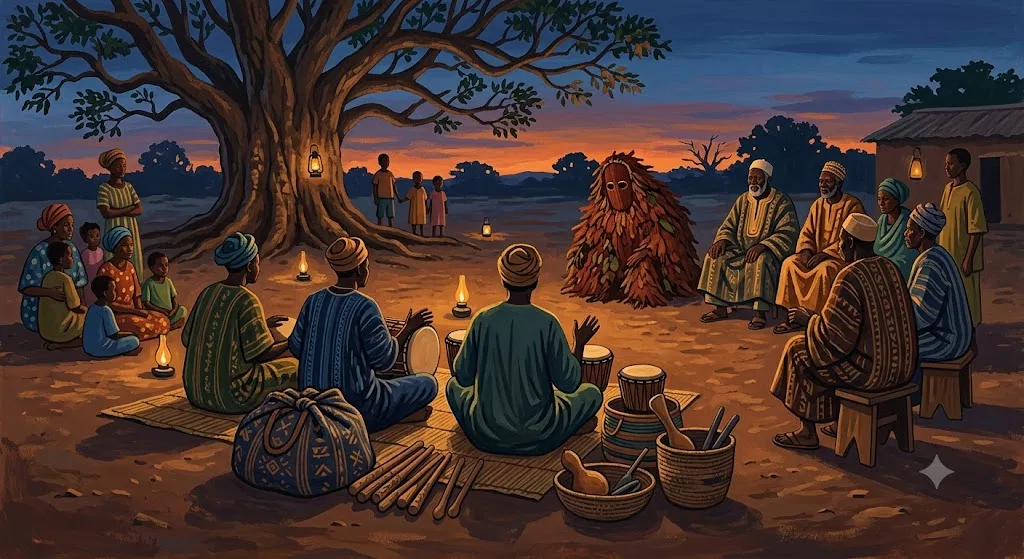
For a curious reader, the most useful starting point is this: Senegal’s folklore is strongest where story, ritual and social life still meet. A Serer divination ceremony is not just a legend about the future; it is a community event before the rains. A masked Manding figure is not just a “creature”; it is a guardian of initiation, order and sacred forest. A charm worn for protection is not simply superstition; it sits at the meeting point of Islamic learning, older ideas about power in nature, and everyday anxieties about illness, envy and luck. UNESCO’s Senegal listings — including the Serer divination ceremony Xooy, the Kankurang Manding initiatory rite, and the culinary heritage of Ceebu Jën — show how much of this heritage remains performative, communal and practical rather than merely literary.[ICH UNESCO]ich.unesco.orgsenegal SNsenegal SN
Why Senegalese Folklore Is Mostly Oral, Performed and Local
Many readers arrive expecting a national “mythology” comparable to Greek or Norse myth. Senegal does have sacred narratives, spirit traditions and legendary beings, but much of the country’s folklore has historically lived in performance: told by elders, sung by specialists, enacted in ceremonies, remembered by families, and adapted to local landscapes. UNESCO’s general description of oral tradition is useful here: tales, legends, myths, songs, chants, prayers, proverbs and dramatic performance can all transmit knowledge, values and collective memory.[ICH UNESCO]ich.unesco.orgOpen source on unesco.org.
In Senegal, this oral character matters because it affects what counts as evidence. Some traditions are documented in UNESCO files, ethnography, archives or older folklore collections. Others are best understood as living community practices, where public description is intentionally partial because parts of the rite or story are not meant for outsiders. The result is a folklore record that is rich but uneven: stronger for visible ceremonies and famous collected tales, thinner for private ritual knowledge, sacred speech and family-specific spirit traditions.
The griot tradition is central to this world of remembered speech. Across West Africa, griots are historians, praise singers, musicians, genealogists and public storytellers; the Metropolitan Museum of Art describes griots as narrators of oral traditions, especially known for carrying epic histories through performance.[The Metropolitan Museum of Art]metmuseum.orgOpen source on metmuseum.org. In Senegal, the role is not only entertainment. Griot performance can preserve genealogy, honour patrons, comment on public life and turn the past into something socially active in the present.
That does not mean oral tradition is a simple recording of “what happened”. Historian Philip Curtin’s study of Senegambian bardic traditions around the foundation of Bundu warns that oral history often teaches political, moral and social lessons, and that different versions may travel across long distances and generations. In his sample, versions of one important tradition were recorded from the 1840s to the 1960s, some hundreds of kilometres from Bundu itself.[Persée]persee.frOpen source on persee.fr. For folklore readers, that is not a weakness. It is a reminder that Senegalese legends are often living arguments about ancestry, authority, land, morality and belonging.
Serer Spirits, Sacred Trees and the Xooy Ceremony
One of Senegal’s best-documented indigenous religious traditions is Serer spirituality, especially in west-central Senegal. It is not simply a store of old stories; it includes cosmology, ritual specialists, ancestral spirits, sacred sites, divination and a moral understanding of how the living relate to the dead. Serer traditions are also shared across parts of the wider Senegambian region, so strict modern borders do not always match the older cultural map.
At the centre of many Serer accounts are ancestral or saintly spirits often described in English as Pangool. They are not “monsters” in the modern horror sense. They are powerful ancestral presences associated with lineage, land, protection, sacred trees, groves, water and village foundations. Sources on Serer religion describe them as intermediaries between human beings and the supreme divine power, and as spirits linked to specific places and histories.[Wikipedia]WikipediaOpen source on wikipedia.org.
This is where Senegalese folklore becomes place-based. A tree, grove, river or old settlement may matter not just as scenery but as a spiritual address. Some accounts of Serer belief connect trees and serpents with ancestral spirits, and describe snakes as important symbols in the passage between the living and the dead.[Encyclopedia.pub]encyclopedia.pubOpen source on encyclopedia.pub. Such motifs should be read carefully: they are not generic “African snake worship”, but part of a particular Serer religious imagination in which ancestry, land and moral order are tied together.
The most visible Serer ritual on the international heritage stage is Xooy, a divination ceremony held before the rainy season. UNESCO describes it as a long nocturnal gathering in village squares in west-central Senegal, where master seers deliver predictions on matters such as rains, illness, plagues and remedies, accompanied by drumming.[ICH UNESCO]ich.unesco.orgOpen source on unesco.org. For a folklore reader, Xooy is important because it shows a tradition doing several things at once: forecasting, healing, public drama, religious authority, agricultural anxiety and social cohesion.
Xooy also demonstrates why “folklore” is too small a word if it is taken to mean quaint old tales. The ceremony addresses practical fears: Will the rains come? Will disease strike? What must the community do? Its power lies in the way supernatural knowledge is made public through performance. In that sense, it belongs both to sacred tradition and to the everyday survival calendar of rural life.
Kankurang and the Power of the Masked Guardian
The Kankurang is one of the most striking figures associated with Senegalese and Gambian intangible heritage. UNESCO identifies it as a Manding initiatory rite practised in Senegal and The Gambia, with a central masked figure linked to initiation, order and protection. The Kankurang is described as a protective spirit embodied by a masked and costumed man, within a wider system of songs, traditions and initiatory rites.[ICH UNESCO]ich.unesco.orgOpen source on unesco.org.
The figure is visually memorable: accounts describe a masked initiate clothed in bark fibre, leaves and plant material, associated with the forest and with the authority of elders. In the UNESCO-linked safeguarding project, the rite is said to help boys learn community rules, medicinal plants, hunting techniques and other knowledge, while the Kankurang protects order, justice and the community from evil spirits.[UNESCO Japan]unesco.emb-japan.go.jpOpen source on go.jp.
For outsiders, it is tempting to treat Kankurang as a “monster” or festival costume. That misses the point. The Kankurang is not merely a character in a story; it is an enacted authority. It appears in relation to initiation and community discipline, and its power depends on secrecy, fear, respect and collective participation. The masked body is a bridge between human performer and spirit role.
The Kankurang also shows how folklore changes under modern pressure. UNESCO’s safeguarding project notes threats from urbanisation, deforestation and the loss of sacred forests, as well as the risk that the rite may become standardised.[UNESCO Japan]unesco.emb-japan.go.jpOpen source on go.jp. This is a key tension in Senegalese folklore today: public recognition can help protect traditions, but it can also freeze, display or simplify practices that once depended on secrecy, local variation and restricted knowledge.
Casamance, Jola Mask Traditions and Forest Spirits
Southern Senegal’s Casamance region has its own strong ritual and legendary texture. Among Jola communities, masked figures such as Kumpo, Samay and Niasse are associated with village life, sacred forest, discipline, celebration and communication between visible and invisible worlds. Sources on the Kumpo describe it as a Jola figure of Casamance and The Gambia, covered with palm leaves, linked to the sacred forest and treated as more than an ordinary human performer.[Wikipedia]WikipediaOpen source on wikipedia.org.
Kumpo traditions are a good example of how “spirit” and “social order” can overlap. The figure may appear during village festivities, encourage communal participation, bless the community and enforce expectations about proper behaviour. Some descriptions emphasise that it is taboo to touch the Kumpo or try to see inside the palm leaves, because the identity of the performer is not the point; the figure’s authority depends on its status as a forest presence.[Wikipedia]WikipediaOpen source on wikipedia.org.
Ethnographic work on the Senegalese Kumpo also reminds readers that masks move historically. A JSTOR-listed study by Ferdinand de Jong traces the “trajectories” of the Senegalese Kumpo and notes that the mask spread among Jola villages in the twentieth century, rather than being a timeless object fixed in one form forever.[JSTOR]jstor.orgTrajectories of a Mask PerformanceTrajectories of a Mask Performance That kind of evidence is useful because it prevents romantic oversimplification. Living folklore has routes, dates, borrowings and reinventions.
Casamance traditions also overlap with tourism, cultural festivals and regional identity. Recent travel writing often presents Kumpo as a forest spirit that draws visitors to southern Senegal, but the better interpretation is more careful: public appearances may be accessible to visitors, yet the tradition’s deeper meanings sit inside local community rules, sacred spaces and forms of knowledge that are not automatically open to spectators.[The Times of India]timesofindia.indiatimes.comOpen source on indiatimes.com.
The Yumboes: Senegal’s Famous “Fairies” and a Caution About Sources
One of the most internet-friendly creatures linked to Senegal is the Yumboe, often described as a small, pale, fairy-like being from the area near Gorée Island. The best-known early English source is Thomas Keightley’s nineteenth-century work The Fairy Mythology. Keightley reports that the “Jaloff” inhabitants opposite Gorée believed in beings called Yumboes, about two feet high, white in colour, also called “Good People”. He says they imitated human dress and behaviour, attached themselves to families, lamented the dead, lived in an underground dwelling near hills called the Paps, stole meal, fished at night and beat drums after drinking palm wine.[Internet Sacred Text Archive]sacred-texts.comOpen source on sacred-texts.com.
This is wonderful folklore material, but it should be handled with caution. Keightley’s own note says the account came from a young woman who had lived at Gorée as a child and had heard it from a Wolof-speaking maid.[Internet Sacred Text Archive]sacred-texts.comOpen source on sacred-texts.com. In other words, the Yumboes are not supported by a broad archive of independent Senegalese oral recordings in the way that Xooy or Kankurang are supported by contemporary heritage documentation. They are famous partly because an early European folklore collector found them comparable to European fairies.
That does not make the Yumboes worthless. It makes them a fascinating case of collected, translated and reframed folklore. Modern retellings often call them “Senegalese fairies”, but that phrase imports European categories into a West African setting. A better description is: a reported nineteenth-century spirit tradition from the Gorée/Jolof context, preserved in English through a second-hand collector’s account, later revived by mythology websites, fantasy writers and internet folklore lists.
The setting matters too. Gorée itself is now globally known less for fairy lore than for memory of the Atlantic slave trade. UNESCO describes the island, lying off Dakar, as a major Atlantic slave-trading centre from the fifteenth to nineteenth centuries and now a place of remembrance and reconciliation.[UNESCO World Heritage Centre]whc.unesco.orgWorld Heritage Centre Island of GoréeWorld Heritage Centre Island of Gorée That creates a powerful contrast: the same island region appears in global memory as a site of historical trauma and in folklore collections as a landscape of small nocturnal spirits. A responsible Senegal folklore page should keep both in view without collapsing one into the other.
Animal Tricksters, Hare and Hyena
Animal tales are among the most recognisable forms of Senegalese oral storytelling. The hare and the hyena appear widely in West African tale traditions, including Wolof and Soninke contexts connected to Senegal and the wider Senegambian region. In many versions, the hare is clever, patient or socially agile, while the hyena is greedy, foolish, impulsive or easily tricked. A JSTOR-listed article on Wolof oral narratives specifically treats the hare as a figure with social identification inside Wolof storytelling, not merely a generic animal character.[JSTOR]jstor.orgCaste Identification of the Hare in Wolof Oral NarrativesCaste Identification of the Hare in Wolof Oral Narratives
These stories work because they are funny and sharp. A hare tricking a hyena is not just a children’s entertainment; it can encode lessons about hunger, wit, status, self-control, gullibility and survival among the powerful. In oral performance, the pleasure lies not only in the plot but in timing, repetition, voice, audience recognition and the storyteller’s ability to make a familiar pattern feel new.
Readers should be cautious with modern web retellings of “Senegalese folktales”. Some are useful introductions, but many are unattributed, rewritten, blended across countries or newly invented in a traditional style. The strongest evidence for older oral tradition usually comes from recorded collections, academic studies, archival holdings or named oral performers. Senegal’s oral record is known to have been collected by institutions including IFAN and national archival bodies, but scholars have also noted that preservation has been uneven and historically fragmented.[JSTOR]jstor.orgOpen source on jstor.org.

Marabouts, Charms and Everyday Protective Folklore
Senegal is overwhelmingly Muslim, with strong Sufi orders and a public religious culture in which marabouts — religious teachers and spiritual authorities — have major influence. Alongside formal Islam, many Senegalese practices involve protective objects, esoteric knowledge, dream interpretation, divination, prayer work and amulets. These should not be lazily labelled “pagan survivals” or “witchcraft”; they are part of a complex religious field where Islamic texts, older ideas about power and practical problem-solving overlap.
The most familiar protective object is the gris-gris: an amulet often associated with Qur’anic writing, leather wrapping, blessing and personal protection. Georgetown’s Berkley Center describes gris-gris in Senegal as amulets made by marabouts for good luck, often enclosing Qur’anic writings, and notes that people across religious lines may use similar protective objects.[Berkley Center]berkleycenter.georgetown.eduanish savani on the blend of religion and mysticism in senegalese cultureanish savani on the blend of religion and mysticism in senegalese culture Academic work on marabout women in Dakar also shows that Islamic esoteric practices — including divination, dream interpretation and prayer sessions — are central to many West African social worlds, while often being understudied.[Cambridge University Press & Assessment]cambridge.orgOpen source on cambridge.org.
This is folklore in a very everyday sense. Charms may be worn for protection, strength, love, health, success or defence against envy. They turn invisible worries into material form: a packet sewn into leather, tied to the body, placed in a room, or prescribed by a specialist. The belief is not simply that “magic exists”, but that social life is full of hidden forces — blessing, jealousy, prayer, harm, luck, ancestral influence — that need management.
There is also a modern conservation problem. In 2025, Associated Press reported on Senegal’s illegal trade in lion and leopard parts for gris-gris, noting that Niokolo-Koba National Park is the last sanctuary in Senegal for lions and that the trade in big-cat parts is a threat to critically endangered West African lions. The report describes gris-gris as hybrid objects that may combine written prayers or Qur’anic verses with perceived powers in animal parts.[AP News]apnews.comOpen source on apnews.com. This is a clear example of living belief having real-world consequences: folklore is not only symbolic; it can affect wildlife, law enforcement and conservation ethics.
Sacred Places and Memory Landscapes
Senegal’s folklore is strongly tied to place. Sacred trees, groves, rivers, islands, initiation forests, ancestral shrines and old settlements can all carry stories. In Serer contexts, sacred trees and groves may be linked to ancestral spirits; in Manding and Jola contexts, forests may be ritually important for initiation and masked figures; in urban Dakar and Gorée, older spirit stories exist alongside colonial, Islamic and Atlantic histories.
Gorée is the clearest example of a place where folklore, memory and history must be separated but not isolated. The Yumboe account places fairy-like beings in the landscape opposite Gorée, while UNESCO frames Gorée primarily as a “memory island” of the Atlantic slave trade, with built remains that testify to exploitation and reconciliation.[Internet Sacred Text Archive]sacred-texts.comOpen source on sacred-texts.com. A folklore reader should therefore ask: is this place sacred, haunted, legendary, historical, touristic, or all of these in different registers?
Sacred forests are another crucial landscape. The Kankurang safeguarding project explicitly links the survival of the rite with preservation of the natural environment, including sacred forests, and points to deforestation and urbanisation as threats.[UNESCO Japan]unesco.emb-japan.go.jpOpen source on go.jp. The same pattern appears in Casamance masking traditions, where figures such as Kumpo are associated with the sacred forest and village order.[Wikipedia]WikipediaOpen source on wikipedia.org.
This place-based quality makes Senegalese folklore hard to reduce to a list of creatures. A spirit may matter because of where it appears. A rite may lose meaning if the forest disappears. A tale may change when performed in a village square, schoolbook, museum, tourist festival or online video. Landscape is not background; it is part of the story.
How Senegalese Folklore Is Being Preserved and Reframed
Senegalese folklore today sits between oral transmission, academic collection, national heritage policy, UNESCO recognition, tourism and digital retelling. UNESCO’s Senegal page lists Xooy, Kankurang and Ceebu Jën as inscribed elements, while also noting broader efforts around community-based inventories and safeguarding living heritage.[ICH UNESCO]ich.unesco.orgsenegal SNsenegal SN Senegal’s Directorate of Cultural Heritage has also been identified as the national body responsible for intangible heritage safeguarding, working through regional cultural centres and local communities.[ICH UNESCO]ich.unesco.orgICH UNESCOSenegalICH UNESCOSenegal
This preservation work is valuable, but it changes the traditions it protects. When a masked rite becomes a UNESCO element, it may gain funding, visibility and pride. It may also become staged, photographed, standardised or moved into museums and festivals. When a spirit story enters an English-language folklore database, it may reach new readers but lose its local language, performance setting and social function.
The same is true of food heritage. Ceebu Jën’s UNESCO listing is not a monster story or spirit belief, but it matters because folklore is not only supernatural. Foodways carry origin stories, regional pride, family transmission, ritual hospitality and national identity. UNESCO identifies the dish as originating in the fishing communities of Saint-Louis and varying by region, which makes it part of Senegal’s broader living heritage rather than a merely culinary fact.[ICH UNESCO]ich.unesco.orgOpen source on unesco.org.
Modern media has also brought older forms into new channels. Reports on Senegalese oral history podcasts, online Wolof and French storytelling projects, and digital folklore sites show that oral tradition is not simply disappearing; it is being recorded, repackaged and circulated in new ways.[Quartz]qz.comQuartz Senegal is preserving its oral history in a podcastQuartz Senegal is preserving its oral history in a podcast The challenge is credibility. Some digital retellings are careful; others invent “ancient legends” with little evidence. For readers, the safest approach is to ask whether a story is tied to a named community, collector, archive, ritual, performer or documented source.
What Readers Should Remember
Senegalese folklore is most vivid when treated as living culture rather than a catalogue of exotic beings. Its strongest traditions join story to performance, place and social need: Serer diviners speaking before the rains, Manding masked guardians protecting initiates, Jola forest figures enforcing village order, griots turning history into song, and protective charms translating fear and hope into something worn on the body.
The most famous supernatural “creature” in English-language folklore lists may be the Yumboe, but the best-attested living traditions are often ceremonies, masks, spirit relationships and oral histories rather than fairy-like beings. That distinction matters. The Yumboes show how a collected tale can travel through books and the internet; Xooy, Kankurang and Casamance mask traditions show how folklore can remain embedded in public life, local authority and sacred landscape.
The honest picture is therefore richer than a simple mythology page. Senegal’s legendary culture includes ancient oral memory, Islamic esoteric practice, ancestral spirits, animal tricksters, masked forest powers, sacred places and modern heritage politics. Its folklore survives not because it has stayed unchanged, but because Senegalese communities have continued to perform it, argue with it, protect it, adapt it and give it new forms.
Amazon book picks
Further Reading
Books and field guides related to Where Senegal's Stories Still Walk. Use these as the next step if you want deeper reading beyond the article.
Oral Literature in Africa
Explains how folklore survives through performance, memory and oral transmission.
African Religions and Philosophy
Provides broad context for ancestral spirits, ritual practice and oral traditions across Africa, including themes central to Senegal.
Religions of Africa
Introduces spiritual systems, ritual specialists and sacred worldviews relevant to Senegalese traditions.
The Epic of Sundiata
Connects readers to the wider Manding cultural world that influenced parts of Senegal.
eBay marketplace picks
Marketplace Samples
Live-tested eBay searches with available results related to this page.


Endnotes
1.
Source: ich.unesco.org
Title: senegal SN
Link:https://ich.unesco.org/en/state/senegal-SN
2.
Source: ich.unesco.org
Link:https://ich.unesco.org/en/RL/xooy-a-divination-ceremony-among-the-serer-of-senegal-00878
3.
Source: ich.unesco.org
Link:https://ich.unesco.org/en/projects/action-plan-for-the-safeguarding-of-the-kankurang-manding-initiatory-rite-00039
4.
Source: ich.unesco.org
Link:https://ich.unesco.org/en/oral-traditions-and-expressions-00053
5.
Source: Wikipedia
Link:https://en.wikipedia.org/wiki/Pangool
6.
Source: Wikipedia
Title: Serer religion
Link:https://en.wikipedia.org/wiki/Serer_religion
7.
Source: encyclopedia.pub
Link:https://encyclopedia.pub/entry/32172
8.
Source: Wikipedia
Link:https://en.wikipedia.org/wiki/Serer_creation_myth
9.
Source: Wikipedia
Link:https://en.wikipedia.org/wiki/Kumpo
10.
Source: Wikipedia
Link:https://en.wikipedia.org/wiki/Niasse
11.
Source: jstor.org
Title: Trajectories of a Mask Performance
Link:https://www.jstor.org/stable/4392913
12.
Source: whc.unesco.org
Title: World Heritage Centre Island of Gorée
Link:https://whc.unesco.org/en/list/26/
13.
Source: jstor.org
Title: Caste Identification of the Hare in Wolof Oral Narratives
Link:https://www.jstor.org/stable/3818257
14.
Source: jstor.org
Link:https://www.jstor.org/stable/40293498
15.
Source: berkleycenter.georgetown.edu
Title: anish savani on the blend of religion and mysticism in senegalese culture
Link:https://berkleycenter.georgetown.edu/posts/anish-savani-on-the-blend-of-religion-and-mysticism-in-senegalese-culture
16.
Source: cambridge.org
Link:https://www.cambridge.org/core/journals/africa/article/marabout-women-in-dakar-creating-authority-in-islamic-knowledge/2D7A2F5AF7F876BA6EC5A49EE7D890CD
17.
Source: ich.unesco.org
Title: ICH UNESCOSenegal
Link:https://ich.unesco.org/en-state/senegal-SN?info=periodic-reporting
18.
Source: ich.unesco.org
Link:https://ich.unesco.org/en/RL/ceebu-jen-a-culinary-art-of-senegal-01748
19.
Source: folktales.africa
Title: Senegalese Hare and Hyena stories
Link:https://folktales.africa/five-hare-and-hyena-folktales-from-senegal-lessons-in-patience-and-wisdom/
20.
Source: folktales.africa
Title: the hare and the hyena in wolof stories from senegal
Link:https://folktales.africa/the-hare-and-the-hyena-in-wolof-stories-from-senegal/
21.
Source: folktales.africa
Link:https://folktales.africa/category/african-folktales/west-african-folktales/senegalese-folktales/
22.
Source: folktales.africa
Title: the yumboes spirits of the jaloff people an african folktale
Link:https://folktales.africa/the-yumboes-spirits-of-the-jaloff-people-an-african-folktale/
23.
Source: ich.unesco.org
Title: gambia GM
Link:https://ich.unesco.org/en/state/gambia-GM
24.
Source: ich.unesco.org
Title: guinea bissau GW
Link:https://ich.unesco.org/en/state/guinea-bissau-GW
25.
Source: ich.unesco.org
Title: senegal SN
Link:https://ich.unesco.org/en/state/senegal-SN?info=projects
26.
Source: ich.unesco.org
Title: 01857 EN
Link:https://ich.unesco.org/doc/src/01857-EN.pdf
27.
Source: ich.unesco.org
Title: 00264 EN
Link:https://ich.unesco.org/doc/src/00264-EN.pdf
28.
Source: ich.unesco.org
Link:https://ich.unesco.org/en/video/59077
29.
Source: unesdoc.unesco.org
Link:https://unesdoc.unesco.org/ark%3A/48223/pf0000397395
30.
Source: ich.unesco.org
Link:https://ich.unesco.org/en/video/17739
31.
Source: ich.unesco.org
Link:https://ich.unesco.org/en/video/35105
32.
Source: ich.unesco.org
Title: 00010 EN
Link:https://ich.unesco.org/doc/src/00010-EN.pdf
33.
Source: ich.unesco.org
Title: kankurang manding initiatory rite 00143
Link:https://ich.unesco.org/en/RL/kankurang-manding-initiatory-rite-00143
34.
Source: ich.unesco.org
Title: gambia GM
Link:https://ich.unesco.org/en/state/gambia-GM?call=film&id=41681&include=film_inc.php&width=700
35.
Source: ich.unesco.org
Link:https://ich.unesco.org/en/lists
36.
Source: ich.unesco.org
Link:https://ich.unesco.org/en/news/senegalese-communities-at-the-heart-of-inventories-of-intangible-cultural-heritage-00322
37.
Source: ich.unesco.org
Title: extensive training on community based inventory on the ich concept 00687
Link:https://ich.unesco.org/en/events/extensive-training-on-community-based-inventory-on-the-ich-concept-00687
38.
Source: ich.unesco.org
Link:https://ich.unesco.org/en/decisions-bureau/13.COM%201.BUR/3.6
39.
Source: ich.unesco.org
Link:https://ich.unesco.org/es/asistencias/-01431
40.
Source: Wikipedia
Link:https://en.wikipedia.org/wiki/Griot
41.
Source: Wikipedia
Title: West African mythology
Link:https://en.wikipedia.org/wiki/West_African_mythology
42.
Source: Wikipedia
Title: Lists of Intangible Cultural Heritage elements
Link:https://en.wikipedia.org/wiki/Lists_of_Intangible_Cultural_Heritage_elements
43.
Source: Wikipedia
Title: Oral traditions of the Soninke people
Link:https://en.wikipedia.org/wiki/Oral_traditions_of_the_Soninke_people
44.
Source: Wikipedia
Link:https://de.wikipedia.org/wiki/Kankurang
45.
Source: Wikipedia
Link:https://en.wikipedia.org/wiki/Yumboes
46.
Source: Wikipedia
Title: Gris gris (talisman)
Link:https://en.wikipedia.org/wiki/Gris-gris_%28talisman%29
47.
Source: digitalcollections.sit.edu
Link:https://digitalcollections.sit.edu/cgi/viewcontent.cgi?article=2536&context=isp_collection&httpsredir=1&referer=
48.
Source: digitalcollections.sit.edu
Link:https://digitalcollections.sit.edu/cgi/viewcontent.cgi?article=2935&context=isp_collection
49.
Source: archive.org
Link:https://archive.org/details/fairymythologyil00keigiala
50.
Source: archive.org
Link:https://archive.org/details/in.ernet.dli.2015.200668
51.
Source: archive.org
Title: bub gb qf Px Wy2h Wn AC
Link:https://archive.org/details/bub_gb_qfPxWy2hWnAC
52.
Source: archive.org
Link:https://archive.org/details/dli.ministry.12731
53.
Source: archive.org
Link:https://archive.org/details/worldguidetognom0000keig
54.
Source: ia903100.us.archive.org
Title: African Folklore An Encyclopedia
Link:https://ia903100.us.archive.org/30/items/africanfolkloreanencyclopedia/African%20Folklore%20-%20An%20Encyclopedia.pdf
55.
Source: jstor.org
Link:https://www.jstor.org/stable/10.1086/338287
56.
Source: jstor.org
Link:https://www.jstor.org/stable/29734394
57.
Source: unesco.de
Title: intangible cultural heritage
Link:https://www.unesco.de/en/sites/intangible-cultural-heritage/
58.
Source: metmuseum.org
Link:https://www.metmuseum.org/perspectives/sahel-sunjata-stories-songs
59.
Source: persee.fr
Link:https://www.persee.fr/doc/cea_0008-0055_1975_num
60.
Source: unesco.emb-japan.go.jp
Link:https://www.unesco.emb-japan.go.jp/htm/d_ich_kankurang.htm
61.
Source: timesofindia.indiatimes.com
Link:https://timesofindia.indiatimes.com/life-style/travel/destinations/meet-the-mysterious-forest-spirit-that-draws-curious-travellers-to-west-africa-most-fascinating-living-traditions/articleshow/131741637.cms
62.
Source: sacred-texts.com
Link:https://sacred-texts.com/neu/celt/tfm/tfm185.htm
63.
Source: apnews.com
Link:https://apnews.com/article/4a238577a3f6b91044a76386d1fece73
64.
Source: qz.com
Title: Quartz Senegal is preserving its oral history in a podcast
Link:https://qz.com/africa/2014810/senegal-preserves-oral-history-in-a-podcast-with-massamba-gueye
65.
Source: kumakonda.com
Link:https://kumakonda.com/kankurang/
66.
Source: wepa.unima.org
Link:https://wepa.unima.org/en/senegal/
67.
Source: offbeat.fandom.com
Link:https://offbeat.fandom.com/wiki/Yumboes
68.
Source: mythus.fandom.com
Link:https://mythus.fandom.com/wiki/Kumpo/Samay/Niasse
69.
Source: openlibrary.org
Title: The Fairy Mythology
Link:https://openlibrary.org/books/OL20547662M/The_Fairy_Mythology
Additional References
70.
Source: youtube.com
Title: Xooy, a divination ceremony among the Serer of Senegal
Link:https://www.youtube.com/watch?v=iG4ISBIQdAc
Source snippet
Serer Religion: The Ancient Spiritual Tradition of Senegal...
71.
Source: youtube.com
Title: Yumboes: Senegal’s Moonlit Spirits of Legend
Link:https://www.youtube.com/watch?v=_W-0VIYhERU
Source snippet
Remote Senegalese tribe mixes traditional ceremony and modern life...
72.
Source: youtube.com
Title: Serer Religion: The Ancient Spiritual Tradition of Senegal
Link:https://www.youtube.com/watch?v=1UhsmvAu8QI
Source snippet
Yumboes: Senegal's Moonlit Spirits of Legend...
73.
Source: facebook.com
Link:https://www.facebook.com/Welcometogambia/posts/ilovegambia-thegambia-culture-tradition-the-different-types-of-kankurang-masquer/974032385219402/
74.
Source: researchgate.net
Link:https://www.researchgate.net/publication/397838000_2829Jeliya_goes_Spotify_From_Griot_Oral_Traditions_to_Multimodal_Representations_of_Contemporary_West_African_Music_and_Languages
75.
Source: researchgate.net
Link:https://www.researchgate.net/publication/382371261_African_Oral_Traditions_as_Heritage_and_Unesco%27s_Intangible_List
76.
Source: instagram.com
Link:https://www.instagram.com/reel/C2ftiZPoMZs/?hl=en-gb
77.
Source: reddit.com
Link:https://www.reddit.com/r/Senegal/comments/1ioq367/are_idols_a_thing_in_traditional_serer_religion/
78.
Source: imgur.com
Link:https://imgur.com/gallery/daily-mythical-creature-248-yumboes-wolof-mythology-senegal-mythology-qYCO1pw
79.
Source: oxfordre.com
Link:https://oxfordre.com/africanhistory/display/10.1093/acrefore/9780190277734.001.0001/acrefore-9780190277734-e-1356?d=%2F10.1093%2Facrefore%2F9780190277734.001.0001%2Facrefore-9780190277734-e-1356&p=emailAqvo2jxXEyU%2Fg
Topic Tree
Follow this branch
Related pages 192
- Afghan Folklore
- Albanian Folklore
- Algerian Folklore
- Australian Folklore
- Azerbaijan Folklore
- +187 more in sidebar