Where North Macedonia's Legends Still Live
North Macedonia’s folklore is best understood as a living borderland tradition: Slavic, Balkan, Orthodox Christian, Muslim, Romani, Albanian, Turkish, Aromanian and local rural customs overlap rather than sit in neat boxes.
Page outline Jump by section
Introduction
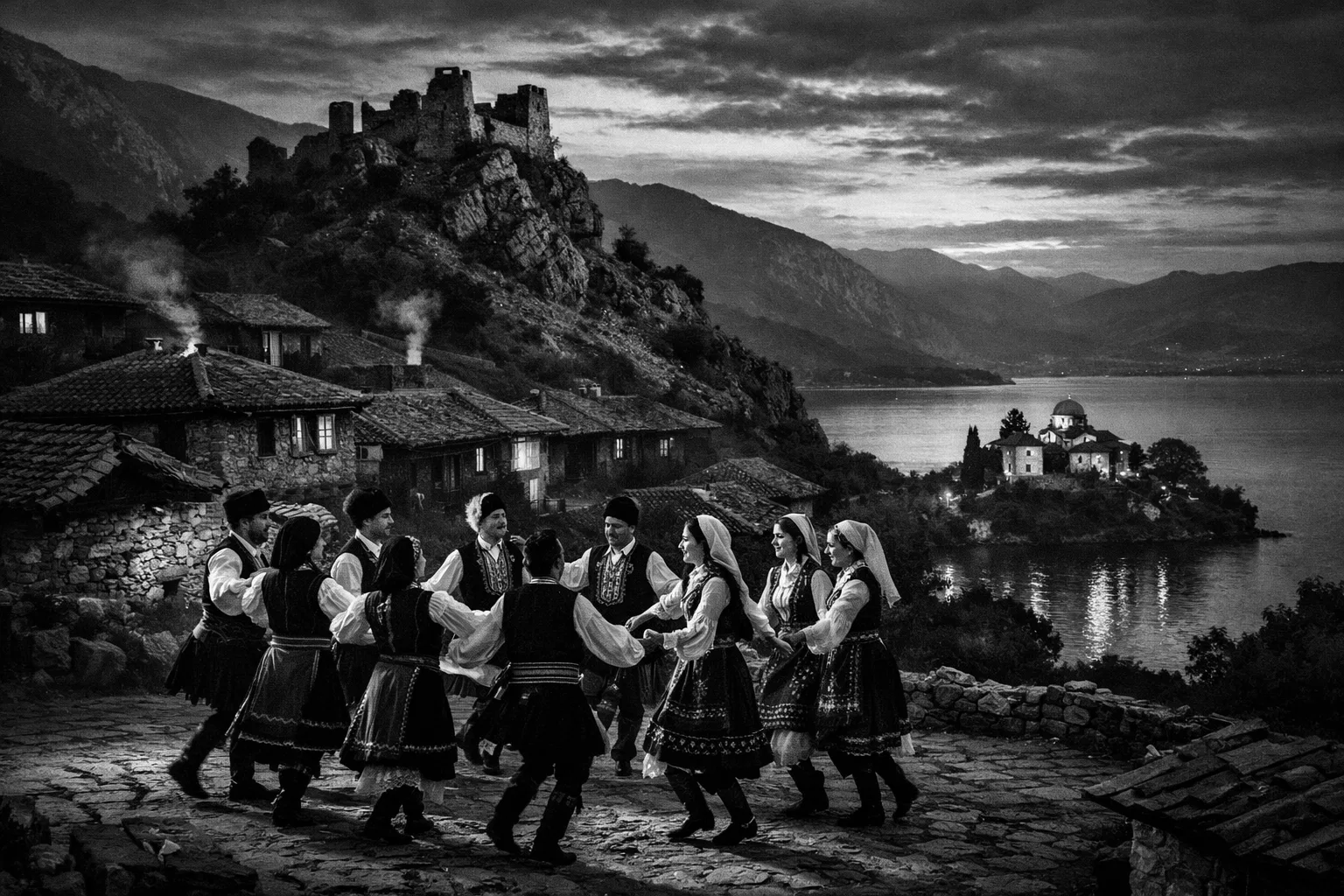
The country is small, but its folklore is unusually dense because it sits where routes, empires, languages and religions have long met. A legend from Prilep may belong to the same heroic cycle known across the Balkans; a spring amulet may be shared with Bulgaria, Romania and Moldova; a Turkish community celebration may be part of a wider North Macedonian and Turkish heritage inscription. The most useful way to read this folklore is not as a single “mythology”, but as a layered culture of stories, rites and places: some are ancient-looking but recently reshaped, some are well attested in archives, and some live most strongly in performance, tourism and family memory.[UNESCO Intangible Cultural Heritage]ich.unesco.orgOpen source on unesco.org.
The oral tradition is the real centre of North Macedonian folklore
North Macedonia’s folklore is rooted less in a single sacred book of myths than in oral genres: wonder tales, moral stories, epic songs, riddles, charms, curses, healing formulas, wedding songs, seasonal customs and local legends attached to villages, hills, churches and lakes. That matters because many of the country’s supernatural beings are not “characters” with one fixed story. They vary by region, narrator, religion, language and social use. A fairy-like being may appear as a dangerous woman of the mountains in one tale, a helper in another, and a sign of boundary-crossing in a healing narrative.[DergiPark]dergipark.org.trOpen source on dergipark.org.tr.
The institutional centre of this work is the Institute of Folklore “Marko Cepenkov” in Skopje, whose specialist journal began in 1968 and, according to the institute, has continued as a twice-yearly scholarly publication with work in Macedonian and English. That is important for readers because North Macedonian folklore is not only a matter of colourful tourist retellings; it has been collected, classified and debated by folklorists, ethnologists, musicologists and cultural historians.[ifmc.ukim.mk]ifmc.ukim.mkOpen source on ukim.mk.
The most famous older collector associated with this tradition is Marko Cepenkov, born in Prilep in 1829, whose enormous body of recorded folk material made him a central figure in the study of Macedonian oral culture. English-language library records show a selection of his tales published as 19th Century Macedonian Folktales, while later bibliographic listings record multiple editions of his tales, songs and other folklore materials.[National Library of Australia Catalogue]catalogue.nla.gov.auOpen source on nla.gov.au.
Cepenkov also illustrates a complication that should be handled carefully. In the nineteenth century, the region’s identities, publishing networks and national movements did not map cleanly onto today’s borders and labels. Modern North Macedonian, Bulgarian and wider Balkan scholarship may frame the same collector or story differently. For a folklore page, the safest point is not to force a modern identity backwards, but to recognise that the tales he recorded are foundational evidence for the oral culture of the region that includes today’s North Macedonia.[Wikipedia]WikipediaMarko TsepenkovMarko Tsepenkov
King Marko: the hero who turns history into landscape
The legendary hero most readers are likely to meet first is King Marko, a medieval ruler transformed in South Slavic epic tradition into a larger-than-life warrior, trickster and protector. In North Macedonia, his name is especially tied to Prilep and the dramatic fortress known as Marko’s Towers. The archaeological site is a real medieval stronghold above the city, while the legendary Marko attached to it is a folk hero whose stories stretch far beyond one historical biography.[Wikipedia]WikipediaMarkovi KuliMarkovi Kuli
This is where folklore does one of its most recognisable jobs: it makes the landscape memorable. Rocks, towers and ruined walls become proof-texts for story. A fortress is no longer only a military site; it becomes the kind of place where a heroic rider might have leapt, fought, hidden treasure or left a mark on stone. Such legends are rarely useful as literal history, but they are powerful as cultural memory. They tell readers how people have imagined authority, bravery, loss and survival in a region repeatedly reshaped by empire and border change.
King Marko also shows why North Macedonian folklore naturally links across borders. The same heroic cycle is known in Serbian, Bulgarian and wider Balkan song traditions. That does not make the North Macedonian version less local. It means that local identity often works through shared material: the hero may be regional, but the hill, the tower, the dialect, the singer and the audience make each performance particular.
Fairies, dragons, vampires and the dangerous edge of the village
North Macedonian supernatural tradition includes many beings familiar across the Balkans, but with local names, habits and moral meanings. A study of supernatural beings in Macedonian belief lists vampires, spectres, fairies, dragons, lamia-like monsters, witches, fate spirits and guardian or haunting beings among the important figures. It also stresses that some of these beliefs should not be treated only as remote antiquarian curiosities, because versions have persisted into modern local memory.[DergiPark]dergipark.org.trOpen source on dergipark.org.tr.
The most revealing pattern is where these beings appear. Folklore about danger often gathers around thresholds: nightfall, childbirth, illness, water, forests, village edges, crossroads and the boundary between cultivated land and wild space. A study of folk healing and witchcraft in Macedonian traditional culture describes supernatural danger as especially active at liminal times and places: at night, at the border between night and day, outside the village, near water or in the forest.[Journals at KU]journals.ku.eduOpen source on ku.edu.
Several figures stand out:
Fairy-like women are often imagined as beautiful, elusive and dangerous beings associated with mountains, water, night and forbidden spaces. In healing and witchcraft contexts, such beings belong to a wider class of powers that punish people who cross boundaries at the wrong time or in the wrong way.[Journals at KU]journals.ku.eduOpen source on ku.edu.
Vampires in Macedonian belief are not simply the aristocratic blood-drinkers of modern horror. Local vampire lore belongs to a broader Balkan world of revenants, restless dead and community fear around improper death, burial, illness and unexplained misfortune. The Institute of Folklore has published work specifically on vampires in Macedonian beliefs and legends, described as analysing local rituals of protection and the role of vampire stories in community identity.[makedonskadrzava.com]makedonskadrzava.comVampires in Macedonian Beliefs and LegendsVampires in Macedonian Beliefs and Legends
Lamia-like monsters and dragons show the influence of the wider Balkan and eastern Mediterranean imagination. These creatures often belong to stories of hoarded treasure, drought, storms, heroic combat or the control of nature. They are best read as flexible monster types rather than fixed species with one official description.[DergiPark]dergipark.org.trOpen source on dergipark.org.tr.
Witches and healers are especially important because they sit between fear and help. Macedonian traditional culture distinguished people believed to cast harmful spells from those believed to break them, heal illness or counter supernatural danger. The same source notes that accusations and anxieties often centred on health, life, milk, corn and household prosperity: the everyday things on which rural survival depended.[Academia]academia.eduThe Secret Knowledge of Folk Healers in MacedonianThe Secret Knowledge of Folk Healers in Macedonian
This is the point modern readers often miss. These beings were not just entertainment. They explained sudden illness, crop failure, infertility, infant danger, nightmares, cattle loss and social envy. Folklore gave people a language for misfortune, and sometimes a ritual script for responding to it.
Seasonal customs turn folklore into public life
Some of North Macedonia’s best-attested traditions are not monster stories but annual customs. UNESCO’s country listing for North Macedonia includes several intangible cultural heritage elements: the Feast of the Holy Forty Martyrs in Štip, Kopachkata dance from Dramche in Pijanec, male two-part singing in Dolni Polog, spring celebration Hıdrellez, practices associated with 1 March, and traditional bagpipe making and performing.[UNESCO Intangible Cultural Heritage]ich.unesco.orgOpen source on unesco.org.
The Feast of the Holy Forty Martyrs in Štip takes place on 22 March, honouring fourth-century Christian martyrs while also marking the first day of spring. Its folklore value lies in that double character: a church feast and a seasonal rite meet in one public event. UNESCO’s description treats it as a local practice tied to annual renewal, religious memory and civic participation, not merely as a church calendar date.[UNESCO Intangible Cultural Heritage]ich.unesco.orgOpen source on unesco.org.
The 1 March practices are another good example of shared regional folklore. UNESCO describes the main practice as making, giving and wearing red-and-white thread, then removing it when the first blossom tree, swallow or stork is seen. In North Macedonia these amulets are part of a broader south-east European spring complex also recognised in Bulgaria, Moldova and Romania. Their meaning is simple enough for a child to understand and old enough to carry deep associations: health, luck, seasonal change, protection and the visible arrival of spring.[UNESCO Intangible Cultural Heritage]ich.unesco.orgOpen source on unesco.org.
Hıdrellez, inscribed by North Macedonia and Türkiye, takes place annually on 6 May and is associated with the awakening of nature. UNESCO describes ceremonies and rituals connected with family and community wellbeing, livestock, crops and the arrival of spring. In North Macedonia, it also points to the country’s Turkish and Muslim heritage and to the way a national folklore page must include more than ethnic Macedonian Orthodox custom.[UNESCO Intangible Cultural Heritage]ich.unesco.orgOpen source on unesco.org.
Kopachkata, from the village of Dramche in the Pijanec region, shows how performance can become regional identity. UNESCO describes it as a dynamic social dance performed by local residents at weddings, public gatherings and religious holidays, accompanied by instruments such as drums, fiddle, tamboura or bagpipes. The UNESCO committee decision also notes that the dance has become a symbol of identity for the Pijanec region and is transmitted from generation to generation.[UNESCO Intangible Cultural Heritage]ich.unesco.orgOpen source on unesco.org.
The same is true of male two-part singing in Dolni Polog, which UNESCO places on the Urgent Safeguarding List. It is performed in small groups, often at celebrations, assemblies, weddings and dinners, with a drone voice and melodic leading voice. For folklore readers, this matters because oral tradition is not only what is said; it is also how voices sound together in a room.[UNESCO Intangible Cultural Heritage]ich.unesco.orgglasoechko male two part singing in dolni polog 01104glasoechko male two part singing in dolni polog 01104
Ohrid and sacred landscapes: when place becomes legend
North Macedonia’s sacred geography is one of the strongest parts of its folklore. Lake Ohrid and the town of Ohrid are internationally known for historic churches, monasteries, icons and layered religious memory. UNESCO describes Ohrid as one of Europe’s oldest human settlements, with architecture mainly from the 7th to 19th centuries, the oldest Slav monastery dedicated to St Pantelejmon, and more than 800 Byzantine-style icons dating from the 11th to the late 14th century.[UNESCO World Heritage Centre]whc.unesco.orgOpen source on unesco.org.
For folklore, Ohrid matters not only because it is old, but because sacred architecture gives stories places to live. Pilgrimage, healing, saintly presence and local legend cluster around churches and monasteries. One widely repeated tradition at the Monastery of Saint Naum says that visitors who place an ear to the saint’s tomb can hear his heartbeat. Travel and heritage accounts often present the sound as a matter of belief, while some explain it more prosaically as lake or stone acoustics. The folklore value is not in proving the miracle; it is in the continued act of listening.[Cyril and Methodius Route]cyril-methodius.euCyril and Methodius Route Saint Naum Monastery OhridCyril and Methodius Route Saint Naum Monastery Ohrid
Kokino, in the north-east, offers a different kind of sacred landscape. UNESCO’s tentative World Heritage description calls it an archaeo-astronomical site on the rocky hill of Tatićev Kamen, around 1,013 metres above sea level, and presents it as a complex formed about 3,900 years ago with ritual and calendrical functions. Claims about ancient observatories can become exaggerated in popular culture, so Kokino should be handled carefully: it is an important archaeological and symbolic site, but modern retellings often add a mystical shine that goes beyond what the evidence can securely prove.[UNESCO World Heritage Centre]whc.unesco.orgOpen source on unesco.org.
This distinction is useful across North Macedonian folklore. A sacred place may have archaeological evidence, church history, oral legend, tourist branding and internet mythology all layered together. A good reader does not have to choose between “all true” and “all fake”. The better question is: which layer are we looking at?
Siljan the Stork: a folk tale that still changes shape
One of the most memorable North Macedonian folk narratives is the tale often known in English as Siljan the Stork. It is associated with Marko Cepenkov’s collected material and has become a key example of how a folk story can carry moral, social and national meanings. Academic discussion describes the tale as a Macedonian self-identifying narrative, while linguistic research treats it as the longest Macedonian folk story recorded by Cepenkov and studies its archaic Turkish-origin vocabulary as evidence of historical language contact.[КиберЛенинка]cyberleninka.ruthe story of siljan the stork as a macedonian self identifying narrativethe story of siljan the stork as a macedonian self identifying narrative
At its simplest, the story concerns a human transformed into a stork, but its force comes from more than the magical change. It is about leaving and returning, family obligation, rural life, punishment, recognition and the uneasy relationship between the individual and the group. One scholarly account notes that Cepenkov drew on an older folk legend and shaped it into a rich narrative interwoven with beliefs, legends, sayings, prayers and curses.[UKIM Journals]journals.ukim.mkJournals Key words: Macedonian identity, history, identification, bird,Journals Key words: Macedonian identity, history, identification, bird,
The tale remains culturally alive because storks themselves are visible seasonal creatures. They connect home, migration and spring return in a way that feels newly relevant in a country shaped by rural depopulation and emigration. A recent documentary retelling, The Tale of Silyan, uses the stork story in a modern rural Macedonian setting, following a farmer and an injured white stork. National Geographic’s film description frames it as a contemporary story of land, family departure and an unlikely human-animal bond.[National Geographic Documentary Films]films.nationalgeographic.comOpen source on nationalgeographic.com.
That is exactly how folklore often survives: not by remaining untouched, but by becoming useful again. A nineteenth-century tale about transformation can become a twenty-first-century story about migration, ecological change and staying attached to land.
A multi-ethnic folklore country, not a single sealed tradition
A serious page on North Macedonian folklore must avoid treating the country as culturally uniform. Ethnic Macedonians form the majority, but Albanians are the largest minority, and Turks, Roma, Serbs, Vlachs/Aromanians and other groups are also part of the country’s social fabric. Minority Rights Group describes Albanians as mainly living in the west and notes Turks, Roma, Serbs and Vlachs among other minorities.[Minority Rights Group]minorityrights.orgOpen source on minorityrights.org.
This matters because folklore follows people, not administrative borders. Turkish communities help explain the importance of Hıdrellez. Aromanian cultural organisations emphasise language, literature, folklore and tradition as part of identity maintenance. Albanian, Romani and other community traditions also belong within the lived heritage of the country, even when a single public-facing article cannot cover each in depth.[UNESCO Intangible Cultural Heritage]ich.unesco.orgOpen source on unesco.org.
Heritage politics can be sensitive in North Macedonia because folklore is often used to claim antiquity, belonging and recognition. Scholar Carol Silverman’s work on Macedonia and UNESCO intangible heritage argues that heritage debates have played out along ethnic and religious fault lines. That does not mean the traditions are artificial. It means public recognition can change how traditions are presented, funded, taught and contested.[JSTOR]jstor.orgMacedonia, UNESCO, and Intangible Cultural HeritageMacedonia, UNESCO, and Intangible Cultural Heritage
For readers, the practical rule is this: treat North Macedonian folklore as a shared and contested cultural field. Some customs are local, some national, some Balkan-wide, and some belong especially to particular communities within the country. The richness comes from that overlap.
What is old, what is documented, and what is modern retelling?
Not every striking story from North Macedonia has the same evidential weight. Some traditions are well documented in institutional collections, UNESCO files, archival publications and fieldwork-based scholarship. Others are real as tourist lore or internet-era storytelling but thinly sourced as older oral tradition.
The strongest evidence usually appears in three forms. First are collected oral texts and ethnographic publications, such as Cepenkov’s folktales and institute-based folklore research. Second are recognised living practices, such as UNESCO-listed dances, singing traditions and seasonal rites. Third are sacred or historical places where folklore is tied to long-standing ritual use, such as Ohrid’s monasteries or the spring customs around Štip.[nla.gov.au]catalogue.nla.gov.auOpen source on nla.gov.au.
Weaker evidence often appears in modern “haunted places” lists, unsourced monster summaries or travel copy that repeats legends without saying where they came from. These can still be interesting as modern folklore, but they should not be confused with well-attested oral tradition. A YouTube list of haunted places, for example, may show what internet audiences want from North Macedonia’s strange landscape, but it is not the same kind of source as a folklorist’s fieldwork or a UNESCO nomination.[YouTube]youtube.comOpen source on youtube.com.
Modern heritage also creates new meanings. UNESCO recognition can help safeguard a dance, song or spring rite, but it can also standardise a tradition that was once more fluid. Tourism can keep a legend visible, but it may simplify it into a short anecdote. Film and theatre can renew a folk tale, but they also transform it. The result is not a loss of folklore; it is folklore doing what it has always done: adapting to new audiences.

Why North Macedonia’s folklore still matters
North Macedonia’s folklore matters because it gives ordinary life a mythic geography. Prilep has heroic towers. Ohrid has saints, icons, lake legends and listening rituals. Villages have dances and songs that turn local memory into public performance. Spring arrives through red-and-white thread, hill-climbing, feasts and rituals for crops, animals and family wellbeing. The supernatural world explains fear at the edge of the village, while folk healing traditions show how communities once understood illness, envy and protection.[prilepinfo.mk]prilepinfo.mkOpen source on prilepinfo.mk.
It also matters because it resists a simple national story. North Macedonia’s traditions are local and cross-border, Christian and Muslim, Slavic and non-Slavic, archival and performative, rural and modern. King Marko belongs to a broader Balkan epic world, but Marko’s Towers make him feel local to Prilep. Hıdrellez is shared with Türkiye, but it is also part of North Macedonia’s living heritage. The 1 March amulet custom belongs to a wider south-east European spring tradition, yet it is worn on individual wrists and pinned to individual clothes.[UNESCO Intangible Cultural Heritage]ich.unesco.orgOpen source on unesco.org.
The best way to approach North Macedonian folklore is therefore with curiosity and caution together. Enjoy the fairies, vampires, dragons, storks, saints and heroic ruins, but ask what kind of evidence supports each story. Is it an old collected tale, a living ritual, a local legend, a church tradition, a national heritage claim, a modern film adaptation or an internet retelling? The answer usually makes the story more interesting, not less.
Amazon book picks
Further Reading
Books and field guides related to Where North Macedonia's Legends Still Live. Use these as the next step if you want deeper reading beyond the article.
Dr. Bruno Bettelheim Reads "the Struggle for Meaning" and "Ha...
First published 1985.
Serbian Folk Tales
Introduces many South Slavic folk themes that overlap with North Macedonian traditions.
eBay marketplace picks
Marketplace Samples
Live-tested eBay searches with available results related to this page.
Endnotes
1.
Source: ich.unesco.org
Link:https://ich.unesco.org/en/state/north-macedonia-MK
2.
Source: ifmc.ukim.mk
Link:https://ifmc.ukim.mk/spisanie-mf/
3.
Source: ich.unesco.org
Link:https://ich.unesco.org/en/RL/cultural-practices-associated-to-the-1st-of-march-01287
4.
Source: ich.unesco.org
Link:https://ich.unesco.org/en/RL/spring-celebration-hdrellez-01284
5.
Source: journals.ku.edu
Link:https://journals.ku.edu/folklorica/article/download/3797/3635/4674
6.
Source: Wikipedia
Title: Marko Tsepenkov
Link:https://en.wikipedia.org/wiki/Marko_Tsepenkov
7.
Source: Wikipedia
Title: Markovi Kuli
Link:https://en.wikipedia.org/wiki/Markovi_Kuli
8.
Source: prilepinfo.mk
Link:https://www.prilepinfo.mk/en/heritage/cultural-and-historical-heritage/archeological-localities/marco-s-towers
9.
Source: makedonskadrzava.com
Title: Vampires in Macedonian Beliefs and Legends
Link:https://www.makedonskadrzava.com/books/vampires-in-macedonian-beliefs-and-legends
10.
Source: Wikipedia
Title: Ala (demon)
Link:https://en.wikipedia.org/wiki/Ala_%28demon%29
11.
Source: academia.edu
Title: The Secret Knowledge of Folk Healers in Macedonian
Link:https://www.academia.edu/70341969/The_Secret_Knowledge_of_Folk_Healers_in_Macedonian_Traditional_Culture
12.
Source: ich.unesco.org
Link:https://ich.unesco.org/en/RL/feast-of-the-holy-forty-martyrs-in-stip-00734
13.
Source: ich.unesco.org
Link:https://ich.unesco.org/en/decisions/8.COM/8.27
14.
Source: unesco.org
Title: document 4640
Link:https://www.unesco.org/archives/multimedia/document-4640
15.
Source: ich.unesco.org
Link:https://ich.unesco.org/en/RL/kopachkata-a-social-dance-from-the-village-of-dramche-pijanec-00995
16.
Source: ich.unesco.org
Link:https://ich.unesco.org/en/decisions/7.COM/11.31
17.
Source: ich.unesco.org
Title: glasoechko male two part singing in dolni polog 01104
Link:https://ich.unesco.org/en/USL/glasoechko-male-two-part-singing-in-dolni-polog-01104
18.
Source: whc.unesco.org
Link:https://whc.unesco.org/en/list/99/
19.
Source: unesco.org
Title: document 1449
Link:https://www.unesco.org/archives/multimedia/document-1449
20.
Source: whc.unesco.org
Link:https://whc.unesco.org/en/tentativelists/5413/
21.
Source: Wikipedia
Link:https://en.wikipedia.org/wiki/Kokino
22.
Source: journals.ukim.mk
Title: Journals Key words: Macedonian identity, history, identification, bird,
Link:https://journals.ukim.mk/index.php/philologicalstudies/article/download/604/525
23.
Source: jstor.org
Title: Macedonia, UNESCO, and Intangible Cultural Heritage
Link:https://www.jstor.org/stable/10.2979/jfolkrese.52.2-3.233
24.
Source: youtube.com
Link:https://www.youtube.com/watch?v=PqVIQwn4KVE
25.
Source: Wikipedia
Link:https://en.wikipedia.org/wiki/UNESCO
26.
Source: Wikipedia
Title: Lists of Intangible Cultural Heritage elements
Link:https://en.wikipedia.org/wiki/Lists_of_Intangible_Cultural_Heritage_elements
27.
Source: Wikipedia
Title: Macedonian Slavic mythology
Link:https://en.wikipedia.org/wiki/Macedonian_Slavic_mythology
28.
Source: Wikipedia
Title: The Tale of Silyan
Link:https://en.wikipedia.org/wiki/The_Tale_of_Silyan
29.
Source: Wikipedia
Link:https://en.wikipedia.org/wiki/Vampire
30.
Source: Wikipedia
Title: North Macedonia
Link:https://en.wikipedia.org/wiki/North_Macedonia
31.
Source: Wikipedia
Link:https://en.wikipedia.org/wiki/Aromanians
32.
Source: unesco.org
Link:https://www.unesco.org/en
33.
Source: ich.unesco.org
Title: north macedonia MK
Link:https://ich.unesco.org/en/state/north-macedonia-MK?info=periodic-reporting
34.
Source: ich.unesco.org
Title: north macedonia MK
Link:https://ich.unesco.org/en-state/north-macedonia-MK?call=film&id=31117&include=film_inc.php&width=700
35.
Source: ich.unesco.org
Link:https://ich.unesco.org/en/video/31117
36.
Source: ich.unesco.org
Link:https://ich.unesco.org/en/lists
37.
Source: unesco.org
Title: document 3671
Link:https://www.unesco.org/archives/multimedia/document-3671
38.
Source: ich.unesco.org
Link:https://ich.unesco.org/en/Decisions/8.COM/7.a.11
39.
Source: ich.unesco.org
Link:https://ich.unesco.org/en/decisions/9.COM/10.43
40.
Source: ich.unesco.org
Link:https://ich.unesco.org/en/video/11395
41.
Source: ich.unesco.org
Link:https://ich.unesco.org/en/video/41070
42.
Source: ich.unesco.org
Link:https://ich.unesco.org/en/video/41019
43.
Source: ich.unesco.org
Title: photo pop up 00973
Link:https://ich.unesco.org/en/photo-pop-up-00973?photoID=11067
44.
Source: ich.unesco.org
Title: 8 representative list 00665
Link:https://ich.unesco.org/en/8-representative-list-00665?call=slideshow&id=00734&include=slideshow_inc.php&mode=scroll&width=620
45.
Source: ich.unesco.org
Title: photo pop up 00973
Link:https://ich.unesco.org/en/photo-pop-up-00973?photoID=06383
46.
Source: ich.unesco.org
Title: feast of the holy forty martyrs in stip 00734
Link:https://ich.unesco.org/en/RL/feast-of-the-holy-forty-martyrs-in-stip-00734?RL=00734&id=11395&include=film_inc.php
47.
Source: ich.unesco.org
Title: north macedonia MK
Link:https://ich.unesco.org/en/state/north-macedonia-MK?call=film&id=41070&include=film_inc.php&width=700
48.
Source: ich.unesco.org
Title: photo pop up 00973
Link:https://ich.unesco.org/en/photo-pop-up-00973?photoID=08493
49.
Source: whc.unesco.org
Link:https://whc.unesco.org/en/list/99/gallery/
50.
Source: whc.unesco.org
Link:https://whc.unesco.org/document/176095
51.
Source: ich.unesco.org
Title: 36235 EN.doc
Link:https://ich.unesco.org/doc/src/36235-EN.doc
52.
Source: makedonskadrzava.com
Title: Institute of Folklore “Marko Cepenkov”
Link:https://www.makedonskadrzava.com/authors/institute-of-folklore-marko-cepenkov-skopje
53.
Source: makedonskadrzava.com
Link:https://www.makedonskadrzava.com/books/folk-demonology-of-the-macedonians
54.
Source: youtube.com
Link:https://www.youtube.com/watch?v=j5kk_7ikxoI
55.
Source: youtube.com
Link:https://www.youtube.com/watch?v=gpFRHlESKbU
56.
Source: youtube.com
Link:https://www.youtube.com/watch?v=a1aRgksdfbA
57.
Source: youtube.com
Link:https://www.youtube.com/watch?v=e29eSrUHlkA
58.
Source: youtube.com
Link:https://www.youtube.com/watch?v=N-zT9lGrMzM
59.
Source: youtube.com
Link:https://www.youtube.com/watch?v=53R1H9Z_UaM
60.
Source: youtube.com
Link:https://www.youtube.com/watch?v=_8PXrfzDyrM
61.
Source: academia.edu
Link:https://www.academia.edu/29401410/TURKISH_WORDS_IN_THE_LONGEST_MACEDONIAN_FOLK_STORY_SILJAN_STORK_pdf
62.
Source: academia.edu
Link:https://www.academia.edu/7119416/Supernatural_Beings_from_Slovenian_Myth_and_Folktales
63.
Source: academia.edu
Title: Kokino Megalithic Ancient Observatory
Link:https://www.academia.edu/710887/Kokino_Megalithic_Ancient_Observatory
64.
Source: academia.edu
Link:https://www.academia.edu/40866533/Vlachs_Aromanians_in_Macedonia
65.
Source: folklore.ee
Link:https://www.folklore.ee/balkan_baltic_yearbook/YBBS/bio15
66.
Source: youtube.com
Title: Looking at Macedonian Culture: A Glimpse at Life in Macedonia
Link:https://www.youtube.com/watch?v=AzL18qSjAmE
Source snippet
North Macedonian Legend for Kids A Story About Coming Home | Silyan the Stork...
67.
Source: youtube.com
Title: North Macedonian Legend for Kids A Story About Coming Home | Silyan the Stork
Link:https://www.youtube.com/watch?v=sBr8HSK4Z-U
Source snippet
Glasoechko, male two-part singing in Dolni Polog...
68.
Source: youtube.com
Title: Glasoechko, male two-part singing in Dolni Polog
Link:https://www.youtube.com/watch?v=UE19DePM4sc
Source snippet
UNESCO Intangible Cultural Heritage...
69.
Source: youtube.com
Title: Тешкото | Teshkoto
Link:https://www.youtube.com/watch?v=npN3AChqdOM
Source snippet
Music...
70.
Source: youtube.com
Title: Macedonia: The Land of Gods & Legends | The True Meaning of Makedonia
Link:https://www.youtube.com/watch?v=eGi9RqvdrG0
71.
Source: dergipark.org.tr
Link:https://dergipark.org.tr/tr/download/article-file/1163759
72.
Source: minorityrights.org
Link:https://minorityrights.org/country/macedonia/
73.
Source: archive.ukim.edu.mk
Title: en struktura contact
Link:https://archive.ukim.edu.mk/en_struktura_contact.php?inst=37
74.
Source: catalogue.nla.gov.au
Link:https://catalogue.nla.gov.au/catalog/1795978
75.
Source: openlibrary.org
Title: Marko Cepenkov
Link:https://openlibrary.org/authors/OL1160503A/Marko_Cepenkov
76.
Source: dergipark.org.tr
Link:https://dergipark.org.tr/en/pub/jiees/article/732893
77.
Source: cyril-methodius.eu
Title: Cyril and Methodius Route Saint Naum Monastery Ohrid
Link:https://www.cyril-methodius.eu/ohrid-saint-naum-monastery/
78.
Source: cyberleninka.ru
Title: the story of siljan the stork as a macedonian self identifying narrative
Link:https://cyberleninka.ru/article/n/the-story-of-siljan-the-stork-as-a-macedonian-self-identifying-narrative
79.
Source: eprints.ugd.edu.mk
Title: baltam 2016
Link:https://eprints.ugd.edu.mk/16182/1/baltam%202016.pdf
80.
Source: films.nationalgeographic.com
Link:https://films.nationalgeographic.com/the-tale-of-silyan
81.
Source: whitestorkproject.org
Title: the tale of silyan
Link:https://whitestorkproject.org/the-tale-of-silyan/
82.
Source: facebook.com
Link:https://www.facebook.com/natgeodocs/photos/in-the-heart-of-rural-north-macedonia-nikolaa-farmer-grappling-with-the-harsh-re/1329275005465595/
83.
Source: facebook.com
Link:https://www.facebook.com/ethnicheritagecouncilpnw/photos/happy-1st-of-march-romania-moldova-north-macedonia-and-bulgaria-share-similar-cu/1330283767341138/
84.
Source: rucksack.se
Link:https://www.rucksack.se/en/ohrid-nordmakedonien/
85.
Source: eprints.ugd.edu.mk
Title: ugd.edu.mk MACEDONIA N IDENTITY
Link:https://eprints.ugd.edu.mk/34654/1/Dimitrov%20V.%20Nikola%20%282024%29%2C%20Macedonian%20identity-UNESCO%20world%20heritage-arguments%20and%20propositions-.pdf
86.
Source: eprints.ugd.edu.mk
Title: ugd.edu.mk Folklore Institute Marko Cepenkov
Link:https://eprints.ugd.edu.mk/12371/
87.
Source: ebsco.com
Link:https://www.ebsco.com/research-starters/geography-and-cartography/north-macedonia
88.
Source: yakegm.ktb.gov.tr
Title: ktb.gov.tr Spring Celebration: Hıdrellez (Multinational
Link:https://yakegm.ktb.gov.tr/TR-345140/spring-celebration-hidrellez-multinational—2017.html
89.
Source: cyril-methodius.eu
Link:https://www.cyril-methodius.eu/heritage-in-north-macedonia/
90.
Source: uzkn.gov.mk
Link:https://uzkn.gov.mk/mk/wp-content/uploads/2023/02/Ohrid-World-Heritage-Site-EN.pdf
91.
Source: vmacedonia.com
Title: King Marko
Link:https://vmacedonia.com/history/ottoman-macedonia/king-marko-a-legend-and-reality.html
Additional References
92.
Source: instagram.com
Link:https://www.instagram.com/reel/DOHWe8cE20b/
93.
Source: instagram.com
Link:https://www.instagram.com/p/DTlY—FXpw/?hl=en
94.
Source: facebook.com
Link:https://www.facebook.com/groups/230169227008743/posts/30639071519025114/
95.
Source: researchgate.net
Link:https://www.researchgate.net/publication/385332241_Folklore_and_Language_as_Identity_Markers_in_the_Vlachs%27_Communities_from_Albania_and_North_Macedonia
96.
Source: openlibrary.org
Link:https://openlibrary.org/publishers/Institut_za_folklor_%22Marko_Cepenkov%22–Skopje
97.
Source: facebook.com
Link:https://www.facebook.com/macedoniapast/posts/king-marko-the-legend-that-lives-through-centuries-kingmarko-macedonianhistory-b/122149460948978092/
98.
Source: instagram.com
Link:https://www.instagram.com/p/DRcmpufj28A/
99.
Source: folkdancefootnotes.org
Link:https://folkdancefootnotes.org/culture/ethnicity-history-geography/macedonians/
100.
Source: komoot.com
Link:https://www.komoot.com/highlight/4362972
101.
Source: livetheworld.com
Link:https://www.livetheworld.com//post/miraculous-st-naum-jvog
Topic Tree
Follow this branch
Related pages 192
- Afghan Folklore
- Albanian Folklore
- Algerian Folklore
- Australian Folklore
- Azerbaijan Folklore
- +187 more in sidebar