Haunting Traditions of Kuwait
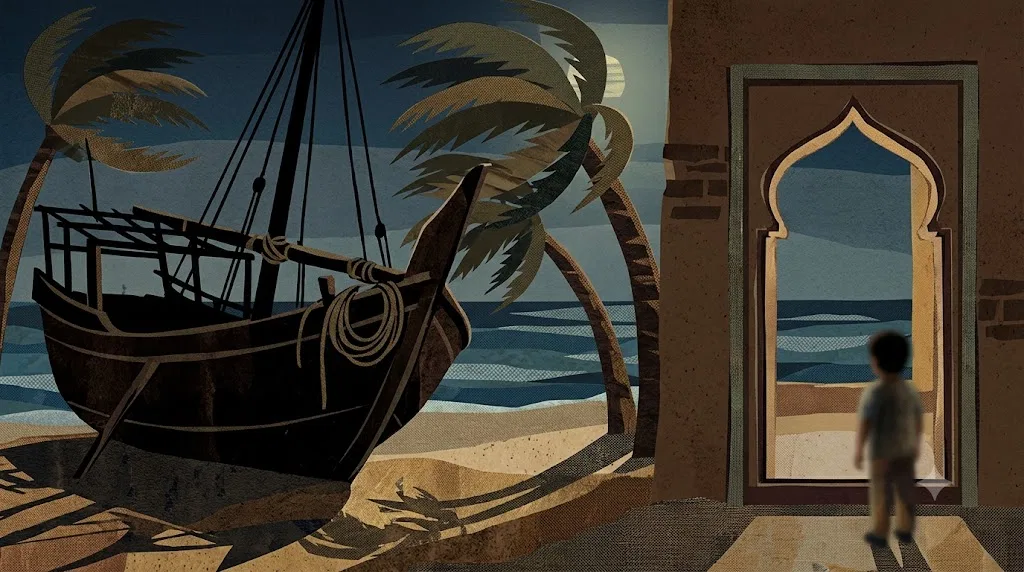
Kuwait’s folklore is best understood as the story-world of a country balanced between desert, town and sea.
Page outline Jump by section
What makes Kuwaiti folklore distinctive?
Kuwaiti folklore is distinctive because it grew from three closely connected worlds. The first is the desert and Bedouin world, where poetry, weaving, animal knowledge, tents, migration routes and family teaching carried memory across generations. The second is the old town, with its neighbourhood life, markets, children’s songs, Ramadan customs and household tales. The third is the maritime world of sailors, pearl divers, shipwrights and merchants, whose work connected Kuwait to Bahrain, Qatar, Oman, India, East Africa and the wider Indian Ocean. Dr Yacoub Y. Al-Hijji’s work on Kuwaiti maritime folklore, for example, was built from interviews with sailors, dhow captains, shipwrights and merchants, and set out to record fables, sayings, songs and social practices before they disappeared from living memory.[Academia]academia.eduPDF) Maritime Folklore of KuwaitPDF) Maritime Folklore of Kuwait
That matters because many Kuwaiti legendary beings are not abstract monsters. They belong to recognisable situations: a child wants to go outside at dangerous noon heat; a sailor hears a cry in the dark; a family wants children asleep before night roaming; a community tries to explain a drowning, a strange light, a desert noise or a frightening shadow. A 2015 Kuwait Times report, drawing on an interview with Kuwait University anthropologist Dr Mohammad Al-Haddad, describes these figures as part of a culture handed down across generations, often used by adults to keep children safe or obedient.[Kuwait Times]kuwaittimes.comOpen source on kuwaittimes.com.
Modern Kuwait has changed the setting in which these stories are told. Education, urban life, television, social media and heritage institutions have weakened the old everyday use of many tales, but have also given them new forms: museum displays, children’s books, paintings, theatre, cinema, heritage festivals and online nostalgia. The result is a folklore culture that is both fragile and unusually visible: some beliefs have receded from daily life, while their images have become symbols of Kuwaiti identity and creative memory.[Kuwait Times]kuwaittimes.comOpen source on kuwaittimes.com.
The old warning beings: fear with a practical purpose
Many of Kuwait’s famous supernatural figures were once used as warning tales. They were frightening, but they were not merely entertainment. They worked like memorable safety instructions in a hot, coastal, pre-air-conditioning society where children could genuinely be harmed by heat, deep water, darkness or getting lost.
The most famous of these figures is Tantal, often described as a very tall, strange night-roaming being. In one account, Dr Al-Haddad describes him as a notorious Kuwaiti boogeyman, imagined as enormous, dark, dishevelled and heavy-footed, carrying a staff and sometimes appearing ghostlike at night to kidnap children. He also noted that although the figure has largely vanished from everyday belief, the name still survives in Kuwaiti speech as a way to refer to an unusually tall person.[Kuwait Times]kuwaittimes.comOpen source on kuwaittimes.com.
Another major warning figure is Hemarat Al-Gayla, the “noon donkey” figure. Kuwait Times’ 2024 discussion of mythical creatures explains that this being was associated with the dangerous middle of the day: a donkey-like creature, or in some versions a woman with a donkey’s leg, who might harm those who crossed its path at noon. The likely practical lesson is clear. In Kuwait’s climate, the old tale turned heat danger into a figure a child could remember.[Kuwait Times]kuwaittimes.comOpen source on kuwaittimes.com.
Umm Al-Sa’af Wa-Alleef shows how folklore can grow from the physical environment. Heritage researcher Salem Abdullatif Al-Misbah described her as a frightening old woman with messy hair and wings, said to fly around and threaten children into sleeping. He links the figure to a kind of palm tree whose movement and noise on dark, windy nights could be misread by children as something alive and terrifying. This is a useful example of how folk belief may transform ordinary sounds and shadows into supernatural explanation.[Kuwait Times]kuwaittimes.comOpen source on kuwaittimes.com.
Other figures include Al-Seolu, described in older local history as a child-kidnapping, cannibalistic being associated in one account with public fear after a boy drowned by the seashore in 1910, and Al-Duaidea or Edaida, a mysterious moving ember or fire-like light that seemed to retreat when approached. These are not well documented in the same way as a written epic or state religion; they are better read as fragments of oral warning culture, preserved through memory, local research and later retellings.[Kuwait Times]kuwaittimes.comOpen source on kuwaittimes.com.

Sea demons, pearl songs and the haunted Gulf
Kuwait’s maritime folklore is especially important because Kuwait’s pre-oil society depended heavily on the sea. Shipbuilding, trade, fishing and pearl diving were not just economic activities; they shaped music, language, family life, danger, status and memory. Al-Hijji’s work explicitly treats Kuwait’s maritime heritage as a source of anecdotes, narratives, fables, popular songs and sayings, gathered from people who had worked in or inherited that seafaring world.[Academia]academia.eduPDF) Maritime Folklore of KuwaitPDF) Maritime Folklore of Kuwait
The most memorable sea monster in Kuwaiti folklore is Bu Darya, a water demon or half-human sea figure feared by sailors. One modern heritage account says he was believed to climb aboard ships, seize sailors and drag them into the water; another describes him as a half-human, half-fish creature that cried at night like a drowning person, luring rescuers close before drowning them. The story works because it turns a real maritime danger into a dramatic moral test: at sea, compassion and caution could collide in the dark.[Kuwait Times]kuwaittimes.comOpen source on kuwaittimes.com.
Pearl-diving music gives the sea a different emotional register. Across the Gulf, pearl divers sang work songs on wooden dhows, usually led by a main singer and answered by a chorus with clapping and percussion. Smithsonian Folklife describes this music as both entertainment and inspiration for divers, while noting that today the singers no longer lead working pearl crews but act as preservationist artists.[Smithsonian Folklife Festival]festival.si.eduOpen source on si.edu.
Kuwait has its own recognised sea-song heritage. Ethnomusicologist Lisa Urkevich’s recordings and study of Kuwaiti sea songs highlight the Hamid Bin Hussein Sea Band of Kuwait, whose performers are described as descendants of pearlers and seamen and as cherished bearers of a shrinking tradition. The point is not simply musical. Sea songs preserve rhythm, labour, memory and social feeling from a world in which men could be away for months and where diving was physically dangerous.[Dr Lisa - Saudi & Gulf Heritage & Music]urkevich.comDr LisaDr Lisa
Modern scholarship and revival projects also stress the cosmopolitan side of Kuwaiti pearl-diving music. NYU Abu Dhabi describes Kuwaiti musician and scholar Ghazi Faisal Al-Mulaifi as reviving his ancestors’ pearl-diving music and bringing it to new audiences, while WOMEX frames Kuwaiti pearl-diving music as shaped by sea trade stretching from Zanzibar to Bombay and Kuwait. That wider Indian Ocean context helps explain why Kuwaiti maritime folklore should not be treated as isolated “national colour”; it is part of a shared Gulf and oceanic culture, locally rooted but historically connected.[New York University Abu Dhabi]nyuad.nyu.eduNew York University Abu Dhabi Reviving the Sounds of Kuwait's Pearl DiversNew York University Abu Dhabi Reviving the Sounds of Kuwait's Pearl Divers
Desert memory in woven symbols
Not all folklore is a spoken tale. In Kuwait, Al Sadu weaving is one of the clearest examples of material folklore: inherited knowledge carried through pattern, technique, gendered labour and social use. UNESCO describes traditional Al Sadu weaving as textile made by Bedouin women on a ground loom using natural fibres from the environment. WIPO’s 2025 profile of Kuwait’s Al Sadu Society calls it one of the oldest and most prominent traditional crafts in Kuwait and the Arabian Peninsula, rooted in Bedouin nomadic life and strongly tied to Kuwaiti cultural identity.[UNESCO Intangible Cultural Heritage]ich.unesco.orgOpen source on unesco.org.
Al Sadu matters to folklore because it tells stories without necessarily narrating them. Its geometric motifs, tent furnishings, dividers and practical objects belong to a world of movement, animals, family space and desert survival. The craft was traditionally learned by girls assisting mothers with spinning, dyeing and weaving, making it a channel of intergenerational teaching as much as decoration.[WIPO]wipo.intOpen source on wipo.int.
It is also one of Kuwait’s best-supported heritage traditions. Al Sadu was inscribed on UNESCO’s Representative List of the Intangible Cultural Heritage of Humanity in 2020, and the Al Sadu Society has used documentation, education, workshops, publications and intellectual property tools to preserve traditional techniques and adapt them for modern design. Many expert weavers are now elderly, so the Society’s work to document their skills is not a cosmetic heritage project; it is a race against the loss of living knowledge.[WIPO]wipo.intOpen source on wipo.int.
Sadu House in Kuwait City gives this tradition a public home. The Al Sadu Society describes the museum as a depository for textile weaving and Sadu-style embroidery, designed to connect past, present and future. Its museum narrative moves “from desert to town”, showing how Bedouin weaving heritage became part of Kuwait’s wider cultural identity rather than remaining only a memory of nomadic life.[Alsadu Society]alsadu.org.kwOpen source on alsadu.org.kw.
Ramadan songs and children’s street folklore
Kuwaiti folklore also appears in seasonal custom, especially children’s traditions. Gargee’an, often spelt in several ways in English, is a mid-Ramadan celebration in which children dress in traditional clothing, go from house to house, sing, and receive sweets or nuts from neighbours. Xinhua’s 2025 coverage of the practice in Kuwait describes children in Capital Governorate observing it from the 13th to the 15th day of Ramadan, while Kuwait Times describes Girgian as a joyful traditional celebration usually marked on those same nights.[Xinhua News]english.news.cnOpen source on news.cn.
This custom is folklore because it is performed collectively and passed through repeated social practice. The songs matter as much as the sweets. Children do not simply ask for treats; they sing inherited verses, move through the neighbourhood, meet neighbours and enact belonging. In older settings, this kind of custom depended on trust: children could walk familiar streets, and households expected to take part.
Modern Gargee’an has changed. Malls, schools, companies and families now stage more organised or commercial celebrations, and gifts can be packaged with far more expense than the older handfuls of nuts and sweets. Yet the central folk structure remains recognisable: children, costume, song, doors, blessing, generosity and neighbourhood memory.[Al Mujtama Magazine]en.mugtama.comOpen source on mugtama.com.
Sacred and legendary landscapes: Failaka’s deeper past
Kuwaiti folklore does not begin only with modern Kuwait City or the pearl-diving era. Failaka Island gives the country a much older legendary and sacred landscape. UNESCO’s tentative World Heritage description calls Failaka a palimpsest of human civilisations, noting its dense archaeological layers and strategic position in the north-western Gulf. It also records ancient descriptions of the island, known in the Hellenistic period as Ikaros, as rich in vegetation and home to animals considered sacred by inhabitants who dedicated them to local deities.[UNESCO World Heritage Centre]whc.unesco.orgOpen source on unesco.org.
Failaka’s ancient story links Kuwait to Dilmun, Mesopotamia and Hellenistic culture. The Middle East Institute at the National University of Singapore notes that cuneiform texts from Failaka identify it with the land of Anzak, one of Dilmun’s gods, and that stamp seals and other finds connect the island to Dilmun’s trading world. This matters for a folklore page because it shows that Kuwait’s legendary geography is layered: later Islamic, Gulf and Kuwaiti oral traditions sit on top of far older sacred and trading landscapes.[Middle East Institute]mei.nus.edu.sgOpen source on edu.sg.
Recent archaeology continues to reshape how the island is understood. In October 2025, Kuwait Times reported that Kuwait’s National Council for Culture, Arts and Letters announced the discovery of a nearly 4,000-year-old Bronze Age Dilmun temple on Failaka by a joint Kuwaiti-Danish team from Moesgaard Museum. Such finds do not prove a continuous line from Bronze Age religion to modern Kuwaiti folktales, and it would be misleading to claim that they do. What they do show is that Kuwait’s landscape has long been a place where trade, ritual, story and settlement met.[Kuwait Times]kuwaittimes.comKuwait Times Ancient Bronze Age temple of Dilmun civilizationKuwait Times Ancient Bronze Age temple of Dilmun civilization
Failaka has also acquired a modern ghostly reputation because of abandonment, war damage and ruins after the 1990 Iraqi invasion. Travel writing and online urban-exploration accounts often describe it as a “ghost island”, but these should be treated carefully: they are modern atmosphere and memory, not necessarily old folklore. The stronger interpretation is that Failaka’s ancient sacred past, war-scarred modern buildings and partial abandonment have made it a powerful place for new haunting stories to gather.[Atlas Obscura]atlasobscura.comAtlas Obscura Failaka Island in ZoorAtlas Obscura Failaka Island in Zoor
Jinn, religion and everyday belief
Jinn beliefs form part of the wider Islamic and Arabic supernatural imagination, and Kuwait is no exception. A 2024 academic article on jinn belief specifically includes interviews with Sunni Muslim men and women living in Kuwait, and sets out to compare formal Islamic concepts with individual interpretations, everyday customs and urban legends. That is useful because it separates three things that are often blurred: scriptural belief, local folk explanation and modern urban legend.[OJS Lib Unideb]ojs.lib.unideb.huOJS Lib Unideb THE JINN – THE CULPRIT OF THE ARABIC WORLDOJS Lib Unideb THE JINN – THE CULPRIT OF THE ARABIC WORLD
In Kuwaiti folklore, jinn are not always presented as named storybook monsters. They often function as an explanation for uncanny places, possession stories, strange sounds, dangerous thresholds or events that feel beyond ordinary cause. Maritime folklore also includes reports of divers in Gulf pearl beds being possessed by jinn or hearing uncanny cries from the seabed, although such stories belong to the broader Gulf maritime world rather than Kuwait alone.[Academia]academia.eduPDF) Maritime Folklore of KuwaitPDF) Maritime Folklore of Kuwait
For readers, the key is not to ask whether these beings are “real” in a paranormal sense. A folklore approach asks what the belief does: how it marks danger, explains misfortune, gives language to fear, supports religious healing, or turns a place into a moral landscape. In Kuwait, as elsewhere in the Gulf, jinn belief overlaps with Islam, family caution, oral storytelling and modern haunted-place narratives.
How old are these traditions?
Kuwait’s folklore is not all the same age. Some layers are ancient in setting but not continuous in evidence. Failaka’s sacred landscape reaches back thousands of years, but modern Kuwaiti readers should not assume an unbroken oral chain from Dilmun temples to today’s monsters. The archaeology is strong; the continuity of specific folk narratives is much harder to prove.[UNESCO World Heritage Centre]whc.unesco.orgOpen source on unesco.org.
Other traditions are better tied to the pre-oil Gulf. Maritime songs, pearl-diving memories, dhow culture, sailors’ sayings and sea-demon stories are linked to the working maritime society that shaped Kuwait before oil wealth transformed the economy. Al-Hijji’s collection work is especially valuable here because it records memories from people connected to that older seafaring world.[Academia]academia.eduPDF) Maritime Folklore of KuwaitPDF) Maritime Folklore of Kuwait
The child-scaring beings are harder to date precisely. Figures such as Tantal, Hemarat Al-Gayla, Bu Darya and Umm Al-Sa’af Wa-Alleef are presented by Kuwaiti heritage researchers as old oral tales, but many accessible English accounts are modern summaries based on interviews and cultural memory. They are well worth discussing as Kuwaiti folklore, but they should not be inflated into a fixed ancient mythology with a single authoritative version.[Kuwait Times]kuwaittimes.comOpen source on kuwaittimes.com.
Al Sadu, by contrast, is one of the clearest cases of documented living heritage. It has institutional safeguarding, public teaching programmes, UNESCO recognition, museum interpretation and named publications by the Al Sadu Society. That does not make it more “authentic” than oral tales, but it does make its evidence base stronger and easier for visitors to verify.[WIPO]wipo.intOpen source on wipo.int.
Folklore today: from household fear to cultural revival
Today, much Kuwaiti folklore survives less as active fear and more as cultural memory. The old monsters no longer organise childhood in the same way, but they still appear in articles, paintings, theatre, cinema and online discussion. Kuwait Times’ 2024 feature explicitly notes that although these tales have nearly disappeared from daily life, they remain vivid in memory and continue to inspire films, plays, books and paintings.[Kuwait Times]kuwaittimes.comOpen source on kuwaittimes.com.
This modern revival can be valuable, but it also changes the material. A painted Tantal is not the same as a grandmother’s warning at night; a heritage festival is not the same as a neighbourhood custom performed without cameras; a museum display freezes a craft that once belonged to everyday making. None of these changes make the tradition false. They show how folklore moves from use to memory, and from memory to identity.
Kuwait’s strongest heritage work often succeeds when it does not merely display the past, but teaches skills and context. The Al Sadu Society’s school programmes, weaver documentation and modern design collaborations show how an old practice can survive by adapting. Maritime music revival works in a similar way: old pearl-diving songs are no longer needed to coordinate labour on the same scale, but musicians and scholars can still preserve their rhythms, stories and emotional force.[WIPO]wipo.intOpen source on wipo.int.
What to remember about Kuwaiti folklore
Kuwaiti folklore is not a neat pantheon of gods and heroes. It is a practical and imaginative heritage made from heat, sea danger, children’s movement, Bedouin craft, Ramadan song, neighbourhood memory and the older sacred geography of the Gulf. Its creatures are often frightening because they had work to do: keep children out of the noon sun, stop them wandering at night, warn sailors about the sea, or give shape to fears that could not be safely explained.
The best way to read these traditions is with both curiosity and caution. Tantal, Bu Darya, Hemarat Al-Gayla and Umm Al-Sa’af Wa-Alleef are vivid parts of Kuwaiti legendary culture, but their accessible documentation is mostly modern and memory-based. Al Sadu and maritime music are more institutionally documented, but they too have changed as they moved from everyday life into museums, schools and performance. Failaka gives Kuwait a much older mythic horizon, but its Bronze Age and Hellenistic sacred history should not be casually blended with modern ghost stories.
Seen together, these strands show Kuwait as a country whose folklore is intimate rather than remote: stories told to children, songs sung by working men, patterns woven by women, customs performed in streets, and islands where archaeology and modern haunting meet. Its power lies in that closeness to ordinary life.
eBay marketplace picks
Marketplace Samples
Live-tested eBay searches with available results related to this page.


Endnotes
1.
Source: academia.edu
Title: (PDF) Maritime Folklore of Kuwait
Link:https://www.academia.edu/82472974/Maritime_Folklore_of_Kuwait
2.
Source: wipo.int
Link:https://www.wipo.int/en/web/wipo-magazine/articles/how-al-sadu-society-is-weaving-ip-into-the-promotion-of-traditional-textiles-in-kuwait-71417
3.
Source: urkevich.com
Title: Dr Lisa
Link:https://www.urkevich.com/pearl-divers-music-kuwait
4.
Source: nyuad.nyu.edu
Title: New York University Abu Dhabi Reviving the Sounds of Kuwait’s Pearl Divers
Link:https://nyuad.nyu.edu/en/news/latest-news/arts-and-culture/2025/march/reviving-the-sounds-of-kuwaits-pearl-divers.html
5.
Source: womex.com
Title: Kuwaiti Pearl Diving Music
Link:https://www.womex.com/virtual/piranha_arts_1/event/kuwaiti_pearl_diving
6.
Source: ich.unesco.org
Link:https://ich.unesco.org/en/RL/traditional-weaving-of-al-sadu-02158
7.
Source: whc.unesco.org
Link:https://whc.unesco.org/en/tentativelists/6800/
8.
Source: ojs.lib.unideb.hu
Title: OJS Lib Unideb THE JINN – THE CULPRIT OF THE ARABIC WORLD
Link:https://ojs.lib.unideb.hu/kulonlegesbanasmod/article/download/14204/12234
9.
Source: ich.unesco.org
Link:https://ich.unesco.org/en/Decisions/20.COM/7.b.54
10.
Source: ich.unesco.org
Link:https://ich.unesco.org/en/lists
11.
Source: ich.unesco.org
Link:https://ich.unesco.org/en/decisions/15.COM/8.B.4
12.
Source: ich.unesco.org
Title: kuwait KW
Link:https://ich.unesco.org/en/state/kuwait-KW
13.
Source: ich.unesco.org
Link:https://ich.unesco.org/doc/src/40306.pdf?v=1528728412
14.
Source: unesco.org
Title: document 5349
Link:https://www.unesco.org/archives/multimedia/document-5349
15.
Source: ich.unesco.org
Title: 8b representative list 01146
Link:https://ich.unesco.org/en/8b-representative-list-01146?id=01586&include=slideshow_inc.php
16.
Source: ich.unesco.org
Title: LHE 22 17.CO M 7.c EN.docx
Link:https://ich.unesco.org/doc/src/LHE-22-17.COM-7.c-EN.docx
17.
Source: ich.unesco.org
Title: photo pop up 00973
Link:https://ich.unesco.org/en/photo-pop-up-00973?photoID=13409
18.
Source: ich.unesco.org
Link:https://ich.unesco.org/en/decisions/17.COM/7.C.3
19.
Source: urkevich.com
Link:https://www.urkevich.com/ar/pearl-divers-music-kuwait
20.
Source: academia.edu
Link:https://www.academia.edu/44004814/101_Middle_Eastern_Tales_and_Their_Impact_on_Western_Oral_Tradition
21.
Source: academia.edu
Link:https://www.academia.edu/11869814/A_review_of_Kuwait_and_the_Sea_A_Brief_Social_and_Economic_History_by_Yacoub_Yusuf_Al_Hijji
22.
Source: ojs.lib.unideb.hu
Link:https://ojs.lib.unideb.hu/kulonlegesbanasmod/article/download/10911/9682/21731
23.
Source: kuwaittimes.com
Link:https://kuwaittimes.com/mythical-characters-abound-in-old-kuwaiti-folk-tales/
24.
Source: kuwaittimes.com
Link:https://kuwaittimes.com/article/18387/lifestyle/art-fashion/kuwaiti-mythical-creatures-that-can-still-cast-a-spell/
25.
Source: festival.si.edu
Link:https://festival.si.edu/blog/pearl-diving-music
26.
Source: alsadu.org.kw
Link:https://alsadu.org.kw/
27.
Source: alsadu.org.kw
Link:https://alsadu.org.kw/museum/
28.
Source: english.news.cn
Link:https://english.news.cn/20250314/394084f7201e4b8f89786525429ac57c/c.html
29.
Source: kuwaittimes.com
Title: girgian o girgian
Link:https://kuwaittimes.com/article/12339/lifestyle/art-fashion/girgian-o-girgian/
30.
Source: en.mugtama.com
Link:https://en.mugtama.com/articles/gargee_an_and_10_cultural_and_social_landmarks
31.
Source: mei.nus.edu.sg
Link:https://mei.nus.edu.sg/publication/insight-89-failaka-islandunearthing-the-past-in-kuwait/
32.
Source: kuwaittimes.com
Title: Kuwait Times Ancient Bronze Age temple of Dilmun civilization
Link:https://kuwaittimes.com/article/34926/kuwait/ancient-bronze-age-temple-of-dilmun-civilization-discovered-on-failaka-island/
33.
Source: atlasobscura.com
Title: Atlas Obscura Failaka Island in Zoor
Link:https://www.atlasobscura.com/places/failaka-island
34.
Source: kuwaittimes.com
Link:https://kuwaittimes.com/kuwaits-favorite-historical-folktales/
35.
Source: kuwaittimes.com
Title: al sadu recognized as part of worlds intangible cultural heritage
Link:https://kuwaittimes.com/al-sadu-recognized-as-part-of-worlds-intangible-cultural-heritage/
36.
Source: kuwaittimes.com
Title: city of jinn magical myths haunt ancient omani oasis
Link:https://kuwaittimes.com/article/8047/lifestyle/art-fashion/city-of-jinn-magical-myths-haunt-ancient-omani-oasis/
37.
Source: Wikipedia
Title: Al Sadu
Link:https://en.wikipedia.org/wiki/Al_Sadu
38.
Source: Wikipedia
Title: Failaka Island
Link:https://en.wikipedia.org/wiki/Failaka_Island
39.
Source: Wikipedia
Title: Sadu House
Link:https://en.wikipedia.org/wiki/Sadu_House
40.
Source: facebook.com
Link:https://www.facebook.com/kuwaittimesdaily/posts/long-ago-the-quiet-nights-of-kuwait-spent-between-the-sea-and-desert-inspired-it/925823709591365/
41.
Source: facebook.com
Link:https://www.facebook.com/kuwaittimesdaily/posts/gardenia-will-officially-open-on-thursday-january-15-for-its-fourth-season-at-th/1319934783513587/
42.
Source: facebook.com
Link:https://www.facebook.com/kuwait.upto.date/photos/gergean-or-gergeean-is-a-longstanding-kuwaiti-cultural-tradition-that-is-celebra/724193113216764/
43.
Source: facebook.com
Link:https://www.facebook.com/saduhouse/
44.
Source: folkways.si.edu
Link:https://folkways.si.edu/bahrain-fidjeri-songs-of-the-pearl-divers/world/music/album/smithsonian
45.
Source: tripadvisor.com
Title: Failaka Island
Link:https://www.tripadvisor.com/Attraction_Review-g298255-d7149719-Reviews-or30-Failaka_Island-Ahmadi.html
46.
Source: tripadvisor.com
Title: Failaka Island
Link:https://www.tripadvisor.com/Attraction_Review-g298255-d7149719-Reviews-Failaka_Island-Ahmadi.html
47.
Source: tripadvisor.com
Title: Sadu House
Link:https://www.tripadvisor.com/Attraction_Review-g294003-d4762448-Reviews-Sadu_House-Kuwait_City.html
48.
Source: jcasc.com
Link:https://jcasc.com/index.php/jcasc/article/download/2703/807
49.
Source: kuwaitembassy.ca
Link:https://kuwaitembassy.ca/index.php/the-embassy/gallery/2-uncategorised/2-culture
50.
Source: p4panorama.com
Link:https://www.p4panorama.com/panos/failaka-island-kuwait-360-virtual-tour/
51.
Source: daftar.afikra.com
Title: failaka island
Link:https://www.daftar.afikra.com/articles/failaka-island
52.
Source: kbs2.edu.kw
Link:https://kbs2.edu.kw/school-news/kbs-gergean-celebration-brings-joy-and-tradition-to-the-community/
Additional References
53.
Source: loc.gov
Link:https://www.loc.gov/aba/publications/FreeLCSH/H.pdf
54.
Source: youtube.com
Title: Kuwait Folklore
Link:https://www.youtube.com/watch?v=LB6BBCUVVq0
Source snippet
Traditional Kuwaiti Sawt & Samri Folk Song...
55.
Source: researchgate.net
Link:https://www.researchgate.net/publication/379681385The_Jinn-_The_Culprit_of_the_Arabic_World
56.
Source: researchgate.net
Link:https://www.researchgate.net/publication/254304910A_review_of%27Kuwait_and_the_Sea_A_Brief_Social_and_Economic_History%27_by_Yacoub_Yusuf_Al-Hijji
57.
Source: reddit.com
Link:https://www.reddit.com/r/Kuwait/comments/gspc6g/does_anyone_know_of_any_urban_legends_from_kuwait/
58.
Source: trmkt.org
Link:https://trmkt.org/failaka-period/
59.
Source: facebook.com
Link:https://www.facebook.com/TheNationalNews/posts/fjiri-is-a-music-and-dance-performance-with-its-roots-in-the-pearl-diving-tradit/4919918914697638/
60.
Source: facebook.com
Link:https://www.facebook.com/kuwaittimesdaily/posts/girgian-childrens-joy-in-ramadanby-faten-omarthe-nights-of-13-14-and-15-of-ramad/10156404037002065/
61.
Source: psychopomp.com
Link:https://psychopomp.com/jinn-in-the-gulf/
62.
Source: researchgate.net
Link:https://www.researchgate.net/publication/263807403_Islam_Arabs_and_the_Intelligent_World_of_the_Jinn
Topic Tree
Follow this branch
Related pages 192
- Afghan Folklore
- Albanian Folklore
- Algerian Folklore
- Australian Folklore
- Azerbaijan Folklore
- +187 more in sidebar