Layered Folklore of Hungary
Hungarian folklore is not a single ancient “mythology book” waiting to be decoded. It is a layered tradition made from medieval origin legends, village belief stories, witches and healers remembered in court records, seasonal customs, children’s tales, folk song and dance, and modern revivals.
Page outline Jump by section
Why Hungarian folklore feels unusually layered
Hungary sits in the Carpathian Basin, where Hungarian-speaking traditions have long existed beside Slavic, German, Jewish, Roma, Romanian, Croatian, Serbian and other neighbouring cultures. That makes its folklore both distinctive and porous. A Hungarian village belief might preserve a local name and local explanation, yet share motifs with wider Central and South-Eastern European traditions: storm magic, witches stealing milk, fairies or night spirits, masked winter rites, dragon-fighting heroes, and stories of the dead returning at dangerous points in the calendar.[SciSpace]scispace.comSci Space The Hungarian Táltos and the Shamanism of PaganSci Space The Hungarian Táltos and the Shamanism of Pagan
A useful way to read Hungarian folklore is to separate four overlapping layers. The first is medieval legendary history, especially stories that explain where the Hungarians came from. The second is oral village belief, collected by ethnographers and preserved in archives. The third is literary and children’s folklore, shaped by collectors, editors and writers such as Elek Benedek. The fourth is public heritage, where customs such as the Mohács masked carnival or folk dance revival are performed, safeguarded and promoted in the present.[wikipedia.org]WikipediaHunor and MagorHunor and Magor
This matters because “Hungarian folklore” is sometimes presented online as a neat pantheon of gods and monsters. The evidence is more complicated. Scholars have repeatedly warned that fragments of old belief were reinterpreted through Christianity, nationalism, Romantic-era reconstruction and later popular media. The result is not fake folklore, but folklore with a visible history: stories have collectors, editors, performances, political uses and changing audiences.[SciSpace]scispace.comSci Space The Hungarian Táltos and the Shamanism of PaganSci Space The Hungarian Táltos and the Shamanism of Pagan
The miraculous stag and the question of origin
The most famous Hungarian origin legend is the hunt of the miraculous stag. In medieval tradition, the brothers Hunor and Magor pursue a wondrous hind or stag, are led into new lands, and become connected with the ancestry of the Huns and the Magyars. The story is preserved in medieval chronicle tradition, especially in connection with Simon of Kéza’s late thirteenth-century account, and later versions also appear in the fourteenth-century illustrated chronicle tradition.[Wikipedia]WikipediaHunor and MagorHunor and Magor
For ordinary readers, the key point is not whether the stag story is “true history”. It is a foundation legend: a story that gives movement, ancestry and destiny a memorable image. The animal is not just prey. It is a guide, drawing hunters away from the known world towards a future homeland. That structure is common in origin legends: a chase becomes a migration, and a supernatural animal becomes a sign that history has meaning.[Wikipedia]WikipediaHunor and MagorHunor and Magor
The legend has also had political uses. Medieval and later writers used Hun-Hungarian continuity to connect the Hungarian kingdom with Attila and the Huns. That connection mattered in noble identity and in later national imagination, even though modern history treats the legend as a medieval ideological construction rather than straightforward evidence of ethnic continuity. The stag therefore sits at a crossroads between myth, literature and politics.[Wikipedia]WikipediaHunor and MagorHunor and Magor
Its afterlife is just as important as its medieval form. The miraculous stag has been retold in poetry, children’s literature, illustration, national symbolism and modern cultural branding. It remains one of the easiest ways to recognise Hungarian legendary tradition, but it should be read as a living cultural emblem rather than as a simple window onto pre-Christian religion.[Wikipedia]WikipediaHunor and MagorHunor and Magor
Gifted people: weather-workers, witches and wandering scholars
One of the richest parts of Hungarian folk belief concerns people thought to possess unusual powers. These figures were not always monsters. They could heal, curse, divine, protect, harm, find lost things, raise storms or communicate with the dead. In village life, such people were often morally ambiguous: feared, needed, accused, consulted and remembered.[eng.polgariszemle.hu]eng.polgariszemle.huOpen source on polgariszemle.hu.
The best-known figure is the táltos, often described in popular accounts as a shaman-like specialist. Older scholarship connected the figure to pre-Christian Hungarian religion, but recent research is much more cautious. Éva Pócs’s work argues that the táltos tradition is best understood through weather magic, heroic and Balkan parallels, and later folk belief, rather than as firm proof of a classic Eurasian shaman with drum-induced ecstasy and a fully preserved ancient ritual system.[SciSpace]scispace.comSci Space The Hungarian Táltos and the Shamanism of PaganSci Space The Hungarian Táltos and the Shamanism of Pagan
This caution is important because the táltos has become a magnet for modern mythmaking. Some accounts treat the figure as a direct survival from pagan Hungary; others dismiss that entirely. The strongest position is between those extremes: Hungarian sources do preserve powerful traditions about special people born with signs, able to fight or travel spiritually, and linked to weather and healing; but scholars dispute how far those traditions can be projected backwards into the ninth or tenth century.[scispace.com]scispace.comSci Space The Hungarian Táltos and the Shamanism of PaganSci Space The Hungarian Táltos and the Shamanism of Pagan
The garabonciás is another memorable figure: a wandering student or learned magician associated with books, storms and supernatural knowledge. The Hungarian ethnographic summary hosted by the Hungarian Electronic Library notes that the figure became mixed with the táltos over time but is linked to Western learned-magic traditions and the idea of the travelling student who had completed years of schooling.[mek.oszk.hu]mek.oszk.huOpen source on oszk.hu.
Witches occupy a different but overlapping world. Hungarian witch beliefs were not merely imported demonology from church courts. Trial records and ethnographic studies show a complicated landscape of neighbourhood conflict, healing, accusations, animal doubles, night journeys, dead souls and local specialists. Pócs’s work on early modern Hungary draws on thousands of pages of witch-trial material and distinguishes popular belief from elite demonological interpretation.[iu.edu]scholarworks.iu.eduScholar Works00.02.05, Pocs, Between the Living and the Dead | The Medieval Review…
That does not make the accusations safe or benign. Witch-hunting in Hungary and Transylvania had real victims, especially in the early modern period, and accusations could turn neighbourly suspicion, illness, failed healing, livestock trouble or family conflict into legal danger. Folklore here is not just entertainment; it is also evidence for how communities explained misfortune and how dangerous those explanations could become.[Academy's Library Repository]real.mtak.huOpen source on mtak.hu.
Spirits, dragons and the darker edge of the tale world
Hungarian supernatural tradition includes many beings that are difficult to translate neatly into English. Some belong mostly to fairy tales; others belong to belief legends told as if they might happen close to home. The distinction matters. A dragon in a wonder tale is not the same kind of evidence as a neighbour’s account of a night spirit pressing on someone’s chest, even if both belong to folklore.[eng.polgariszemle.hu]eng.polgariszemle.huOpen source on polgariszemle.hu.
The lidérc is one of the most striking Hungarian supernatural beings. It appears in scholarship and popular summaries as a night spirit or demonic being with several forms, sometimes connected with erotic haunting, fiery lights, nightmare pressure, wealth, harm or service to a human master. Its variety is the point: it is not a single “monster species” in the modern fantasy sense, but a cluster of related beliefs about dangerous intimacy, night visits and uncanny assistance.[eng.polgariszemle.hu]eng.polgariszemle.huOpen source on polgariszemle.hu.
Dragons are more familiar to international readers, but Hungarian dragons also have local flavour. In folk tales, the dragon is often a many-headed opponent in heroic plots: a princess is threatened, a hero must descend, fight, trick or rescue, and the dragon becomes a test of courage and cleverness. This is the tale-world dragon, closer to European wonder-tale patterns than to a single ancient Hungarian cult being.[Wikipedia]WikipediaHungarian mythologyHungarian mythology
Fairies, giants, dwarfs, devils, old women with magic, ghosts and water beings also appear in Hungarian tale and belief material. But readers should be wary of modern lists that flatten them into a fantasy bestiary. Hungarian folklore is strongest when read through story situations: a young hero bargaining with supernatural helpers, a witch suspected after illness strikes, a student conjuring a storm, a night being disturbing sleep, or a masked community driving out winter.[Wikipedia]WikipediaHungarian mythologyHungarian mythology

Folk tales: from oral storytelling to beloved children’s culture
Hungarian folk tales became nationally visible through collectors, editors and later media. Nineteenth-century printed collections helped create a canon of “Hungarian folk literature”, deciding which tales counted as representative and how they should be presented to readers. Recent scholarship on nineteenth-century Hungarian folk-literature collections stresses that canonisation was an active process, not just passive preservation.[Akademiai Kiado]akjournals.comarticle p5.xmlarticle p5.xml
Elek Benedek is central to the popular memory of Hungarian folk tales. His multi-volume collection of Hungarian tales and legends, published in the 1890s, became a landmark in children’s and national literature, and his birthday, 30 September, is now associated with the Day of Hungarian Folk Tales in public cultural memory.[DailyNewsHungary]dailynewshungary.comDaily News Hungary Generations grew up on these Hungarian Folk talesDaily News Hungary Generations grew up on these Hungarian Folk tales
English-speaking readers can also encounter older translated collections, such as the 1889 volume The Folk-Tales of the Magyars, which gathered tales connected with Hungarian tradition for the Folklore Society in London. Such books are valuable, but they should be read as products of their time: translated, selected, edited and framed for particular audiences.[Internet Archive]archive.orgOpen source on archive.org.
In the late twentieth and early twenty-first centuries, the animated series Hungarian Folk Tales gave this tradition a new public life. The series began in 1980, ran across many years, and used regional motifs, folk ornament and music to create a recognisable visual language for Hungarian tale culture. For many people today, especially outside specialist folklore studies, this animation is the gateway into Hungarian story tradition.[Wikipedia]WikipediaHungarian Folk TalesHungarian Folk Tales
Rituals people still travel to see
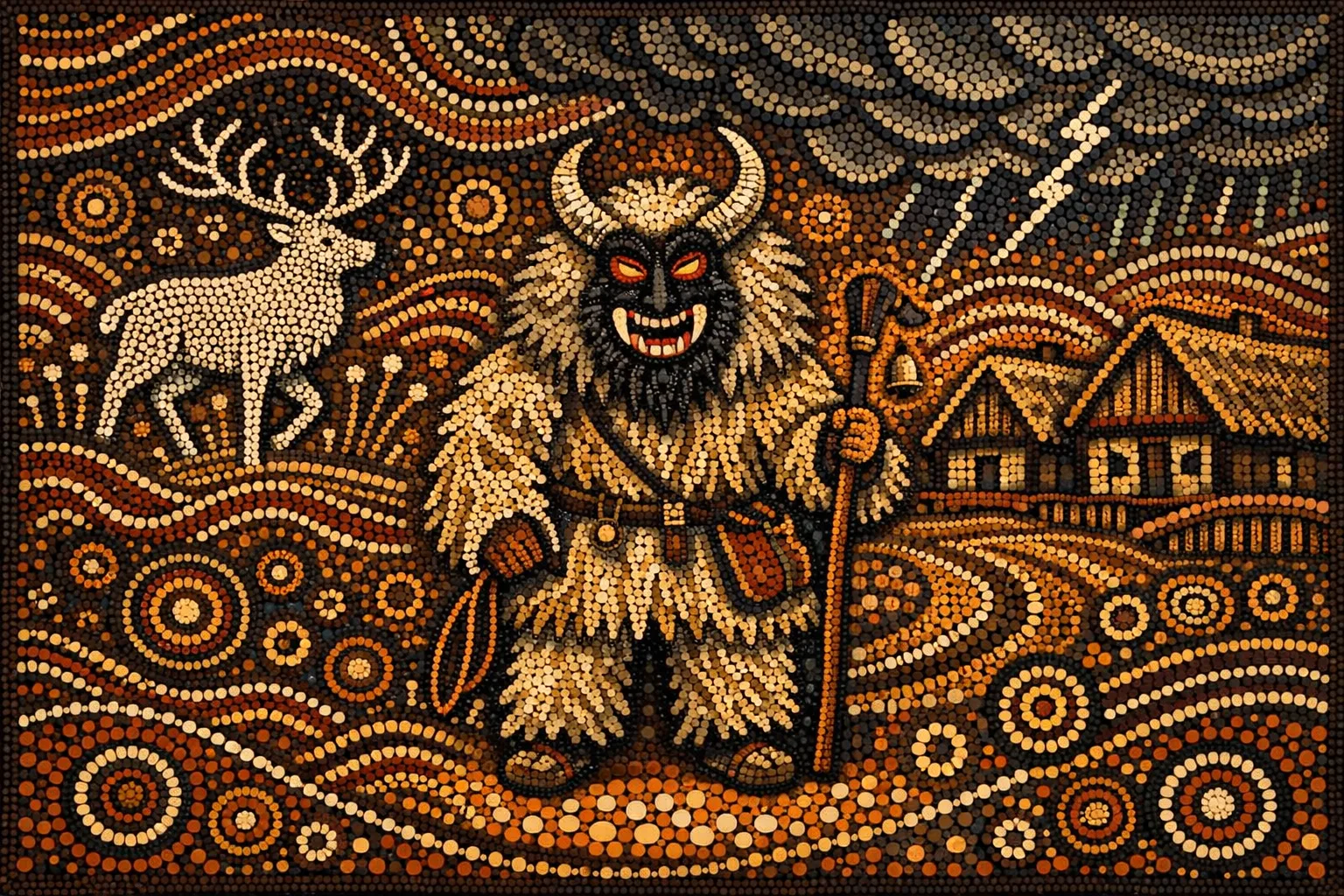
The most internationally visible Hungarian seasonal custom is the masked carnival at Mohács, recognised by UNESCO as the Busó festivities at Mohács: a masked end-of-winter carnival custom. It is a six-day event held in late winter, famous for carved masks, shaggy costumes, noise, processions, music and the symbolic expulsion of winter.[UNESCO Intangible Cultural Heritage]ich.unesco.orgOpen source on unesco.org.
The custom is often explained through a legend that masked locals frightened away Ottoman Turks. Another interpretation presents the masks as driving away winter itself. These two explanations show how folklore works in public heritage: a dramatic historical legend and a seasonal ritual reading can coexist, even when one may be older or more symbolically fitting than the other.[Wikipedia]WikipediaOpen source on wikipedia.org.
Mohács is also a reminder that Hungarian folklore is not only Hungarian-speaking in a narrow ethnic sense. The tradition is associated with the local Šokci Croatian community, and its UNESCO framing emphasises community identity as well as spectacle. That makes it a strong example of Hungary’s multicultural folk heritage rather than a simple national costume parade.[UNESCO Intangible Cultural Heritage]ich.unesco.org25926 EN.doc25926 EN.doc
Other living traditions are less obviously supernatural but still belong to the country’s folklore landscape. Matyó embroidery, recognised by UNESCO, is tied to a traditional community in and around Mezőkövesd and is used in dress, dance, singing and festive life. The Hungarian dance-house movement, recognised by UNESCO as a safeguarding practice, shows how collected village music and dance were revived in urban and national cultural life from the 1970s onwards.[unesco.org]ich.unesco.orgOpen source on unesco.org.
Where evidence lives: museums, archives and field collections
Hungarian folklore is unusually well supported by institutional collecting. The Museum of Ethnography in Budapest describes itself as a cultural space where past and present meet, and external museum listings describe its holdings as one of Hungary’s largest repositories of traditional folk-culture material, including objects, photographs, manuscripts, recordings and films.[neprajz.hu]neprajz.huOpen source on neprajz.hu.
The Hungarian Heritage House is especially important for living and recorded tradition. Its Folklore Documentation Library and Archives preserve folk music, folk dance and textual folklore collections from Hungarian-speaking territories and the wider Carpathian Basin. Its online database offers access to recordings, photographs, films and ethnographic data, searchable by collector, place, performer, location and genre.[Hagyományok Háza]hagyomanyokhaza.huOpen source on hagyomanyokhaza.hu.
This archival base matters because it helps separate evidence from internet folklore. A creature list on a blog may be entertaining, but stronger evidence comes from collected narratives, trial records, museum holdings, printed tale collections, performance documentation and peer-reviewed folklore research. Hungary has all of these, which is why its folklore can be discussed with more precision than a simple “myths and monsters” page suggests.[hagyomanyokhaza.hu]hagyomanyokhaza.huOpen source on hagyomanyokhaza.hu.
At the same time, archives do not freeze folklore. They preserve versions. A tale collected in the nineteenth century, a witch-trial testimony from the eighteenth century, a dance recorded in the twentieth century and a festival staged today are different kinds of evidence. Each tells us something, but none should be mistaken for the whole tradition.[ScholarWorks]scholarworks.iu.eduScholar Works00.02.05, Pocs, Between the Living and the Dead | The Medieval Review…
How Hungary understands its folklore today
Modern Hungary uses folklore in several ways at once. It is children’s culture, national heritage, local identity, academic evidence, tourism, stage performance and online fantasy inspiration. A visitor may meet it through Mohács masks, a folk dance performance, embroidery, a museum exhibition, an animated tale, or a reconstructed “ancient” spiritual image. Those encounters are not equal in age or evidential value, but all are part of the contemporary folklore ecosystem.[unesco.org]ich.unesco.orgOpen source on unesco.org.
The main misunderstanding is to imagine Hungarian folklore as a lost pagan religion that can be cleanly rebuilt. Scholars such as Éva Pócs have shown how tempting and risky that is. Motifs such as the world tree, the táltos and shamanic initiation have been important in Hungarian identity-making, but the evidence is fragmentary and has often been shaped by scholarly assumptions, nationalist desire and later reconstruction.[SciSpace]scispace.comSci Space The Hungarian Táltos and the Shamanism of PaganSci Space The Hungarian Táltos and the Shamanism of Pagan
A better reading is more rewarding. Hungarian folklore is a record of how people made sense of weather, sickness, luck, death, justice, ancestry, winter, danger and cleverness. Its beings are not just “monsters”; they are explanations and story-shapes. Its customs are not just colourful survivals; they are community performances that change as they are protected, staged and visited. Its tales are not just children’s entertainment; they are edited, illustrated and retold bridges between oral memory and modern culture.[iu.edu]scholarworks.iu.eduScholar Works00.02.05, Pocs, Between the Living and the Dead | The Medieval Review…
That is why Hungary’s folklore remains compelling. It has spectacular images, but its deeper interest lies in the tension between memory and invention: the miraculous stag as origin symbol, the táltos as both folk specialist and scholarly puzzle, the witch as neighbour, healer and accused outsider, the winter mask as local ritual and world heritage, and the folk tale as both village inheritance and national children’s classic.
Amazon book picks
Further Reading
Books and field guides related to What Makes Hungarian Folklore So Layered?. Use these as the next step if you want deeper reading beyond the article.
Myths and Symbols in Pagan Europe
Explains recurring motifs shared across European folk cultures.
The Golden Bough
Provides broad comparative folklore context for layered traditions and belief systems.
The Uses of Enchantment
Helps readers understand how folk narratives persist and evolve.
Folklore and Symbolism of Flowers, Plants and Trees
Supports understanding of symbolic traditions found in European folklore.
eBay marketplace picks
Marketplace Samples
Live-tested eBay searches with available results related to this page.
Endnotes
1.
Source: scispace.com
Title: Sci Space The Hungarian Táltos and the Shamanism of Pagan
Link:https://scispace.com/pdf/the-hungarian-[taltos
2.
Source: Wikipedia
Title: Hunor and Magor
Link:https://en.wikipedia.org/wiki/Hunor_and_Magor
3.
Source: ich.unesco.org
Link:https://ich.unesco.org/en/RL/buso-festivities-at-mohacs-masked-end-of-winter-carnival-custom-00252
4.
Source: real.mtak.hu
Title: Academy’s Library Repository
Link:https://real.mtak.hu/186074/1/07_Pocs_The_World_Tree_PDFA.pdf
5.
Source: eng.polgariszemle.hu
Link:https://eng.polgariszemle.hu/archive/148-vol-14-special-issue-2018/religious-policy-history-and-ideologies/930-taltos-witch-incubus-succubus-and-other-beings-in-hungarian-folklore-and-mythology
6.
Source: ojs.zrc-sazu.si
Link:https://ojs.zrc-sazu.si/sms/article/view/1829/1576
7.
Source: mek.oszk.hu
Link:https://mek.oszk.hu/02700/02790/html/176.html
8.
Source: researchgate.net
Title: 321367836 Witchcraft and Demonology in Hungary and Transylvania
Link:https://www.researchgate.net/publication/321367836_Witchcraft_and_Demonology_in_Hungary_and_Transylvania
9.
Source: Wikipedia
Title: Hungarian mythology
Link:https://en.wikipedia.org/wiki/Hungarian_mythology
10.
Source: archive.org
Link:https://archive.org/details/folktalesofmagya00joneuoft
11.
Source: researchgate.net
Link:https://www.researchgate.net/publication/363184678_Collections_of_Hungarian_Folk_Literature_from_the_19th_Century_and_Their_Canonisation
12.
Source: dailynewshungary.com
Title: Daily News Hungary Generations grew up on these Hungarian Folk tales
Link:https://dailynewshungary.com/generations-grew-up-on-these-hungarian-folk-tales-can-you-recognise-any-videos/
13.
Source: Wikipedia
Title: Elek Benedek
Link:https://en.wikipedia.org/wiki/Elek_Benedek
14.
Source: Wikipedia
Title: Hungarian Folk Tales
Link:https://en.wikipedia.org/wiki/Hungarian_Folk_Tales
15.
Source: ich.unesco.org
Link:https://ich.unesco.org/en/decisions/4.COM/13.42
16.
Source: szellemikulturalisorokseg.hu
Link:https://szellemikulturalisorokseg.hu/index0_en.php?name=en_0_busojaras_mohacson
17.
Source: Wikipedia
Link:https://en.wikipedia.org/wiki/Bus%C3%B3j%C3%A1r%C3%A1s
18.
Source: ich.unesco.org
Title: 25926 EN.doc
Link:https://ich.unesco.org/doc/src/25926-EN.doc
19.
Source: ich.unesco.org
Link:https://ich.unesco.org/en/RL/folk-art-of-the-matyo-embroidery-of-a-traditional-community-00633
20.
Source: szellemikulturalisorokseg.hu
Link:https://szellemikulturalisorokseg.hu/index0_en.php?name=en_0_matyo_viselet
21.
Source: museums.eu
Link:https://museums.eu/museum/details/1013
22.
Source: researchgate.net
Link:https://www.researchgate.net/publication/325340453_Taltos_Witch_Incubus_Succubus_and_Other_Beings_in_Hungarian_Folklore_and_Mythology
23.
Source: researchgate.net
Link:https://www.researchgate.net/publication/328115934_The_Hungarian_taltos_and_the_shamanism_of_pagan_Hungarians_Questions_and_hypotheses
24.
Source: researchgate.net
Title: 326883834 Hungarian shamanism material and history of research
Link:https://www.researchgate.net/publication/326883834_Hungarian_shamanism_material_and_history_of_research
25.
Source: Wikipedia
Title: Between the Living and the Dead
Link:https://en.wikipedia.org/wiki/Between_the_Living_and_the_Dead
26.
Source: ich.unesco.org
Link:https://ich.unesco.org/en/video/943
27.
Source: ich.unesco.org
Link:https://ich.unesco.org/en/video/10445
28.
Source: scispace.com
Link:https://scispace.com/pdf/witch-hunting-in-early-modern-hungary-58532hv7ty.pdf
29.
Source: archive.org
Title: selectedhungaria0000wass a4l5
Link:https://archive.org/details/selectedhungaria0000wass_a4l5
30.
Source: dailynewshungary.com
Title: mythical creatures hungarian culture
Link:https://dailynewshungary.com/mythical-creatures-hungarian-culture/
31.
Source: hagyomanyokhaza.hu
Link:https://hagyomanyokhaza.hu/en/archives
32.
Source: scholarworks.iu.edu
Title: Scholar Works
Link:https://scholarworks.iu.edu/journals/index.php/tmr/article/view/14867
Source snippet
00.02.05, Pocs, Between the Living and the Dead | The Medieval Review...
33.
Source: akjournals.com
Title: article p5.xml
Link:https://www.akjournals.com/view/journals/022/66/1/article-p5.xml
34.
Source: real.mtak.hu
Link:https://real.mtak.hu/78777/1/SzKristof_WitchHuntinginHungaryABCClio2004_u.pdf
35.
Source: neprajz.hu
Link:https://www.neprajz.hu/en/
36.
Source: akjournals.com
Title: article p483.xml
Link:https://www.akjournals.com/view/journals/022/64/2/article-p483.xml
37.
Source: hagyomanyokhaza.hu
Link:https://hagyomanyokhaza.hu/en/hsfe
38.
Source: facebook.com
Link:https://www.facebook.com/groups/2672410113084704/posts/4649208422071520/
39.
Source: hagyomanyokhaza.hu
Link:https://hagyomanyokhaza.hu/en
40.
Source: tripadvisor.com
Title: Hungarian Heritage House
Link:https://www.tripadvisor.com/Attraction_Review-g274887-d6756427-Reviews-Hungarian_Heritage_House-Budapest_Central_Hungary.html
41.
Source: fairy-folk-tale.fandom.com
Title: Hungarian tales
Link:https://fairy-folk-tale.fandom.com/wiki/Hungarian_tales
42.
Source: forage.com
Title: Éva Pócs
Link:https://forage.com/author/67831
43.
Source: journal.fi
Link:https://journal.fi/scripta/article/view/67026/27324
44.
Source: real.mtak.hu
Link:https://real.mtak.hu/91922/
45.
Source: czasopisma.ignatianum.edu.pl
Link:https://czasopisma.ignatianum.edu.pl/rfi/article/download/2025.3104.19/3328
46.
Source: hungarianconservative.com
Title: the day of hungarian folk tales
Link:https://www.hungarianconservative.com/articles/culture_society/the-day-of-hungarian-folk-tales/
Additional References
47.
Source: youtube.com
Title: Drum Circle
Link:https://www.youtube.com/watch?v=2n632OwCrOA
Source snippet
This video provides an exploration of the traditional beliefs, shamanistic practices, and ritual music associated with the Táltos figures...
48.
Source: youtube.com
Title: Hungary’s Wildest Carnival (Walking Documentary) Mohácsi busójárás
Link:https://www.youtube.com/watch?v=KXNik1Rp6dk
Source snippet
Hungarian Folk Tales compilation - Season 1...
49.
Source: youtube.com
Title: What Is Happening In Hungary? Busójárás Mohács
Link:https://www.youtube.com/watch?v=KwxE-HcyiV0
Source snippet
Hungary's Wildest Carnival (Walking Documentary) Mohácsi busójárás...
50.
Source: youtube.com
Title: Mythical Creatures and Monsters of Hungarian Folklore
Link:https://www.youtube.com/watch?v=YALjN8bL3wQ
Source snippet
What Is Happening In Hungary? Busójárás Mohács...
51.
Source: tumblr.com
Link:https://www.tumblr.com/abs0luteb4stard/124427580251/csodaszarvas-miraculous-stag-or-wondrous-stag-a
52.
Source: academia.edu
Link:https://www.academia.edu/39531457/48_The_Miracle_Stag
53.
Source: academia.edu
Link:https://www.academia.edu/35545818/Healers_in_Hungarian_Witch_Trials
54.
Source: academia.edu
Link:https://www.academia.edu/126520178/T%C3%A1ltos_Witch_Incubus_Succubus_and_Other_Beings_in_Hungarian_Folklore_and_Mythology
55.
Source: facebook.com
Link:https://www.facebook.com/groups/487740025630735/posts/1236282327443164/
56.
Source: facebook.com
Link:https://www.facebook.com/groups/378461198187137/posts/569424005757521/
Topic Tree
Follow this branch
Related pages 192
- Afghan Folklore
- Albanian Folklore
- Algerian Folklore
- Australian Folklore
- Azerbaijan Folklore
- +187 more in sidebar