Why Belgian Folklore Lives in Public
Belgian folklore is not one single mythology with one national monster or founding epic. It is a layered country of local legends, saints’ processions, carnival figures, giant animals, witch traditions, puppet theatres, river spirits and regional storytelling.
Page outline Jump by section
Introduction
Belgium’s legendary imagination is especially strong in three areas: giants and processions, carnival and ritual inversion, and local supernatural beings. Antwerp has its giant trickster Lange Wapper and its hand-throwing giant Antigoon; Dendermonde has the great horse Bayard; Vielsalm has its witch-like figures from the Ardennes; Binche has the masked Gilles; Bruges has a medieval sacred procession built around a relic tradition. Some of these are old oral or religious customs, some are antiquarian or literary retellings, and some are modern heritage performances based on older motifs. The result is a folklore culture that is vivid, public, regional and often proudly local.
Why Belgian folklore feels regional rather than national
Belgium became an independent state only in 1830, but many of its legends, feast customs and sacred processions belong to older regions: Flanders, Brabant, Hainaut, Liège, Limburg, Wallonia and the Ardennes. This matters because a “Belgian” legend often has a very specific home. Lange Wapper is closely tied to Antwerp; the Ros Beiaard belongs above all to Dendermonde; the Gilles are inseparable from Binche; the Macralles are part of the folklore landscape of Vielsalm and the Salm valley. National folklore in Belgium is therefore best understood as a mosaic of local traditions rather than a single unified pantheon.
Language also shapes the folklore map. Flemish traditions share much with Dutch-speaking Low Countries culture: giants, water spirits, prankster beings, saintly gift-bringers, carnival satire and civic processions. Walloon traditions, especially in the Ardennes, draw on French-speaking rural storytelling, witch legends, saints, forest landscapes, caves, streams and small supernatural beings. An English-language collection such as William Elliot Griffis’s Belgian Fairy Tales, published in 1919, already framed Belgium through a north-south contrast between Flemish-speaking regions and Walloon areas, although modern readers should treat such older collections as literary retellings rather than transparent transcripts of oral tradition.[gutenberg.org]gutenberg.orgOpen source on gutenberg.org.
This regional quality gives Belgian folklore much of its charm. A visitor does not encounter “Belgian mythology” in the abstract; they meet it in a town square, a procession route, a masked carnival, a local museum, a dialect performance, a carved giant or a story attached to a bridge, river or church. Belgium’s official tourism and heritage bodies repeatedly present folklore through public events, processions and living heritage rather than through a single national myth cycle.[belgium.be]belgium.beat a glanceat a glance
Giants, horses and dragons: Belgium’s most visible folklore
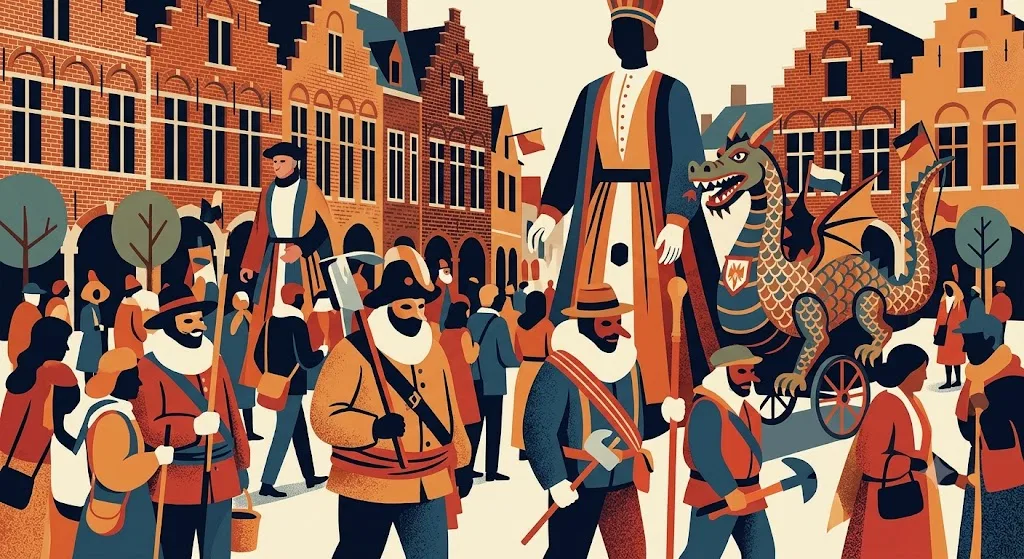
Belgium’s most internationally recognised folklore is not hidden in haunted forests; it towers over crowds. The tradition of processional giants and dragons in Belgium and France is recognised by UNESCO and includes Belgian examples such as St George fighting the dragon in Mons and the horse Bayard in Dendermonde. These figures are not simply parade props. They are civic emblems, carried, guarded, repaired, narrated and celebrated by communities that identify with them across generations.[Intangible Cultural Heritage]ich.unesco.orgGeorge fighting the dragon is staged in Mons; Bayard, the horse from the Charlemagne legend, parades in Dendermonde; and Reuze Papa and R…
The Ros Beiaard of Dendermonde is one of the strongest examples. It is a gigantic wooden horse connected to the medieval legend of the Four Sons of Aymon and the horse Bayard. In Dendermonde, the horse is not an annual attraction but a rare event: it is paraded only once every ten years, which gives the tradition unusual emotional weight. Visit Flanders describes the horse as the city’s symbol, and Flemish heritage material stresses the role of local bearers, school projects and intergenerational transmission in keeping the tradition alive.[visitflanders.com]visitflanders.comOpen source on visitflanders.com.
Antwerp’s giant tradition is more story-like and urban. The best-known Antwerp legend is Antigoon, the giant said to have demanded tolls from those crossing the river Scheldt and to have cut off the hands of those who refused. In the popular explanation of the city’s name, the hero Brabo defeats Antigoon and throws the giant’s hand into the river. Linguists treat this as folklore rather than secure etymology, but as civic myth it is powerful: the severed hand appears in Antwerp’s symbolic landscape, including the Brabo Fountain in the city’s central square.
A different Antwerp figure, Lange Wapper, belongs to the night-time city of alleys, drink, fear and tricks. He is usually described as a giant or shapeshifting trickster who can grow tall, shrink, imitate people or frighten drunkards. Online retellings often make him sound like a monster, but older folk tradition presents him more ambiguously: not merely evil, but mischievous, punitive and socially disruptive. He belongs to the same broad European family as trickster giants, bogeys and warning figures used to explain danger, shame, drunkenness or night wandering.[Wikipedia]WikipediaLange WapperLange Wapper
Carnival turns fear into performance
Carnival is one of the main reasons Belgian folklore remains visible to people who may never open a folktale collection. Carnival allows towns to turn masks, mockery, grotesque bodies, seasonal change and social tension into public theatre. It is festive, but it is not trivial: it decides who belongs, who may perform, what can be mocked, and how far satire can go.
The Carnival of Binche is the most famous Belgian example. UNESCO describes it as one of Europe’s oldest surviving street carnivals, with roots in the Middle Ages. Its central figures are the Gilles, men in elaborate costumes and masks who appear in tightly controlled ritual circumstances. Their oranges, bells, wax masks and ostrich-feather hats are often the images people remember first, but the deeper point is local continuity: the carnival is embedded in Binche’s social fabric, with participation governed by custom and community recognition.[Intangible Cultural Heritage]ich.unesco.orgIntangible Cultural HeritageCarnival of BincheWith roots dating back to the Middle Ages, Binche's famed celebration ranks as one of Europ…
Carnival also shows that folklore is not automatically harmless. The Aalst Carnival was added to UNESCO’s Representative List in 2010 but removed in 2019 after the recurrence of racist and antisemitic representations. UNESCO stated that such representations were incompatible with the principles of the 2003 Convention for the Safeguarding of the Intangible Cultural Heritage. This is an important modern lesson for Belgian folklore as a whole: living tradition is not frozen in a romantic past. It is debated, defended, criticised, changed and sometimes formally rejected.[UNESCO]unesco.orgaalst carnival removed representative list intangible cultural heritage humanityaalst carnival removed representative list intangible cultural heritage humanity
That tension is part of carnival’s nature. Belgian carnival often claims the right to ridicule power, reverse social order and mock solemnity. But the Aalst case shows the difference between satire as civic irreverence and imagery that reproduces dehumanising stereotypes. For readers, it is a useful reminder that “folk tradition” is not a guarantee of innocence; it is a form of cultural power.
Sacred processions and folk religion
Belgian folklore cannot be separated from Catholic ritual. Many traditions that now attract tourists and heritage attention began as religious processions, relic displays, saints’ days or penitential acts. Over time, they gathered civic pride, theatre, costumes, music, guild participation and local legend around them.
The Procession of the Holy Blood in Bruges is a major example. UNESCO describes a procession led by the Brotherhood of the Holy Blood, with more than 1,700 citizens participating on foot, in carts or on horseback. The official procession website traces the tradition to 1304 and presents it as a continuing event of faith, culture and connection. Its centre is a relic believed by devotees to contain the blood of Christ; its public form combines biblical scenes, local history, civic participation and solemn religious devotion.[unesco.org]ich.unesco.orgIntangible Cultural HeritageProcession of the Holy Blood in BrugesLed by the thirty city notables of the Brotherhood of the Holy Blood an…
Brussels has its own sacred-civic layering in the Ommegang. The word originally refers to a procession going “around” a parish with relics and devotional objects, but in Brussels it developed into a major historical pageant. Visit Brussels describes the modern Ommegang as a re-enactment of the 1549 procession in honour of Charles V, with more than 1,400 performers; the city also explains that such processions could shift from religious display into social and political theatre.[Visit Brussels]visit.brusselsevent detail.Ommegang 2026.370148event detail.Ommegang 2026.370148
The Meyboom in Brussels shows a more playful side of civic ritual. The tradition centres on planting a tree before a fixed deadline on 9 August, with a legendary rivalry between Brussels and Leuven over the right to do so. Brussels regional sources date the custom to the early thirteenth century and note its UNESCO-recognised intangible heritage status. Here the mythic charge is not a ghost or monster but a civic wager: plant the tree in time, and the city keeps its privilege.[Visit Brussels]visit.brusselsOpen source on visit.brussels.

Witches, Macralles and the Ardennes imagination
Wallonia and the Ardennes add a darker, more forested texture to Belgian folklore. The region’s hills, streams, caves and wooded valleys have encouraged tales of witches, fairies, hidden beings and uncanny places. These stories are often local, dialectal and tied to festivals or village identity rather than to a single national canon.
The Macralles of Vielsalm are among the clearest modern examples. In local Walloon usage, Macralles are witch-like figures. Tourism and local heritage sources describe the Macralles du Val de Salm as a folklore group founded in 1955, while also linking the performance to older local witch legend, especially the figure of Gustine Maka. Each year around 20 July, the Macralles gather for a staged Sabbath, using Walloon dialect, humour and local anecdote, and then appear in procession during the Blueberry Festival.[Haute Ardenne]haute-ardenne.beOpen source on haute-ardenne.be.
This distinction matters. The Macralles are not simply “ancient witches still worshipped in the Ardennes”, as a sensational version might claim. They are a modern folklore performance built from older motifs: witch belief, local legend, dialect theatre, rural festivity and community satire. That makes them more interesting, not less. They show how a region can transform feared figures into comic, theatrical guardians of local identity.
Walloon witch folklore also remembers the violence of real witch persecution. Visit Wallonia’s page on the Tchesse aux Macrales in Ermeton connects the event to sixteenth-century witch trials and says the modern re-enactment treats that harsh history with humour while highlighting its cruelty. This is a common pattern in European folk culture: frightening beliefs become seasonal theatre, but the historical memory behind them may involve accusation, punishment and social fear.[Visit Wallonia]visitwallonia.comOpen source on visitwallonia.com.
Water spirits, night beings and smaller supernatural creatures
Not all Belgian folklore is spectacular. Much of it belongs to ditches, rivers, farms, bridges, coastlines and night roads. Flemish and Walloon traditions include water spirits, shape-shifters, nightmare beings, small underground or cave-dwelling creatures, and local bogeys used to warn children or explain danger.
In Flemish material, water spirits and shapeshifting beings often appear in rural settings: canals, farm ditches, marshy places and the flat watery landscape of Flanders. Modern retellings of Flemish folktales include nixie-like creatures appearing as animals or lights, a pattern found across northern European folklore. These beings do not always behave like fairies in a romantic sense. They may lure, frighten, punish or test people who enter unsafe places at night.[Signe Maene]signemaene.comOpen source on signemaene.com.
The Kludde, often described as a demonic dog-like or shapeshifting water creature, is another Low Countries figure associated with Belgium and the Netherlands. It is usually said to haunt lonely roads, bridges or water edges, sometimes with chains or blue flames. The evidence for such beings is scattered across folklore compilations and modern retellings, so they should be handled as regional supernatural motifs rather than as a single standardised “Belgian monster”.[Myth and Folklore]mythus.fandom.comMyth and Folklore KluddeMyth and Folklore Kludde
Walloon tradition has its own small beings, often linked to caves, underground spaces and rocky landscapes. Folklore summaries of the Low Countries describe Walloon nuton-like figures as related to the broader European family of elves, dwarfs or household spirits, but adapted to the Ardennes terrain of caverns and tunnels. Such creatures remind us that Belgian folklore often grows from landscape: the coast gives ghost ships and sea witches, the polders give watery bogeys, the Ardennes gives caves, witches and hidden folk.[Wikipedia]WikipediaFolklore of the Low CountriesFolklore of the Low Countries

Folk tales in books: useful, but not the whole tradition
Readers often meet Belgian folklore through English-language fairy-tale books, but these sources need careful handling. William Elliot Griffis’s Belgian Fairy Tales is freely available through Project Gutenberg and the Internet Archive, and it helped introduce Belgian stories to English-speaking readers. Yet it was published in 1919 by an American author writing in a literary fairy-tale mode. It is valuable as reception history and as a readable early collection, but it should not be mistaken for an untouched record of oral performance.[gutenberg.org]gutenberg.orgOpen source on gutenberg.org.
Jean de Bosschère, a Belgian artist and writer, also helped bring Flemish stories to a wider literary audience in the early twentieth century. Modern folklore sites and publishers continue to retell Flemish tales, sometimes emphasising witches, ghosts, shapeshifters and morally ambiguous monsters. These retellings keep stories alive, but they also reshape them for new readers: darker, more atmospheric, more feminist, more Gothic or more marketable than older variants may have been.[fairytalez.com]fairytalez.comBelgian Folk Tales & Folklore: 11 Stories Read 11 Belgian folk tales freeBelgian Folk Tales & Folklore: 11 Stories Read 11 Belgian folk tales free
The important distinction is between oral tradition, literary retelling and heritage performance. A fireside tale about a water spirit, a 1919 fairy-tale book, a UNESCO-recognised procession and a modern tourist witch festival are all part of Belgian folklore culture, but they are not the same kind of evidence. Good interpretation asks what form the tradition takes, who performs or retells it, and what purpose it serves now.
Museums, archives and living heritage
Belgium has strong institutions for preserving and interpreting popular culture. The Musée International du Carnaval et du Masque in Binche presents Belgian carnivals and festivals through costumes, masks, accessories, iconographic documents and written archives. Its Binche Carnival material is especially important because it links a famous living tradition to a documented collection of masks and ritual objects.[Mumask]mumask.bebelgian carnivals and folklorebelgian carnivals and folklore
In Flanders, intangible heritage policy has placed emphasis on identifying, documenting and transmitting living practices. Flemish policy documents discuss inventories, community involvement and education, including projects around the Ros Beiaard that bring schools, local artists, associations and heritage organisations into the process of transmission. This is folklore treated not as quaint entertainment, but as a living practice requiring skills, memory, organisation and future planning.[Immaterieel Erfgoed Vlaanderen]immaterieelerfgoed.beOpen source on immaterieelerfgoed.be.
Brussels also treats folklore as living urban heritage. Its recognised traditions include the Ommegang and Meyboom, and recent reporting has highlighted efforts to seek UNESCO recognition for Brussels rod puppetry and the Grand-Place flower carpet. The rod puppetry tradition, associated with Theatre Toone, shows another Belgian folklore pathway: not a monster or a saint, but popular theatre, comic performance and urban memory preserved through repertoire and craft.[Reuters]reuters.comBrussels seeks UNESCO heritage mark for puppetry, flower carpetBrussels seeks UNESCO heritage mark for puppetry, flower carpet
How Belgian folklore is understood today
Modern Belgian folklore sits between pride, tourism, scholarship and debate. Towns use traditions to express identity; museums preserve costumes and masks; tourism bodies promote processions and festivals; UNESCO recognition brings international prestige; and communities argue over authenticity, inclusion, humour and change.
The most useful way to read Belgian folklore today is not to ask whether every legend is “true”. The better questions are: who tells the story, where, when, and why? Lange Wapper tells us about Antwerp’s urban imagination and night-time moral tales. The Ros Beiaard tells us how a city can bind itself to a medieval heroic legend. The Gilles of Binche show how strict ritual, costume and local honour can survive in a modern carnival. The Macralles show how witch fear can become comic regional theatre. The Holy Blood procession shows how medieval relic devotion can remain a living public ceremony.
Belgium’s folklore is therefore unusually public. It is not only in books of fairy tales, though those matter. It is carried on shoulders, planted before a deadline, danced through streets, staged in dialect, argued over in heritage committees, photographed by tourists and taught to children before the next procession comes round. That is why Belgian folklore still feels alive: it is local memory performed in front of everyone.
Amazon book picks
Further Reading
Books and field guides related to Why Belgian Folklore Lives in Public. Use these as the next step if you want deeper reading beyond the article.
The Lore of the Land
Useful comparative framework for European local folklore traditions.
The Oxford Companion to World Mythology
Provides background on recurring folklore themes and traditions.

eBay marketplace picks
Marketplace Samples
Live-tested eBay searches with available results related to this page.
Endnotes
1.
Source: belgium.be
Title: at a glance
Link:https://www.belgium.be/sites/default/files/downloads/belgium_at_a_glance.pdf
Source snippet
Belgium at a glanceApril 25, 2012 — traditions and folklore such as the Procession of the Holy Blood in Bruges... sion in Bruges, the A...
Published: April 25, 2012
2.
Source: ich.unesco.org
Link:https://ich.unesco.org/en/RL/carnival-of-binche-00033
Source snippet
Intangible Cultural HeritageCarnival of BincheWith roots dating back to the Middle Ages, Binche's famed celebration ranks as one of Europ...
3.
Source: ich.unesco.org
Link:https://ich.unesco.org/en/RL/procession-of-the-holy-blood-in-bruges-00263
Source snippet
Intangible Cultural HeritageProcession of the Holy Blood in BrugesLed by the thirty city notables of the Brotherhood of the Holy Blood an...
4.
Source: ich.unesco.org
Link:https://ich.unesco.org/en/RL/processional-giants-and-dragons-in-belgium-and-france-00153
Source snippet
George fighting the dragon is staged in Mons; Bayard, the horse from the Charlemagne legend, parades in Dendermonde; and Reuze Papa and R...
5.
Source: gutenberg.org
Link:https://www.gutenberg.org/files/67256/67256-h/67256-h.htm
6.
Source: archive.org
Link:https://archive.org/details/belgianfairytale00grifiala
7.
Source: belgium.be
Title: at a glance
Link:https://www.belgium.be/sites/default/files/Brochure_2022_Anglais_web.pdf
8.
Source: visit.brussels
Link:https://www.visit.brussels/en/visitors/what-to-do/unesco-heritage-in-brussels/intangible-heritage
9.
Source: Wikipedia
Title: Lange Wapper
Link:https://en.wikipedia.org/wiki/Lange_Wapper
10.
Source: mumask.be
Title: carnival in binche
Link:https://mumask.be/en/carnival-in-binche/
11.
Source: unesco.org
Title: aalst carnival removed representative list intangible cultural heritage humanity
Link:https://www.unesco.org/en/articles/aalst-carnival-removed-representative-list-intangible-cultural-heritage-humanity
12.
Source: unesco.org
Title: document 317
Link:https://www.unesco.org/archives/multimedia/document-317
13.
Source: visit.brussels
Title: event detail.Ommegang 2026.370148
Link:https://www.visit.brussels/en/visitors/agenda/event-detail.Ommegang-2026.370148
14.
Source: visit.brussels
Title: brussels folklore and heritage
Link:https://www.visit.brussels/en/visitors/agenda/brussels-folklore-and-heritage
15.
Source: haute-ardenne.be
Link:https://www.haute-ardenne.be/en/explore/folklore-and-legends?id=ALD-01-08H4-0LNF
16.
Source: Wikipedia
Title: Folklore of the Low Countries
Link:https://en.wikipedia.org/wiki/Folklore_of_the_Low_Countries
17.
Source: gutenberg.org
Link:https://www.gutenberg.org/ebooks/67256
18.
Source: fairytalez.com
Title: Belgian Folk Tales & Folklore: 11 Stories Read 11 Belgian folk tales free
Link:https://fairytalez.com/region/belgian/
19.
Source: mumask.be
Title: belgian carnivals and folklore
Link:https://mumask.be/en/belgian-carnivals-and-folklore/
20.
Source: reuters.com
Title: Brussels seeks UNESCO heritage mark for puppetry, flower carpet
Link:https://www.reuters.com/lifestyle/brussels-seeks-unesco-heritage-mark-puppetry-flower-carpet-2024-04-02/
21.
Source: ich.unesco.org
Title: belgium BE
Link:https://ich.unesco.org/en-state/belgium-BE?info=activities-with-the-patronage
22.
Source: ich.unesco.org
Title: belgium BE
Link:https://ich.unesco.org/en/state/belgium-BE?call=film&id=48629&include=film_inc.php&width=700
23.
Source: ich.unesco.org
Title: aalst carnival 00402
Link:https://ich.unesco.org/en/RL/aalst-carnival-00402
24.
Source: ich.unesco.org
Title: belgium BE
Link:https://ich.unesco.org/en/state/belgium-BE?info=elements-on-the-lists
25.
Source: ich.unesco.org
Link:https://ich.unesco.org/en/video/1059
26.
Source: ich.unesco.org
Link:https://ich.unesco.org/en/decisions/4.COM/13.04
27.
Source: ich.unesco.org
Title: 42915 EN.docx
Link:https://ich.unesco.org/doc/src/42915-EN.docx
28.
Source: ich.unesco.org
Title: 14.COM 1.BUR
Link:https://ich.unesco.org/en/decisions-bureau/14.COM%201.BUR/4
29.
Source: ich.unesco.org
Title: 26284 EN.doc
Link:https://ich.unesco.org/doc/src/26284-EN.doc
30.
Source: ich.unesco.org
Link:https://ich.unesco.org/en/Decisions/14.COM/10.b.4
31.
Source: Wikipedia
Title: Ros Beiaard (Dendermonde)
Link:https://en.wikipedia.org/wiki/Ros_Beiaard_%28Dendermonde%29
32.
Source: Wikipedia
Title: Folklore of Belgium
Link:https://en.wikipedia.org/wiki/Folklore_of_Belgium
33.
Source: Wikipedia
Title: Carnival of Binche
Link:https://en.wikipedia.org/wiki/Carnival_of_Binche
34.
Source: Wikipedia
Title: Carnival of Aalst
Link:https://en.wikipedia.org/wiki/Carnival_of_Aalst
35.
Source: Wikipedia
Title: Procession of the Holy Blood
Link:https://en.wikipedia.org/wiki/Procession_of_the_Holy_Blood
36.
Source: visit.brussels
Link:https://www.visit.brussels/en/visitors/agenda/event-highlights.Marni-Jazz-Festival.592218
37.
Source: visit.brussels
Title: event highlights.Nayad Festival d art de rue Straatkunstenfestival.5700021476
Link:https://www.visit.brussels/en/visitors/agenda/event-highlights.Nayad-Festival-d-art-de-rue-Straatkunstenfestival.5700021476
38.
Source: visit.brussels
Link:https://www.visit.brussels/it/visitatori/agenda/event-highlights.Artisanal-Intelligence.5700023129
39.
Source: visit.brussels
Link:https://www.visit.brussels/en/visitors.Orchestre-du-Festival-Shirly-Laub.593279
40.
Source: visit.brussels
Link:https://www.visit.brussels/en/press
41.
Source: visit.brussels
Link:https://www.visit.brussels/en/professionals/partners/the-visit.brussels-ticketing-services.brussels-ticketing-services.brussels-ticketing-services
42.
Source: visit.brussels
Title: event detail.Ommegang 2026.370148
Link:https://www.visit.brussels/fr/visiteurs/agenda/event-detail.Ommegang-2026.370148
43.
Source: gutenberg.org
Link:https://www.gutenberg.org/ebooks/subject/37366
44.
Source: gutenberg.org
Link:https://www.gutenberg.org/ebooks/author/2568
45.
Source: youtube.com
Title: Processional Giants and Dragons in Belgium and France
Link:https://www.youtube.com/watch?v=8SbvmiyhEws
Source snippet
Wikipedia...
46.
Source: youtube.com
Title: Belgium’s Binche carnival kicks off with flying oranges
Link:https://www.youtube.com/watch?v=vfORfJj6eBc
Source snippet
Wikipedia...
47.
Source: be.brussels
Link:https://be.brussels/en/leisure-events-sports/cultural-activities/brussels-folklore/meyboom
48.
Source: visitflanders.com
Link:https://www.visitflanders.com/en/flemish-destinations/dendermonde
49.
Source: visitflanders.com
Title: flanders immaterial cultural heritage always impressive
Link:https://www.visitflanders.com/en/stories/flanders-immaterial-cultural-heritage-always-impressive
50.
Source: immaterieelerfgoed.be
Title: unesco rapport concept ontwerp terugkoppeling
Link:https://immaterieelerfgoed.be/files/attachments/.2128/unesco-rapport-concept-ontwerp-terugkoppeling.pdf
51.
Source: immaterieelerfgoed.be
Link:https://immaterieelerfgoed.be/files/attachments/.679/Beleid_Vlaamseoverheid.pdf
52.
Source: signemaene.com
Link:https://signemaene.com/category/belgian-folklore/
53.
Source: theguardian.com
Title: unesco removes racist belgian carnival aalst from heritage list
Link:https://www.theguardian.com/world/2019/dec/13/unesco-removes-racist-belgian-carnival-aalst-from-heritage-list
54.
Source: visitwallonia.com
Link:https://visitwallonia.com/en-gb/content/macralles-sabbath-vielsalm
55.
Source: visitwallonia.com
Link:https://visitwallonia.com/en-gb/content/tchesse-aux-macrales-or-witch-hunt-ermeton
56.
Source: mythus.fandom.com
Title: Myth and Folklore Kludde
Link:https://mythus.fandom.com/wiki/Kludde
57.
Source: signemaene.com
Link:https://signemaene.com/flemish-folktales-retold/
58.
Source: immaterieelerfgoed.be
Link:https://immaterieelerfgoed.be/files/attachments/.680/Visienota_immaterieel_erfgoedbeleid.pdf
59.
Source: immaterieelerfgoed.be
Link:https://immaterieelerfgoed.be/nl/erfgoederen/De-ludieke-vete-tussen-Aalst-en-Dendermonde
60.
Source: immaterieelerfgoed.be
Link:https://immaterieelerfgoed.be/files/attachments/.5401/poetic-harvest-Rethinking-Folklore.pdf
61.
Source: immaterieelerfgoed.be
Link:https://immaterieelerfgoed.be/nl/erfgoederen/alles-es-just-van-lokale-volksheld-tot-verbindend-erfgoedfestival
62.
Source: visitflanders.com
Link:https://www.visitflanders.com/en/flemish-destinations
63.
Source: visitflanders.com
Link:https://www.visitflanders.com/nl/bestemmingen-vlaanderen/dendermonde
64.
Source: visitflanders.com
Title: vlaanderens immaterieel cultureel erfgoed altijd indrukwekkend
Link:https://www.visitflanders.com/nl/verhalen/vlaanderens-immaterieel-cultureel-erfgoed-altijd-indrukwekkend
65.
Source: visitflanders.com
Title: il patrimonio culturale immateriale delle fiandre
Link:https://www.visitflanders.com/it/storie/il-patrimonio-culturale-immateriale-delle-fiandre
66.
Source: visitflanders.com
Link:https://www.visitflanders.com/nl/bestemmingen-vlaanderen
67.
Source: visitflanders.com
Title: flanderns immaterielles kulturerbe immer wieder beeindruckend
Link:https://www.visitflanders.com/de/geschichten/flanderns-immaterielles-kulturerbe-immer-wieder-beeindruckend
68.
Source: visitflanders.com
Title: le patrimoine culturel immateriel flamand un ravissement permanent
Link:https://www.visitflanders.com/fr/histoires/le-patrimoine-culturel-immateriel-flamand-un-ravissement-permanent
69.
Source: visitwallonia.com
Link:https://visitwallonia.com/en-gb/content/binche-carnival-and-its-folkloric-gilles
70.
Source: abookofcreatures.com
Link:https://abookofcreatures.com/category/belgium/
71.
Source: youtube.com
Link:https://www.youtube.com/watch?v=KQJfBbNmDL4
72.
Source: fairy-folk-tale.fandom.com
Title: Flemish tales
Link:https://fairy-folk-tale.fandom.com/wiki/Flemish_tales
73.
Source: signemaene.com
Title: faeries and snakes
Link:https://signemaene.com/2023/03/17/faeries-and-snakes/
74.
Source: press.visitbruges.be
Title: procession of the holy blood
Link:https://press.visitbruges.be/en/experiencing-bruges/storylines/unesco-world-heritage/procession-of-the-holy-blood
Additional References
75.
Source: youtube.com
Title: Medieval Jousting Thrills Crowds At Brussels’ Ommegang Festival
Link:https://www.youtube.com/watch?v=sBM80SEfTEE
Source snippet
Belgium's Binche carnival kicks off with flying oranges...
76.
Source: instagram.com
Link:https://www.instagram.com/p/DXhoHCvme4n/
77.
Source: reddit.com
Link:https://www.reddit.com/r/belgium/comments/1dteng8/are_there_spookywitchyfolklore_towns_or_places_in/
78.
Source: booktokapp.com
Link:https://booktokapp.com/belgian-fairy-tales-william-elliot-griffis-b90ce2d2-e8d8-41a6-a504-247490101fa3
79.
Source: facebook.com
Link:https://www.facebook.com/thebulletinmagazine/posts/belgiums-most-illustrious-carnival-tradition-binche-also-enjoys-unesco-recogniti/1488545109946580/
80.
Source: facebook.com
Link:https://www.facebook.com/visitflanders/posts/the-procession-of-the-holy-blood-is-one-of-bruges-proud-traditions-the-large-pro/624325609725692/
81.
Source: visiteurope.com
Link:https://visiteurope.com/event/carnival-binche
82.
Source: amazon.nl
Link:https://www.amazon.nl/-/en/Signe-Maene/dp/9464988398?tag=searcht-20
83.
Source: tumblr.com
Link:https://www.tumblr.com/bestiarium/tagged/Flemish%20mythology
84.
Source: bloedprocessiebrugge.be
Link:https://www.bloedprocessiebrugge.be/en/i-am/visitor/
Topic Tree
Follow this branch
Related pages 192
- Afghan Folklore
- Albanian Folklore
- Algerian Folklore
- Australian Folklore
- Azerbaijan Folklore
- +187 more in sidebar