Where Lebanon's Legends Meet the Landscape
Lebanon’s folklore is not a single neat mythology but a layered story-world: ancient river myths, sacred mountains and trees, spirits and protective saints, sung poetry, village tales, coffeehouse storytelling, and modern urban retellings all sit beside one another.
Page outline Jump by section
Introduction
The evidence is uneven. Some Lebanese traditions are ancient and textually well attested, especially the Adonis myth around Byblos and Afqa. Others survive mainly as oral practice, family memory, community ritual, or modern heritage work. UNESCO’s work in Lebanon is useful here because it treats living heritage as something transmitted and remade, not as a frozen museum category; its Lebanon material highlights shared practices such as sung poetry, dance, cuisine, crafts and storytelling as part of a diverse national inheritance.[UNESCO]unesco.orgIntangible cultural heritage: a wealth disseminated by UNESCOIntangible cultural heritage: a wealth disseminated by UNESCO
The Adonis River: Lebanon’s best-known mythic landscape
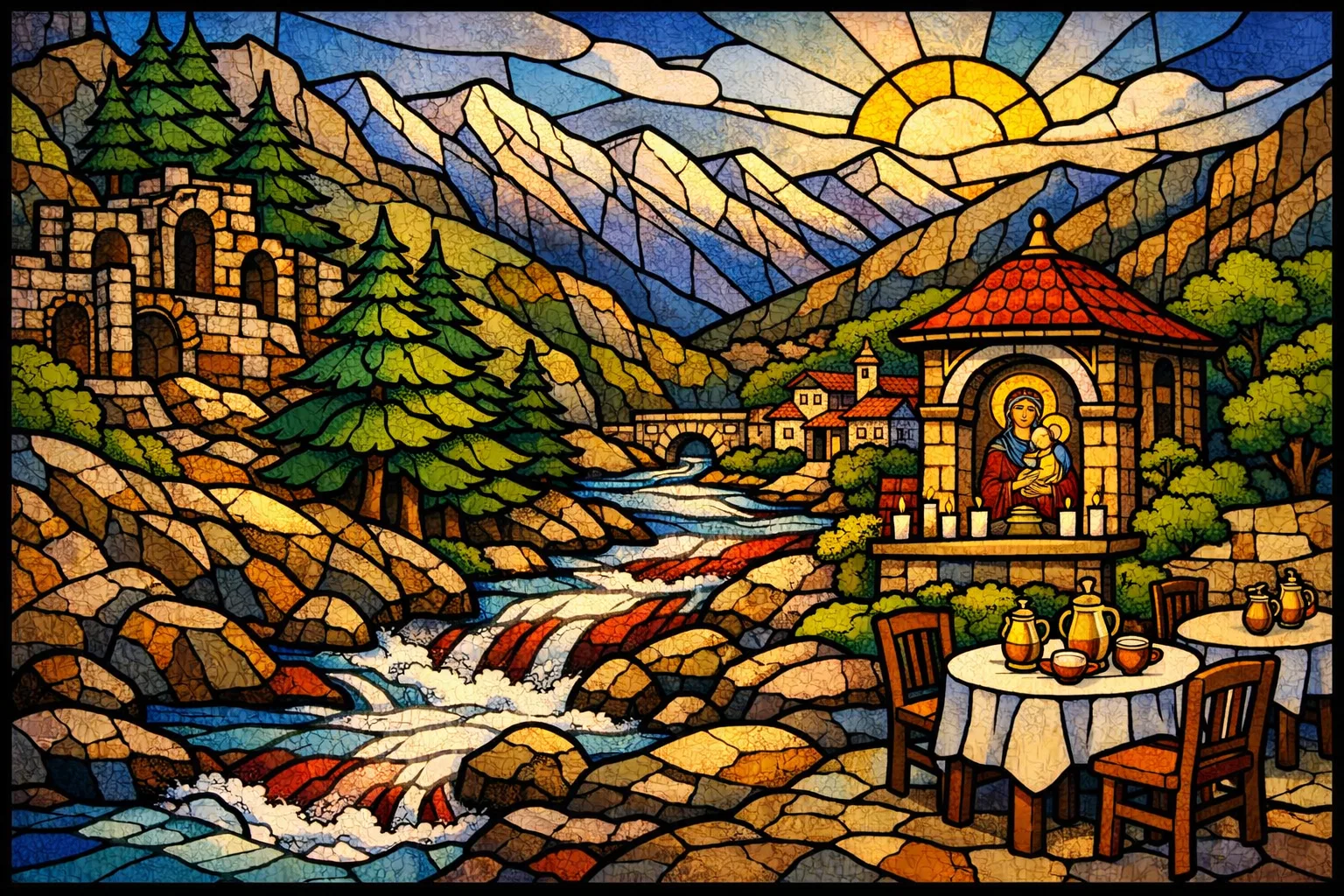
The most famous mythic landscape in Lebanon is the valley of the Ibrahim River, also known in classical tradition as the Adonis River. It rises near Afqa, in Mount Lebanon, where water emerges from a limestone cave and falls through a dramatic mountain landscape before flowing towards the Mediterranean. Ancient and later accounts linked this place with the story of Adonis, the beautiful youth loved by Aphrodite, killed by a boar, and mourned in rites of seasonal grief and renewal.[Med-O-Med]medomed.orgMed-O-Med Nahr Ibrahim Valley. The Adonis myth, LEBANONMed-O-Med Nahr Ibrahim Valley. The Adonis myth, LEBANON
The core Lebanese version centres on a visible natural event. In spring, melting snow and rain can wash reddish soil into the river. Tradition interpreted this red colour as the blood of Adonis returning to the water each year. The story therefore works on two levels at once: as a myth of death and return, and as a folk explanation for a striking seasonal change in the landscape. Med-O-Med’s cultural-landscape account explicitly identifies Afqa, the river, the red spring water, and the Adonis myth as the valley’s main intangible value.[Med-O-Med]medomed.orgMed-O-Med Nahr Ibrahim Valley. The Adonis myth, LEBANONMed-O-Med Nahr Ibrahim Valley. The Adonis myth, LEBANON
This is not simply a “Greek myth placed in Lebanon”. The area around Byblos and Afqa belonged to a wider eastern Mediterranean religious world in which local cults, Phoenician deities, Greek names and Roman-era retellings overlapped. The Afqa landscape is associated with Astarte/Aphrodite, while the mythic Adonis figure became a way to read Lebanon’s mountains, caves, water and vegetation through a cycle of loss and return. The story’s long life comes from that fit between tale and terrain: even a reader who does not believe the myth can see why a reddening river would attract ritual explanation.[Med-O-Med]medomed.orgMed-O-Med Nahr Ibrahim Valley. The Adonis myth, LEBANONMed-O-Med Nahr Ibrahim Valley. The Adonis myth, LEBANON
For folklore readers, the key point is that the Adonis River tradition is both ancient and place-bound. It is not an internet-era invention, nor merely a tourist slogan, though tourism now uses it. It belongs to a long habit of interpreting dramatic Lebanese landscapes through stories of divine presence, grief, fertility and seasonal change.[Med-O-Med]medomed.orgMed-O-Med Nahr Ibrahim Valley. The Adonis myth, LEBANONMed-O-Med Nahr Ibrahim Valley. The Adonis myth, LEBANON
Cedars, holy valleys and trees with more than natural meaning
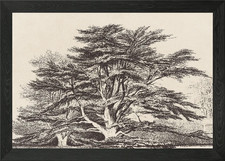
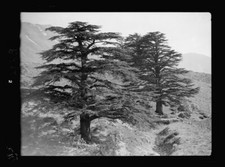
Lebanon’s cedars are national symbols, but in folklore and religious imagination they are more than emblematic trees. The Forest of the Cedars of God, near the Qadisha Valley in northern Lebanon, is recognised by UNESCO as part of a World Heritage cultural landscape. UNESCO describes the forest as one of the last vestiges of the ancient cedar forests of Lebanon, while the nearby Qadisha Valley contains old monasteries, hermitages and caves associated with early Christian monastic life.[UNESCO World Heritage Centre]whc.unesco.orgOpen source on unesco.org.
This gives the cedar landscape an unusually dense symbolic charge. It is natural heritage, national icon, biblical memory and sacred geography at the same time. UNESCO notes that the cedar was highly valued in antiquity for major religious buildings and is repeatedly cited in the Bible; it also describes Qadisha as a place of refuge, meditation and monastic settlement over many centuries. In Lebanese cultural memory, therefore, the cedar is not just a tree species. It is a witness to endurance.[UNESCO World Heritage Centre]whc.unesco.orgOpen source on unesco.org.
Lebanon’s tree traditions are not limited to the famous cedars. Recent anthropological work on southern Lebanon has drawn attention to the idea of trees or places being inhabited by spirits. In accounts of the south, a spirit-inhabited tree can function as a sacred presence, a village marker, and a way of thinking about land that has survived war, occupation and displacement. This is a different register from the polished national symbolism of the cedar: more local, more intimate, and often harder to document because it lives in oral knowledge rather than official heritage plaques.[NomadIT]nomadit.co.ukOpen source on nomadit.co.uk.
These traditions matter because they show how Lebanese folklore often treats landscape as morally alive. A spring, cave, tree, shrine or river may be understood as a place where ordinary and unseen worlds meet. That does not mean every Lebanese person believes the same thing, or that such beliefs are unchanged from antiquity. It means that stories about place remain a way of explaining danger, blessing, memory and belonging.[An-Najah Staff]staff.najah.eduOpen source on najah.edu.

Jinn, saints and the unseen in everyday geography
Belief in jinn and other unseen beings is shared across much of the Arabic-speaking and Islamic world, but in Lebanon it appears through local places: houses, caves, wells, graveyards, shrines, trees, old ruins and rural edges. Recent scholarship on haunted landscapes in the Levant describes jinn not just as monsters from tales, but as beings through which communities mark boundaries: clean and unclean, safe and dangerous, sacred and exposed, morally ordered and socially unstable.[Sage Journals]journals.sagepub.comOpen source on sagepub.com.
In folk practice, unseen beings can threaten but also heal. A saintly presence, shrine or blessed place may protect a person or landscape, while a disturbed or dangerous place may be associated with affliction. This is why the Lebanese and wider Levantine supernatural world should not be reduced to “ghost stories”. It is often part of folk religion: a way of understanding illness, fear, healing, protection, misfortune and the invisible obligations people feel towards places.[Sage Journals]journals.sagepub.comOpen source on sagepub.com.
Southern Lebanon is especially important for this kind of place-based belief because of its history of conflict and borderland life. Work on sacred or spirit-inhabited trees in the south suggests that folklore can become a language of survival: old trees and shrines are not only picturesque remnants, but anchors of continuity in landscapes repeatedly marked by violence and displacement.[NomadIT]nomadit.co.ukOpen source on nomadit.co.uk.
Modern “haunted Lebanon” content often turns these ideas into paranormal entertainment, especially around ruins or old urban sites. Such retellings can be interesting, but they should be treated carefully. A tale about jinn at a particular archway or ruin may preserve a real local motif, but modern web versions can also exaggerate, simplify or detach the story from its community setting. The older pattern is not simply “a scary place”; it is a place where history, danger, sacredness and social memory overlap.[ما وراء الطبيعة - PARANORMAL ARABIA]paranormalarabia.comما وراء الطبيعةما وراء الطبيعة
Baalbek: when giant stones invite giant stories
Baalbek is one of Lebanon’s great examples of how archaeological scale produces folklore. The Roman sanctuary complex is famous for enormous stone blocks, including the monolith known as the Stone of the Pregnant Woman. A University of Notre Dame architectural archive describes it as a Roman monolith and one of the very largest stones quarried by humans, intended for the nearby temple complex.[Marble]marble.nd.eduOpen source on nd.edu.
Because the stones are so large, Baalbek has long attracted stories that exceed ordinary engineering. A New Yorker account of archaeological work at the site summarised several origin legends: Cain hiding from divine wrath, giants building at Nimrod’s command, and Solomon using jinn to create a palace for the Queen of Sheba. The same article contrasts those legends with archaeological explanations that place the great Roman construction in phases beginning around the late first century BCE and continuing into the Roman imperial period.[The New Yorker]newyorker.comThe New Yorker The Myth of the Megalith | The New YorkerThe New Yorker The Myth of the Megalith | The New Yorker
This makes Baalbek a useful case study in the difference between folklore and false history. The legends are culturally meaningful because they show how people responded to the mystery of monumental ruins before modern archaeology had persuasive explanations. But they are not evidence that giants, jinn or ancient aliens built the site. Their value lies in what they reveal about wonder: when a structure seems too large for ordinary human effort, storytelling supplies extraordinary builders.[The New Yorker]newyorker.comThe New Yorker The Myth of the Megalith | The New YorkerThe New Yorker The Myth of the Megalith | The New Yorker
The Stone of the Pregnant Woman also shows how a name can become a folk magnet. Even when a monolith is securely discussed as part of Roman quarrying and construction, its popular name invites narrative. That is typical of Lebanese legendary geography: a place-name, a ruin, a cave or a stone becomes the seed of a story, and the story then changes how visitors experience the place.[Marble]marble.nd.eduOpen source on nd.edu.
Storytellers, folktales and the changing art of oral performance
Lebanon’s oral storytelling tradition is one of the clearest bridges between old folklore and modern cultural life. The professional storyteller, often known by the regional term hakawati, once performed in urban cafés, especially in cities such as Beirut, Tripoli and Saida. According to the iHERITAGE register, this urban professional figure had largely disappeared from cafés by around 1975–1980, during the civil war period.[iHeritage]iheritage.eui Heritage Hkeyeh, the traditional Lebanese storytelling – i Heritagei Heritage Hkeyeh, the traditional Lebanese storytelling – i Heritage
The older café storyteller usually sat before an audience and recited or read long popular epics and romances, often centred on heroic adventures, battles, courage and love. This was not merely entertainment. It created a shared listening space, with suspense, repetition, memory and performance binding the audience together. In rural settings, non-professional storytelling at wakes and family gatherings also helped transmit tales across generations, but iHERITAGE notes that these settings have become rarer because of displacement, rural migration and broken chains of transmission.[iHeritage]iheritage.eui Heritage Hkeyeh, the traditional Lebanese storytelling – i Heritagei Heritage Hkeyeh, the traditional Lebanese storytelling – i Heritage
Modern Lebanon has not simply lost storytelling; it has changed its form. New storytelling festivals, training courses and stage performances have turned oral narration into a more self-conscious performing art. Organisations in Beirut, Tripoli and Hammana have supported festivals or workshops, while contemporary storytellers draw from written collections as well as inherited oral material.[iHeritage]iheritage.eui Heritage Hkeyeh, the traditional Lebanese storytelling – i Heritagei Heritage Hkeyeh, the traditional Lebanese storytelling – i Heritage
There is also a newer autobiographical strand. Reporting on Beirut storytelling events describes a twenty-first-century revival in which personal stories, refugee experience, civil-war memory and social issues are shared in public performance. This is not the same as a café performer reciting heroic epics, but it continues a central Lebanese and regional idea: important truths are carried through the human voice, in front of listeners, with emotion, timing and communal presence.[Nieman Storyboard]niemanstoryboard.orgOpen source on niemanstoryboard.org.
Women’s tales, ogres and domestic wisdom
Lebanese folktales are not only public café performances. Many circulated through women’s storytelling in homes, family settings and children’s worlds. Najla Jraissaty Khoury’s collected oral tales, published in English as Pearls on a Branch, are especially important because they foreground stories told by women in Lebanon and the wider Syrian-Lebanese oral sphere. Publisher descriptions identify the collection as traditional Syrian and Lebanese folktales collected by Khoury and translated by Inea Bushnaq.[Amazon]amazon.comPearls on a Branch: Oral TalesPearls on a Branch: Oral Tales
These tales contain familiar folktale machinery: clever girls, dangerous ogres, magical transformations, talking animals, tests of generosity, punishments for greed, and riddling moral lessons. Reviews and summaries of the collection emphasise its women storytellers and women protagonists, which matters because public folklore is often imagined as male performance while domestic storytelling is treated as secondary. In practice, women’s storytelling has been one of the major ways children learned fear, humour, caution, resilience and social intelligence.[The Millions]themillions.comThe Millions The Wisdom of Women Shines in Najla Jraissaty Khoury'sThe Millions The Wisdom of Women Shines in Najla Jraissaty Khoury's
The ogre or ghoul figure is especially revealing. Across Arabic folklore, the ghoul is associated with danger, appetite, wilderness, graveyards or the frightening edge of the social world. In Lebanese tale collections, ogres and ghouls do not always function as simple monsters; they can test a hero’s wit, embody predatory power, or make a lesson memorable for children. The iHERITAGE register’s bibliography for Lebanese storytelling includes works specifically on Lebanese ogre and ghoul tales, showing that these beings form part of the country’s documented story tradition rather than only imported horror imagery.[iHeritage]iheritage.eui Heritage Hkeyeh, the traditional Lebanese storytelling – i Heritagei Heritage Hkeyeh, the traditional Lebanese storytelling – i Heritage
What these tales preserve is not a fixed “Lebanese pantheon”, but a storytelling habit. A supernatural being appears when ordinary social rules need sharpening: do not be foolish, do not trust too quickly, honour hospitality, listen to older wisdom, use cleverness when strength is not enough. That is why the same tale can feel magical, comic and practical at once.[The Millions]themillions.comThe Millions The Wisdom of Women Shines in Najla Jraissaty Khoury'sThe Millions The Wisdom of Women Shines in Najla Jraissaty Khoury's

Sung poetry, dance and festive folklore
Folklore in Lebanon also lives in performed social forms rather than in supernatural tales alone. UNESCO lists Lebanese sung or recited folk poetry, known as zajal, as an element of intangible cultural heritage, and its Lebanon state page also records other recognised practices, including the culinary practice of man’ouché and Arabic calligraphy in multi-country files.[UNESCO Intangible Cultural Heritage]ich.unesco.orgIntangible Cultural Heritage LebanonIntangible Cultural Heritage Lebanon
Zajal matters for folklore because it is public, competitive, social and memorable. It turns poetry into a live event: poets perform before audiences, use rhythm and wit, and often respond to one another in a way that makes the community part of the occasion. It is a good reminder that folklore is not only “old stories about spirits”. It also includes verbal art, festive performance, humour, rivalry and shared occasions where language becomes a form of belonging.[UNESCO Intangible Cultural Heritage]ich.unesco.orgOpen source on unesco.org.
UNESCO’s 2021 account of safeguarding intangible heritage in Lebanon makes the same wider point. It names practices such as zajal, dabke, Lebanese cuisine, crafts and Jezzine knives as living heritage shared across communities, while also stressing that such heritage changes with people’s environments and needs. That is particularly important in Lebanon, where religious and regional diversity can make “national folklore” difficult to summarise. The common ground is not one single myth, but a repertoire of practices people recognise, perform, inherit and remake.[UNESCO]unesco.orgIntangible cultural heritage: a wealth disseminated by UNESCOIntangible cultural heritage: a wealth disseminated by UNESCO
Old tradition, literary retelling and modern invention
A careful reader should separate five different layers in Lebanese folklore. First are ancient myths tied to specific landscapes, such as Adonis at Afqa and the river’s red spring water. Second are folk religious practices and beliefs around saints, jinn, shrines, trees and healing. Third are oral folktales transmitted in homes, rural gatherings and cafés. Fourth are literary and heritage retellings, including published collections and staged performances. Fifth are modern online or tourist stories, which may preserve genuine local motifs but often simplify them.[medomed.org]medomed.orgMed-O-Med Nahr Ibrahim Valley. The Adonis myth, LEBANONMed-O-Med Nahr Ibrahim Valley. The Adonis myth, LEBANON
The Adonis River tradition is ancient and well anchored in classical and local landscape material. Baalbek’s jinn and giant-builder legends are better understood as explanatory legends around monumental ruins, not as archaeological evidence. Spirit-inhabited trees in the south are strongly local and ethnographic, but they are not always easy to document in public-facing sources because such knowledge is often held within communities. Café storytelling is historically remembered, documented as declining, and now partly reinvented through festivals, workshops and personal narrative events.[medomed.org]medomed.orgMed-O-Med Nahr Ibrahim Valley. The Adonis myth, LEBANONMed-O-Med Nahr Ibrahim Valley. The Adonis myth, LEBANON
This distinction matters because Lebanese folklore is sometimes flattened into either ancient Phoenician romance or modern ghost content. The reality is richer. Some traditions are old; some are revived; some are shared with Syria, Palestine, Jordan and the wider Arab world; some are shaped by Lebanon’s civil war, migration, urbanisation and economic pressures. A living tradition can be authentic without being unchanged, but it should not be presented as ancient unless the evidence supports that claim.[UNESCO]unesco.orgIntangible cultural heritage: a wealth disseminated by UNESCOIntangible cultural heritage: a wealth disseminated by UNESCO
How Lebanon’s folklore is understood today
Today, Lebanese folklore sits between preservation and reinvention. UNESCO-supported heritage work has focused on training, inventorying and safeguarding because Lebanon’s intangible heritage is vulnerable to economic crisis, globalisation, displacement, weakened transmission and the loss of older craft and performance settings. The most useful heritage approach is not to trap folklore in the past, but to help communities transmit it in forms that still make sense.[UNESCO]unesco.orgIntangible cultural heritage: a wealth disseminated by UNESCOIntangible cultural heritage: a wealth disseminated by UNESCO
For visitors and general readers, the most memorable entry points are concrete places. Afqa and the Adonis River show how a natural phenomenon can become myth. The Cedars of God and Qadisha Valley show how sacred landscape, national symbol and religious memory can overlap. Baalbek shows how ruins generate legends when engineering feels almost beyond belief. Storytelling revivals in Beirut and elsewhere show how an oral tradition can shift from heroic epics to personal testimony without losing its core power: a person standing before others and making memory communal.[medomed.org]medomed.orgMed-O-Med Nahr Ibrahim Valley. The Adonis myth, LEBANONMed-O-Med Nahr Ibrahim Valley. The Adonis myth, LEBANON
Lebanon’s folklore therefore matters not because it offers one tidy national myth, but because it reveals how a small country can hold many story-worlds at once. Ancient gods, saintly places, jinn, ogres, women’s tales, sung poetry, mountain monasteries, sacred trees and modern stages all belong to the same broader pattern: landscape and memory are never merely background. In Lebanese tradition, they are active participants in the story.
Amazon book picks
Further Reading
Books and field guides related to Where Lebanon's Legends Meet the Landscape. Use these as the next step if you want deeper reading beyond the article.
The Power of Myth
Rating: 4.5/5 from 14 Google Books ratings
Explores how landscapes and myths become culturally meaningful.
eBay marketplace picks
Marketplace Samples
Live-tested eBay searches with available results related to this page.
Endnotes
1.
Source: whc.unesco.org
Link:https://whc.unesco.org/en/list/850/
2.
Source: unesco.org
Title: Intangible cultural heritage: a wealth disseminated by UNESCO
Link:https://www.unesco.org/en/articles/intangible-cultural-heritage-wealth-disseminated-unesco-throughout-lebanon
3.
Source: ich.unesco.org
Title: Intangible Cultural Heritage Lebanon
Link:https://ich.unesco.org/en/state/lebanon-LB
4.
Source: staff.najah.edu
Link:https://staff.najah.edu/en/publications/15921/
5.
Source: paranormalarabia.com
Title: ما وراء الطبيعة
Link:https://www.paranormalarabia.com/en/articles/2025/05/the-archway-of-the-jinn-in-tyre
6.
Source: iheritage.eu
Title: i Heritage Hkeyeh, the traditional Lebanese storytelling – i Heritage
Link:https://www.iheritage.eu/featured_item/hkeyeh-the-traditional-lebanese-storytelling/
7.
Source: amazon.com
Title: Pearls on a Branch: Oral Tales
Link:https://www.amazon.com/Pearls-Branch-Najla-Jraissaty-Khoury/dp/0914671960?tag=searcht-20
8.
Source: ich.unesco.org
Link:https://ich.unesco.org/en/RL/al-zajal-recited-or-sung-poetry-01000
9.
Source: staff-beta.najah.edu
Link:https://staff-beta.najah.edu/media/published_research/2024/06/20/al-qobbaj-marshall-2024-dwelling-and-healing-with-saints-and-jinn-in-the-haunted-landscapes-of-palestine.pdf
10.
Source: staff.najah.edu
Title: JOURNAL OF HISTORICAL GEOGRAPHY ARTICLE
Link:https://staff.najah.edu/media/published_research/2024/02/16/JOURNAL_OF_HISTORICAL_GEOGRAPHY_ARTICLE.pdf
11.
Source: phoenician.org
Title: Adonis Legend & Myth
Link:https://phoenician.org/adonis_legend/
12.
Source: ich.unesco.org
Title: 07949 EN.doc
Link:https://ich.unesco.org/doc/src/07949-EN.doc
13.
Source: ich.unesco.org
Title: 07953 EN.doc
Link:https://ich.unesco.org/doc/src/07953-EN.doc
14.
Source: ich.unesco.org
Title: inventorying intangible cultural heritage practices in lebanon 13220
Link:https://ich.unesco.org/en/news/inventorying-intangible-cultural-heritage-practices-in-lebanon-13220
15.
Source: ich.unesco.org
Title: examples of regional living heritage 00379
Link:https://ich.unesco.org/en/examples-of-regional-living-heritage-00379
16.
Source: ich.unesco.org
Link:https://ich.unesco.org/
17.
Source: ich.unesco.org
Link:https://ich.unesco.org/en/video/68937
18.
Source: ich.unesco.org
Title: examples of regional living heritage 00379
Link:https://ich.unesco.org/en/examples-of-regional-living-heritage-00379?id=18634&include=film_inc.php
19.
Source: whc.unesco.org
Link:https://whc.unesco.org/en/list/850/gallery/
20.
Source: whc.unesco.org
Link:https://whc.unesco.org/en/list/850/documents/
21.
Source: amazon.de
Title: Arab Folktales
Link:https://www.amazon.de/-/en/INEA-Y-BUSHNAQ/dp/0394501047?tag=searcht-20
22.
Source: amazon.de
Link:https://www.amazon.de/-/en/Najla-Jraissaty-Khoury-ebook/dp/B071K4DM9C?tag=searcht-20
23.
Source: unesco.nl
Title: Ouadi Qadisha (de Heilige vallei) en het Bos
Link:https://unesco.nl/werelderfgoed/ouadi-qadisha-de-heilige-vallei-en-het-bos-van-de-ceders-van-god-horsh-arz-el-rab
24.
Source: iheritage.eu
Link:https://www.iheritage.eu/?sf_paged=12&sfid=71
25.
Source: folklore.ee
Link:https://www.folklore.ee/~maris/work/folklore48/flore48.pdf
26.
Source: archive.org
Link:https://archive.org/details/arabfolktales00inea
27.
Source: medomed.org
Title: Med-O-Med Nahr Ibrahim Valley. The Adonis myth, LEBANON
Link:https://medomed.org/featured_item/the-cultural-landscape-of-nahr-ibrahim-valley-the-adonis-myth-and-the-archaeological-remains-lebanon/
28.
Source: newyorker.com
Title: The New Yorker The Myth of the Megalith | The New Yorker
Link:https://www.newyorker.com/tech/annals-of-technology/baalbek-myth-megalith
29.
Source: nomadit.co.uk
Link:https://nomadit.co.uk/conference/easa2022/paper/64621
30.
Source: journals.sagepub.com
Link:https://journals.sagepub.com/doi/10.1177/14744740241234297
31.
Source: marble.nd.edu
Link:https://marble.nd.edu/item/c886d8ab-2e60-4019-a74d-79160a8ffa33
32.
Source: niemanstoryboard.org
Link:https://niemanstoryboard.org/2017/06/06/in-arab-world-an-ancient-tradition-of-oral-storytelling-gets-a-21st-century-spin/
33.
Source: themillions.com
Title: The Millions The Wisdom of Women Shines in Najla Jraissaty Khoury’s ‘
Link:https://themillions.com/2018/10/the-wisdom-of-women-shines-in-najla-jraissaty-khourys-pearls-on-a-branch-oral-tales.html
34.
Source: Wikipedia
Link:https://en.wikipedia.org/wiki/Jinn
35.
Source: Wikipedia
Link:https://en.wikipedia.org/wiki/Afqa
36.
Source: Wikipedia
Title: Cedars of God
Link:https://en.wikipedia.org/wiki/Cedars_of_God
37.
Source: Wikipedia
Link:https://en.wikipedia.org/wiki/Baalbek
38.
Source: medomed.org
Link:https://medomed.org/featured_item/ouadi-qadisha-the-holy-valley-and-the-forest-of-the-cedars-of-god-horsh-arz-el-rab-lebanon/
39.
Source: scribd.com
Link:https://www.scribd.com/document/147092229/Baalbek
40.
Source: eventscal.lau.edu.lb
Link:https://eventscal.lau.edu.lb/event.php?evt=20200702_lebanese-zajal-as-a-unesco-intan
41.
Source: amazon.com.be
Link:https://www.amazon.com.be/-/en/Inea-Bushnaq/dp/0394751795?tag=searcht-20
42.
Source: dalanasser.com
Title: adonis river
Link:https://www.dalanasser.com/adonis-river
43.
Source: iheritage.ccib.org.lb
Link:https://iheritage.ccib.org.lb/wp-content/uploads/2024/02/ICHLEBANONEN.pdf
44.
Source: hal.science
Link:https://hal.science/hal-05205299v1/document
45.
Source: arabnews.com
Link:https://www.arabnews.com/node/2625870/unesco%E2%80%99s-intangible-cultural-heritage-list-adds-traditions-middle-east-and-africa
46.
Source: abouther.com
Link:https://www.abouther.com/node/63871/people/features/unesco-recognizes-cultural-riches-palestinian-dabke-lebanese-manouche-and
47.
Source: soniasulaiman.com
Title: lebanese folktales
Link:https://soniasulaiman.com/tag/lebanese-folktales/
48.
Source: pheniciens.com
Link:https://www.pheniciens.com/cites/baalbek.php?lang=en
49.
Source: cultural-hub.com
Link:https://cultural-hub.com/magazine/unesco-world-heritage-sites-lebanon-complete-guide/
50.
Source: bau.edu.lb
Link:https://www.bau.edu.lb/SDG/11
51.
Source: libraries.aub.edu.lb
Title: aub.edu.lb Ghouls and ogres–Folklore 1
Link:https://libraries.aub.edu.lb/poha/Search/Results?filter%5B%5D=topic_facet%3AGhouls+and+ogres–Folklore&sort=topic
Additional References
52.
Source: youtube.com
Title: Cedars of God + Khalil Gibran Museum (Bsharri, Lebanon)
Link:https://www.youtube.com/watch?v=4jjiQMBKif8
Source snippet
AI Finally Solved Lebanon's Baalbek Megalithic Mystery - What It Revealed Shocked Archaeologists...
53.
Source: youtube.com
Title: Ep.270: ‘Heritage and Roots’ with Charles al-Hayek
Link:https://www.youtube.com/watch?v=gK7Dfhfn2Hc
Source snippet
The MEGALITHIC Mystery of Baalbek — Massive Stones No One Can Explain...
54.
Source: facebook.com
Link:https://www.facebook.com/LebaneseMinistryOfCulture/posts/trails-and-tales-is-a-european-union-cultural-initiative-at-the-national-library/1253423620155503/
55.
Source: researchgate.net
Link:https://www.researchgate.net/publication/378647522_Demons_spirits_and_haunted_landscapes_in_Palestine
56.
Source: academia.edu
Link:https://www.academia.edu/5802424/The_Mythical_Ghoul_in_Arabic_Culture
57.
Source: researchgate.net
Link:https://www.researchgate.net/publication/277816715_The_Mythical_Ghoul_in_Arabic_Culture
58.
Source: antipodeonline.org
Link:https://antipodeonline.org/wp-content/uploads/2024/07/Book-review_Carpi-on-Khayyat.pdf
59.
Source: academia.edu
Link:https://www.academia.edu/44004814/101_Middle_Eastern_Tales_and_Their_Impact_on_Western_Oral_Tradition
60.
Source: researchgate.net
Link:https://www.researchgate.net/publication/390977764_INTANGIBLE_CULTURAL_HERITAGE_CONCEPTUAL_DILEMMAS_BETWEEN_THE_IMMATERIAL_AND_THE_CULTURAL
61.
Source: researchgate.net
Link:https://www.researchgate.net/publication/397199572_Safeguarding_Intangible_Cultural_Heritage_through_Participatory_Approaches_The_Case_of_Jezzine_Lebanon
Topic Tree
Follow this branch
Related pages 192
- Afghan Folklore
- Albanian Folklore
- Algerian Folklore
- Australian Folklore
- Azerbaijan Folklore
- +187 more in sidebar