Layered Folklore of Syria
Syria’s folklore is not one single mythology but a layered culture of stories: ancient storm-god myths from Ugarit on the Mediterranean coast, public storytelling in Damascus cafés, shadow-puppet satire, saintly shrines, protective charms, songs from Aleppo, refugee-preserved folktales, and modern memories of damaged but still meaningful places.
Page outline Jump by section
What makes Syrian folklore distinctive?
Syrian folklore sits at a crossroads. The country’s landscape has been shaped by Mediterranean trade, desert routes, ancient city-states, Islamic and Christian sacred geographies, Ottoman urban culture and modern displacement. That makes its story culture unusually layered: a Syrian tale may carry a moral found across the wider Arab world, while its setting, dialect, humour, saint, market, mountain or village custom makes it local. A children’s tale from Aleppo, a shrine story near Damascus and a puppet comedy from a café are not the same kind of evidence, but together they show how tradition works: it moves through voices, places and repeated occasions.[Colorín Colorado]colorincolorado.orgColorín Colorado Syrian Folktales | Colorín ColoradoColorín Colorado Syrian Folktales | Colorín Colorado
A useful warning is that “Syrian folklore” should not be flattened into either ancient mythology or modern ghost stories. Ancient Ugaritic myths are Syrian by place and archaeological context, but they are not the same as recent village belief. Modern internet legends may borrow Syrian ruins or demons as atmosphere, but they are often far removed from local oral tradition. The strongest Syrian folklore evidence comes from documented performance traditions, collected folktales, museum objects, regional belief practices and heritage records, rather than unsourced paranormal retellings.[metmuseum.org]metmuseum.orgThe Metropolitan Museum of Art UgaritThe Metropolitan Museum of Art Ugarit
The oldest mythic layer: Ugarit and the storm-god tradition
One of the most important mythic anchors for Syria is Ugarit, the Late Bronze Age city at Ras Shamra near the modern Syrian coast. The Metropolitan Museum of Art describes Ugarit as a flourishing city with temples dedicated to Baal and Dagan, and the wider Ugaritic corpus preserves some of the most influential mythic material from the ancient Levant.[The Metropolitan Museum of Art]metmuseum.orgThe Metropolitan Museum of Art UgaritThe Metropolitan Museum of Art Ugarit
The best-known text is the Baal Cycle, a mythic sequence written in Ugaritic on clay tablets between roughly 1400 and 1200 BCE, with surviving tablets often dated around the thirteenth century BCE. Its central drama is cosmic: the storm god Baal struggles with the sea and with death, wins kingship, loses power, and returns. For modern readers, the point is not that Syrians today “believe” this myth in a continuous, unchanged way. Rather, Ugarit shows that the land now called Syria has a very deep record of myth-making about rain, fertility, kingship, the sea and the underworld.[EBSCO]ebsco.comOpen source on ebsco.com.
This ancient layer also helps explain why Syrian folklore often feels attached to weather, land and sacred geography. A storm-god myth from Ugarit, a village shrine, a desert monster tale and a protective amulet are not one tradition, but they all show a recurring concern with forces that cannot be fully controlled: drought, sickness, envy, danger on the road, injustice, death and divine protection. That is where folklore becomes culturally useful. It gives invisible fears a memorable form.
Storytellers, cafés and the public voice
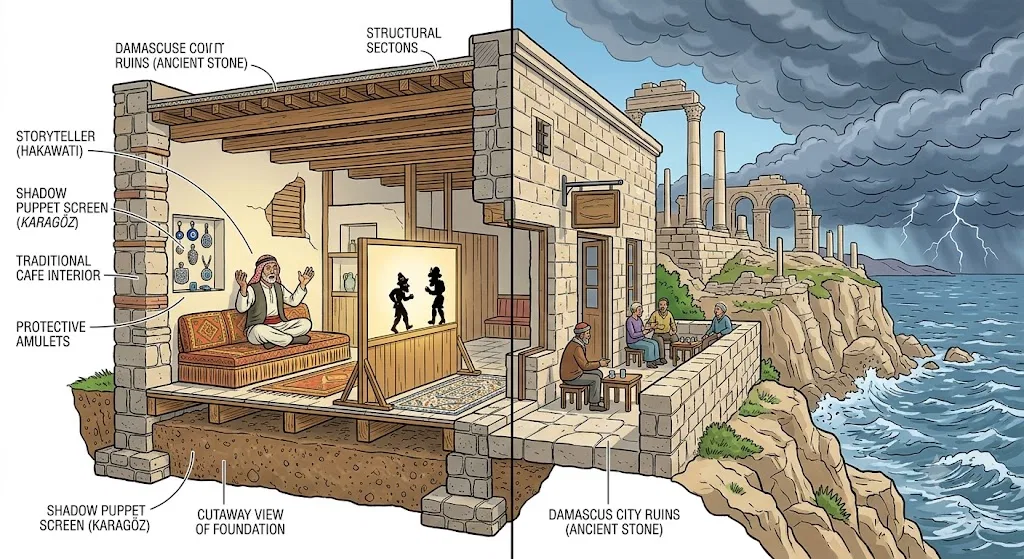
The public storyteller is one of Syria’s most recognisable folk figures, especially in the cultural memory of Damascus. Reports on the Damascene tradition describe storytellers and poetry recital as long-standing café arts, with narrators performing heroic tales, popular epics and moral stories for gathered audiences.[The Syrian Observer - A News Website]syrianobserver.comThe Syrian ObserverThe Syrian Observer
This matters because Syrian folklore is not only a set of old plots. It is also a performance style. The storyteller’s authority comes from voice, timing, suspense and the social space of listening. In a café, a tale is public entertainment, but it can also be a lesson in courage, cleverness, loyalty or social criticism. The audience is part of the event: listeners know when to laugh, when to wait, and when a familiar episode has been given a new twist.
Modern projects have treated Syrian storytelling as a heritage practice at risk. Digital Syria describes the public storyteller as a figure who has brought Syrian folktales and epic stories to ordinary people for generations, while heritage organisations have used storytelling projects to preserve oral tradition among Syrians displaced by war.[Digital Syria]digitalsyria.org.ukDigital Syria HakawatiDigital Syria Hakawati

Shadow play: satire behind a screen
Syrian shadow play is one of the clearest examples of folklore as performance rather than simply narrative. UNESCO describes it as a traditional art of handmade puppets moving behind a translucent screen in a dark theatre, with a light projecting the figures while an oral script and music shape the performance. Today it is practised mainly in Damascus.[UNESCO Intangible Cultural Heritage]ich.unesco.orgshadow play 01368UNESCO Intangible Cultural HeritageShadow play15 Dec 2022 — Shadow play is a traditional art consisting of handmade puppets moving behind…
Its content is especially important: UNESCO notes that Syrian shadow play revolves around humorous social criticism, with satirical narratives carried by two main characters. That makes it a folk art of public commentary. The puppets can say what ordinary people may find harder to say directly: they mock foolishness, expose hypocrisy and turn everyday frustrations into comedy.[UNESCO]unesco.orgdocument 4779document 4779
UNESCO placed Syrian shadow play on the List of Intangible Cultural Heritage in Need of Urgent Safeguarding in 2018. The listing is not just a badge of honour; it signals that the tradition is vulnerable. Urban change, shrinking performance spaces, war, displacement and changing entertainment habits all make it harder for such arts to survive by ordinary transmission.[UNESCO Intangible Cultural Heritage]ich.unesco.orgshadow play 01368UNESCO Intangible Cultural HeritageShadow play15 Dec 2022 — Shadow play is a traditional art consisting of handmade puppets moving behind…
Folktales at home: morals, riddles and regional voices
Printed collections of Syrian folktales give a more intimate view of tradition. Muna Imady’s collection, described by Colorín Colorado, gathers stories and recipes from different Syrian regions and emphasises that every governorate has its own folklore traditions, including stories, sayings, riddles, foods, embroidery patterns and traditional dress.[Colorín Colorado]colorincolorado.orgColorín Colorado Syrian Folktales | Colorín ColoradoColorín Colorado Syrian Folktales | Colorín Colorado
That range is important. Folklore is not limited to supernatural beings. A riddle, a proverb, a recipe attached to a feast, a remembered dress pattern or a cautionary tale told to children can all carry local identity. In Syria, as elsewhere, folktales often teach by indirection. A foolish character is tricked, a poor person wins through patience, a proud person is humbled, or a dangerous figure is defeated by clever speech rather than strength.
The refugee-collected volume Timeless Tales is especially poignant because it shows folklore travelling with people. Its preface says the book contains 21 folktales preserved from potential loss amid displacement, and accounts of the project report that researchers gathered many more stories from displaced Syrians before selecting a smaller set for publication.[chwb.org]chwb.orgCHw B Syrisk Antologi eng lowCHw B Syrisk Antologi eng low
Spirits, envy and protection
Syrian belief culture shares many features with wider Levantine and Arab traditions: spirits, the evil eye, protective words, amulets, saints and sacred places. These should be presented as beliefs and practices, not as proven supernatural facts. A mainstream reader may recognise the evil eye as the idea that envy or a harmful glance can bring misfortune. A Syrian amulet held by the Pitt Rivers Museum is described as protection against that belief, especially for treasured things such as children, animals and homes.[Oxford PRM]web.prm.ox.ac.ukOxford PRMSmall BlessingsOxford PRMSmall Blessings
The protective logic is simple and powerful: what is loved is vulnerable, and what is admired may attract envy. This gives everyday objects symbolic work to do. Jewellery, charms, spoken blessings and household practices help people feel that a child, a bride, an animal or a new home has some defence against unseen harm. Pew Research notes that Islamic sources refer to witchcraft, the evil eye and supernatural beings known as jinn, although local interpretation varies widely.[Pew Research Center]pewresearch.orgPew Research Center Chapter 4: Other Beliefs and PracticesPew Research Center Chapter 4: Other Beliefs and Practices
The figure of the jinn is especially important because it crosses formal religion and folk narrative. In learned Islamic tradition, jinn are created beings with moral responsibility; in folk stories, they may appear as dangerous presences, helpers, tricksters or explanations for illness and misfortune. In Syrian contexts, such beliefs should be read locally and carefully: urban, rural, Bedouin, Muslim, Christian, Druze and Alawi communities may preserve different emphases, and not every Syrian treats these ideas in the same way.
Sacred places and haunted landscapes
Syrian folklore is strongly attached to place. Mountains, caves, shrines, tombs, old cities and ruins become story containers. A place may be officially archaeological, religious or touristic, but local imagination can give it an additional layer: a saint’s blessing, a miracle story, a warning, a ghostly association or a tale about the first crime, a hidden treasure or a vanished people.
The shrine tradition is part of that landscape. Sources on the wider Levant describe shrines associated with holy figures as common in Syria and neighbouring areas, often linked to saints, pious figures or older sacred sites. In practice, such places can be visited for blessing, healing, vows or protection, and may be meaningful across community boundaries.[Wikipedia]WikipediaMaqam (shrineMaqam (shrine
One vivid example is the tradition of Al-Khidr, a mysterious holy figure revered in several Middle Eastern religious settings. Reporting on modern Syrian belief notes that among Alawis, and in other communities too, Al-Khidr may be understood as a righteous, miracle-working figure who never dies and remains active in the world. Such traditions show how folklore and folk religion overlap: a sacred figure can be theological, legendary and local all at once.[openDemocracy]opendemocracy.netopen Democracy Of myths, monsters and gods in modern Syriaopen Democracy Of myths, monsters and gods in modern Syria
Aleppo, Damascus and folklore as urban culture
Syria’s folklore is not only rural. Damascus and Aleppo are central to its urban cultural memory. Damascus carries the café storyteller and shadow-play associations; Aleppo is strongly linked with song, market culture and refined musical tradition. UNESCO describes Al-Qudoud al-Halabiya as a traditional music form from Aleppo with fixed melodies, used for religious and entertainment purposes, with lyrics varying by occasion.[UNESCO Intangible Cultural Heritage]ich.unesco.orgOpen source on unesco.org.
For folklore readers, this matters because songs can preserve story culture as effectively as tales. A melody learned at a celebration, a devotional gathering or a family occasion carries memory through repetition. UNESCO’s account notes that the tradition has been influenced by social changes but has retained traditional elements and continues to be performed.[UNESCO]unesco.orgdocument 5623document 5623
Modern archives also show how Syrian popular memory survives in sound. The Syrian Cassette Archives, for example, grew from efforts to preserve and share recordings connected to Syrian music culture. While not all popular music is folklore, cassette culture helps document regional voices, performance habits and community memory that might otherwise disappear.[Archive Stories]archive-stories.comOpen source on archive-stories.com.
Ruins, tourism and the folklore of damaged places
Syria’s ancient and medieval sites are not folklore in themselves, but they are powerful engines of legendary imagination. Palmyra, Bosra, Aleppo, Damascus, the ancient villages of northern Syria and Crac des Chevaliers all appear in UNESCO’s World Heritage records for Syria. These places are often presented through archaeology and history, yet ordinary visitors also encounter them through story: who built them, who died there, what was hidden, what was cursed, what survived.[UNESCO World Heritage Centre]whc.unesco.orgWorld Heritage Centre Syrian Arab RepublicWorld Heritage Centre Syrian Arab Republic
Palmyra is the clearest modern case. Associated internationally with monumental ruins and the historical figure Zenobia, it has become a symbol of splendour, destruction and possible recovery. Associated Press reporting from 2025 described experts returning to war-damaged heritage sites, including Palmyra and Crac des Chevaliers, in the hope of laying groundwork for restoration and future tourism.[AP News]apnews.comOpen source on apnews.com.
The same report notes that Palmyra, once a major tourist destination, is now marked by damaged temples and shattered columns, and that looting, vandalism and conflict damage remain serious problems. For folklore, this changes the stories people tell. A ruin is no longer only a romantic remnant of antiquity; it becomes part of living memory, grief, survival and debate about who has the right to restore, interpret and visit the past.[AP News]apnews.comOpen source on apnews.com.
What is old, what is collected, and what is modern?
A careful Syria folklore page needs to separate several kinds of tradition.
Ancient myth includes Ugaritic material such as the Baal Cycle. It is old, written and archaeologically grounded, but it should not be treated as unchanged living Syrian folk belief.
Oral folktale includes stories collected from families, regions and displaced communities. These tales may have old roots, but their documented forms are usually modern recordings or publications.
Performance heritage includes the café storyteller, shadow play and Aleppine song. These are living or recently living arts shaped by audience, place and transmission.
Folk belief and folk religion includes protective practices, the evil eye, spirits, saints and shrines. These are often well attested as broad regional patterns, but local details can vary sharply.
Modern reinterpretation includes novels, digital archives, diaspora projects and tourism narratives. These can keep tradition alive, but they also reshape it for new audiences.
The most interesting Syrian folklore often appears where these categories meet. A public storyteller may perform old heroic material in a modern café. A displaced family may preserve a folktale in a European archive. A UNESCO listing may turn a once-local performance into world heritage. A damaged ruin may shift from tourist backdrop to symbol of cultural survival.
Why Syrian folklore still matters
Syrian folklore matters because it preserves forms of memory that official history often misses. It records how people explain danger, teach children, laugh at authority, bless households, remember saints, mourn places and carry identity across borders. In a country whose recent history has been dominated by war, displacement and heritage loss, folklore is not a decorative extra. It is one of the ways Syrians keep speaking about home.
Its strongest traditions are not frozen museum pieces. Shadow play depends on performance. Folktales depend on someone choosing to retell them. Songs depend on singers and listeners. Protective customs depend on belief, habit and family memory. Sacred places depend on visitation and care. Even ancient myths depend on translation and interpretation if they are to mean anything to modern readers.
The result is a folklore landscape that is deep, uneven and alive. Syria’s legendary culture stretches from Bronze Age tablets to café stories, from amulets against envy to puppet satire, from Aleppine songs to refugee-preserved tales. Its value lies not in proving a single national myth, but in showing how many kinds of story can belong to one country’s cultural imagination.
Amazon book picks
Further Reading
Books and field guides related to What Makes Syrian Folklore So Layered?. Use these as the next step if you want deeper reading beyond the article.
Folktales of the Jews, Volume 2
Contains stories from communities historically connected to the eastern Mediterranean cultural sphere.
Myths from Mesopotamia
Connects ancient regional mythic traditions to deeper cultural layers present in Syrian folklore.
A History of the Arab Peoples
Helps readers understand the historical layers that shaped Syrian folklore and identity.
Arab Folktales
Provides a broad collection of folk narratives from the Arab world that helps contextualize Syrian oral traditions.
eBay marketplace picks
Marketplace Samples
Live-tested eBay searches with available results related to this page.

Endnotes
1.
Source: ich.unesco.org
Title: shadow play 01368
Link:https://ich.unesco.org/en/USL/shadow-play-01368
Source snippet
UNESCO Intangible Cultural HeritageShadow play15 Dec 2022 — Shadow play is a traditional art consisting of handmade puppets moving behind...
2.
Source: ich.unesco.org
Link:https://ich.unesco.org/en/RL/al-qudoud-al-halabiya-01578
3.
Source: archive-stories.com
Link:https://archive-stories.com/Syrian-Cassette-Archives
4.
Source: web.prm.ox.ac.uk
Title: Oxford PRMSmall Blessings
Link:https://web.prm.ox.ac.uk/amulets/index.php/museum-trail/15-resources/145-trail-evil-eye/index.html
5.
Source: ebsco.com
Link:https://www.ebsco.com/research-starters/religion-and-philosophy/baal-myth-ugarit
6.
Source: Wikipedia
Title: Baal Cycle
Link:https://en.wikipedia.org/wiki/Baal_Cycle
7.
Source: syrianobserver.com
Title: The Syrian Observer
Link:https://syrianobserver.com/syrian-actors/al_hakawati_folklore_a_memory_the_past.html
8.
Source: Wikipedia
Title: Shrine of Khidr
Link:https://en.wikipedia.org/wiki/Shrine_of_Khidr
9.
Source: unesco.org
Title: document 4779
Link:https://www.unesco.org/archives/multimedia/document-4779
10.
Source: ich.unesco.org
Link:https://ich.unesco.org/en/decisions/13.COM/10.a.7
11.
Source: chwb.org
Title: CHw B Syrisk Antologi eng low
Link:https://chwb.org/wp-content/uploads/2015/02/CHwB_SyriskAntologi_eng_low.pdf
12.
Source: Wikipedia
Title: Maqam (shrine)
Link:https://en.wikipedia.org/wiki/Maqam_%28shrine%29
13.
Source: opendemocracy.net
Title: open Democracy Of myths, monsters and gods in modern Syria
Link:https://www.opendemocracy.net/en/of-myths-monsters-and-gods-in-modern-syria/
14.
Source: unesco.org
Title: document 5623
Link:https://www.unesco.org/archives/multimedia/document-5623
15.
Source: whc.unesco.org
Title: World Heritage Centre Syrian Arab Republic
Link:https://whc.unesco.org/en/statesparties/sy
16.
Source: Wikipedia
Link:https://en.wikipedia.org/wiki/Jinn
17.
Source: Wikipedia
Link:https://en.wikipedia.org/wiki/Palmyra
18.
Source: Wikipedia
Title: Evil eye
Link:https://en.wikipedia.org/wiki/Evil_eye
19.
Source: Wikipedia
Title: List of World Heritage Sites in Syria
Link:https://en.wikipedia.org/wiki/List_of_World_Heritage_Sites_in_Syria
20.
Source: Wikipedia
Title: Qudud Halabiya
Link:https://en.wikipedia.org/wiki/Qudud_Halabiya
21.
Source: ich.unesco.org
Title: 07951 EN
Link:https://ich.unesco.org/doc/src/07951-EN.pdf
22.
Source: ich.unesco.org
Title: chapei dang veng 01165
Link:https://ich.unesco.org/en/USL/chapei-dang-veng-01165
23.
Source: ich.unesco.org
Link:https://ich.unesco.org/doc/src/Signed%20periodic%20report%20-%20Periodic%20report-60382.pdf
24.
Source: whc.unesco.org
Link:https://whc.unesco.org/en/tentativelists/5702/
25.
Source: ich.unesco.org
Title: 39072 EN.doc
Link:https://ich.unesco.org/doc/src/39072-EN.doc
26.
Source: ich.unesco.org
Link:https://ich.unesco.org/en/video/44862
27.
Source: ich.unesco.org
Title: syrian arab republic SY
Link:https://ich.unesco.org/en/state/syrian-arab-republic-SY?call=film&id=44862&include=film_inc.php&width=700
28.
Source: ich.unesco.org
Title: 10a urgent safeguarding list 01012
Link:https://ich.unesco.org/en/10a-urgent-safeguarding-list-01012?id=01368&include=slideshow_inc.php
29.
Source: ich.unesco.org
Title: syrian arab republic SY
Link:https://ich.unesco.org/en/state/syrian-arab-republic-SY
30.
Source: ich.unesco.org
Link:https://ich.unesco.org/doc/src/36723.pdf
31.
Source: ich.unesco.org
Title: 10a urgent safeguarding list 01012
Link:https://ich.unesco.org/en/10a-urgent-safeguarding-list-01012?call=film&id=44862&include=film.inc.php&width=700
32.
Source: ich.unesco.org
Link:https://ich.unesco.org/doc/src/46261.pdf
33.
Source: ich.unesco.org
Link:https://ich.unesco.org/en/video/59239
34.
Source: ich.unesco.org
Link:https://ich.unesco.org/en/decisions/16.COM/8.B.40
35.
Source: archive.org
Link:https://archive.org/details/arabfolktales0001unse
36.
Source: youtube.com
Title: Shadow play
Link:https://www.youtube.com/watch?v=A-5WLhhtQfA
Source snippet
The Tradition of Storytelling The Last Hakawati in Damascus...
37.
Source: colorincolorado.org
Title: Colorín Colorado Syrian Folktales | Colorín Colorado
Link:https://www.colorincolorado.org/book/syrian-folktales
38.
Source: metmuseum.org
Title: The Metropolitan Museum of Art Ugarit
Link:https://www.metmuseum.org/essays/ugarit
39.
Source: digitalsyria.org.uk
Title: Digital Syria Hakawati
Link:https://digitalsyria.org.uk/project-2/
40.
Source: pewresearch.org
Title: Pew Research Center Chapter 4: Other Beliefs and Practices
Link:https://www.pewresearch.org/religion/2012/08/09/the-worlds-muslims-unity-and-diversity-4-other-beliefs-and-practices/
41.
Source: apnews.com
Link:https://apnews.com/article/dbdf67015d91c6eb1cc0d19db992bf0a
42.
Source: facebook.com
Title: unesco inscribes al qudoud of aleppo on the list of world heritage of humanityda
Link:https://www.facebook.com/100064481360306/posts/unesco-inscribes-al-qudoud-of-aleppo-on-the-list-of-world-heritage-of-humanityda/280382990787744/
43.
Source: informational-magicpedia.fandom.com
Link:https://informational-magicpedia.fandom.com/wiki/Jinn
Additional References
44.
Source: youtube.com
Title: The Tradition of Storytelling The Last Hakawati in Damascus
Link:https://www.youtube.com/watch?v=qjQ1r3vjm6E
Source snippet
Faraj Abyad: Qaddukal Mayyas: Syrian Folklore...
45.
Source: youtube.com
Title: Traditional Syrian music earns spot on UNESCO list
Link:https://www.youtube.com/watch?v=cXxL94Kfdco
Source snippet
Anass Habib Syrian Happy song: "Ah Ya Hilou Ya Msallini"...
46.
Source: studocu.com
Link:https://www.studocu.com/en-gb/document/university-of-westminster/the-cinema-as-a-source-for-historians/08-timeless-tales-folktales-told-by-syrian-refugees-author-cultural-heritage-without-borders/62606003
47.
Source: academia.edu
Link:https://www.academia.edu/5802424/The_Mythical_Ghoul_in_Arabic_Culture
48.
Source: syrianguides.com
Link:https://syrianguides.com/12-hilarious-and-weird-syrian-superstitions-thatll-make-you-rethink-your-life-choices/
49.
Source: ijllc.eu
Link:https://ijllc.eu/?download_id=17739&sdm_process_download=1
50.
Source: researchgate.net
Link:https://www.researchgate.net/publication/377471793_Al-Qudoud_al-Halabiyah_on_the_Intangible_Cultural_Heritage_List_A_Historical_and_Analytical_Study
51.
Source: doaks.org
Link:https://www.doaks.org/resources/syria/time-periods/ancient
52.
Source: nuhaira.com
Link:https://nuhaira.com/en/discovering-syrias-cultural-heritage-a-historical-treasure-at-the-crossroads-of-civilizations/
53.
Source: facebook.com
Link:https://www.facebook.com/groups/661755930543460/posts/26669029659389398/
Topic Tree
Follow this branch
Related pages 192
- Afghan Folklore
- Albanian Folklore
- Algerian Folklore
- Australian Folklore
- Azerbaijan Folklore
- +187 more in sidebar