Where Chinese Legends Still Shape Daily Life
China’s folklore is not one neat mythology with a single canon. It is a huge, layered tradition made from village ritual, ancestor practice, regional storytelling, imperial literature, Buddhist and Daoist ideas, local gods, monsters, ghosts, festival customs and modern popular culture.
Page outline Jump by section
What makes Chinese folklore distinctive?
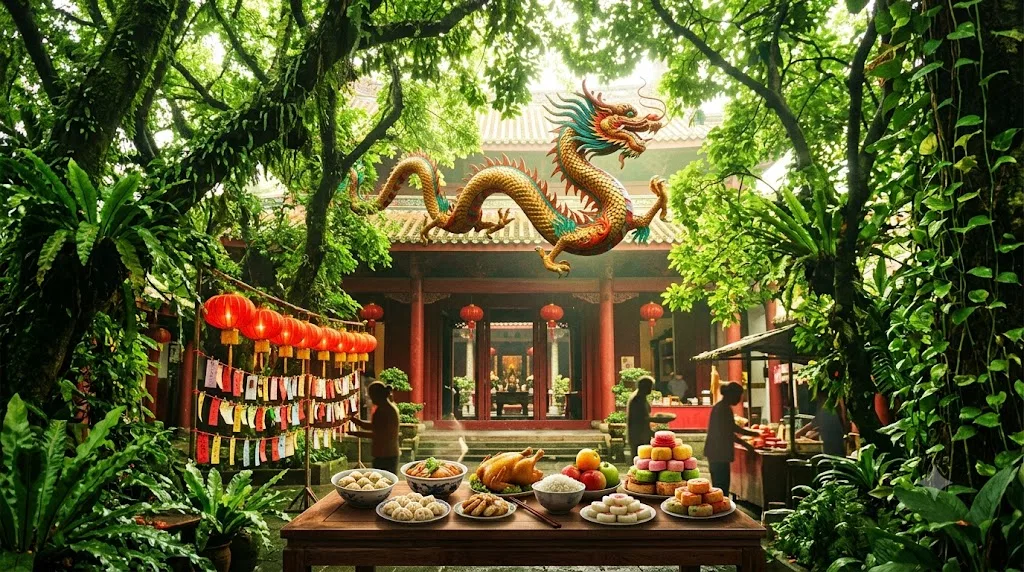
Chinese folklore is distinctive because it often refuses to separate story from conduct. A dragon is not just a monster; it may signal rain, imperial power, success or cosmic balance. A ghost story is not only a scare tale; it may ask whether the dead have been properly honoured. A festival legend is not just an origin story; it explains why a family hangs decorations, eats a seasonal food, visits graves or races boats.
This is partly because Chinese popular religion developed through overlapping systems rather than one exclusive creed. Local belief, ancestor veneration, Daoist ritual, Buddhist afterlife ideas and Confucian family ethics could sit beside each other in the same household or temple culture. Columbia University’s Asia for Educators describes premodern Chinese religious life as one in which Buddhist stories, popular temple art, ritual specialists and storytellers circulated across a society where many people encountered sacred narratives through performance and images rather than formal scripture.[Asia for Educators]afe.easia.columbia.eduAsia for Educators
That overlap matters for folklore. The same supernatural figure might appear as a temple god in one setting, a stage character in another, a protective household image in another, and a modern film character in another. The tradition is therefore best understood as a web of retellings rather than a fixed “mythology book”.
Dragons, tigers and protective beasts
For many readers, the Chinese dragon is the most recognisable figure in the country’s folklore. In much European tradition, dragons are often dangerous hoarders or enemies to be slain. In China, dragons are more often auspicious, associated with water, rainfall, authority, achievement and good fortune. A British Museum learning guide contrasts the European dragon-slaying pattern with the Chinese dragon’s long, snake-like form, imperial symbolism and continuing association with good luck.[British Museum]britishmuseum.orgBritish Museum In this issueBritish Museum In this issue
That does not mean every dragon tale is gentle. Chinese tradition includes dragon kings, storm powers, river beings and dramatic conflicts with heroes or gods. But the dominant public image of the dragon is not simply “monster”. It is closer to a charged emblem of power that can be cosmic, royal, watery, protective or celebratory depending on the context.
Other animals also carry protective force. The British Museum’s discussion of Chinese talismanic tigers notes that tigers represented bravery and could function as defensive symbols against harm. This helps explain why animal imagery in Chinese folklore often appears on prints, clothing, charms, doors and children’s objects: the image is not merely decorative, but part of a wider belief that symbols can guard people and households.[British Museum]britishmuseum.orgchinas talismanic tigerschinas talismanic tigers
A good way to read Chinese folk creatures is to ask what work they do. Some protect thresholds. Some explain weather and landscape. Some warn against moral failure. Some bless marriage, children, wealth or examination success. Others mark the dangerous edges between human society and the wild, the dead, the seductive or the unknown.

Ghosts, ancestors and the moral world of the dead
Ghosts occupy a central place in Chinese folklore because the dead are not imagined as simply gone. Ancestors may protect descendants if properly honoured; neglected or wandering spirits may become troublesome; gods and ghosts may be treated through ritual, offerings and moral negotiation. This is why Chinese ghost tradition often feels less like horror for its own sake and more like a social order extending beyond death.
The distinction between Qingming, the spring grave-sweeping festival, and the later Ghost Festival is useful. Qingming centres strongly on remembering and tending ancestral graves, while the Ghost Festival is associated more broadly with spirits of the dead, including wandering or hungry ghosts. EBSCO’s overview of the Ghost Festival describes it as a Daoist and Buddhist festival connected with spirits visiting the living during the seventh lunar month, while a Guardian explainer on Qingming notes its grave-sweeping, offerings, spring outing customs and weather lore.[EBSCO]ebsco.comOpen source on ebsco.com.
In older ghost stories, the dead may demand justice, food, burial, recognition or revenge. They are frightening because obligations have failed. This is why the ghost in Chinese folklore is often not just a “spooky figure” but a sign that a relationship has broken down: between parent and child, official and victim, husband and wife, host and guest, living and dead.
The literary tradition of strange tales developed this world in memorable form. Scholars use the term “records of the strange” for classical tales about encounters with ghosts, spirits, monsters and anomalies; one open-access academic chapter describes this as a major home of Chinese ghost narratives. Pu Songling’s later Strange Tales from a Chinese Studio, written in the late seventeenth and early eighteenth centuries and printed in 1766, gathered and reshaped hundreds of supernatural tales involving ghosts, fox spirits, scholars, judges and uncanny bargains.[JSTOR]jstor.orgHumanisation of Chinese Ghosts in Chinese ZhiguaiHumanisation of Chinese Ghosts in Chinese Zhiguai
Fox spirits and shape-shifting desire
Fox spirits are among the most fascinating beings in Chinese folklore because they are morally unstable. They may be dangerous seducers, loyal lovers, clever teachers, social climbers, demonic tricksters or beings seeking refinement and immortality. They often cross the boundary between animal and human, wild and civilised, desire and danger.
Modern summaries sometimes reduce the fox spirit to a femme fatale. That is too simple. The older tradition is richer. Fox spirits can expose hypocrisy, reward kindness, punish cruelty or reveal the fragility of male scholarly virtue. In Strange Tales from a Chinese Studio, fox and ghost lovers often blur the line between supernatural danger and emotional sincerity, which is one reason the stories remain so adaptable for theatre, film and television.[Wikipedia]WikipediaStrange Tales from a Chinese StudioStrange Tales from a Chinese Studio
The fox spirit also shows how Chinese folklore travels across East Asia. The nine-tailed fox motif moved into Korean, Japanese and Vietnamese traditions, where it took on local names and meanings. That shared regional life does not make the creature less Chinese in origin; it shows how Chinese literary and religious culture helped shape a wider East Asian supernatural vocabulary.[Wikipedia]WikipediaFox spiritFox spirit
Famous legends every reader should know
China’s best-known legends often survive because they moved between oral telling, poetry, drama, novels, opera, painting, local tourism and screen adaptation. Their “oldest version” is rarely the only important one. A legend may begin as a short poem, grow into theatre, become a regional attraction, and then reappear in film or animation.
The Monkey King is one of the clearest examples. The character is now inseparable from the sixteenth-century novel Journey to the West, one of the great works of Chinese literature, but Monkey-related pilgrimage stories are older. A specialist Journey to the West research site notes evidence of Monkey Pilgrim imagery in Gansu cave paintings from the eleventh century, long before the Ming-dynasty novel took its famous form.[Journey to the West Library]journeytothewestlibrary.comOpen source on journeytothewestlibrary.com.
The Monkey King matters because he is not only comic or magical. He is a rebel, trickster, martial hero, spiritual student and disruptive force gradually folded into a Buddhist quest. His appeal lies in that tension: he is lovable because he breaks rules, but the story also asks how wild power can be disciplined.
Mulan is different. Her earliest core is a short northern ballad, usually dated to the fifth or sixth century, about a daughter who takes her father’s place in military service. Columbia’s Asia for Educators presents the poem as a primary source from a period when north and south China were divided and northern rulers included non-Han groups. Modern adaptations often make the story a patriotic national epic or a feminist coming-of-age drama, but the old poem is spare, practical and strikingly unsentimental.[Asia for Educators]afe.easia.columbia.eduAsia for Educators The Ballad of Mulan (Ode of MulanAsia for Educators The Ballad of Mulan (Ode of Mulan
The White Snake is a romantic supernatural legend centred on a snake spirit who becomes a woman and loves a human man. Google Arts & Culture describes it as a famous Chinese folktale with roots associated with the Tang dynasty and later spread through novels, opera, shadow plays and films. Scholarship on the tale stresses that there is no single dominant version: across late imperial performance traditions, the story’s moral centre shifts between demonic deception, faithful love, religious authority and tragic separation.[Google Arts & Culture]artsandculture.google.comOpen source on google.com.
These three examples show why Chinese folklore cannot be reduced to “ancient myth”. It is a tradition of repeated remaking. The story people know today may be a literary classic, a temple performance, a children’s version, a television memory or an international film adaptation.
Festivals where story becomes action
Chinese festivals are among the clearest places where folklore becomes public life. The official modern calendar recognises major traditional holidays such as Spring Festival, Qingming, the Dragon Boat Festival and the Mid-Autumn Festival, but the meanings attached to them are older, layered and regionally varied.[raider.pressbooks.pub]raider.pressbooks.pubOpen source on pressbooks.pub.
Spring Festival, widely known in English as Chinese New Year, is surrounded by customs of renewal, household protection and good fortune: red decorations, firecrackers, door images, family reunion meals and lucky phrases. The popular monster story of the Year Beast explains why noise, red colour and light drive away danger at the turn of the year. A Confucius Institute retelling presents the monster as a fierce beast that came ashore at year’s end to attack people and livestock, before villagers learned how to frighten it away.[confuciusinstitute.ac.uk]confuciusinstitute.ac.ukOpen source on confuciusinstitute.ac.uk.
The Dragon Boat Festival is one of the strongest examples of a festival with both local ritual and national heritage status. UNESCO’s listing describes a combination of sacrifice to a local hero, dragon races, boating, feasting and related customs. In popular telling, the festival is often linked with the poet-official Qu Yuan, but its ritual life also includes older concerns with protection, water, seasonal danger and community identity.[ICH UNESCO]ich.unesco.orgDragon Boat festivalA memorial ceremony offering sacrifices to a local hero is combined with sporting events such as dragon rac…
The Mid-Autumn Festival centres on the full moon, family reunion and stories of the moon goddess. It is often presented gently today through mooncakes, lanterns and family gatherings, but its folklore also belongs to a wider world of immortality, separation, longing and celestial distance.
Qingming, by contrast, is quieter and earthier. It joins seasonal renewal with grave visits, offerings and family remembrance. The fact that the same festival can involve both spring outings and tomb care says much about Chinese folklore’s emotional range: life, death, family and landscape are not neatly separated.[The Guardian]theguardian.comThe Guardian Weatherwatch: 'Clear and brightThe Guardian Weatherwatch: 'Clear and bright
Sacred places, local gods and regional voices
A country-level page on China has to be careful: there is no single local folklore. China contains many languages, ethnic groups, landscapes and regional histories. Folklore from the northeast, the central plains, the lower Yangtze, Fujian, Tibet, Xinjiang, Yunnan or the southern coast may differ sharply in form and emphasis.
Local gods are especially important. Temples to city gods, sea goddesses, mountain powers, plague deities, warrior protectors and ancestors turn folklore into place-based religion. Mazu belief and customs, centred on a sea goddess with strong coastal and maritime devotion, are listed by UNESCO as Chinese intangible cultural heritage. Her cult is especially important for understanding how folklore follows migration and trade routes across coastal China and beyond.[ICH UNESCO]ich.unesco.orgICH UNESCOChinaDragon Boat festival. China. Mazu belief and customs. China. China engraved block printing technique. China. 2008. Representative List of…
Oral traditions also matter beyond the Han majority frame that often dominates English-language summaries. Hezhen storytelling, for instance, is recognised by UNESCO as an oral tradition in need of urgent safeguarding. UNESCO materials describe it as including myths, songs, legends and explanations of beliefs, reminding readers that Chinese folklore includes minority traditions whose survival may depend on language transmission, performance contexts and active safeguarding.[ICH UNESCO]ich.unesco.orgOpen source on unesco.org.
This is where “Chinese folklore” becomes most interesting and most difficult. The national frame is useful for orientation, but the real tradition is local: a bridge associated with the White Snake, a temple procession for a sea goddess, a village paper-cut image, a ghost story tied to a grave, a mountain said to house immortals, or a seasonal custom kept by one community and forgotten by another.
Old tradition, literary invention and modern media
One common mistake is to treat every famous Chinese legend as an ancient oral survival. Some are old, some are literary, and many are both. Mulan’s early ballad is brief and probably rooted in northern frontier culture; later plays and films add motives, romance, villains, costumes and national meanings. The Monkey King draws on older pilgrimage and monkey-spirit material, but his best-known form belongs to a major Ming novel. The White Snake has older roots but became widely known through changing performance and print traditions.[columbia.edu]afe.easia.columbia.eduAsia for Educators The Ballad of Mulan (Ode of MulanAsia for Educators The Ballad of Mulan (Ode of Mulan
This distinction does not make later versions “fake”. Folklore often lives by adaptation. A stage version can become more influential than an older text. A film can introduce a legend to people who will never read the classical source. A tourist site can preserve a story while also simplifying it.
The modern media life of Chinese folklore is especially visible in opera, television, animation, games and fantasy cinema. Strange Tales from a Chinese Studio has inspired ghost-romance and painted-skin adaptations; Journey to the West remains a deep reservoir for comics, games and screen heroes; Mulan has become a global story, although international versions often reshape the legend around modern expectations of individual identity and empowerment.[Wikipedia]WikipediaStrange Tales from a Chinese StudioStrange Tales from a Chinese Studio
For readers, the useful question is not “which version is the real one?” but “what kind of version am I looking at?” An antiquarian collection, a temple ritual, a children’s picture book, a government heritage listing, a local opera and a streaming fantasy drama may all preserve something, but each does different cultural work.
How to read Chinese folklore without flattening it
The best way to approach Chinese folklore is to keep three distinctions in mind.
First, distinguish belief from story. A ghost tale may reflect actual ritual concerns about the dead without proving that every listener treated the specific story as literal fact. A dragon may be a mythic being, a decorative emblem, a rain symbol and a political image at the same time.
Second, distinguish national fame from local practice. The Monkey King and Mulan are famous across China and beyond, but local temple festivals, minority epics, household customs and regional ghost stories may be just as important to the communities that keep them.
Third, distinguish old sources from living heritage. UNESCO listings, museum collections and academic translations help document traditions, but festivals, opera performances, family rituals, online retellings and tourist narratives show how those traditions keep changing. The Dragon Boat Festival is a good example: it is both anciently framed and officially recognised, both local and national, both ritual and sport.[ICH UNESCO]ich.unesco.orgDragon Boat festivalA memorial ceremony offering sacrifices to a local hero is combined with sporting events such as dragon rac…
China’s folklore endures because it is useful as well as beautiful. It explains why families honour ancestors, why certain images protect the home, why lovers meet under the moon, why a rebellious monkey can become a spiritual hero, why a snake spirit can be tragic rather than merely monstrous, and why the dead must not be forgotten. It is a folklore of thresholds: between human and animal, living and dead, village and cosmos, old tale and new performance.
Amazon book picks
Further Reading
Books and field guides related to Where Chinese Legends Still Shape Daily Life. Use these as the next step if you want deeper reading beyond the article.
Handbook of Chinese Mythology
Comprehensive guide to major Chinese folklore traditions.
Strange Tales from a Chinese Studio
Major source for ghosts, fox spirits, and folklore motifs.
eBay marketplace picks
Marketplace Samples
Live-tested eBay searches with available results related to this page.


Endnotes
1.
Source: ich.unesco.org
Title: ICH UNESCOChina
Link:https://ich.unesco.org/en/state/china-CN?info=elements-on-the-lists
Source snippet
Dragon Boat festival. China. Mazu belief and customs. China. China engraved block printing technique. China. 2008. Representative List of...
2.
Source: ich.unesco.org
Link:https://ich.unesco.org/en/RL/dragon-boat-festival-00225
Source snippet
Dragon Boat festivalA memorial ceremony offering sacrifices to a local hero is combined with sporting events such as dragon rac...
3.
Source: ich.unesco.org
Link:https://ich.unesco.org/doc/src/08266-EN.doc
4.
Source: afe.easia.columbia.edu
Title: Asia for Educators
Link:https://afe.easia.columbia.edu/cosmos/main/spirits_of_chinese_religion.pdf
5.
Source: ebsco.com
Link:https://www.ebsco.com/research-starters/religion-and-philosophy/ghost-festival-zhongyuan-festival
6.
Source: jstor.org
Title: Humanisation of Chinese Ghosts in Chinese Zhiguai
Link:https://www.jstor.org/content/oa_chapter_edited/j.ctv2t4d7f.17?seq=1
7.
Source: Wikipedia
Title: Strange Tales from a Chinese Studio
Link:https://en.wikipedia.org/wiki/Strange_Tales_from_a_Chinese_Studio
8.
Source: Wikipedia
Title: Fox spirit
Link:https://en.wikipedia.org/wiki/Fox_spirit
9.
Source: Wikipedia
Title: Journey to the West
Link:https://en.wikipedia.org/wiki/Journey_to_the_West
10.
Source: afe.easia.columbia.edu
Title: Asia for Educators The Ballad of Mulan (Ode of Mulan)
Link:https://afe.easia.columbia.edu/ps/china/mulan.pdf
11.
Source: time.com
Link:https://time.com/5881064/mulan-real-history/
Source snippet
The 2020 film has received backlash for historical inaccuracies in costume and architecture and controversy over ties to political issues...
12.
Source: artsandculture.google.com
Link:https://artsandculture.google.com/story/legend-of-the-white-snake/CgVhg_73SS0vJA?hl=en
13.
Source: raider.pressbooks.pub
Link:https://raider.pressbooks.pub/chineseculture/chapter/1-traditional-chinese-holidays/
14.
Source: confuciusinstitute.ac.uk
Link:https://www.confuciusinstitute.ac.uk/the-legend-of-the-beast-nian-origins-of-chinese-new-year/
15.
Source: ich.unesco.org
Link:https://ich.unesco.org/en/decisions/4.COM/13.12
16.
Source: ich.unesco.org
Title: 17330 EN
Link:https://ich.unesco.org/doc/src/17330-EN.pdf?v=1344431951
17.
Source: Wikipedia
Title: Chinese mythology
Link:https://en.wikipedia.org/wiki/Chinese_mythology
18.
Source: Wikipedia
Title: Hua Mulan
Link:https://en.wikipedia.org/wiki/Hua_Mulan
19.
Source: Wikipedia
Title: Legend of the White Snake
Link:https://en.wikipedia.org/wiki/Legend_of_the_White_Snake
20.
Source: Wikipedia
Title: Chinese folk religion
Link:https://en.wikipedia.org/wiki/Chinese_folk_religion
21.
Source: Wikipedia
Title: Ghost Festival
Link:https://en.wikipedia.org/wiki/Ghost_Festival
22.
Source: Wikipedia
Title: Classic of Mountains and Seas
Link:https://en.wikipedia.org/wiki/Classic_of_Mountains_and_Seas
23.
Source: ich.unesco.org
Title: 01857 EN
Link:https://ich.unesco.org/doc/src/01857-EN.pdf
24.
Source: ich.unesco.org
Link:https://ich.unesco.org/en/video/1406
25.
Source: ich.unesco.org
Title: ITH 11 6.CO M CONF.206 Decisions EN.doc
Link:https://ich.unesco.org/doc/src/ITH-11-6.COM-CONF.206-Decisions-EN.doc
26.
Source: ich.unesco.org
Title: china CN
Link:https://ich.unesco.org/en/state/china-CN
27.
Source: ich.unesco.org
Title: 06859 EN
Link:https://ich.unesco.org/doc/src/06859-EN.pdf
28.
Source: ich.unesco.org
Title: photo pop up 00973
Link:https://ich.unesco.org/en/photo-pop-up-00973?photoID=01097
29.
Source: ich.unesco.org
Title: 00010 EN
Link:https://ich.unesco.org/doc/src/00010-EN.pdf
30.
Source: ich.unesco.org
Link:https://ich.unesco.org/en/Decisions/19.COM/7.c.3
31.
Source: ich.unesco.org
Title: 43041 EN.docx
Link:https://ich.unesco.org/doc/src/43041-EN.docx
32.
Source: ich.unesco.org
Title: photo pop up 00973
Link:https://ich.unesco.org/en/photo-pop-up-00973?id=01406&include=film_inc.php
33.
Source: ich.unesco.org
Title: oral traditions and expressions 00053
Link:https://ich.unesco.org/en/oral-traditions-and-expressions-00053
34.
Source: ich.unesco.org
Title: ITH 09 4.CO M CONF.209 Decisions EN.doc
Link:https://ich.unesco.org/doc/src/ITH-09-4.COM-CONF.209-Decisions-EN.doc
35.
Source: ich.unesco.org
Link:https://ich.unesco.org/en/project
36.
Source: ich.unesco.org
Link:https://ich.unesco.org/en/lists
37.
Source: ich.unesco.org
Title: 16658 EN.doc
Link:https://ich.unesco.org/doc/src/16658-EN.doc
38.
Source: ebsco.com
Link:https://www.ebsco.com/research-starters/literature-and-writing/ballad-mulan
39.
Source: pressbooks.pub
Title: exploring ideology in imperial china through the lens of chinese ghost stories
Link:https://pressbooks.pub/chin330/chapter/exploring-ideology-in-imperial-china-through-the-lens-of-chinese-ghost-stories/
40.
Source: britishmuseum.org
Title: British Museum In this issue
Link:https://www.britishmuseum.org/sites/default/files/2019-10/Issue%2059.pdf
41.
Source: britishmuseum.org
Title: chinas talismanic tigers
Link:https://www.britishmuseum.org/blog/chinas-talismanic-tigers
42.
Source: theguardian.com
Title: The Guardian Weatherwatch: ‘Clear and bright’
Link:https://www.theguardian.com/news/2024/apr/11/weatherwatch-clear-and-bright-the-start-of-qingming-in-the-chinese-calendar
43.
Source: journeytothewestlibrary.com
Link:https://www.journeytothewestlibrary.com/
44.
Source: britishmuseum.org
Link:https://www.britishmuseum.org/collection
45.
Source: britishmuseum.org
Title: samurai large print guide
Link:https://www.britishmuseum.org/exhibitions/samurai/samurai-large-print-guide
46.
Source: britishmuseum.org
Link:https://www.britishmuseum.org/shop
47.
Source: britishmuseum.org
Title: introducing scythians
Link:https://www.britishmuseum.org/blog/introducing-scythians
48.
Source: britishmuseum.org
Title: historys most famous pot meidias hydria
Link:https://www.britishmuseum.org/blog/historys-most-famous-pot-meidias-hydria
49.
Source: britishmuseum.org
Title: Money Gallery LPG 2020 Room 68
Link:https://www.britishmuseum.org/sites/default/files/2021-05/Money_Gallery_LPG_2020_Room_68.pdf
50.
Source: beastsoflegend.com
Link:https://beastsoflegend.com/bestiary/asia-2/east-asia/china/
51.
Source: english.ecnu.edu.cn
Link:https://english.ecnu.edu.cn/content.jsp?urltype=news.NewsContentUrl&wbnewsid=1237&wbtreeid=1599
52.
Source: globalchinacenter.org
Title: chinese popular religion
Link:https://www.globalchinacenter.org/analysis/2004/06/08/chinese-popular-religion
53.
Source: lcc.ujs.edu.cn
Link:https://lcc.ujs.edu.cn/info/1081/1298.htm
54.
Source: ink.library.smu.edu.sg
Title: Chan BodiesOfGods 2012 AFV
Link:https://ink.library.smu.edu.sg/context/soss_research/article/2487/viewcontent/Chan_BodiesOfGods_2012_AFV.pdf
55.
Source: brothersjudd.com
Link:https://brothersjudd.com/index.cfm/fuseaction/reviews.detail/book_id/2155/mulan.htm
56.
Source: jflc.hunnu.edu.cn
Link:https://jflc.hunnu.edu.cn/__local/5/EF/BE/B4F62697E80C66D666A650D9AF7_EDE0C3B0_A9EFD.pdf
57.
Source: dr.ntu.edu.sg
Link:https://dr.ntu.edu.sg/bitstreams/1ec7e968-78b6-4da7-951d-06ad1b526a43/download
58.
Source: library.hkust.edu.hk
Title: beyond text interactive journey through classic mountains and seas shan hai jing
Link:https://library.hkust.edu.hk/news-events/news/beyond-text-interactive-journey-through-classic-mountains-and-seas-shan-hai-jing
Additional References
59.
Source: lemonde.fr
Link:https://www.lemonde.fr/en/international/article/2025/04/05/in-taiwan-mazu-goddess-of-the-sea-and-chinese-influence_6739855_4.html
Source snippet
Despite warnings from Taipei and travel restrictions on some religious figures, many Taiwanese, including religious leaders like temple d...
60.
Source: youtube.com
Title: The ENTIRE Story of Chinese Mythology – Full Detailed Documentary
Link:https://www.youtube.com/watch?v=si38B0uFTmE
Source snippet
The Legend of the Eight Immortals – Chinese Mythology...
61.
Source: youtube.com
Title: The Legend of the Eight Immortals – Chinese Mythology
Link:https://www.youtube.com/watch?v=ZBHKxUQt8A8
Source snippet
The Complete Story of Chinese Mythology: Gods, Myths and Legends...
62.
Source: researchgate.net
Link:https://www.researchgate.net/publication/361613572_Strange_Ghosts_Asian_Reconfigurations_of_the_Chinese_Ghost_Story
63.
Source: takaoclub.com
Link:https://www.takaoclub.com/foxmyths/chinese_fox_myths.htm
64.
Source: academia.edu
Link:https://www.academia.edu/35948514/Chinese_Gods_Ghosts_Ancestors_and_their_Neighbours_An_observation_through_fieldwork
65.
Source: advantour.com
Link:https://www.advantour.com/china/culture/chinese-mythology.htm
66.
Source: historycooperative.org
Link:https://historycooperative.org/chinese-mythology/
67.
Source: twinkl.co.uk
Link:https://www.twinkl.co.uk/resource/us2-t-135-chinese-new-year-the-myth-of-nian-story-powerpoint
68.
Source: academia.edu
Link:https://www.academia.edu/Documents/in/Chinese_festivals
Topic Tree
Follow this branch
Related pages 192
- Afghan Folklore
- Albanian Folklore
- Algerian Folklore
- Australian Folklore
- Azerbaijan Folklore
- +187 more in sidebar