South Africa's Uncanny Folklore
South African folklore is not one tradition but a meeting ground of many: San and Khoekhoe oral narratives, Zulu, Xhosa, Sotho, Tswana, Venda and other regional story-worlds, Afrikaans and Cape legends, maritime ghost lore, Christian and African religious ideas, children’s literature, popular music, film and internet retellings.
Page outline Jump by section
Why South African folklore is so diverse
South Africa’s folklore reflects the country’s languages, landscapes and histories. Stories differ between coastal towns, highveld settlements, mountain regions, rural households, mining towns and cities. A tale may belong to a particular family, language community or region, yet later circulate nationally through schoolbooks, radio, newspapers, tourism, theatre or social media. That is why South African folklore is best understood as a layered field rather than a fixed list of “official myths”.
The oldest written records of southern African oral tradition include the nineteenth-century Bleek and Lloyd collection, a major archive of San narratives, language, drawings and ethnographic notes. The Digital Bleek and Lloyd archive at the University of Cape Town makes scans of notebooks, drawings and related material available online, including extensive records of San stories about land, rain, animals, the moon and the first people. UNESCO lists the Bleek Collection in its Memory of the World register, recognising its global documentary importance.[uct.ac.za]digitalbleeklloyd.uct.ac.zaDigital Bleek & Lloyd The Digital Bleek and Lloyd ArchiveDigital Bleek & Lloyd The Digital Bleek and Lloyd Archive
That archive is invaluable, but it also reminds readers to be careful. Many San stories were recorded under colonial conditions, often after violence, dispossession and imprisonment had already shattered older communities. The archive preserves voices that might otherwise have been lost, but it is not the same thing as hearing a tradition in its full social setting. For modern readers, the best approach is to treat the material as testimony, literature, memory and cultural evidence at once, while remembering the unequal circumstances in which much of it was written down.[Google Books]books.google.comOpen source on google.com.
San stories, rock art and the spirit of the landscape
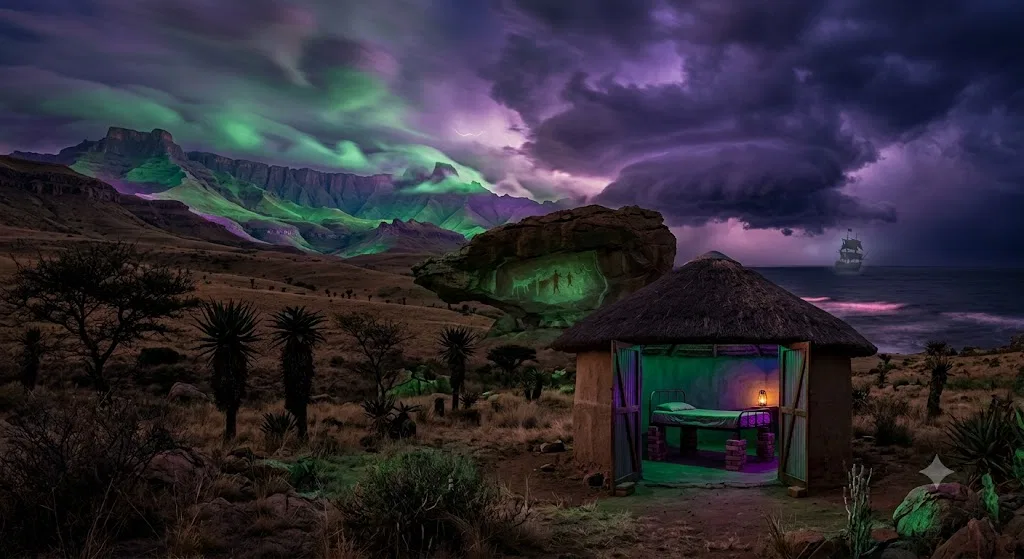
For many readers, South Africa’s deepest folklore begins with San narratives and rock art. These traditions often blur the line between animal, human and spirit. The Mantis, eland, rain animals, moon, stars and transformed beings appear not as decorative “characters” but as part of a world where animals, weather and ritual power are closely connected.
Rock art in the Drakensberg and other southern African regions has often been interpreted through San religious ideas, especially trance, healing and rainmaking. The Origins Centre at the University of the Witwatersrand explains the San trance dance as a ritual performed for healing, social cohesion and rain, and notes that such ritual and spirit-world themes are frequently depicted in rock art.[Google Arts & Culture]artsandculture.google.comOpen source on google.com. Academic work on San rock art likewise connects images of rain animals with beliefs that ritual specialists could capture or control rain in visionary form.[unisapressjournals.co.za]unisapressjournals.co.zaAnimal Studies, Decoloniality and San Rock Art and MythAnimal Studies, Decoloniality and San Rock Art and Myth
One memorable example is the “rain animal”. In some interpretations, rain is imagined as an animal that can be led across the land and ritually killed, its blood or milk becoming rainfall. This is not just a quaint nature metaphor. It shows a worldview in which weather, animals, ritual action and survival are woven together. In dry landscapes, rain is not background scenery; it is life, danger, blessing and power.[Bradshaw Foundation]bradshawfoundation.comOpen source on bradshawfoundation.com.
San mythology also influenced South African literature and children’s books. Scholars of South African children’s literature note how twentieth-century and post-apartheid writers drew on San and other African folktale traditions, sometimes to recover a suppressed past and sometimes to create a shared national children’s literature after apartheid.[South African History Online]sahistory.org.zaSouth African History Onlinesouth african english children's literatureSouth African History Onlinesouth african english children's literature This is one of the recurring tensions in South African folklore: old oral material can be preserved, celebrated and reimagined, but it can also be simplified, romanticised or detached from the people whose knowledge it was.
The tokoloshe: fear, witchcraft and modern life
The tokoloshe is probably South Africa’s most widely recognised folk creature. It is usually described as a small, dangerous night being associated with witchcraft, harm, sexual threat, illness and misfortune. In popular retellings it is often made goblin-like or comic, but in many belief contexts it is not a joke. A 2024 study of AmaXhosa participants in rural Eastern Cape communities found that the tokoloshe was discussed as a real supernatural threat linked to witchcraft, fear and mental health.[ResearchGate]researchgate.netResearch Gate"i will not lie to you. the tokoloshe exists": mythicalResearch Gate"i will not lie to you. the tokoloshe exists": mythical
The same study is useful because it does not treat belief merely as “superstition”. Instead, it asks how a frightening supernatural figure affects people’s emotional lives, their explanations of misfortune and their sense of safety. Participants described the tokoloshe as an evil spirit sent by a witch to cause harm. The authors argue that mental-health work in South Africa needs to take such cultural beliefs seriously, not by confirming supernatural claims, but by understanding the world in which patients and communities interpret fear, illness and danger.[ResearchGate]researchgate.netResearch Gate"i will not lie to you. the tokoloshe exists": mythicalResearch Gate"i will not lie to you. the tokoloshe exists": mythical
This distinction matters. Folklore is not only a collection of entertaining tales; it can shape behaviour. Stories about the tokoloshe have been linked in popular culture with raising beds above the floor, avoiding certain places at night or seeking help from religious or traditional specialists. Some claims about the tokoloshe are heavily sensationalised online, especially in horror lists and creepypasta-style summaries, so careful writing should separate well-attested social belief from internet exaggeration.[ResearchGate]researchgate.netResearch Gate"i will not lie to you. the tokoloshe exists": mythicalResearch Gate"i will not lie to you. the tokoloshe exists": mythical
The tokoloshe also travels easily into modern media. It appears in South African jokes, cartoons, music, horror films and urban legends. That modern visibility does not make it fake folklore; it shows how folklore works. A frightening figure can move from rural oral tradition into newspapers, film, satire and memes while still retaining a serious role in some communities.
The Rain Queen and the sacred cycad forest
The Rain Queen, or Queen Modjadji, belongs to the Balobedu people of Limpopo and is one of South Africa’s most distinctive traditions linking rulership, rainmaking and sacred landscape. Museum and heritage sources describe Modjadji as a line of queens associated with the power to influence clouds and rainfall, with origins connected in tradition to the Karanga kingdom of Monomotapa in present-day Zimbabwe.[National Museum Publications]nationalmuseumpublications.co.zaNational Museum Publications Modjadji- The Rain Queen | NationalNational Museum Publications Modjadji- The Rain Queen | National
This is both political history and folklore. The Rain Queen is not simply a “mythical woman” invented for tourist brochures; she belongs to a real royal institution with a documented place in Balobedu society. At the same time, the queen’s authority is surrounded by narratives of rainmaking, secrecy, sacred power and unusual succession. The National Museum in Bloemfontein summarises the tradition as a line of Balobedu queens known for their ability to control clouds and rainfall, while Ditsong Museums describes the dynasty’s matrilineal succession and ritual seclusion.[National Museum Publications]nationalmuseumpublications.co.zaNational Museum Publications Modjadji- The Rain Queen | NationalNational Museum Publications Modjadji- The Rain Queen | National
The Modjadji Cycad Reserve gives the tradition a vivid landscape. South African tourism material describes the reserve as linked to the Rain Queen’s village and to legends of a rainmaking royal line, while the South African National Biodiversity Institute identifies the Modjadji cycad as abundant in the remarkable cycad forest at Modjadji but classed as Near Threatened because of pressures including collecting, habitat clearance, die-off and bark harvesting.[South Africa]southafrica.netOpen source on southafrica.net.
This makes the Rain Queen tradition more than a royal legend. It connects folklore to ecology. The sacredness of the forest, the queen’s rainmaking reputation and the conservation of cycads all reinforce one another. A reader visiting the story today is not just encountering a picturesque myth about rain; they are seeing how belief, landscape and environmental protection can become entangled.
Lightning birds, monsters and dangerous powers
South African supernatural tradition includes other feared beings besides the tokoloshe. One of the most striking is the lightning bird, often associated with Zulu and Xhosa folklore. It is commonly described as a bird linked to storms, witchcraft and blood, sometimes imagined as a familiar of witches. Sources vary in detail, and modern online accounts often borrow from one another, so it is best treated as a cluster of southern African beliefs rather than a single fixed monster story.[ResearchGate]researchgate.netResearch Gate(PDF) Some aspects of imagery in the poetry of S.M. BurnsResearch Gate(PDF) Some aspects of imagery in the poetry of S.M. Burns
The lightning bird shows how natural danger becomes story. Lightning is sudden, destructive and hard to predict; folklore gives it intention, personality and social meaning. In some accounts the bird is connected with witches and with harmful magic, which turns weather into a moral drama: a storm is no longer only a storm, but perhaps a sign of hidden hostility.
Another famous creature is the Grootslang, usually placed in the Richtersveld or near the Orange River: a giant serpent, sometimes mixed with elephant features, said to guard treasure or diamonds. The evidence for the Grootslang as old oral tradition is thinner and more mediated than for San narratives or the tokoloshe. It appears strongly in popular monster lore and in twentieth-century literary or antiquarian retellings, with later encyclopaedias and internet lists repeating the story. A cautious account should therefore describe it as a South African legendary creature with roots in regional storytelling and literary amplification, not as a uniformly ancient national myth.[Wikipedia]WikipediaOpen source on wikipedia.org.
These beings matter because they show two common patterns in South African folklore. First, danger is often localised: rivers, caves, storms, beds, mountain passes and forests become places where hidden forces act. Second, supernatural power is usually social. Monsters are rarely just monsters; they are tied to envy, witchcraft, greed, secrecy, broken taboos or disrespect for the land.
Cape ghosts and colonial legends
South African folklore also includes Cape colonial and maritime legends. The story of Van Hunks and the Devil explains Table Mountain’s “tablecloth” cloud as smoke from a pipe-smoking contest between a retired seaman and a mysterious stranger. The tale is widely told in Cape Town tourist culture, but its origins are not as old or simple as many retellings imply. Accounts of Devil’s Peak note that the name was formerly linked with Windberg or Charles Mountain, and that the Van Hunks story is better treated as later folklore and literary legend than as a proven origin of the mountain’s name.[Wikipedia]WikipediaDevil's Peak (Cape TownDevil's Peak (Cape Town
The Flying Dutchman is more international, but the Cape of Good Hope is central to its most famous form. The ghost ship is usually doomed to sail forever after its captain swears to round the Cape despite storm and divine judgement. Historical summaries trace printed versions of the legend to the late eighteenth and early nineteenth centuries, with the Cape’s dangerous seas giving the story its emotional force.[wikipedia.org]WikipediaFlying DutchmanFlying Dutchman
These Cape legends are different in texture from San rain animals or Nguni witchcraft beings. They come through seafaring, colonial settlement, European literary culture and local place-making. Yet they became South African because they attach themselves to recognisable South African landscapes: Table Mountain, Devil’s Peak, Table Bay and the Cape of Good Hope. Folklore often belongs to the place where people keep telling it, even when its ingredients have travelled.

Animal tricksters and everyday moral lessons
Animal tales are a major part of South African storytelling. Jackal, hyena, hare, tortoise, lion and mongoose appear in stories of cunning, greed, survival and social reversal. These tales are entertaining, but they also teach practical and moral intelligence: how the weak outwit the strong, how greed exposes fools, how speech can deceive, and how community rules are tested.
Afrikaans Jackal and Hyena stories, for example, draw heavily on African oral tradition, especially Khoekhoe material, while also raising questions about appropriation and retelling in children’s literature. A 2018 study of Jackal and Hyena stories argues that these animal figures moved from African oral literature into Afrikaans children’s literature through processes that included acknowledgement, adaptation and denial.[SciELO]scielo.org.zaOpen source on scielo.org.za.
Zulu trickster traditions include figures such as the small mongoose trickster and semi-human tricksters who move between animal and human worlds. Research on Zulu folktales describes the mongoose trickster as a cunning survivor who can escape larger animals or defeat them for food, while semi-human trickster figures can interact with both people and animals.[ResearchSpace]researchspace.ukzn.ac.zaOpen source on ukzn.ac.za.
For modern readers, the important point is that these stories are not childish leftovers. Trickster tales often flourish in societies undergoing pressure, inequality or rapid change because they give people a way to think about power without speaking in direct political language. Research on nineteenth-century southern African storytelling argues that women used trickster tales to make sense of, and sometimes critique, changing social and political orders.[SciELO]scielo.org.zaOpen source on scielo.org.za.
Folklore after apartheid: books, schools and performance
Since the end of apartheid, folklore has often been used to imagine a more inclusive South African cultural inheritance. Children’s books, school readers, storytelling festivals and public performances have helped move oral traditions into print, theatre and broadcast media. This process can preserve stories, but it can also reshape them for new audiences.
Nelson Mandela’s Madiba Magic, first published in South Africa in 2002, is a useful example. University of Cape Town reporting described it as a collection of 32 stories from southern and other parts of Africa, including South African, Lesotho, Swazi, Namibian, Botswanan and Cape Malay or Indian-linked tales.[UCT News]news.uct.ac.zaUCT News Spinning tales for that Madiba magicUCT News Spinning tales for that Madiba magic Children’s book sources describe the collection as bringing together African folk tales retold by leading South African storytellers and illustrated by South African artists.[Children's Book Network]childrensbook.co.zaOpen source on childrensbook.co.za.
Gcina Mhlophe is one of the most important modern South African storytelling figures. Literary festival profiles describe her as a major contributor to the revival of African storytelling tradition, while education and literature sources note her work across performance, children’s literature and oral tradition.[internationales literaturfestival berlin]literaturfestival.comOpen source on literaturfestival.com. Her career shows that folklore is not only something collected from the past. It is performed in the present, often by artists who consciously move between old forms and new media.
This modern revival also changes the reader’s question. Instead of asking only “Is this ancient?”, it is often better to ask: Who is telling this version? For children, tourists, local audiences, school pupils, theatre-goers or internet users? A folktale in a family setting, a museum label, a horror film and a national children’s anthology may all preserve something real, but they do different cultural work.
Belief, law and harm
Folklore becomes socially serious when supernatural belief intersects with accusation, violence or law. South Africa still has legal and public debates around witchcraft accusations, harmful practices and the colonial-era Witchcraft Suppression Act. A South African Law Reform Commission discussion paper notes that the existing Act does not deal adequately with killings and crimes committed to obtain body parts for so-called medicine, and treats such crimes as a serious societal concern.[Justice]justice.gov.zaJustice PROJECT 135 THE REVIEW OF THE WITCHCRAFTJustice PROJECT 135 THE REVIEW OF THE WITCHCRAFT
Legal scholarship has also argued that the Act failed to remove witchcraft belief or prevent violence connected with accusations.[WHRIN]whrin.orgCultural Denial: What South Africa's Treatment of WitchcraftCultural Denial: What South Africa's Treatment of Witchcraft This is important for any folklore page because it prevents romanticising the subject. Stories about witches, familiars, night spirits and magical harm can be meaningful parts of cultural life, but accusations against real people can lead to fear, exclusion or violence.
A balanced account must therefore hold two ideas together. First, South African supernatural traditions deserve respect as cultural narratives and lived belief systems. Second, belief should not be used to justify harm, scapegoating or abuse. Folklore is not automatically harmless just because it is traditional, and it is not automatically irrational nonsense just because it involves spirits. It is part of how people explain the world, and those explanations can comfort, frighten, entertain, teach or endanger.
How to read South African folklore today
The most useful way to approach South African folklore is to ask what kind of tradition you are looking at. Some stories are old oral narratives preserved in archives. Some are sacred or ritual traditions still connected to living communities. Some are literary retellings shaped for children or national culture. Some are tourist legends attached to famous places. Some are modern horror, satire or internet folklore.
A few practical distinctions help:
- Old oral tradition: San narratives in the Bleek and Lloyd archive, animal trickster tales, regional family storytelling and ritual knowledge.
- Living belief: tokoloshe fears, witchcraft-related explanations of misfortune, rainmaking traditions and sacred landscapes.
- Literary and educational retelling: children’s books, school readers, Madiba Magic, theatre and public storytelling.
- Place legend: Table Mountain’s cloud, Devil’s Peak, the Cape of Good Hope, haunted roads, caves and rivers.
- Modern reinvention: films, songs, memes, comics, horror lists and urban legends.
South African folklore matters because it is one of the country’s richest ways of thinking about place. Mountains smoke, rain becomes an animal, lightning turns into a bird, a forest protects a queenly power, a ghost ship circles the Cape, a trickster exposes greed, and a feared night spirit gives form to hidden anxieties. The stories are not all equally old, equally local or equally well documented, but together they reveal a country where landscape, danger, memory and imagination remain deeply intertwined.
Amazon book picks
Further Reading
Books and field guides related to What Haunts South African Folklore?. Use these as the next step if you want deeper reading beyond the article.
Myths and Legends of Southern Africa
Covers many traditions discussed in South African folklore.
African Myths of Origin
Introduces major storytelling traditions across the continent.
Specimens of Bushman Folklore
Foundational source for southern African oral narratives.
eBay marketplace picks
Marketplace Samples
Live-tested eBay searches with available results related to this page.

Endnotes
1.
Source: unesco.org
Title: The Bleek Collection
Link:https://www.unesco.org/en/memory-world/bleek-collection
2.
Source: books.google.com
Link:https://books.google.com/books/about/Claim_to_the_Country.html?id=D-BP0-NOrT0C
3.
Source: artsandculture.google.com
Link:https://artsandculture.google.com/story/trance-and-transformation-in-the-san-great-dance-origins-centre/-gXxnvHUJ2LNvA?hl=en
4.
Source: unisapressjournals.co.za
Title: Animal Studies, Decoloniality and San Rock Art and Myth
Link:https://unisapressjournals.co.za/index.php/jls/article/download/11580/5743/58864
5.
Source: researchgate.net
Title: Research Gate”i will not lie to you. the tokoloshe exists”: mythical
Link:https://www.researchgate.net/publication/377306178_I_WILL_NOT_LIE_TO_YOU_THE_TOKOLOSHE_EXISTS_MYTHICAL_CREATURES_AND_THEIR_INFLUENCE_ON_MENTAL_HEALTH_AMONGST_A_SAMPLE_OF_AMAXHOSA_IN_THE_EASTERN_CAPE_SOUTH_AFRICA
6.
Source: researchgate.net
Title: Research Gate(PDF) Some aspects of imagery in the poetry of S.M. Burns
Link:https://www.researchgate.net/publication/270028946_Some_aspects_of_imagery_in_the_poetry_of_SM_Burns-Ncamashe
7.
Source: Wikipedia
Title: Lightning bird
Link:https://en.wikipedia.org/wiki/Lightning_bird
8.
Source: Wikipedia
Link:https://en.wikipedia.org/wiki/Grootslang
9.
Source: Wikipedia
Title: Devil’s Peak (Cape Town)
Link:https://en.wikipedia.org/wiki/Devil%27s_Peak_%28Cape_Town%29
10.
Source: Wikipedia
Title: Table Mountain
Link:https://en.wikipedia.org/wiki/Table_Mountain
11.
Source: Wikipedia
Title: Flying Dutchman
Link:https://en.wikipedia.org/wiki/Flying_Dutchman
12.
Source: sites.pitt.edu
Link:https://sites.pitt.edu/~dash/type0777ast.html
13.
Source: literaturfestival.com
Link:https://literaturfestival.com/en/authors/gcina-mhlophe/
14.
Source: whrin.org
Title: Cultural Denial: What South Africa’s Treatment of Witchcraft
Link:https://www.whrin.org/wp-content/uploads/2013/03/Cultural-Denial-What-South-Africas-Treatment-of-Witchcraft-Says.pdf
15.
Source: Wikipedia
Link:https://en.wikipedia.org/wiki/%C7%80Kaggen
16.
Source: Wikipedia
Title: Rain Queen
Link:https://en.wikipedia.org/wiki/Rain_Queen
17.
Source: Wikipedia
Link:https://en.wikipedia.org/wiki/Tokoloshe
18.
Source: Wikipedia
Title: San rock art
Link:https://en.wikipedia.org/wiki/San_rock_art
19.
Source: Wikipedia
Title: Gcina Mhlophe
Link:https://en.wikipedia.org/wiki/Gcina_Mhlophe
20.
Source: researchgate.net
Link:https://www.researchgate.net/publication/236163099_Trickster_tropes_Female_storytelling_and_the_re-imagination_of_social_orders_in_four_nineteenth-century_southern_African_communities
21.
Source: researchgate.net
Link:https://www.researchgate.net/publication/378327077_Convening_Context_Reading_the_Bleek_and_Lloyd_xun_Collection_Digitally
22.
Source: researchgate.net
Title: 283907125 THE CYCADS OF SOUTHERN AFRICA
Link:https://www.researchgate.net/publication/283907125_THE_CYCADS_OF_SOUTHERN_AFRICA
23.
Source: researchgate.net
Title: 233016931 The role of birds in the culture of the Ndebele people of Zimbabwe
Link:https://www.researchgate.net/publication/233016931_The_role_of_birds_in_the_culture_of_the_Ndebele_people_of_Zimbabwe
24.
Source: researchgate.net
Link:https://www.researchgate.net/publication/351230053_University_of_Pittsburgh-Of_the_Commonwealth_System_of_Higher_Education_Bushmen_as_Mediators_in_Nguni_Cosmology
25.
Source: researchgate.net
Title: 45681366 African witchcraft in theological perspective
Link:https://www.researchgate.net/publication/45681366_African_witchcraft_in_theological_perspective
26.
Source: researchgate.net
Link:https://www.researchgate.net/publication/309487275_Lightning_injuries
27.
Source: researchgate.net
Link:https://www.researchgate.net/publication/360263584_Common_Divine_Healing_Themes_in_Ancient_Greek_and_Traditional_Zulu_Culture
28.
Source: researchgate.net
Link:https://www.researchgate.net/profile/Roger-Sansi/publication/284723320_Sorcery_in_the_Black_Atlantic/links/60c1d1f94585157774c2d493/Sorcery-in-the-Black-Atlantic.pdf
29.
Source: researchgate.net
Link:https://www.researchgate.net/publication/390261335_Petrus-Roelofse-Phillips-Maritz_Acta_Criminologica_Southern_African_Journal_of_Criminology_3122018_168_RETHINKING_OCCULTISM_AND_CRIME_SATANISM_THE_OCCULT_AND_YOUTH_GANG_SUBCULTURES_IN_THE_GLOBAL_AND_S
30.
Source: researchgate.net
Link:https://www.researchgate.net/publication/230791057_High_levels_of_vulnerability_and_anticipated_stigma_reduce_the_impetus_for_tuberculosis_diagnosis_in_Cape_Town_South_Africa
31.
Source: researchgate.net
Link:https://www.researchgate.net/publication/401583311_RAINMAKING_THROUGH_THE_ROCK_ART_IN_EAST_AND_SOUTH_AFRICA_A_COMPARISON_WITH_CURRENT_TRADITIONAL_TRIBES
32.
Source: researchgate.net
Link:https://www.researchgate.net/publication/268301558_The_imagistic_web_of_San_myth_art_and_landscape
33.
Source: researchgate.net
Link:https://www.researchgate.net/publication/398465329_46556_Witchcraft_Suppression_Act_and_Witchcraft_Commissions
34.
Source: journals.co.za
Title: AJA10168427 126
Link:https://journals.co.za/doi/pdf/10.10520/AJA10168427_126
35.
Source: journals.co.za
Title: AJA10231757 470
Link:https://journals.co.za/doi/pdf/10.10520/AJA10231757_470
36.
Source: journals.co.za
Link:https://journals.co.za/doi/10.1080/0035919X.2023.2244923
37.
Source: journals.co.za
Title: AJA10168427 145
Link:https://journals.co.za/doi/pdf/10.10520/AJA10168427_145
38.
Source: archive.org
Link:https://archive.org/details/treasuryofafrica00cour
39.
Source: archive.org
Title: Specimens Of Bushman Folklore
Link:https://archive.org/details/specimens-of-bushman-folklore-wilhelm-bleek
40.
Source: archive.org
Link:https://archive.org/details/cu31924029904830
41.
Source: archive.org
Title: nelsonmandelasfa00nels 0
Link:https://archive.org/details/nelsonmandelasfa00nels_0
42.
Source: books.google.com
Title: Madiba Magic
Link:https://books.google.com/books/about/Madiba_Magic.html?id=6NOBAAAAMAAJ
43.
Source: books.google.com
Title: Stories of Africa
Link:https://books.google.com/books/about/Stories_of_Africa.html?id=kORZAAAACAAJ
44.
Source: unisapressjournals.co.za
Link:https://unisapressjournals.co.za/index.php/AJNM/article/view/1487
45.
Source: youtube.com
Link:https://www.youtube.com/watch?v=7kbFkKC008U
Source snippet
Africa's Weather Controllers: The Balobedu Rain Queens...
46.
Source: digitalbleeklloyd.uct.ac.za
Title: Digital Bleek & Lloyd The Digital Bleek and Lloyd Archive
Link:https://digitalbleeklloyd.uct.ac.za/
47.
Source: open.uct.ac.za
Link:https://open.uct.ac.za/server/api/core/bitstreams/3f7c28ff-96de-4905-b777-7d06cc5d510d/content
48.
Source: bradshawfoundation.com
Link:https://www.bradshawfoundation.com/south_africa/san_rock_art/index.php
49.
Source: sahistory.org.za
Title: South African History Onlinesouth african english children’s literature
Link:https://sahistory.org.za/sites/default/files/archive-files/elwyn_jenkins_national_character_in_south_africabook4me.org_.pdf
50.
Source: nationalmuseumpublications.co.za
Title: National Museum Publications Modjadji- The Rain Queen | National
Link:https://nationalmuseumpublications.co.za/modjadji-the-rain-queen/
51.
Source: southafrica.net
Link:https://www.southafrica.net/gl/en/travel/article/ancient-cycads-modjadji-cycad-reserve-limpopo
52.
Source: scielo.org.za
Link:https://scielo.org.za/scielo.php?pid=S0041-476X2018000300008&script=sci_arttext
53.
Source: researchspace.ukzn.ac.za
Link:https://researchspace.ukzn.ac.za/items/9d40d662-e363-44b2-bdb4-11dc387e8625
54.
Source: scielo.org.za
Link:https://www.scielo.org.za/scielo.php?pid=S0018-229X2010000100004&script=sci_arttext
55.
Source: news.uct.ac.za
Title: UCT News Spinning tales for that Madiba magic
Link:https://www.news.uct.ac.za/article/-2002-11-18-spinning-tales-for-that-madiba-magic
56.
Source: childrensbook.co.za
Link:https://www.childrensbook.co.za/book/madiba-magic/
57.
Source: justice.gov.za
Title: Justice PROJECT 135 THE REVIEW OF THE WITCHCRAFT
Link:https://www.justice.gov.za/salrc/dpapers/dp158-p135-Revised-Review-WitchcraftSuppressionAct.pdf
58.
Source: sahistory.org.za
Title: oral tradition and indigenous knowledge
Link:https://sahistory.org.za/article/oral-tradition-and-indigenous-knowledge
59.
Source: sahistory.org.za
Title: visualizing realm rain queen patricia davidson and george mahashe
Link:https://sahistory.org.za/archive/visualizing-realm-rain-queen-patricia-davidson-and-george-mahashe
60.
Source: sahistory.org.za
Link:https://sahistory.org.za/sites/default/files/archive-files3/stv2n479.pdf
61.
Source: sahistory.org.za
Title: howfreeisfreee book 25082016 final lowres
Link:https://sahistory.org.za/sites/default/files/archive-files/howfreeisfreee-book-25082016-final-lowres.pdf
62.
Source: sahistory.org.za
Link:https://sahistory.org.za/taxonomy/features/modjadji-cycad-reserve
63.
Source: facebook.com
Link:https://www.facebook.com/innocent.tino.2025/posts/south-africans-believe-in-something-called-tokoloshe-a-living-evl-creature-that-/2045822175881823/
64.
Source: schoolreadinglist.co.uk
Title: gcina mhlophe
Link:https://schoolreadinglist.co.uk/tag/gcina-mhlophe/
65.
Source: finglobal.com
Title: south african myths and folklore
Link:https://www.finglobal.com/2025/10/24/south-african-myths-and-folklore/
66.
Source: reddit.com
Link:https://www.reddit.com/r/southafrica/comments/s3albs/south_african_folklorecryptidsmonstersurban/
67.
Source: mythopia.io
Title: African Folklore
Link:https://mythopia.io/tagged/102/folklore
68.
Source: oriire.com
Link:https://oriire.com/article/tokoloshe—fear-witchcraft-and-the-unseen-forces-of-zulu-society
69.
Source: nationalarchives.gov.za
Title: Memory of the World Register
Link:https://www.nationalarchives.gov.za/sites/default/files/u64/Bleek%20Collection%20Nomination.pdf
70.
Source: funkymunky.co.za
Link:https://funkymunky.co.za/sa_legends.html
71.
Source: atworldsorigins.com
Title: The Cape of Good Hope
Link:https://atworldsorigins.com/2023/10/25/the-cape-of-good-hope-legend-of-the-flying-dutchman-a-haven-for-wildlife/
72.
Source: cryptidz.fandom.com
Link:https://cryptidz.fandom.com/wiki/Tokoloshe
73.
Source: globalgreyebooks.com
Link:https://www.globalgreyebooks.com/south-african-folk-tales-ebook.html
74.
Source: scribd.com
Link:https://www.scribd.com/document/550743898/Mythology-The-Modjadji-Rain-Queen
75.
Source: digital.library.txst.edu
Link:https://digital.library.txst.edu/bitstreams/62b477f0-9580-46b5-b4a2-b526ebbdc292/download
76.
Source: folklore.usc.edu
Link:https://folklore.usc.edu/tokoloshe/
77.
Source: cogta.gov.za
Title: the balobedu queenship recognised and dignity restored
Link:https://www.cogta.gov.za/index.php/2016/07/27/the-balobedu-queenship-recognised-and-dignity-restored/
78.
Source: fairytalez.com
Link:https://fairytalez.com/region/south-african/
79.
Source: africacommons.net
Title: bleek and lloyd collection
Link:https://africacommons.net/collections/30545/bleek-and-lloyd-collection/
80.
Source: greaterletaba.gov.za
Link:https://www.greaterletaba.gov.za/sstaff/pages/sites/letaba/documents/latestnews/MODJADJI%20NATURE%20RESERVE.pdf
81.
Source: africafreak.com
Title: south africa myths
Link:https://africafreak.com/south-africa-myths
82.
Source: scielo.org.za
Link:https://scielo.org.za/pdf/kronos/v38n1/04.pdf
83.
Source: southafrica.net
Link:https://southafrica.net/zw/en/travel/article/from-the-roots-of-all-humanity-to-a-human-story-that-inspired-the-world
84.
Source: atlasobscura.com
Title: south africa rain queen
Link:https://www.atlasobscura.com/articles/south-africa-rain-queen
85.
Source: pinterest.com
Link:https://www.pinterest.com/ideas/south-african-mythical-creatures/898430952453/
Additional References
86.
Source: youtube.com
Title: Africa’s Weather Controllers: The Balobedu Rain Queens
Link:https://www.youtube.com/watch?v=I8AKXgSgRyk
Source snippet
70k "Oldest Ritual Site" Beliefs Spread with Out of Africa?...
87.
Source: facebook.com
Link:https://www.facebook.com/groups/1519728355233731/posts/2086438775229350/
88.
Source: academia.edu
Link:https://www.academia.edu/10634299/Therianthropes_in_San_rock_art
89.
Source: academia.edu
Link:https://www.academia.edu/12800187/Witchcraft_and_the_State_in_South_Africa
90.
Source: sahr.hst.org.za
Link:https://sahr.hst.org.za/article/143071-how-people-centred-is-south-africa-s-mental-health-system-an-integrative-review-of-research-from-2011-to-2024
91.
Source: twinkl.nl
Link:https://www.twinkl.nl/resource/african-folktales-how-jackal-got-its-stripe-za-hl-1738143239
92.
Source: mythologis.com
Link:https://mythologis.com/mythologies/africa-middle-east/african
93.
Source: audiofiction.co.uk
Link:https://audiofiction.co.uk/show.php?id=20230301-03
94.
Source: facebook.com
Link:https://www.facebook.com/groups/241170300977312/posts/630928895334782/
95.
Source: facebook.com
Link:https://www.facebook.com/misterclaudey/posts/connecting-with-the-spirit-worldrock-paintings-in-southern-africa-san-people/1717742186867612/
Topic Tree
Follow this branch
Related pages 192
- Afghan Folklore
- Albanian Folklore
- Algerian Folklore
- Australian Folklore
- Azerbaijan Folklore
- +187 more in sidebar