Within Montenegro Folklore
What Haunted Old Montenegro?
Montenegro's supernatural beings are best read as local variants of wider South Slavic fears about wild places, wolves and uneasy death.
On this page
- Fairies in mountains, forests and waters
- Vampires, wolves and walking corpses
- Old belief versus modern monster myth
Page outline Jump by section
Introduction
What haunted old Montenegro? Traditional answers rarely involved the elegant, aristocratic vampires of modern films. Instead, Montenegrin supernatural lore centred on dangerous fairies inhabiting remote landscapes, on the fear that the dead might not remain peacefully buried, and on creatures that blurred the boundaries between humans, wolves and revenants. These beliefs formed part of a wider South Slavic cultural world, yet they took on distinctive meanings in Montenegro’s mountains, forests, lakes and isolated rural communities. The stories helped explain illness, sudden death, misfortune, strange sounds in the wilderness and the uneasy feeling that some places stood closer to the supernatural than others. They also reveal how older folk traditions interacted with Christianity, local customs and changing ideas about death.[Springer]link.springer.comWerewolves in Some South Slavic Folk TraditionsWerewolves in Some South Slavic Folk TraditionsJuly 6, 2015 — South Slavic folklore and ethnographic sources from the end of the…
Rather than a separate mythology with fixed rules, Montenegrin beliefs about fairies, vampires and restless dead were part of a living folklore in which oral stories, ritual practices and local experience overlapped. Many traditions survived well into the nineteenth and early twentieth centuries, when ethnographers began recording them, although their meanings have continued to change in the modern era.[Springer]link.springer.comWerewolves in Some South Slavic Folk TraditionsWerewolves in Some South Slavic Folk TraditionsJuly 6, 2015 — South Slavic folklore and ethnographic sources from the end of the…
Fairies in Mountains, Forests and Waters
Among the most widespread supernatural beings in the South Slavic world were the fairy-like spirits often known as vile. In Montenegro, as elsewhere in the western Balkans, they were imagined not as tiny winged creatures but as powerful female beings connected to wild nature. They belonged to mountains, forests, springs, lakes and remote places where ordinary human rules seemed weaker.[Wikipedia]WikipediaVila (fairyVila (fairy
Descriptions varied from place to place, but several themes appear repeatedly:
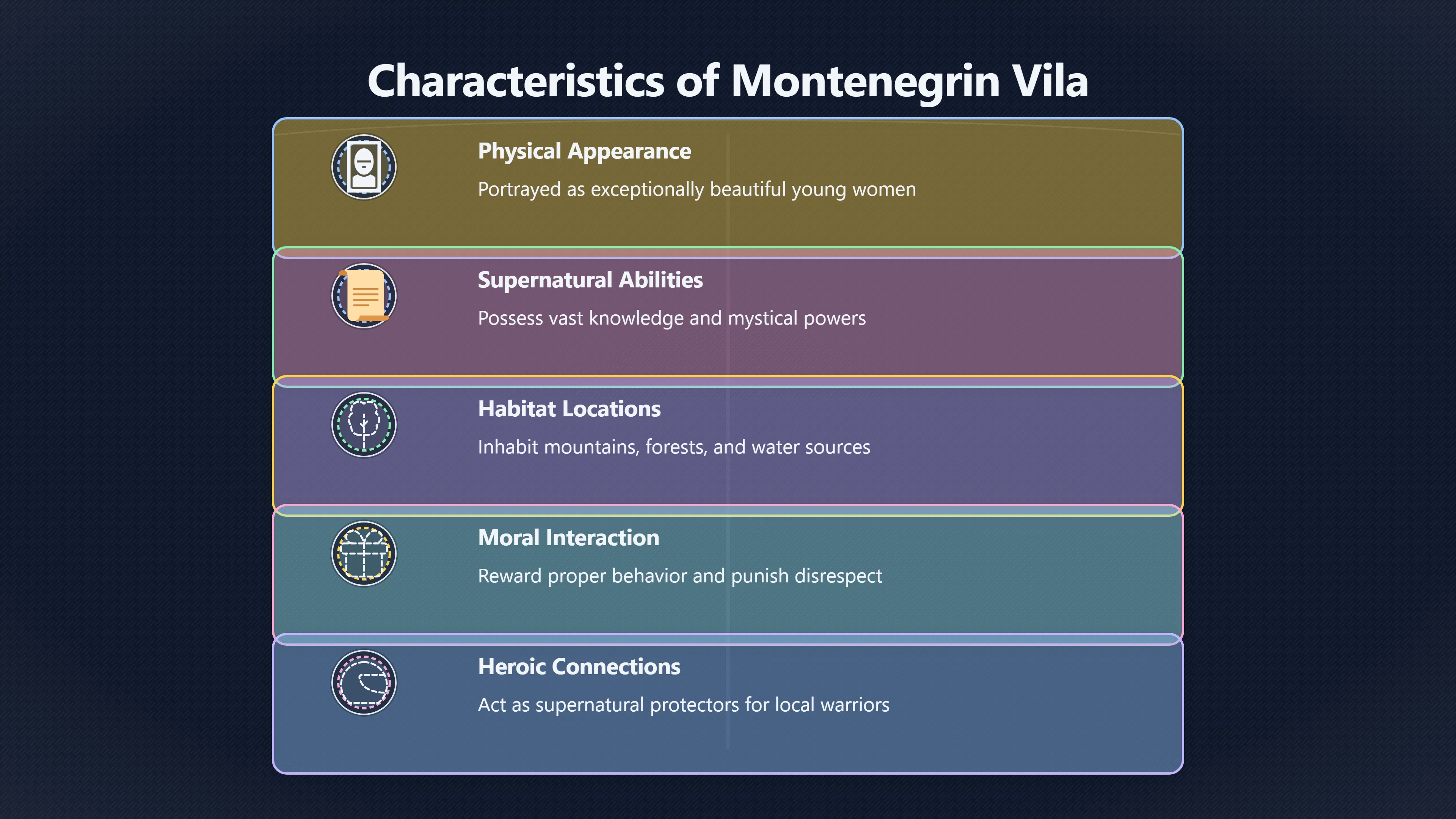
- They were exceptionally beautiful young women.
- They possessed supernatural powers and knowledge.
- They could help or harm humans depending on how they were treated.
- They were closely associated with dancing grounds, caves, mountain meadows and water sources.
- They punished disrespect and rewarded proper behaviour.[Wikipedia]WikipediaVila (fairyVila (fairy
The landscape of Montenegro made such beliefs especially meaningful. High mountain pastures, deep forests and isolated valleys were not simply scenery; they were working environments for shepherds, travellers and villagers. Fairy traditions provided a way of interpreting dangerous or mysterious places. A lonely spring, an unusual rock formation or a meadow where strange sounds were heard could become associated with supernatural inhabitants.
Unlike the gentle fairies of many Victorian children’s stories, Balkan fairies often possessed an unsettling side. Folk narratives describe them as healers, protectors or helpers, but also as beings capable of inflicting illness, leading travellers astray or taking revenge for insults. Their beauty was inseparable from danger.[Wikipedia]WikipediaVila (fairyVila (fairy
Another striking feature is their connection to heroes. In South Slavic epic traditions, which strongly influenced Montenegrin culture, a fairy might become the supernatural protector or symbolic sister of a warrior. This linked the world of folklore to the heroic songs that celebrated local fighters and clan leaders.[Wikipedia]WikipediaVila (fairyVila (fairy
Vampires, Wolves and Walking Corpses
If fairies represented the mystery of wild nature, vampire beliefs reflected anxiety about death. The traditional Balkan vampire was not primarily a blood-drinking seducer. It was a revenant: a dead person believed to have returned from the grave and resumed a harmful existence among the living.[Emerging Europe]emerging-europe.comhow balkan vampires captured the worlds imaginationBut how exactly did these vampire stories spread from the Balkans all the…Read more…
Montenegro shared many vampire traditions with neighbouring Serbia and other South Slavic regions. Folklore commonly held that certain deaths were especially dangerous. People who died violently, unexpectedly, through suicide, through sorcery, or under unusual circumstances might fail to rest peacefully. Such individuals could become restless dead and return to trouble their communities.[Wikipedia]WikipediaOpen source on wikipedia.org.
Reports collected across the South Slavic cultural area describe revenants blamed for:
- Unexplained illness.
- Sudden deaths within families.
- Livestock losses.
- Night-time disturbances.
- General misfortune affecting a household or village.[Wikipedia]WikipediaOpen source on wikipedia.org.
The idea was less about horror entertainment than social order. A proper death required proper burial, ritual observance and acceptance into the community of ancestors. When something disrupted that process, people feared the boundary between the living and the dead could break down.[Wikipedia]WikipediaUnclean dead in Slavic mythologyUnclean dead in Slavic mythology

Why Wolves Appear in the Stories
One of the most intriguing features of Balkan folklore is the overlap between vampires and wolves. Modern audiences often separate vampires and werewolves into distinct monster categories, but traditional South Slavic beliefs were less rigid.
Ethnographic and folkloric studies record recurring associations between wolves, the dead and revenants. In some traditions, a vampire could temporarily appear in wolf form. In others, the categories of vampire and werewolf became partially merged. Historical accounts from parts of eastern Montenegro and neighbouring regions describe beliefs that vampires assumed the shape of wolves during part of their existence.[BarBalkans]barbalcani.substack.comBar Balkans S3E11Wednesday Addams' Balkan werewolves - BarBalkansJanuary 14, 2023 — Records of South Slavic beliefs dating back to the 15th and 16th centu…
This connection made cultural sense in a mountainous region where wolves were real, feared animals. Wolves occupied the boundary between civilisation and wilderness. Folklore often used them as symbols of danger arriving from outside the protected social world of the village. Scholars caution that not every wolf belief was linked directly to death, but the association between wolves, revenants and supernatural threat was nevertheless an important element of South Slavic folk imagination.[Academia]academia.eduWolves and Death: An Assessment of Thanatological Wolf…19th and 20th-century sources show rare links between wolves and folk b…
Why the Restless Dead Mattered
Modern readers sometimes treat vampire stories as entertainment, but older communities approached them differently. Beliefs about restless dead addressed practical fears.
They offered explanations for events that people could not otherwise understand: epidemics, unexplained deaths, recurring family tragedies or sudden illness. They also reinforced moral expectations. Individuals who violated social or religious norms were often portrayed as being at greater risk of becoming dangerous after death.[Wikipedia]WikipediaOpen source on wikipedia.org.
Across Slavic traditions, the category sometimes described as the “unclean dead” included people whose deaths did not fit the expected pattern of a peaceful transition. Their souls were believed to remain trapped between worlds. The vampire was therefore only one expression of a broader concern about disturbed or incomplete death.[Wikipedia]WikipediaUnclean dead in Slavic mythologyUnclean dead in Slavic mythology
In Montenegro’s clan-based rural communities, where family memory and ancestral identity carried enormous importance, the possibility of a disturbed relationship between living descendants and the dead had particular emotional power. Folklore transformed those concerns into vivid supernatural narratives.
Old Belief Versus Modern Monster Myth
The modern vampire known from novels, cinema and television differs greatly from the creature imagined in traditional Montenegrin folklore. The contemporary image owes much to nineteenth-century Gothic literature and later popular culture. The older Balkan revenant was usually less glamorous and more frightening precisely because it seemed plausible within everyday village life.[Emerging Europe]emerging-europe.comhow balkan vampires captured the worlds imaginationBut how exactly did these vampire stories spread from the Balkans all the…Read more…
The same applies to fairies. Modern fantasy often portrays fairies as whimsical magical beings, whereas South Slavic fairy traditions emphasised their unpredictability, their connection to dangerous landscapes and their ability to punish human arrogance.[Wikipedia]WikipediaVila (fairyVila (fairy
Today, few people in Montenegro literally expect to encounter vampires or mountain fairies. Yet these traditions remain culturally important. They survive in folklore collections, oral storytelling, local legends, literature, tourism narratives and discussions of Balkan cultural heritage. They also offer a valuable reminder that older communities interpreted the world through a mixture of religious belief, inherited custom and direct experience of a landscape that could feel both beautiful and threatening.[Emerging Europe]emerging-europe.comhow balkan vampires captured the worlds imaginationBut how exactly did these vampire stories spread from the Balkans all the…Read more…
The supernatural beings of old Montenegro therefore reveal more than a catalogue of monsters. Fairies reflected the mystery of mountains and waters; vampires expressed fears about death and social disorder; and restless-dead traditions helped communities understand the uncertain boundary between the living and those who had gone before.[springer.com]link.springer.comWerewolves in Some South Slavic Folk TraditionsWerewolves in Some South Slavic Folk TraditionsJuly 6, 2015 — South Slavic folklore and ethnographic sources from the end of the…
Amazon book picks
Further Reading
Books and field guides related to What Haunted Old Montenegro?. Use these as the next step if you want deeper reading beyond the article.
Vampires, Burial, and Death
Rating: 4.5/5 from 5 Google Books ratings
Directly addresses the revenant beliefs that informed Montenegrin vampire traditions.
The Vampire
Explores folklore traditions behind vampire beliefs across Eastern Europe.
Slavic Folklore
Includes fairies, supernatural beings and folk beliefs found across South Slavic regions.
Russian Folk Belief
Provides comparative context for beliefs in spirits, witches and the restless dead.
eBay marketplace picks
Marketplace Samples
Live-tested eBay searches with available results related to this page.
Endnotes
1.
Source: link.springer.com
Title: Werewolves in Some South Slavic Folk Traditions
Link:https://link.springer.com/content/pdf/10.1007/978-1-137-52634
Source snippet
Werewolves in Some South Slavic Folk TraditionsJuly 6, 2015 — South Slavic folklore and ethnographic sources from the end of the...
Published: July 6, 2015
2.
Source: Wikipedia
Title: Unclean dead in Slavic mythology
Link:https://en.wikipedia.org/wiki/Unclean_dead_in_Slavic_mythology
3.
Source: emerging-europe.com
Title: how balkan vampires captured the worlds imagination
Link:https://emerging-europe.com/how-balkan-vampires-captured-the-worlds-imagination/
Source snippet
But how exactly did these vampire stories spread from the Balkans all the...Read more...
4.
Source: Wikipedia
Title: Vila (fairy)
Link:https://en.wikipedia.org/wiki/Vila_%28fairy%29
5.
Source: Wikipedia
Link:https://en.wikipedia.org/wiki/Vampire_folklore_by_region
6.
Source: Wikipedia
Link:https://en.wikipedia.org/wiki/Werewolf_in_Slavic_mythology
Source snippet
Werewolf in Slavic mythologyAccording to folk beliefs, transformation into a wolf is the most common form of shapeshifting among Slavs...
7.
Source: academia.edu
Link:https://www.academia.edu/829107/Wolves_and_Death_An_Assessment_of_Thanatological_Wolf_Symbolism_in_Western_South_Slavic_Folk_Tradition
Source snippet
Wolves and Death: An Assessment of Thanatological Wolf...19th and 20th-century sources show rare links between wolves and folk b...
8.
Source: Wikipedia
Link:https://en.wikipedia.org/wiki/Vrykolakas
Source snippet
VrykolakasIt shares similarities with numerous other legendary creatures, but is generally equated with the vampire of the folklore of...
9.
Source: barbalcani.substack.com
Title: Bar Balkans S3E11
Link:https://barbalcani.substack.com/p/s3e11-wednesday-addams-balkan-werewolves
Source snippet
Wednesday Addams' Balkan werewolves - BarBalkansJanuary 14, 2023 — Records of South Slavic beliefs dating back to the 15th and 16th centu...
Published: January 14, 2023
10.
Source: barbalcani.substack.com
Title: barbalkans supernatural creatures balkan folklore
Link:https://barbalcani.substack.com/p/barbalkans-supernatural-creatures-balkan-folklore
Source snippet
substack.comS6E6. Welcome to the world of supernatural creaturesWelcome to the world of supernatural creatures. Werewolves intertwined wi...
Additional References
11.
Source: researchgate.net
Link:https://www.researchgate.net/publication/358767746_Balkan_Vampire_Myth_Urban_Legends_or_a_Publicity_tool
Source snippet
Balkan Vampire Myth: Urban Legends or a Publicity tool?One of the first known 'real vampires' in the Balkan area, Jure Grando, has served...
12.
Source: traveller.distantera.com
Link:https://traveller.distantera.com/the-people-of-light-and-shadow-the-vila/
Source snippet
People of Light and Shadow: The VilaThe vila (plural vile) is a the nymph of Slavic folklore. In some traditions they are woodland, mount...
13.
Source: facebook.com
Link:https://www.facebook.com/groups/worldwatercolor/posts/4176170229309020/
Source snippet
Vampire legend in Balkan folkloreIn Slavic folklore, vampire-demons are considered resurrected dead... South Slavic folklore and in many...
14.
Source: journals.uni-vt.bg
Link:https://journals.uni-vt.bg/getarticle.aspx?aid=10137&type=.pdf
Source snippet
Virginia Tech JournalsFolkloric Elements in 𝑇ℎ𝑒 𝑃𝑜𝑏𝑟𝑎𝑡𝑖𝑚: 𝐴 𝑆𝑙𝑎𝑣 𝑁𝑜𝑣𝑒𝑙In the South Slavic countries, it was believed that a deceased pers...
15.
Source: facebook.com
Link:https://www.facebook.com/groups/spectreman1/posts/836140994200794/
Source snippet
Wurdalak vampire in Slavic folkloreBelief in the vampire in Slavonic legend is ultimately linked with spirits of the dead. Among the Slav...
16.
Source: facebook.com
Link:https://www.facebook.com/SlavPaganism/posts/psoglav-serbian-%D0%BF%D1%81%D0%BE%D0%B3%D0%BB%D0%B0%D0%B2-literally-doghead-is-a-demonic-mythical-creature-from-ba/1248737413958949/
17.
Source: tumblr.com
Link:https://www.tumblr.com/oh-warrior-mother/92626561718/days-of-slavic-mythology-mythological
Source snippet
These Vilas lived in forests, mountains, near rivers - and depending on where they lived was how they got...
18.
Source: facebook.com
Link:https://www.facebook.com/groups/2208364950/posts/10162323495429951/
Source snippet
rbia, all a woman needs to do to ensure that she returns from the dead as a...Read more...
19.
Source: instagram.com
Link:https://www.instagram.com/reel/DQmcLpDE1ba/
Source snippet
N5STARS INTERVIEW WITH THE VAMPIRE. timeflys911's profile picture...
20.
Source: instagram.com
Title: The Montenegrin vampire of Balkan folklore
Link:https://www.instagram.com/p/DOI2Gqqkoph/
Source snippet
Montenegrin vampire is traditionally called the Tenatz and is usually found in the shape of a dead person, although in...
Topic Tree