Why Thai Folklore Still Haunts Everyday Life
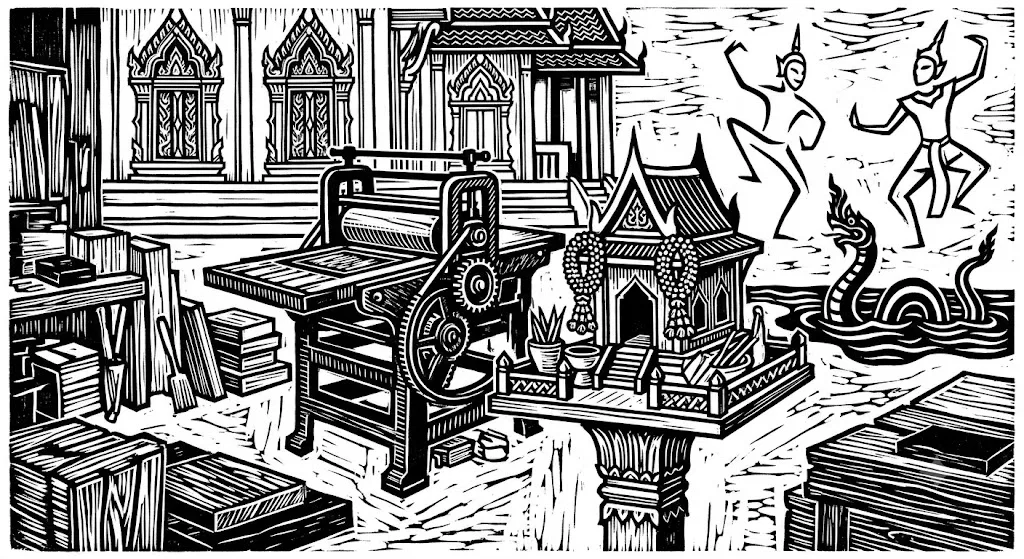
Thailand’s folklore is not a separate world tucked away from everyday religion, entertainment or tourism. It is woven through temple murals, masked dance, village festivals, household shrines, ghost films, protective amulets, river-serpent stories and family rites.
Page outline Jump by section
Introduction
For a first-time reader, the quickest way to understand Thai folklore is to notice that it often asks practical questions: Who protects this house or field? What happens after a bad death? Which spirits belong to a tree, river, mountain or city? How should humans keep good relations with unseen powers? Those questions appear in traditions as different as Bangkok’s famous Mae Nak ghost story, the north-eastern Phi Ta Khon masked festival, the serpent legends of the Mekong, southern Nora dance-drama and the supernatural powers of the folk epic Khun Chang Khun Phaen.[jstor.org]jstor.orgOpen source on jstor.org.
What makes Thai folklore distinctive?
Thai folklore is distinctive because it rarely divides neatly into “religion”, “myth”, “ghost story” and “performance”. A single tradition may be devotional, entertaining, frightening, protective and commercially successful at the same time. A ghost can be a warning about death and attachment, a shrine figure receiving offerings, and a cinema icon. A masked festival can be linked to Buddhist merit-making, local spirit mediation, agricultural timing and regional identity.[in.th]thailandnow.in.thphi ta khon festivalphi ta khon festival
A useful starting point is the broad category of spirits and ghosts often discussed in Thai studies. Anthropologist Penny Van Esterik’s work on guardian spirits in Thai Buddhism is frequently cited because it treats spirits not as a marginal superstition but as an important part of how many Thai communities organise sacred space, protection and obligation.[JSTOR]jstor.orgOpen source on jstor.org. In rural and urban settings alike, shrines may mark households, businesses, accident sites, trees, roadsides or public places. They do not simply “decorate” the landscape; they show that places are thought to have occupants, histories and powers that people must respect.[UQ eSpace]espace.library.uq.edu.auUQ e Space Spirit houses in contemporary urban ThailandUQ e Space Spirit houses in contemporary urban Thailand
That mixture also explains why Thai folklore travels so well into modern culture. Ghost stories become horror-comedies and television dramas; legendary beings appear in tourism campaigns; old performance forms are safeguarded by UNESCO; and stories once passed through recitation or ritual now circulate through films, social media and museum displays.[UNESCO Intangible Cultural Heritage]ich.unesco.orgOpen source on unesco.org.
Spirits, shrines and the living landscape
One of the most visible forms of Thai belief culture is the small spirit shrine. In Thailand, many homes, shops, hotels and office buildings have shrines associated with guardian spirits of land or place. Academic work on contemporary urban Thailand notes that many house compounds include small shrines dedicated to locality and guardian spirits, while earlier scholarship emphasises that guardian spirits are central to Thai religious imagination rather than an exotic side issue.[UQ eSpace]espace.library.uq.edu.auUQ e Space Spirit houses in contemporary urban ThailandUQ e Space Spirit houses in contemporary urban Thailand
For readers used to thinking of Buddhism mainly as doctrine, this can be surprising. Thailand is strongly associated with Theravada Buddhism, yet Thai practice has long included older local spirit relations, Brahmanic ritual elements, merit-making and protective rites. Spirit houses are often explained as homes for unseen beings so that humans and spirits can share space without conflict. Offerings, flowers, food, drink and ritual attention are ways of acknowledging that relationship.[JSTOR]jstor.orgOpen source on jstor.org.
This is not only a domestic tradition. Research on roadside memorials in north-eastern Thailand describes how some places of fatal accidents become permanent shrines where the violently dead are worshipped or petitioned by members of the public. That detail matters because it shows a recurring pattern in Thai folklore: an unsettling death, a powerful spirit and a marked place can become part of a wider popular religious landscape.[Sage Journals]journals.sagepub.comOpen source on sagepub.com.
The same idea underlies many haunted-place stories. Trees, burial grounds, abandoned houses, crossroads, rivers and mountains are not neutral backdrops. They are the kinds of places where stories gather. In a Thai context, a haunting is often less about proving a paranormal event than about asking what kind of death, vow, injustice, longing or neglected obligation has attached itself to a location.

Why Thai ghost stories are so powerful
Thai ghost lore is broad, but its most memorable figures often grow from intense human situations: childbirth, betrayal, sudden death, jealousy, hunger, loneliness and attachment. These stories work because they are emotional before they are monstrous. The ghost is not merely a jump scare; it is a social problem that has not been settled.
The best-known example is Mae Nak of Phra Khanong, usually presented as a woman who dies in childbirth while her husband is away and returns as a ghost out of love for him. The story is associated with Bangkok and with a shrine at Wat Mahabut, where visitors still make offerings. Travel and local guide accounts describe the shrine as a living devotional site rather than a simple tourist prop, with offerings such as dresses, toys and garlands connected to the legend’s themes of wifehood, motherhood and longing.[Your Thai Guide]yourthaiguide.comwat mahabut mae nak phra khanong tourist faqwat mahabut mae nak phra khanong tourist faq
Mae Nak also shows how folklore changes form. The tale is often said to be linked to events in the nineteenth century, but its modern power has been shaped heavily by film, television, shrine practice and retelling. Thai cinema repeatedly returns to the story, from horror treatments to comic versions, because the legend can be read in more than one way: as a frightening haunting, a tragic love story, a Buddhist warning about attachment, or a portrait of domestic grief.[Wikipedia]WikipediaGhosts in Thai cultureGhosts in Thai culture
Other Thai ghost figures are more openly monstrous. Stories of a floating female head with trailing organs, dangerous possessive spirits, hungry ghosts or tree-haunting female beings are widely discussed in accounts of Thai ghost culture. The important point is that these beings do not all come from one source. Some are connected to local oral tradition, some to Buddhist cosmology, some to neighbouring Southeast Asian patterns, and some have been sharpened visually by modern film and comics.[Wikipedia]WikipediaGhosts in Thai cultureGhosts in Thai culture
That last point is essential. Many readers first encounter Thai ghosts through horror cinema, but films are not simply preserving an unchanged ancient catalogue. They often standardise appearances, exaggerate powers, blend regional variants and create the “classic” image that later audiences imagine to be timeless. Folklore here is alive precisely because it keeps being remade.
Mae Nak, the famous Bangkok ghost
Mae Nak deserves special attention because she has become Thailand’s most recognisable ghostly figure. The core story is simple enough to travel: a young wife dies while pregnant, her husband returns unaware, and the boundary between home and grave collapses. Yet the tale’s endurance comes from its emotional ambiguity. Mae Nak is terrifying because she refuses death, but sympathetic because her refusal is rooted in love.
The shrine tradition complicates the story further. Visitors do not only come to be frightened. Some seek luck, help with military conscription, family matters or fertility-related hopes; others come because the shrine is part of Bangkok’s living folklore landscape. The devotional setting turns a ghost from a horror character into a figure with whom people may negotiate.[Your Thai Guide]yourthaiguide.comwat mahabut mae nak phra khanong tourist faqwat mahabut mae nak phra khanong tourist faq
Mae Nak also illustrates the difference between folklore, local memory and documented history. Many retellings present the story as based on real events, but the evidence is not the same as a modern historical record. What is well attested is not a single provable haunting, but the tale’s cultural force: its shrine, its repeated adaptations, its place in Thai popular memory and its usefulness as a story about love, death and release.
Masks, merit and mischief at Phi Ta Khon
If Mae Nak represents the intimate, domestic side of Thai ghost lore, Phi Ta Khon represents its public, festive side. Held in Dan Sai district in Loei province, the festival is famous for colourful ghost masks, processions and playful performances. Official Thai sources describe it as part of the annual Bun Luang festival and a local tradition passed down through generations. The 2026 event was listed for 20–22 June, with the grand parade on 21 June.[SAWASDEE THAILAND - THAILAND.GO.TH]thailand.go.thSAWASDEE THAILANDSAWASDEE THAILAND
The festival is often explained through a Buddhist story: when Prince Vessantara, one of the Buddha’s previous lives, returned after a long absence, the celebration was so loud and joyful that it woke the dead. That story gives the masks a religious frame, but the event is also strongly local. Dates are traditionally linked to local ritual specialists and the rainy-season calendar, and the festival includes merit-making and Buddhist activities as well as exuberant masked play.[Thailand NOW]thailandnow.in.thphi ta khon festivalphi ta khon festival
What makes Phi Ta Khon memorable is the way it refuses to make ghosts solemn. The masks are strange, comic, handmade and often wildly colourful. The result is not a Halloween imitation but a regional Thai form in which ghosts can be mischievous, communal and agricultural. The festival links the unseen world to rain, fertility, local identity and the social joy of performance.
For tourism, this creates both opportunity and tension. Phi Ta Khon is now promoted nationally and internationally, which helps preserve visibility and income, but it can also flatten the event into a photogenic “ghost festival”. The deeper story is richer: it is a living ritual calendar in which Buddhism, local spirits, seasonal timing and community creativity meet.
Serpents of water, kingship and the Mekong
The serpent being known across South and Southeast Asian traditions is especially important in Thailand’s riverside, Buddhist and royal imagination. In Thai contexts, serpent legends are associated with water, fertility, protection, temple architecture and the Mekong. Recent research on serpent symbolism in north-eastern Thailand describes the serpent as a giant semi-divine being in Buddhism, folklore and mythology, visible not only in old stories but in contemporary urban landscapes.[Taylor & Francis Online]tandfonline.comOpen source on tandfonline.com.
The most famous modern example is the Mekong fireball tradition. Around the end of Buddhist Lent, glowing balls are reported along stretches of the Mekong, especially in north-eastern Thailand. Local belief commonly connects the lights to the river serpent honouring the Buddha’s return from heaven. Scholarly discussion of the phenomenon has examined how a local event became a major festival, tourist attraction and public controversy over whether the lights are supernatural, natural or human-made.[ResearchGate]researchgate.netResearch Gate(PDF) The "Postmodernization" of a Mythical Event: NagaResearch Gate(PDF) The "Postmodernization" of a Mythical Event: Naga
The fireballs matter for folklore because the debate itself is part of the tradition. Some people approach the event through faith, others through scepticism, science or tourism. The story’s power does not depend only on whether a single explanation wins. It depends on the way the Mekong becomes a theatre where Buddhist time, local serpent belief, regional pride and modern media attention all converge.
Serpent imagery also appears throughout Thai sacred and royal art. Serpents flank temple stairways, appear in decorative architecture and help express the idea that sacred space is guarded and connected to water. This is one reason serpent lore is not merely a “monster” topic in Thailand. It belongs to a larger symbolic system of protection, fertility, landscape and authority.
Epics, performance and royal retelling
Not all Thai folklore is ghostly. Some of the country’s most influential mythic storytelling lives in performance and literature. The Thai masked dance-drama known as Khon is one of the clearest examples. UNESCO describes Khon as a performing art that combines music, vocal performance, literature, dance, ritual and handicraft, and notes that it depicts the life and glory of Rama, a heroic figure associated with order and justice.[UNESCO Intangible Cultural Heritage]ich.unesco.orgOpen source on unesco.org.
Khon is closely tied to the Thai version of the Ramayana tradition, commonly known through the Ramakien. This is not simply an imported Indian story copied into Thai form. Over centuries it became part of Thai court culture, visual art, dance, moral instruction and national heritage. The murals around the Temple of the Emerald Buddha at Bangkok’s Grand Palace are one of the most visible public expressions of that epic world, with long painted sequences narrating the Thai version of the story.[DTH Travel]dth.travelTraveltour the story of the Ramakien at Bangkok's Grand PalaceTraveltour the story of the Ramakien at Bangkok's Grand Palace
For folklore readers, Khon and the Ramakien are important because they show how myth can become state art. The demons, monkeys, heroes and divine weapons of the story are not just literary characters; they are embodied through masks, costumes, gestures, music and training lineages. UNESCO’s recognition in 2018 underlines Khon’s status as intangible cultural heritage, but its meaning also rests in the way performers learn highly codified movement and audiences recognise moral and emotional patterns through stylised action.[UNESCO Intangible Cultural Heritage]ich.unesco.orgOpen source on unesco.org.
This is a different kind of folklore from a village ghost tale, yet the two belong on the same country-level map. Both deal with invisible power, moral consequence and the transformation of story through performance. One is royal and classical; the other may be local and domestic. Both have shaped how Thai audiences imagine good, danger, loyalty and disorder.
Southern Thailand’s Nora and the bird-woman story
Southern Thailand has its own major performance tradition in Nora, also called Manora in many contexts. UNESCO inscribed Nora, dance drama in southern Thailand, on the Representative List of the Intangible Cultural Heritage of Humanity in 2021. It describes Nora as a community-based practice with deep cultural and social significance, using regional dialects, music, colourful costume, improvisational singing and stories often based on the Buddha or legendary heroes.[UNESCO Intangible Cultural Heritage]ich.unesco.orgOpen source on unesco.org.
Nora is especially valuable for understanding how folklore lives in bodies. Performers wear ornate costumes with headdresses, bird-like wings and swan-tail elements, giving the dance a visibly avian quality. The tradition is often linked to stories of Manora, a celestial bird-woman figure known through Buddhist narrative traditions and local southern retellings.[UNESCO]unesco.orgdocument 5624document 5624
The social setting matters as much as the story. Nora is performed at community events, temple fairs and ceremonies, and knowledge is transmitted through families, masters, students and local institutions. UNESCO’s account stresses that it remains culturally and spiritually significant in southern communities, not merely as stage entertainment.[UNESCO Intangible Cultural Heritage]ich.unesco.orgOpen source on unesco.org.
Nora also shows how Thai folklore is regional. A country-level page can mention “Thai folklore”, but the traditions of Bangkok, Loei, the Mekong region, Chiang Mai or southern Thailand are not interchangeable. They share broad themes of spirits, merit, protection and performance, yet each has its own language, costume, ritual setting and local memory.
Folk epics, magic and protective power
The long narrative poem Khun Chang Khun Phaen is one of Thailand’s great bridges between oral tradition, literature and supernatural belief. Scholars Chris Baker and Pasuk Phongpaichit trace the poem’s development from a troubadour-style recitation tradition, with the tale probably originating around 1600 and expanding over time in response to popular demand.[The Siam Society]thesiamsociety.orgJSS 097 0c Baker Pasuk Career Of Khun Chang Khun PhaenJSS 097 0c Baker Pasuk Career Of Khun Chang Khun Phaen
Unlike courtly works set among gods and kings, this epic is famous for its dense social realism: provincial towns, marriages, funerals, temple ceremonies, feasts, court cases, travel and everyday ambition. Yet it is also full of supernatural knowledge. Baker and Pasuk’s work on protection and power argues that protective supernaturalism is central to understanding Thai religion, social order and power in the tradition surrounding the poem.[CSEAS Journal]englishkyoto-seas.orgCSEAS Journal From Khun Chang Khun Phaen to the Buddha AmuletCSEAS Journal From Khun Chang Khun Phaen to the Buddha Amulet
The hero’s world includes mantras, diagrams, tattoos, amulets, auspicious timing, spirit helpers and protective substances. These are not random fantasy props. They reflect a wider Thai concern with vulnerability: illness, warfare, political danger, romantic competition, hostile spirits and bad luck. Protection is a practical problem, and folklore supplies both stories and ritual technologies for dealing with it.[CSEAS Journal]englishkyoto-seas.orgCSEAS Journal From Khun Chang Khun Phaen to the Buddha AmuletCSEAS Journal From Khun Chang Khun Phaen to the Buddha Amulet
One especially striking figure connected with this tradition is the child spirit often traced in modern scholarship to Khun Chang Khun Phaen. Recent research on child spirits in Thailand notes that the origin of the tradition is usually linked to the seventeenth-century epic legend, while modern forms include newer practices such as spirit dolls that gained attention in the mid-2010s.[MDPI]mdpi.comOpen source on mdpi.com. Here again, an old literary-supernatural motif does not remain frozen. It moves into amulet culture, household devotion, commerce, controversy and contemporary media.
Old tradition, modern invention and internet-era folklore
A careful account of Thai folklore has to distinguish between several layers. Some traditions are old oral or ritual practices; some are literary or courtly adaptations; some are modern film images that now feel ancient; some are tourist framings; and some are recent commercial or internet-era inventions built from older materials.
Mae Nak is a good example of a tradition with deep cultural resonance but a heavily mediated modern form. The shrine, films and repeated retellings have shaped how the ghost is imagined today. Phi Ta Khon is an older local festival, but national tourism promotion affects how outsiders encounter it. The Mekong fireballs are attached to longstanding river-serpent belief, yet their modern festival branding, media controversy and sceptical debate are part of their contemporary identity.[yourthaiguide.com]yourthaiguide.comwat mahabut mae nak phra khanong tourist faqwat mahabut mae nak phra khanong tourist faq
Modern heritage recognition can also change the way traditions are presented. UNESCO inscription for Khon and Nora helps safeguard and publicise them, but it also encourages neat descriptions of traditions that are, in practice, varied, contested and locally lived.[UNESCO Intangible Cultural Heritage]ich.unesco.orgOpen source on unesco.org. Heritage language is useful, but folklore is not only what appears on official lists. It is also the shrine at the roadside, the rumour about a tree spirit, the horror film everyone has seen, the family warning passed to children, and the local ritual whose meaning depends on who is performing it.
Internet-era folklore adds another layer. Thai ghosts and magical beings now circulate through memes, short videos, fan art, horror games, travel blogs and online explainers. This can spread awareness, but it can also detach beings from local context. A floating-head ghost becomes a monster design; a shrine becomes “spooky content”; a ritual becomes a spectacle. Good folklore writing has to restore context without draining away the strangeness that makes the traditions memorable.
How to read Thai folklore responsibly
The most respectful way to read Thai folklore is neither to believe every supernatural claim literally nor to dismiss the traditions as irrational. Thai legends, ghost stories and ritual practices are cultural evidence. They tell us how people think about death, obligation, place, danger, gender, family, kingship, nature and moral consequence.
A few practical distinctions help:
A story is not the same as a document. Mae Nak may be described as based on historical events, but the stronger evidence lies in the shrine, retellings and cultural impact, not in a single verifiable haunting.
A performance is not just entertainment. Khon and Nora are theatrical, but they also transmit moral, ritual, regional and craft knowledge through trained bodies, costumes, music and inherited technique.[UNESCO Intangible Cultural Heritage]ich.unesco.orgOpen source on unesco.org.
A shrine is not just a symbol. For many people, shrines are part of an active relationship with place, protection and unseen agency. Whether or not an outsider shares that belief, the practice has real social meaning.[JSTOR]jstor.orgOpen source on jstor.org.
A monster may be regional rather than national. Some beings appear across Thailand; others belong strongly to the north-east, south, Bangkok, the Mekong, northern Lanna culture or neighbouring countries. Shared Southeast Asian creatures should not be treated as if one modern national version owns them entirely.
A modern version may be the one people actually know. Film, television and tourism do not merely “corrupt” folklore. They are now part of how folklore survives. The key is to say clearly when a detail comes from older oral tradition, literary tradition, ritual practice, official heritage framing or modern media.
Why Thai folklore still matters
Thai folklore matters because it gives ordinary readers a route into Thailand that is more intimate than a timeline of kings or a list of tourist sites. It shows how people imagine the moral life of places: rivers that remember serpent powers, houses that need guardian shrines, festivals where ghosts join the crowd, dances where celestial beings take human form, and stories where the dead remain close because love, violence or duty has not been resolved.
It also matters because Thai folklore is not fading into the past in any simple way. Some practices decline, some are revived, some are formalised as heritage, some become films, and some reappear in new commercial or digital forms. The result is a living field of belief and storytelling in which old and new are constantly negotiating with each other.
The most memorable Thai traditions are rarely just “scary” or “beautiful”. They are both, and more. Mae Nak is frightening and tender. Phi Ta Khon is ghostly and joyful. Serpent legends are mythic and political, sacred and touristic. Nora is entertainment and ritual memory. Khun Chang Khun Phaen is literature and a map of protective magic. Together they show a folklore culture in which the unseen world is not remote from daily life. It lives at the shrine, on the stage, beside the river, in the cinema and in the stories people keep telling.
eBay marketplace picks
Marketplace Samples
Live-tested eBay searches with available results related to this page.

Endnotes
1.
Source: jstor.org
Link:https://www.jstor.org/stable/40460429
2.
Source: thailand.go.th
Title: SAWASDEE THAILAND
Link:https://www.thailand.go.th/public/issue-focus-detail/discover-phi-ta-khon-thailands-most-colorful-ghost-festival
3.
Source: thailandnow.in.th
Title: phi ta khon festival
Link:https://www.thailandnow.in.th/event/phi-ta-khon-festival/
4.
Source: ich.unesco.org
Link:https://ich.unesco.org/en/RL/khon-masked-dance-drama-in-thailand-01385
5.
Source: ich.unesco.org
Link:https://ich.unesco.org/en/RL/nora-dance-drama-in-southern-thailand-01587
6.
Source: mdpi.com
Link:https://www.mdpi.com/2077-1444/17/3/303
7.
Source: researchgate.net
Link:https://www.researchgate.net/publication/272275858_Accommodating_the_Discarnate_Thai_Spirit_Houses_and_the_Phenomenology_of_Place
8.
Source: Wikipedia
Title: Ghosts in Thai culture
Link:https://en.wikipedia.org/wiki/Ghosts_in_Thai_culture
9.
Source: researchgate.net
Title: 333110562 A Folk Taxonomy of Terms for Ghosts and Spirits in Thai
Link:https://www.researchgate.net/publication/333110562_A_Folk_Taxonomy_of_Terms_for_Ghosts_and_Spirits_in_Thai
10.
Source: researchgate.net
Title: Research Gate(PDF) The “Postmodernization” of a Mythical Event: Naga
Link:https://www.researchgate.net/publication/233486379_The_Postmodernization_of_a_Mythical_Event_Naga_Fireballs_on_the_Mekong_River
11.
Source: Wikipedia
Title: Naga fireball
Link:https://en.wikipedia.org/wiki/Naga_fireball
12.
Source: unesco.org
Title: document 4767
Link:https://www.unesco.org/archives/multimedia/document-4767
13.
Source: dth.travel
Title: Traveltour the story of the Ramakien at Bangkok’s Grand Palace
Link:https://dth.travel/tour-the-story-of-the-ramakien-at-bangkoks-grand-palace/
14.
Source: ich.unesco.org
Link:https://ich.unesco.org/en/Decisions/13.COM/10.b.37
15.
Source: unesco.org
Title: document 5624
Link:https://www.unesco.org/archives/multimedia/document-5624
16.
Source: Wikipedia
Title: Khun Chang Khun Phaen
Link:https://en.wikipedia.org/wiki/Khun_Chang_Khun_Phaen
17.
Source: researchgate.net
Title: 401467222 Child Spirits in Thailand The Intimacy of Kumanthong and Luk Thep
Link:https://www.researchgate.net/publication/401467222_Child_Spirits_in_Thailand_The_Intimacy_of_Kumanthong_and_Luk_Thep
18.
Source: Wikipedia
Title: Mae Nak Phra Khanong
Link:https://en.wikipedia.org/wiki/Mae_Nak_Phra_Khanong
19.
Source: Wikipedia
Link:https://en.wikipedia.org/wiki/Thailand
20.
Source: Wikipedia
Link:https://en.wikipedia.org/wiki/Krasue
21.
Source: Wikipedia
Title: Nang Tani
Link:https://en.wikipedia.org/wiki/Nang_Tani
22.
Source: Wikipedia
Title: Tai folk religion
Link:https://en.wikipedia.org/wiki/Tai_folk_religion
23.
Source: Wikipedia
Title: Phi Ta Khon
Link:https://en.wikipedia.org/wiki/Phi_Ta_Khon
24.
Source: Wikipedia
Title: Thai folklore
Link:https://en.wikipedia.org/wiki/Thai_folklore
25.
Source: Wikipedia
Link:https://en.wikipedia.org/wiki/Khon
26.
Source: Wikipedia
Link:https://en.wikipedia.org/wiki/N%C4%81ga
27.
Source: Wikipedia
Title: Menora (dance)
Link:https://en.wikipedia.org/wiki/Menora_%28dance%29
28.
Source: Wikipedia
Title: Jataka tales
Link:https://en.wikipedia.org/wiki/Jataka_tales
29.
Source: Wikipedia
Title: Spirit house
Link:https://en.wikipedia.org/wiki/Spirit_house
30.
Source: ich.unesco.org
Link:https://ich.unesco.org/en/video/44848
31.
Source: ich.unesco.org
Link:https://ich.unesco.org/en/decisions/16.COM/8.B.42
32.
Source: researchgate.net
Link:https://www.researchgate.net/publication/303859452The_Horror_of_Restive_Women_A_Comparative_Study_of_the_Indonesian_Legend%27Kuntilanak_%27and_Thai_Legend_Mae_Nak_Phra_Khanong%27
33.
Source: researchgate.net
Link:https://www.researchgate.net/publication/386349756_The_Intersection_of_Buddhism_and_Animism_in_Thai_Ritual_Practices_An_Anthropological_Analysis
34.
Source: researchgate.net
Link:https://www.researchgate.net/publication/283552561_Manora_Ancestral_Beings_Possession_and_Cosmic_Rejuvenation_in_Southern_Thailand_Modern_Adaptations_of_the_Multi-Religious_Manora_Ancestral_Vow_Ceremony
35.
Source: vocal.media
Title: 7 Horror Myths in Thailand
Link:https://vocal.media/horror/7-horror-myths-in-thailand
36.
Source: thesiamsociety.org
Title: JSS 097 0c Baker Pasuk Career Of Khun Chang Khun Phaen
Link:https://thesiamsociety.org/wp-content/uploads/2009/03/JSS_097_0c_BakerPasuk_CareerOfKhunChangKhunPhaen.pdf
37.
Source: espace.library.uq.edu.au
Title: UQ e Space Spirit houses in contemporary urban Thailand
Link:https://espace.library.uq.edu.au/view/UQ%3A219294
38.
Source: journals.sagepub.com
Link:https://journals.sagepub.com/doi/10.2190/OM.66.4.e
39.
Source: yourthaiguide.com
Title: wat mahabut mae nak phra khanong tourist faq
Link:https://yourthaiguide.com/wat-mahabut-mae-nak-phra-khanong-tourist-faq/
40.
Source: travelfish.org
Link:https://www.travelfish.org/sight_profile/thailand/bangkok_and_surrounds/bangkok/bangkok/2077
41.
Source: tandfonline.com
Link:https://www.tandfonline.com/doi/full/10.1080/23748834.2024.2421628
42.
Source: englishkyoto-seas.org
Title: CSEAS Journal From Khun Chang Khun Phaen to the Buddha Amulet
Link:https://englishkyoto-seas.org/wp-content/uploads/SEAS_0202_Baker-and-Pasuk.pdf
43.
Source: englishkyoto-seas.org
Link:https://englishkyoto-seas.org/2014/02/vol-2-no2-baker-and-pasuk/
44.
Source: facebook.com
Link:https://www.facebook.com/thailandprd/posts/the-tourism-authority-of-thailand-invites-both-thai-and-international-visitors-t/1392488646247275/
45.
Source: so19.tci-thaijo.org
Link:https://so19.tci-thaijo.org/index.php/WJHS/article/view/1705
46.
Source: so19.tci-thaijo.org
Link:https://so19.tci-thaijo.org/index.php/JEIM/article/view/1006
47.
Source: journals.sagepub.com
Link:https://journals.sagepub.com/doi/10.1177/1474474018762809
48.
Source: journals.sagepub.com
Link:https://journals.sagepub.com/doi/pdf/10.5367/000000009789838468?download=true
49.
Source: journals.sagepub.com
Link:https://journals.sagepub.com/doi/pdf/10.1177/147447409800500203?download=true
50.
Source: journals.sagepub.com
Link:https://journals.sagepub.com/doi/10.1177/08862605251318270
51.
Source: journals.sagepub.com
Link:https://journals.sagepub.com/doi/pdf/10.1177/000134551106200102
52.
Source: englishkyoto-seas.org
Title: vol 6 no 1 kanya wattanagun
Link:https://englishkyoto-seas.org/2017/04/vol-6-no-1-kanya-wattanagun/
53.
Source: thailandnow.in.th
Title: how queen sirikit saved khon behind thailands masked dance revival
Link:https://www.thailandnow.in.th/arts-culture/how-queen-sirikit-saved-khon-behind-thailands-masked-dance-revival/
54.
Source: thailandnow.in.th
Link:https://www.thailandnow.in.th/arts-culture/enter-the-world-of-the-nora-dance-drama/
55.
Source: thailandnow.in.th
Link:https://www.thailandnow.in.th/arts-culture/ghosts-matter/
56.
Source: royalgrandpalace.th
Link:https://www.royalgrandpalace.th/en/attraction/khon
57.
Source: hcmussh.edu.vn
Link:https://hcmussh.edu.vn/static/document/ThesignificanceofNagainThaiOrnaments.pdf
58.
Source: nationthailand.com
Link:https://www.nationthailand.com/news/tourism/40067697
59.
Source: nguvan.hnue.edu.vn
Link:https://nguvan.hnue.edu.vn/Nghi%C3%AAn-c%E1%BB%A9u/V%C4%83n-h%E1%BB%8Dc-n%C6%B0%E1%BB%9Bc-ngo%C3%A0i/p/animism-in-southeast-asian-myths-and-its-impacts-on-acts-of-environmental-protection-1873
60.
Source: thailandcorner.com
Title: ghost stories
Link:https://thailandcorner.com/living/culture/ghost-stories
61.
Source: thaispamassage.es
Title: Thai ghosts
Link:https://thaispamassage.es/en/thai-ghosts/
Additional References
62.
Source: youtube.com
Title: Thai Ghosts Explained: Superstition, Haunted Places, & Scariest Legends
Link:https://www.youtube.com/watch?v=pTqtrRjcg_E
Source snippet
Thailand's Wildest Festival! | Phi Ta Khon Ghost Festival 2026...
63.
Source: youtube.com
Link:https://www.youtube.com/watch?v=BFivo0Xl68U
Source snippet
Mae Nak: Thailand's Eternal Ghost of Love | Full Story...
64.
Source: youtube.com
Title: Ancient Thai Myths Reveal What Happens When We Die
Link:https://www.youtube.com/watch?v=p0bZqBZqby4
Source snippet
Thai Ghosts Explained: Superstition, Haunted Places, & Scariest Legends...
65.
Source: youtube.com
Title: Every Mythical Creature In Thailand Folklore Explained
Link:https://www.youtube.com/watch?v=HG5oJqPkMt4
Source snippet
Ancient Thai Myths Reveal What Happens When We Die...
66.
Source: facebook.com
Link:https://www.facebook.com/thailandprd/videos/nora-or-manora-a-traditional-dance-drama-from-southern-thailand-which-has-been-p/437866441341677/
67.
Source: ssrudlp.ssru.ac.th
Link:https://ssrudlp.ssru.ac.th/data-file/topics/materials/20260213-090156-ca9ea6d5b35cfce94c8d2cb6265b5d81-There%E2%80%99s%20More%20to%20a%20Thai%20Ghost%20Story%20Than%20Being%20Scary%20-%20Thailand%20NOW.pdf
68.
Source: medium.com
Link:https://medium.com/intriguing-times/a-floating-head-with-dangling-entrails-the-southeast-asian-krasue-4d9dfb4813ff
69.
Source: orbittoursthailand.com
Link:https://www.orbittoursthailand.com/a-thai-ghostly-legend/
70.
Source: instagram.com
Link:https://www.instagram.com/reel/DUBNu9Ok8NV/
71.
Source: facebook.com
Link:https://www.facebook.com/groups/bangkokinthailand/posts/4141072656207007/
Topic Tree
Follow this branch
Related pages 192
- Afghan Folklore
- Albanian Folklore
- Algerian Folklore
- Australian Folklore
- Azerbaijan Folklore
- +187 more in sidebar