Why Dutch Folklore Belongs to Its Places
The folklore of the Netherlands is not a single grand national mythology so much as a dense landscape of local legends, seasonal customs, ghost stories, saintly tales, witchcraft memories, migrant storytelling traditions and modern retellings.
Page outline Jump by section
Introduction
For a reader new to Dutch folklore, the key is to expect regional variety. The Netherlands has famous story figures such as the Flying Dutchman, the White Women, gnomes, giants, witches, devil-riders and water spirits, but many are best understood as local traditions rather than as parts of a neat mythological system. Dutch folklore also keeps changing: old tales are collected in archives, revived for tourism, questioned in public debates, adapted into children’s books, and reshaped by communities with roots in Suriname, the Dutch Caribbean, Turkey and elsewhere.[Meertens Instituut]meertens.knaw.nlMeertens Instituut Verhalen van Stad en Streek: Sagen en Legenden in NederlandMeertens Instituut Verhalen van Stad en Streek: Sagen en Legenden in Nederland
Why Dutch folklore feels local rather than mythological
A common question is whether the Netherlands “has mythology”. It does, but not usually in the same way as Greek gods, Norse sagas or Irish fairy lore. Much of the Dutch material survives as legends, saints’ tales, humorous stories, supernatural warnings, place-name explanations, children’s customs and regional memory. The Meertens Institute describes Dutch local storytelling as full of “exciting, funny, eerie or remarkable” tales, and specifically lists figures such as the Flying Dutchman, White Women, gnomes, goat-riders, devils, saints, robbers and werewolves as prominent in locally told stories.[Meertens Instituut]meertens.knaw.nlMeertens Instituut Verhalen van Stad en Streek: Sagen en Legenden in NederlandMeertens Instituut Verhalen van Stad en Streek: Sagen en Legenden in Nederland
That local character matters. A legend may explain why a harbour silted up, why a road feels unsafe after dark, why a mound is associated with hidden beings, or why a village claims a pair of giants as part of its identity. The same story type can move across Europe, but a Dutch version often gains meaning from the exact landscape attached to it: Friesland, Drenthe, Overijssel, Limburg, Zeeland, Twente, the Veluwe, the Achterhoek or a specific town such as Stavoren or Oudewater.[Meertens Instituut]meertens.knaw.nlMeertens Instituut Verhalen van Stad en Streek: Sagen en Legenden in NederlandMeertens Instituut Verhalen van Stad en Streek: Sagen en Legenden in Nederland
This also means that Dutch folklore is not only “old”. Researchers at Meertens note that traditional tales about dragon-slayers, White Women, werewolves, giants and wandering lights remain of interest, while modern jokes, urban legends, rumours, Photoshop hoaxes, chain letters and conspiracy stories also circulate as contemporary folklore. In other words, the Netherlands has both inherited folk narrative and living popular storytelling.[Meertens Instituut]meertens.knaw.nlMeertens Instituut Veelgestelde vragen over volksverhalenMeertens Instituut Veelgestelde vragen over volksverhalen
Mist, fields and the White Women
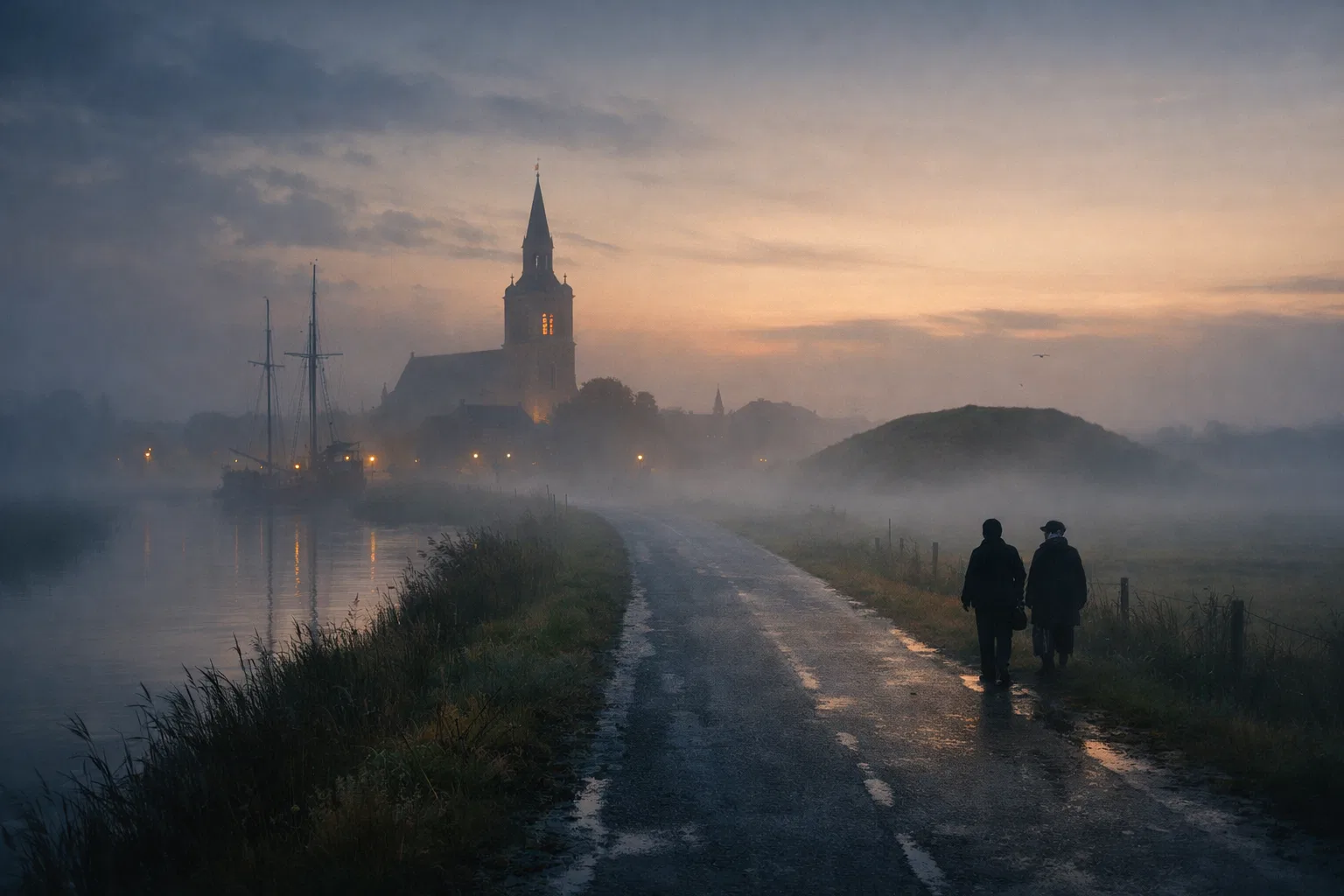
One of the most distinctive Dutch supernatural traditions is the story of the White Women, usually imagined as silent female figures appearing near lonely roads, farms, mounds or misty places. A 1953 folklore questionnaire entry from Nieuwolda, preserved in the Folktale Database, describes them as figures seen on remote roads or near isolated farms in late summer evenings during misty weather. The account says people told little definite about them: they seemed neither clearly good nor clearly evil, but were spoken of with mysterious awe.[Verhalenbank]verhalenbank.nlVolksverhalenbank van de Lage Landen | Witte WievenVolksverhalenbank van de Lage Landen | Witte Wieven
That uncertainty is part of their power. In many retellings, the White Women hover between several categories: ghosts, wise women, fairy-like beings, ancestral spirits, dangerous women, helpers, or ominous presences. The 1953 Nieuwolda account even mentions small grey-clad old women associated with lonely places and underground dwellings, suggesting a porous boundary between ghost story, earth-dweller legend and rural fear.[Verhalenbank]verhalenbank.nlVolksverhalenbank van de Lage Landen | Witte WievenVolksverhalenbank van de Lage Landen | Witte Wieven
The White Women are especially useful for understanding Dutch folklore because they are not just “monsters”. They condense several recurring themes: mist as a supernatural environment, burial mounds and old landscapes as memory sites, women as feared or revered figures, and the way Christianity, local superstition and later romantic retellings can alter the meaning of older beings. In some stories they frighten travellers; in others they resemble household or field spirits who may help with work if treated correctly. Meertens material on gnomes notes overlaps between White Women and small earth-dwelling helpers, including night work, milk, child-swapping and punishment of people who spy on them.[Verhalenbank]verhalenbank.nlOpen source on verhalenbank.nl.
The Flying Dutchman and the sea as a moral landscape
The Flying Dutchman is probably the most internationally famous Dutch-associated legend, but it is also a good example of how folklore crosses borders and changes shape. In Dutch and wider European tradition, the story concerns a doomed ship or captain condemned to sail forever. The Folktale Database notes that the “flying” may be understood literally, as a ship moving through the air or over obstacles, or figuratively, as a reference to unnatural speed.[Verhalenbank]verhalenbank.nlVolksverhalenbank van de Lage Landen | Vliegende HollanderVolksverhalenbank van de Lage Landen | Vliegende Hollander
The captain’s name varies. Van der Decken is common, but Dutch traditions also associate the ship with Barend or Bernard Fockesz, Falkenberg, Van Straten and Pieter van Halen. In Friesland, the legend is especially linked to Barend Fockesz, a historical Frisian seafarer said to have sailed to the East Indies in exceptional time in 1678; folklore then explains that speed through a pact with the devil.[Verhalenbank]verhalenbank.nlVolksverhalenbank van de Lage Landen | Vliegende HollanderVolksverhalenbank van de Lage Landen | Vliegende Hollander
The story’s appeal lies in its moral pattern. A captain boasts, curses, refuses to turn back, sacrifices others, makes a pact, or seeks only his own salvation; the punishment is endless wandering. The Folktale Database records variants with ghostly crews, skeletons, old men, a cursed letter and even a black or white poodle beside the captain. It also compares the legend with other wandering figures, such as the Wandering Jew and the Wild Hunter, showing how the Flying Dutchman belongs to a broader European family of restless, punished wanderers.[Verhalenbank]verhalenbank.nlVolksverhalenbank van de Lage Landen | Vliegende HollanderVolksverhalenbank van de Lage Landen | Vliegende Hollander
For the Netherlands, the legend works because the sea has never been just scenery. It is trade route, danger, wealth, empire, pride and graveyard. The ghost ship turns Dutch maritime history into a supernatural warning about arrogance, speed, profit and damnation.
Giants, robbers and regional pride
Dutch giant stories often attach themselves to prehistoric or rural landscapes. In Drenthe, the figures Ellert and Brammert are now strongly associated with the region, especially around Schoonoord. Meertens describes Ruben Koman’s study of the tale as showing how a widely known international story became linked for centuries with Drenthe and came to function as regional heritage.[Meertens Instituut]meertens.knaw.nlOpen source on knaw.nl.
The important point is that Ellert and Brammert are not merely “two giants”. They show how a local community can claim, reshape and display a legend. Meertens explicitly notes that traditional legends are increasingly used to promote a town, village or region, and presents the Ellert and Brammert case as an example of renewed interest in local folk narrative.[Meertens Instituut]meertens.knaw.nlOpen source on knaw.nl.
This is a recurring pattern in the Netherlands. A story may once have been told as a warning about robbers, dangerous moorland or isolated roads; later it becomes a museum display, a school story, a tourist attraction or a symbol of local identity. Folklore does not simply survive unchanged. It is curated, argued over and repurposed.
Witches, weighing and the memory of persecution
Witchcraft in Dutch folklore sits between belief, law, fear and later heritage. The town of Oudewater is especially important because of its famous weighing house, now Museum de Heksenwaag. The museum presents the history of witch persecutions in the fifteenth, sixteenth and seventeenth centuries and explains how accused people could be weighed there to show they had a normal human weight and were therefore not witches.[Museum De Heksenwaag Oudewater]heksenwaag.nlMuseum De Heksenwaag Oudewater HomeMuseum De Heksenwaag Oudewater Home
This may sound quaint today, but its background is grim. Early modern witchcraft accusations could place people outside the protection of ordinary society. The Oudewater story is remembered partly because, in the museum’s telling, accused people were given a fair chance to prove their innocence, and because the site now links historical persecution with wider questions of exclusion and dehumanisation.[Museum De Heksenwaag Oudewater]heksenwaag.nlMuseum De Heksenwaag Oudewater HomeMuseum De Heksenwaag Oudewater Home
Witches in Dutch legend should therefore not be treated only as Halloween-like figures. They belong to a history of accusation, social fear and gendered suspicion, as well as to local stories about illness, bad luck, animals, storms, milk, children and neighbourly conflict. The modern museum setting turns the old folklore of witchcraft into a public conversation about how societies mark certain people as dangerous or different.[Museum De Heksenwaag Oudewater]heksenwaag.nlMuseum De Heksenwaag Oudewater HomeMuseum De Heksenwaag Oudewater Home
Seasonal customs where folklore is still performed
Some of the most visible Dutch traditions are not monster stories at all, but calendar customs: repeated public performances that carry religious, communal and folkloric meanings. These traditions show folklore as something people do rather than merely believe.
The midwinter horn tradition is a clear example. The Dutch Centre for Intangible Cultural Heritage describes the horn as a long, slightly bent wooden instrument, traditionally blown from the first Sunday of Advent until Epiphany on 6 January. Its sound is described as plaintive and melancholic, often heard at twilight, and capable of carrying several miles.[Immaterieel Erfgoed]immaterieelerfgoed.nlMidwinter horn blowing - Immaterieel Erfgoed…
Although now associated with announcing the birth of Jesus, the custom’s atmosphere is older and more elemental: winter darkness, distance, breath, wood, water, twilight and a call across fields. The Centre notes that regions and neighbourhoods have their own melodies, and that knowledge is passed through families, associations, schools and courses.[Immaterieel Erfgoed]immaterieelerfgoed.nlMidwinter horn blowing - Immaterieel Erfgoed…
Sinterklaas is the most nationally charged seasonal tradition. It centres on Saint Nicholas, gift-giving and children’s celebration, but it has also become one of the Netherlands’ most contested heritage practices because of the figure historically known as Black Pete. Academic work on the debate describes Sinterklaas as the Netherlands’ most important tradition and argues that the controversy involves competing heritage narratives: some people see the figure as insulting and menacing, while others see it as central to inherited identity.[Vrije Universiteit Amsterdam]research.vu.nlEssentializing ‘Black Pete’: competing narratives surrounding the Sinterklaas tradition in the Netherlands - Vrije Universiteit Amsterdam…
The Dutch Centre for Intangible Cultural Heritage now treats Sinterklaas as an example of heritage “in motion”, stressing that celebrations change shape and adapt to the spirit of the times, with attention to mutual respect, racism and freedom of expression. This is a vital point for folklore: a tradition can be deeply loved and still be ethically contested; change does not make it less folkloric, but shows that folklore is part of public life.[Immaterieel Erfgoed]immaterieelerfgoed.nlControversial Intangible Cultural Heritage - Immaterieel Erfgoed…
Anansi and the Netherlands beyond old regional tales
Modern Dutch folklore is also shaped by migration and colonial history. The spider Anansi, known from West African, Surinamese and Caribbean storytelling, has become part of the Netherlands’ living story culture through Suriname and the Antilles. The Dutch Centre for Intangible Cultural Heritage says Anansi stories are vividly alive in West Africa and the Caribbean and became known in the Netherlands through those routes.[Immaterieel Erfgoed]immaterieelerfgoed.nlAnansi storytelling tradition - Immaterieel Erfgoed…
Anansi is not simply a children’s spider. The Centre describes him as an archetypal figure who may be selfish, clever, lazy, brave, naughty or honest, combining good and evil and changing with the environment in which he is told. The stories are not fixed; new ones can arise through music, theatre, television and other cultural forms.[Immaterieel Erfgoed]immaterieelerfgoed.nlAnansi storytelling tradition - Immaterieel Erfgoed…
Scholar Theo Meder has also argued that in the Netherlands Anansi tales can function as identity reinforcement for Surinamese and Antillean communities, while also entering the wider multicultural canon of Dutch children’s literature. That makes Anansi an important reminder that “Dutch folklore” is not limited to old rural legends from the European Netherlands. It includes stories carried, adapted and revoiced by communities shaped by slavery, colonialism, migration and multilingual family life.[quotidian.nl]quotidian.nlDutch Journal for the Study of Everyday LifeDutch Journal for the Study of Everyday Life
Literary invention, tourist folklore and the stories people mistake for ancient tradition
Not every famous “Dutch” story is old Dutch folklore. Some stories are literary inventions that later became tourist symbols. The best-known example is the little boy who plugs a dyke with his finger. Many outsiders associate this with the Netherlands, but the tale was popularised through Mary Mapes Dodge’s nineteenth-century American novel Hans Brinker, or The Silver Skates. Folklorist Theo Meder’s work on Dutch “lore of the land” notes that both Hans Brinker and the Flying Dutchman were fabricated abroad, though the Flying Dutchman has more complex Dutch and international legend roots.[KNAW]pure.knaw.nlOpen source on knaw.nl.
This does not make such stories worthless. Tourist folklore is still culturally powerful. A story invented elsewhere can be adopted, localised, commercialised or joked about until it becomes part of how a country is imagined. But it is important to distinguish an old oral tradition from a literary export that later gained statues, schoolroom fame or travel-guide recognition.
The Lady of Stavoren shows a different pattern. It is a Dutch legend attached to a real Frisian harbour town and its decline, but its present form was shaped over time. Meertens connects the Lady of Stavoren with the Hanseatic past in its “small canon” of everyday cultural stories, placing it beside larger historical themes.[Meertens Instituut]meertens.knaw.nlOpen source on knaw.nl.
Haunted places, monsters and the Dutch taste for grounded strangeness
Dutch folklore has many eerie beings: werewolves, wandering lights, hellhounds, water monsters, ghosts, devils, gnomes and household spirits. The Meertens “Monsters and Dragons” exhibition page lists examples such as the basilisk of Utrecht, the dragon of Gelre, the White Women of Zwiep, the werewolf and the handkerchief, the hellhound of De Lutte, the bull-beggar of the Zaan region, witch-cats and the giants Ellert and Brammert.[Verhalenbank]verhalenbank.nlOpen source on verhalenbank.nl.
What makes many of these stories feel Dutch is their groundedness. They are often tied to a road, farm, marsh, well, mound, harbour, bridge, church, weigh house or region. The supernatural is rarely floating in abstract fantasy space; it is attached to ordinary geography. That makes the stories easy to localise and easy to remember.
The same groundedness makes Dutch folklore useful for museums, walking routes, regional branding and local education. A visitor can stand in Oudewater’s weighing house, see the harbour at Stavoren, visit Drenthe’s giant lore, or hear midwinter horns in the east. Folklore becomes an encounter with place.
How Dutch folklore is collected and understood today
The strongest evidence for Dutch folklore is not a single ancient book but a network of archives, collectors, regional publications, museum interpretation and living performance. The Folktale Database of the Low Countries, begun in 1994 as the Dutch Folktale Database and expanded in 2024 with Flemish material, is especially important because it brings together stories from the Middle Ages to the present and records contextual details where possible.[Meertens Instituut]meertens.knaw.nlMeertens Instituut Folktale Database of the Low CountriesMeertens Instituut Folktale Database of the Low Countries
The Meertens Institute’s work also shows how scholars think about function, not just content. In Verhalen van stad en streek, hundreds of Dutch folktales are arranged by province, with attention to historical core, spread, function and meaning. This helps explain why the same kind of supernatural figure can serve different purposes: warning children, explaining a landscape, marking regional identity, moralising greed, remembering persecution or entertaining a winter gathering.[Meertens Instituut]meertens.knaw.nlMeertens Instituut Verhalen van Stad en Streek: Sagen en Legenden in NederlandMeertens Instituut Verhalen van Stad en Streek: Sagen en Legenden in Nederland
Today, Dutch folklore is best understood as a living mix of archive and performance. Some traditions are old but newly revived. Some are regional but marketed nationally. Some are imported and now deeply Dutch. Some are beloved and contested. Some survive as jokes, rumours and internet legends rather than fireside tales. The Netherlands’ folklore is therefore not a lost mythology waiting to be reconstructed; it is a continuing conversation about place, memory, fear, justice, identity and the stories people keep telling.
Amazon book picks
Further Reading
Books and field guides related to Why Dutch Folklore Belongs to Its Places. Use these as the next step if you want deeper reading beyond the article.
Dutch Fairy Tales for Young Folks
Introduces many of the legends and folk traditions associated with Dutch places.
The Lore of the Land
Shows how folklore becomes attached to landscape, a key theme of the page.
The Golden Bough
Provides wider context for European folk belief and ritual traditions.
eBay marketplace picks
Marketplace Samples
Live-tested eBay searches with available results related to this page.
Endnotes
1.
Source: meertens.knaw.nl
Title: Meertens Instituut Folktale Database of the Low Countries
Link:https://meertens.knaw.nl/en/meertens-collectie/dutch-folktale-database_eng_/
2.
Source: meertens.knaw.nl
Title: Meertens Instituut Verhalen van Stad en Streek: Sagen en Legenden in Nederland
Link:https://meertens.knaw.nl/meertens-onderzoek/verhalen-van-stad-en-streek-sagen-en-legenden-in-nederland/
3.
Source: meertens.knaw.nl
Title: Meertens Instituut Veelgestelde vragen over volksverhalen
Link:https://meertens.knaw.nl/onderzoek/frequently-asked-questions/vragen-over-volksverhalen/
4.
Source: meertens.knaw.nl
Link:https://meertens.knaw.nl/meertens-onderzoek/ellert-en-brammert-een-reuzenclaim-van-een-drents-roversverhaal/
5.
Source: verhalenbank.nl
Title: Volksverhalenbank van de Lage Landen | Witte Wieven
Link:https://www.verhalenbank.nl/items/show/13247
6.
Source: verhalenbank.nl
Link:https://www.verhalenbank.nl/items/show/51277
7.
Source: verhalenbank.nl
Title: Volksverhalenbank van de Lage Landen | Vliegende Hollander
Link:https://www.verhalenbank.nl/items/show/51219
8.
Source: heksenwaag.nl
Title: Museum De Heksenwaag Oudewater Home
Link:https://heksenwaag.nl/en/
9.
Source: heksenwaag.nl
Title: Museum De Heksenwaag Oudewater About the weigh house
Link:https://heksenwaag.nl/en/about-the-weigh-house/
10.
Source: immaterieelerfgoed.nl
Title: Immaterieel Erfgoed
Link:https://www.immaterieelerfgoed.nl/en/midwinterhoornblazen
Source snippet
Midwinter horn blowing - Immaterieel Erfgoed...
11.
Source: research.vu.nl
Title: Vrije Universiteit Amsterdam
Link:https://research.vu.nl/en/publications/essentializing-black-pete-competing-narratives-surrounding-the-si/
Source snippet
Essentializing ‘Black Pete’: competing narratives surrounding the Sinterklaas tradition in the Netherlands - Vrije Universiteit Amsterdam...
12.
Source: immaterieelerfgoed.nl
Title: Immaterieel Erfgoed
Link:https://www.immaterieelerfgoed.nl/en/controversieelerfgoed
Source snippet
Controversial Intangible Cultural Heritage - Immaterieel Erfgoed...
13.
Source: immaterieelerfgoed.nl
Title: Immaterieel Erfgoed
Link:https://www.immaterieelerfgoed.nl/en/anansiverteltraditie
Source snippet
Anansi storytelling tradition - Immaterieel Erfgoed...
14.
Source: quotidian.nl
Title: Dutch Journal for the Study of Everyday Life
Link:https://www.quotidian.nl/www.quotidian.nl/vol02/nr01/a02.html
15.
Source: pure.knaw.nl
Link:https://pure.knaw.nl/portal/files/470742/Dutch_Lore_of_the_Land.pdf
16.
Source: beeldenbank.meertens.knaw.nl
Title: Vrouwtje van Stavoren
Link:https://beeldenbank.meertens.knaw.nl/app/detail/2
17.
Source: verhalenbank.nl
Link:https://www.verhalenbank.nl/exhibits/show/monsters-en-draken/monsters-en-draken
18.
Source: verhalenbank.nl
Link:https://www.verhalenbank.nl/
19.
Source: verhalenbank.nl
Link:https://www.verhalenbank.nl/index.php/solr-search?facet=tag%3A%22verbond%22+AND+95_s%3A%22250-500%22&free=&q=
20.
Source: verhalenbank.nl
Link:https://www.verhalenbank.nl/visuals/timeline?facet=tag%3A%22haar%22+AND+itemtype%3A%22Volksverhaal%22+AND+63_s%3A%22God%22&free=&q=
21.
Source: verhalenbank.nl
Link:https://www.verhalenbank.nl/index.php/visuals/cloud?facet=95_s%3A%22100-250%22+AND+administrative_area_level_1%3A%22Zeeland%22&free=&q=
22.
Source: verhalenbank.nl
Link:https://www.verhalenbank.nl/solr-search?facet=58_s%3A%22sage%22+AND+administrative_area_level_1%3A%22Zeeland%22&free=&q=vuurman+NOT+Effelterre
23.
Source: meertens.knaw.nl
Title: the dutch folktale database the dutch song database
Link:https://meertens.knaw.nl/en/meertens-onderzoek/the-dutch-folktale-database-the-dutch-song-database/
24.
Source: meertens.knaw.nl
Title: nl Databases
Link:https://meertens.knaw.nl/en/collectie-type/dataset-en/
25.
Source: meertens.knaw.nl
Link:https://meertens.knaw.nl/en/meertens-onderzoek/isebel-2/
26.
Source: archieven.meertens.knaw.nl
Link:https://archieven.meertens.knaw.nl/index.php?action=expand&id=168&limit=-1&offset=0&querystring_b64=aW5ob3VkPWtoJmFtcDtzZWFyY2hfc3VibWl0dGVkPVpvZWsmYW1wO29mZnNldD0yMDA%3D
27.
Source: pure.knaw.nl
Link:https://pure.knaw.nl/ws/files/484096/Helsloot_Zwarte_Piet_Cultural_Aphasia-pdf.pdf
28.
Source: meertens.knaw.nl
Link:https://meertens.knaw.nl/meertens-onderzoek/werewolf-histories/
29.
Source: pure.knaw.nl
Link:https://pure.knaw.nl/ws/files/484262/1184_001.pdf
30.
Source: pure.knaw.nl
Link:https://pure.knaw.nl/portal/files/472910/Anansi.pdf
31.
Source: quotidian.nl
Link:https://www.quotidian.nl/www.quotidian.nl/cgi/t/text/text-idx1784.html?c=quotidian%3Bsid%3D2ebc50cc569f33c2b837e673aad092ed%3Bview%3Dtext%3Bidno%3Dm0201a02%3Brgn%3Ddiv1%3Bnode%3Dm0201a02%3A4%3Bcc%3Dquotidian
32.
Source: quotidian.nl
Title: Anansi in the Netherlands
Link:https://www.quotidian.nl/www.quotidian.nl/cgi/t/text/text-idx8dc6.html?c=quotidian%3Bsid%3D2ebc50cc569f33c2b837e673aad092ed%3Bview%3Dtext%3Bidno%3Dm0201a02%3Brgn%3Ddiv1%3Bnode%3Dm0201a02%3A5%3Bcc%3Dquotidian
33.
Source: archive.org
Link:https://archive.org/details/dutchfairytalesf00grif
34.
Source: museum.nl
Link:https://www.museum.nl/en/stg-museum-de-heksenwaag
35.
Source: the-low-countries.com
Title: The Witch Swoops Back Into the Spotlight
Link:https://www.the-low-countries.com/article/the-witch-swoops-back-into-the-spotlight/
36.
Source: youtube.com
Title: Witte Wieven: The White Ladies of Holland Ancient Dutch Legend
Link:https://www.youtube.com/watch?v=NNXxo5D3xMA
Source snippet
The Flying Dutchman - The Incredible Legend of the Ghost Ship...
37.
Source: youtube.com
Title: The Flying Dutchman
Link:https://www.youtube.com/watch?v=5KbPwTa82Ok
Source snippet
Dutch folklore legends myths Mythical Creatures and Monsters from Dutch Folklore Mythos The Historian...
38.
Source: Wikipedia
Title: Hans Brinker, or The Silver Skates
Link:https://en.wikipedia.org/wiki/Hans_Brinker%2C_or_The_Silver_Skates
39.
Source: Wikipedia
Link:https://en.wikipedia.org/wiki/Sinterklaas
40.
Source: Wikipedia
Title: Lady of Stavoren
Link:https://en.wikipedia.org/wiki/Lady_of_Stavoren
41.
Source: Wikipedia
Link:https://en.wikipedia.org/wiki/Anansi
42.
Source: stnicholascenter.org
Link:https://www.stnicholascenter.org/around-the-world/customs/netherlands
43.
Source: ibecomingdutch.wordpress.com
Title: museum de heksenwaag
Link:https://ibecomingdutch.wordpress.com/2020/09/16/museum-de-heksenwaag/
44.
Source: visitingthedutchcountryside.com
Link:https://www.visitingthedutchcountryside.com/culture/midwinterhoornblazen/
45.
Source: visitingthedutchcountryside.com
Title: hans brinker
Link:https://www.visitingthedutchcountryside.com/dutch-folklore/hans-brinker/
46.
Source: immaterieelerfgoed.nl
Link:https://www.immaterieelerfgoed.nl/en/spotten
47.
Source: immaterieelerfgoed.nl
Link:https://www.immaterieelerfgoed.nl/nl/anansiverteltraditie
48.
Source: historicalanthropologist.eu
Link:https://historicalanthropologist.eu/werewolves
49.
Source: whichmuseum.co.uk
Title: Museum de Heksenwaag (Oudewater)
Link:https://whichmuseum.co.uk/museum/museum-de-heksenwaag-oudewater-550
50.
Source: whychristmas.com
Link:https://www.whychristmas.com/cultures/netherlands
51.
Source: degruyterbrill.com
Link:https://www.degruyterbrill.com/document/doi/10.1515/fabula-2023-0006/html?srsltid=AfmBOoo9Fuug6-MZDOn8PX7hL5vR_6mntNc6dDsRwIewqgctGs_cKhVb
52.
Source: languagekids.com
Link:https://languagekids.com/sinterklaas/
Additional References
53.
Source: youtube.com
Title: 5 Interesting Dutch Mythology, Creatures & Folklore
Link:https://www.youtube.com/watch?v=TwQD3alDUb0
Source snippet
Witte Wieven: The White Ladies of Holland Ancient Dutch Legend...
54.
Source: researchgate.net
Link:https://www.researchgate.net/publication/392374784_The_Trickster_Anansi_and_Vladimir_Propp_A_New_Look_at_the_Structure_of_Surinamese_Anansi_Tales
55.
Source: facebook.com
Link:https://www.facebook.com/groups/848711408509546/posts/1760324427348235/
56.
Source: facebook.com
Link:https://www.facebook.com/anansimasters/
57.
Source: dutchmuseumgiftshop.nl
Link:https://dutchmuseumgiftshop.nl/exhibitions-events/anansi-tori/
58.
Source: cjids.in
Link:https://cjids.in/anansi-myth-and-resistance-exploring-anansi-folklore-as-trangressive-culture-during-slavery/
59.
Source: facebook.com
Link:https://www.facebook.com/inthenetherlandss/videos/at-museum-de-heksenwaag-people-accused-of-witchcraft-were-weighed-to-prove-they-/1464050581665422/
60.
Source: gutenberg.org
Link:https://www.gutenberg.org/ebooks/author/2568
61.
Source: wipwap.app
Link:https://www.wipwap.app/en/blog/sint-maarten
62.
Source: ellertenbrammert.nl
Link:https://www.ellertenbrammert.nl/de-legende-van-ellert-en-brammert/
Topic Tree
Follow this branch
Related pages 192
- Afghan Folklore
- Albanian Folklore
- Algerian Folklore
- Australian Folklore
- Azerbaijan Folklore
- +187 more in sidebar